

AI Consulting
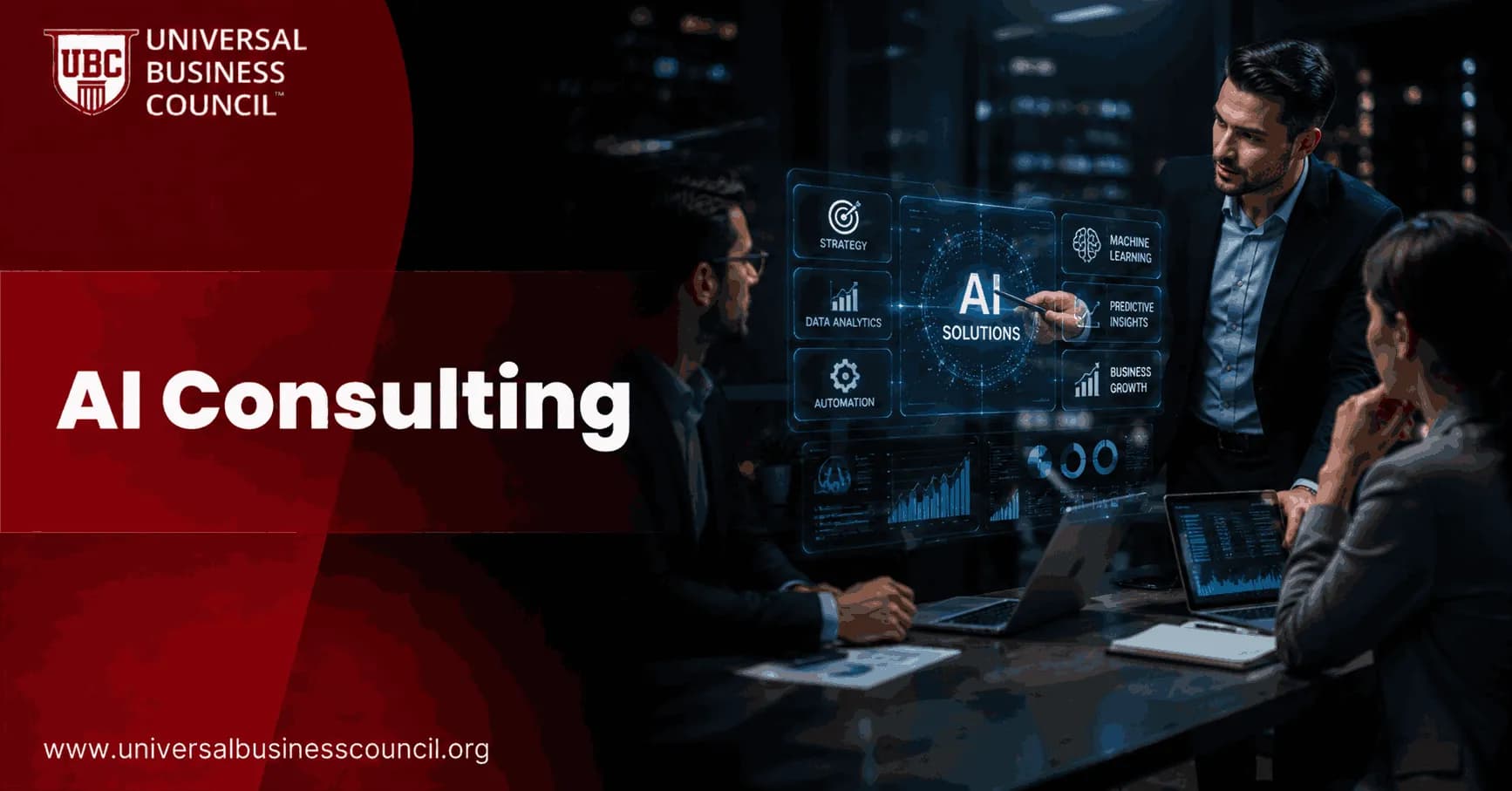
Artificial intelligence is transforming modern businesses faster than almost any previous technology. Companies across industries are using AI to automate operations, improve customer experiences, analyze massive amounts of data, and increase efficiency. As organizations rush to adopt intelligent systems, AI consulting has emerged as one of the most important professional service sectors in the digital economy.
AI consulting helps businesses understand how to use artificial intelligence effectively. From workflow automation and predictive analytics to generative AI and autonomous systems, consultants guide organizations through the challenges of AI adoption and digital transformation.

Modern businesses no longer compete only through products and pricing. They increasingly compete through data, automation, efficiency, and technological adaptability.
Human beings built workplaces full of endless spreadsheets, notifications, reports, meetings, and repetitive administrative work. Then they created artificial intelligence to help survive the productivity systems designed to improve productivity. A truly impressive loop of corporate evolution.
What Is AI Consulting?
AI consulting refers to professional services focused on helping businesses implement and manage artificial intelligence technologies.
AI consultants commonly help organizations:
Develop AI strategies
Automate workflows
Analyze operational data
Improve customer engagement
Integrate machine learning systems
Train employees on AI tools
Support digital transformation projects
The main objective is to improve efficiency and business performance using intelligent technologies.
Why AI Consulting Is Expanding Rapidly
Businesses increasingly invest in AI consulting because modern markets are becoming highly digital and competitive.
Demand for Automation
Organizations want to reduce repetitive work and improve operational efficiency.
Growth of AI Technologies
AI systems are now capable of:
Data analysis
Content generation
Workflow automation
Customer support
Predictive forecasting
Need for Specialized Expertise
Many organizations lack internal AI specialists and require external guidance.
Competitive Pressure
Businesses adopting AI effectively often gain advantages in productivity and decision-making.
These trends continue accelerating demand for AI consulting services worldwide.
Marketing and AI-Driven Customer Engagement
Artificial intelligence is significantly changing digital marketing strategies.
Businesses use AI systems for:
Audience targeting
Personalized communication
Customer behavior analysis
Automated campaigns
Content optimization
Programs such as Marketing certification help professionals understand branding, audience engagement, and digital communication strategies enhanced by AI systems.
Marketing is becoming increasingly data-driven and automation-focused.
Artificial Intelligence and Business Operations
AI systems are improving operational efficiency across industries.
Organizations now use AI for:
Workflow automation
Customer service
Fraud detection
Inventory management
Data analytics
Predictive maintenance
The AI Expert certification helps professionals understand machine learning systems, automation technologies, and practical AI implementation strategies.
AI literacy is becoming highly valuable in modern workplaces.
AI Consulting Across Industries
Healthcare
Healthcare providers use AI for:
Medical data analysis
Patient management systems
Predictive diagnostics
Administrative automation
Finance
Financial organizations use AI for:
Fraud prevention
Risk analysis
Customer support automation
Market forecasting
Retail and E-Commerce
Retail businesses implement AI for:
Personalized recommendations
Demand forecasting
Inventory optimization
Customer analytics
Manufacturing
Manufacturers use AI for:
Robotics
Predictive maintenance
Quality control
Supply chain optimization
AI consulting now supports nearly every major industry.
Agentic AI and Autonomous Systems
One of the fastest-growing AI trends is agentic AI.
Agentic AI systems can:
Execute workflows independently
Adapt dynamically to changing conditions
Manage multi-step tasks
Support intelligent automation
The Agentic AI course explains how autonomous AI agents are transforming business operations and productivity systems.
Organizations increasingly seek consultants familiar with intelligent automation technologies.
Generative AI and Enterprise Productivity
Generative AI has become a major focus in AI consulting because it improves:
Content creation
Customer communication
Research support
Workflow automation
Data summarization
The Generative ai expert course helps professionals understand practical applications of generative AI systems.
Generative AI continues reshaping modern productivity environments.
AI-Powered Coding and Technical Consulting
Software development is evolving rapidly through AI-assisted coding systems.
Modern AI tools help developers:
Generate code
Improve debugging
Automate testing
Optimize documentation
The AI Powered coding expert Course demonstrates how AI-assisted development systems improve software engineering efficiency.
Technical AI consulting continues growing rapidly.
Technology Skills and AI Consulting
AI consultants increasingly require broader technical expertise.
Programs such as Tech certification help professionals understand:
Automation systems
Cloud infrastructure
Cybersecurity
Data management
Emerging digital technologies
Technology awareness is becoming essential in AI consulting careers.
Deep Technology and Intelligent Infrastructure
AI consulting often intersects with deep technology ecosystems involving:
Artificial intelligence
Robotics
Blockchain systems
Cloud computing
Cybersecurity infrastructure
Organizations involved in Deeptech certification ecosystems help professionals understand advanced technologies shaping future industries.
AI systems are becoming increasingly connected with larger digital infrastructures.
Real-World Examples of AI Consulting
Example 1: Retail AI Automation
An AI consultant may help retailers implement:
Personalized recommendation systems
Automated customer support
Demand forecasting tools
Example 2: AI Marketing Optimization
Marketing teams increasingly use AI systems for:
Audience segmentation
Campaign automation
Customer engagement analysis
Example 3: AI Workflow Automation
Businesses use AI systems to automate repetitive administrative tasks and improve efficiency.
These examples demonstrate the broad impact of AI consulting.
Benefits of AI Consulting
Faster Digital Transformation
Consultants help organizations adopt AI systems more efficiently.
Better Decision-Making
AI systems improve analytics and predictive insights.
Reduced Operational Costs
Automation helps reduce repetitive manual work.
Improved Customer Experiences
AI supports personalized communication and faster service.
Competitive Advantages
Organizations using AI effectively often improve productivity and scalability.
These benefits continue driving investment in AI consulting services.
Challenges Facing AI Consulting
Despite rapid growth, AI consulting also presents challenges.
Privacy Concerns
AI systems often process sensitive business and customer information.
Ethical Issues
Organizations must manage bias, transparency, and responsible AI usage.
Technology Complexity
AI implementation can be technically difficult for many businesses.
Resistance to Change
Employees and organizations sometimes resist automation initiatives.
Successful AI consulting requires balancing innovation with practical implementation and governance.
Human beings often fear automation replacing jobs while simultaneously demanding instant customer service, personalized recommendations, and twenty-four-hour business support. The contradictions remain deeply impressive.
The Future of AI Consulting
Several trends are expected to shape the future of AI consulting.
Autonomous AI Systems
AI agents capable of independent workflow management will likely become more common.
Personalized AI Solutions
Businesses may increasingly adopt AI systems customized to specific industries and operational needs.
AI Governance and Regulation
Organizations will likely prioritize ethical AI frameworks and compliance systems.
AI-Human Collaboration
Future workplaces will increasingly combine human expertise with AI-driven automation.
AI consulting is expected to remain a major component of digital transformation strategies worldwide.
Conclusion
AI consulting has become one of the most important sectors in the modern digital economy. As businesses increasingly adopt automation, generative AI, predictive analytics, and intelligent systems, organizations require expert guidance to implement AI technologies effectively and responsibly.
Programs such as Marketing certification, AI Expert certification, Agentic AI course, Generative ai expert course, AI Powered coding expert Course, Tech certification, and Deeptech certification highlight the growing importance of technical expertise, AI literacy, and digital transformation skills.
As artificial intelligence continues evolving, professionals and organizations that combine innovation, adaptability, technical knowledge, and ethical awareness will likely remain most competitive in future digital markets.
FAQs
1. What is AI consulting?
AI consulting helps businesses plan, implement, and manage artificial intelligence solutions. Consultants guide companies on automation, data analysis, AI tools, workflow improvement, and responsible AI adoption.
2. Why is AI consulting important for businesses?
AI consulting is important because many companies want to use AI but lack internal expertise. Consultants help reduce implementation risks and ensure AI tools support real business goals.
3. What does an AI consultant do?
An AI consultant analyzes business processes, identifies automation opportunities, recommends AI tools, supports implementation, and helps teams understand how to use AI effectively.
4. Which industries use AI consulting?
AI consulting is used in healthcare, finance, retail, manufacturing, education, marketing, logistics, customer service, and software development. Apparently every industry looked at spreadsheets and said, “Please automate this misery.”
5. How does AI improve business operations?
AI improves operations by automating repetitive tasks, analyzing large datasets, improving forecasting, supporting customer service, and helping businesses make faster decisions.
6. What is the role of AI in marketing?
AI helps marketing teams with audience targeting, campaign automation, content optimization, customer behavior analysis, and personalization. A Marketing certification can support these skills.
7. What is an AI Expert certification?
The AI Expert certification helps professionals understand AI concepts, machine learning, automation, and practical AI implementation strategies.
8. What is Agentic AI?
Agentic AI refers to autonomous AI systems that can plan, make decisions, and complete tasks with limited human input. The Agentic AI course covers these systems.
9. How is generative AI used in consulting?
Generative AI is used for content creation, research support, report drafting, customer communication, summarization, and workflow automation in business environments.
10. What is the Generative ai expert course?
The Generative ai expert course teaches how generative AI tools are used for automation, communication, productivity, and digital transformation.
11. How does AI help software development?
AI helps developers generate code, debug errors, write documentation, automate testing, and improve development speed. The AI Powered coding expert Course focuses on these skills.
12. Why do companies hire AI consultants?
Companies hire AI consultants to avoid poor implementation, choose the right tools, build AI strategies, improve productivity, and train employees on new technologies.
13. What skills should an AI consultant have?
An AI consultant should understand AI tools, automation, data analysis, business strategy, communication, ethics, and implementation planning. Technical knowledge helps, but business clarity matters too.
14. What is a Tech certification?
A Tech certification helps professionals build skills in digital technologies such as AI, cybersecurity, cloud computing, blockchain, and automation systems.
15. What are deep technologies?
Deep technologies include advanced systems such as AI, robotics, blockchain, cybersecurity, cloud infrastructure, and data-driven automation. Deeptech certification supports learning in these areas.
16. What are the main benefits of AI consulting?
AI consulting can improve efficiency, reduce costs, increase productivity, strengthen customer engagement, and help businesses make better decisions through data and automation.
17. What challenges come with AI consulting?
Common challenges include data privacy concerns, employee resistance, implementation costs, inaccurate AI outputs, ethical risks, and the need for continuous updates.
18. Can small businesses use AI consulting?
Yes, small businesses can use AI consulting for customer support automation, marketing, scheduling, data analysis, and workflow improvement without building complex systems from scratch.
19. Is AI consulting a good career?
AI consulting is a strong career path because demand for AI strategy, automation, and implementation support is growing across industries. Naturally, businesses need guides after sprinting into AI adoption with half a plan.
20. What is the future of AI consulting?
The future of AI consulting will focus on autonomous AI agents, generative AI, AI governance, industry-specific automation, and stronger collaboration between humans and intelligent systems.
Related Articles
View All
Artificial Intelligence
The New Standard for AI-Era Recruitment: AI-Resistant Assessments with HireValid
Explore how HireValid is reshaping AI-era recruitment with AI-resistant assessments, job-relevant skills testing, integrity signals, and human-reviewed evidence of candidate ability.

Artificial Intelligence
Beyond AI-Generated Answers: How HireValid Supports Authentic Skills-Based Hiring
Discover how HireValid moves beyond AI-generated answers with job-relevant assessments, integrity signals, randomized testing, and skills-based evidence that helps employers identify authentic candidate ability.
Artificial Intelligence
Gemini 4 Argon: Features, Pricing, and Availability
Gemini 4 Argon is Google’s new flagship AI model for coding, science, finance, law and security. See its main features, API and subscription pricing, and where you can access it today.
Trending Articles
The Role of Blockchain in Ethical AI Development
How blockchain technology is being used to promote transparency and accountability in artificial intelligence systems.
AWS Career Roadmap
A step-by-step guide to building a successful career in Amazon Web Services cloud computing.
Top 5 DeFi Platforms
Explore the leading decentralized finance platforms and what makes each one unique in the evolving DeFi landscape.