
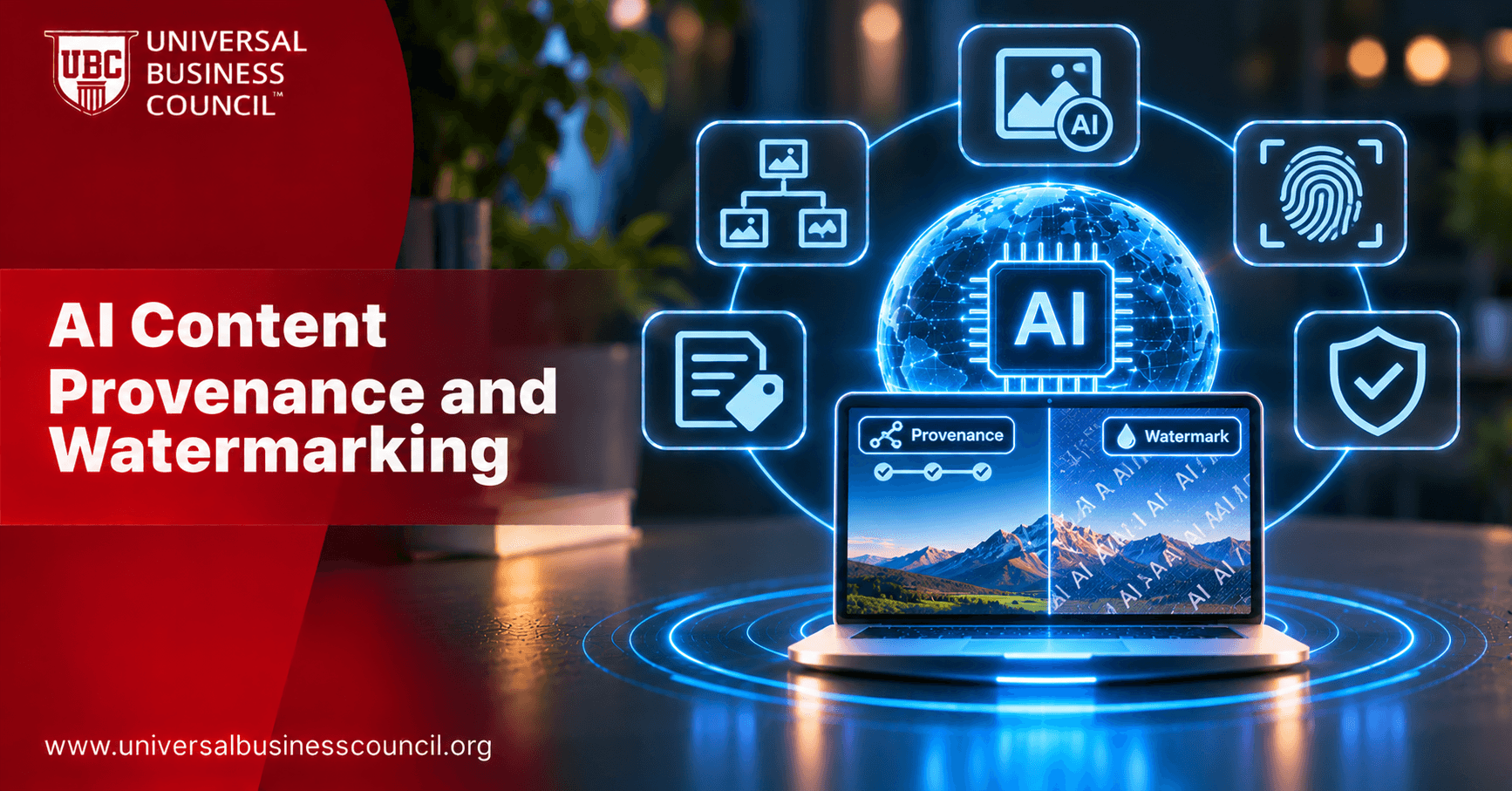
AI Content Provenance and Watermarking: Authenticity and Trust
A photograph once carried its own proof: someone pointed a camera at something real. That assumption no longer holds by default, because images, audio, video and text can now be generated or altered convincingly with ordinary tools. AI content provenance and watermarking are the main technical responses. They try to answer two questions that audiences increasingly ask: where did this come from, and has it been changed? This guide explains how the methods work, where they fall short and how organizations can use them to protect authenticity and trust. For readers who want a formal credential in this field, the Certified Responsible AI Expert program is a good place to start.
What is AI content provenance and watermarking?
Provenance is the recorded history of a piece of content: who or what created it, with which tool, when and what edits followed. Watermarking is the practice of embedding a signal in content, visible or hidden, that marks it as machine-made or links it to its source. The two are related but different. Provenance records tell a story about the content. Watermarks travel inside the content itself.

Neither one proves that something is true. A genuine photo can be misleading and a generated image can be harmless. What these tools offer is context, so people can judge content with better information.
The main approaches
Signed metadata and content credentials
Standards such as C2PA attach a tamper-evident record to a file. The record lists the tool used to create it, the edits made and who signed it, protected by cryptographic signatures. If the file or record is altered, the signature check fails. Cameras, editing software and AI generators can all add credentials as content is made and changed.
Invisible watermarks
These embed a pattern in pixels, audio or even word choices that software can detect but people cannot see or hear. They survive some edits, such as resizing or compression, better than metadata does.
Visible labels
A badge, caption or on-screen notice tells viewers directly that content is AI-generated. Easy to understand, easy to crop.
Fingerprinting and detection
Fingerprints let a platform recognize known content, and classifiers try to guess whether content is synthetic. Both are useful but imperfect, and they work best as supporting signals.
Strengths and limits
No single method is enough. Metadata can be stripped when files are screenshotted, re-encoded or uploaded to platforms that discard it. Watermarks can be weakened or removed by determined attackers, and watermarks in plain text are especially fragile. Tools only mark what they produce, so content from systems that do not participate carries no mark at all. And the absence of a mark proves nothing.
Why a layered approach works better
Credentials give rich, verifiable history when they survive
Watermarks give a fallback signal when metadata is lost
Labels give audiences an instant cue
Detection and human review catch what the others miss
Privacy and fairness considerations
Provenance records can reveal sensitive details, such as a creator's identity, device or location. Make sharing optional where possible, let creators control what is recorded and think about journalists, activists and others who may be at risk if their data is exposed. Also avoid treating unmarked content as automatically fake, since many real creators will not have access to the tools.
The regulatory direction
Several jurisdictions are introducing rules on marking and labelling synthetic content. The EU AI Act includes transparency duties for AI-generated content, and other countries have proposed or adopted labelling requirements. Platforms also publish their own policies. Check the rules that apply to your markets, since details and timelines are still moving.
How organizations can put it into practice
If you create or publish content
Decide which content you will mark, such as all AI-generated images and any synthetic voices
Choose tools that support open standards for credentials and watermarks
Sign content at the point of creation, and preserve the record through editing and export
Show audiences clear labels, and explain what they mean
Protect signing keys carefully, since a stolen key can undermine trust
If you receive or moderate content
Check credentials and watermarks when they are present
Treat the results as signals, not verdicts
Combine them with source checks and human review
Keep records of how decisions about disputed content were reached
If you build AI models
Add watermarking and credentials to generated outputs where feasible, document how they work and their limits and offer verification tools. Be honest that marks can be removed.
Authenticity as a brand asset
For brands, verifiable origin is part of credibility, especially when campaigns use generated visuals, synthetic voices or user content. Honest labelling avoids accusations of deception, and strong provenance helps when fake versions of official content appear. Marketing teams who want a broader grounding can look at the Certified Digital Marketing Expert program.
Governance basics
Write a short policy on when content is marked and labelled, name an owner, train staff who create and review content and test the full chain from creation to publication to check that credentials survive. Review the approach as standards, tools and laws change.
Skills, records and trusted people
Engineers who implement signing, verification and watermark detection need solid fundamentals, which the programming and technology certifications from Global Tech Council can help build. Provenance depends on records that are hard to forge, and teams exploring related techniques such as distributed ledgers can look at the deep tech certifications from Blockchain Council. When you hire engineers and content integrity staff, skills tests show who can really do the job. HireValid offers AI-proof pre-employment tests with an Integrity Score that supports human review.
Conclusion: building trust with AI content provenance and watermarking
AI content provenance and watermarking give audiences context in a world where seeing is no longer proof. Provenance records the history of a piece of content, while watermarks embed signals in the content itself. The main methods are signed metadata such as C2PA content credentials, invisible watermarks, visible labels and fingerprinting or detection, each with strengths and gaps. Metadata can be stripped, watermarks can be weakened, only participating tools add marks and an unmarked item proves nothing, so a layered approach is the sensible answer.
Privacy and fairness must be part of the design, with optional sharing and care for people who could be put at risk by exposure. Regulation is moving toward marking and labelling, so check what applies in your markets. In practice, decide what to mark, use open standards, sign at creation, preserve records through edits, label clearly, protect signing keys and treat checks on incoming content as signals combined with human review. Start by testing whether one piece of your own published content keeps its credentials from creation to the final platform, and fix the first place the chain breaks. The Certified Responsible AI Expert program mentioned at the start can help your team build the skills behind AI content provenance and watermarking.
FAQs
1. What is AI content provenance?
The recorded history of a piece of content, including who or what made it and how it was edited.
2. What is watermarking?
Embedding a visible or hidden signal in content to mark it as machine-made or link it to a source.
3. What is C2PA?
An open standard for attaching signed, tamper-evident provenance records, known as content credentials, to files.
4. Do watermarks prove content is real or fake?
No. They give context about origin, not truth.
5. Can watermarks be removed?
Often, with effort. Some survive common edits better than others.
6. Why does metadata disappear?
Screenshots, re-encoding and some platforms strip it when files are uploaded or shared.
7. Can text be watermarked?
It is possible, but text watermarks are fragile and easy to weaken by editing.
8. Does missing credentials mean content is fake?
No. Many real items will lack credentials, so treat it only as the absence of a signal.
9. Are AI detectors reliable?
They give probabilities and make mistakes, so use them as one input.
10. Is labelling AI content required?
Increasingly, in some regions and on some platforms. Check local rules and platform policies.
11. What does the EU AI Act say?
It sets transparency duties for AI-generated content, with timelines that organizations should confirm.
12. What privacy risks do provenance records carry?
They can reveal creator identity, device or location, so sharing should be optional.
13. How should keys be protected?
Store signing keys securely with limited access, rotation and monitoring.
14. Who should adopt provenance?
Newsrooms, brands, platforms, institutions and anyone whose credibility depends on authenticity.
15. How can audiences check credentials?
Through verification tools and platform displays that read and show the credentials.
16. Should we label all AI-assisted content?
Decide on a clear rule, such as labelling generated media and synthetic voices, and apply it consistently.
17. How do we test our workflow?
Follow content from creation to publication and check where credentials are lost.
18. Can small organizations use provenance tools?
Yes, many mainstream tools now support credentials, so start with those.
19. How often should the approach be reviewed?
Regularly, as standards, tools and laws change.
20. Where can I learn more?
Training such as the Certified Responsible AI Expert program and published content credential standards.
Related Articles
View All
Artificial Intelligence
Responsible AI in Smart Cities: Surveillance, Services and Public Trust
Discover how responsible AI can support smarter city services while protecting privacy, civil liberties, and public trust. Explore the risks of AI-powered surveillance, data collection, algorithmic bias, and automated public services, along with practical safeguards for transparent and accountable urban AI systems.
Artificial Intelligence
What Is Gemini 4 Neon and How Does It Work?
What is Gemini 4 Neon? Google’s new mid-tier AI model, launched November 18, 2026, pairs adjustable thinking levels with a 1M-token context window. Learn how it works, what it costs and how it compares with Carbon and Hydrogen.

Artificial Intelligence
Real-World Applications of Agentic AI
Explore how agentic AI is being used across industries to automate complex tasks, support decision-making, and manage multi-step workflows. Discover real-world applications in healthcare, finance, customer service, education, manufacturing, and other sectors, along with practical examples, benefits, and challenges of adopting agentic AI.