

Has OpenAI Developed AI Capable of Recursive Self-Improvement?
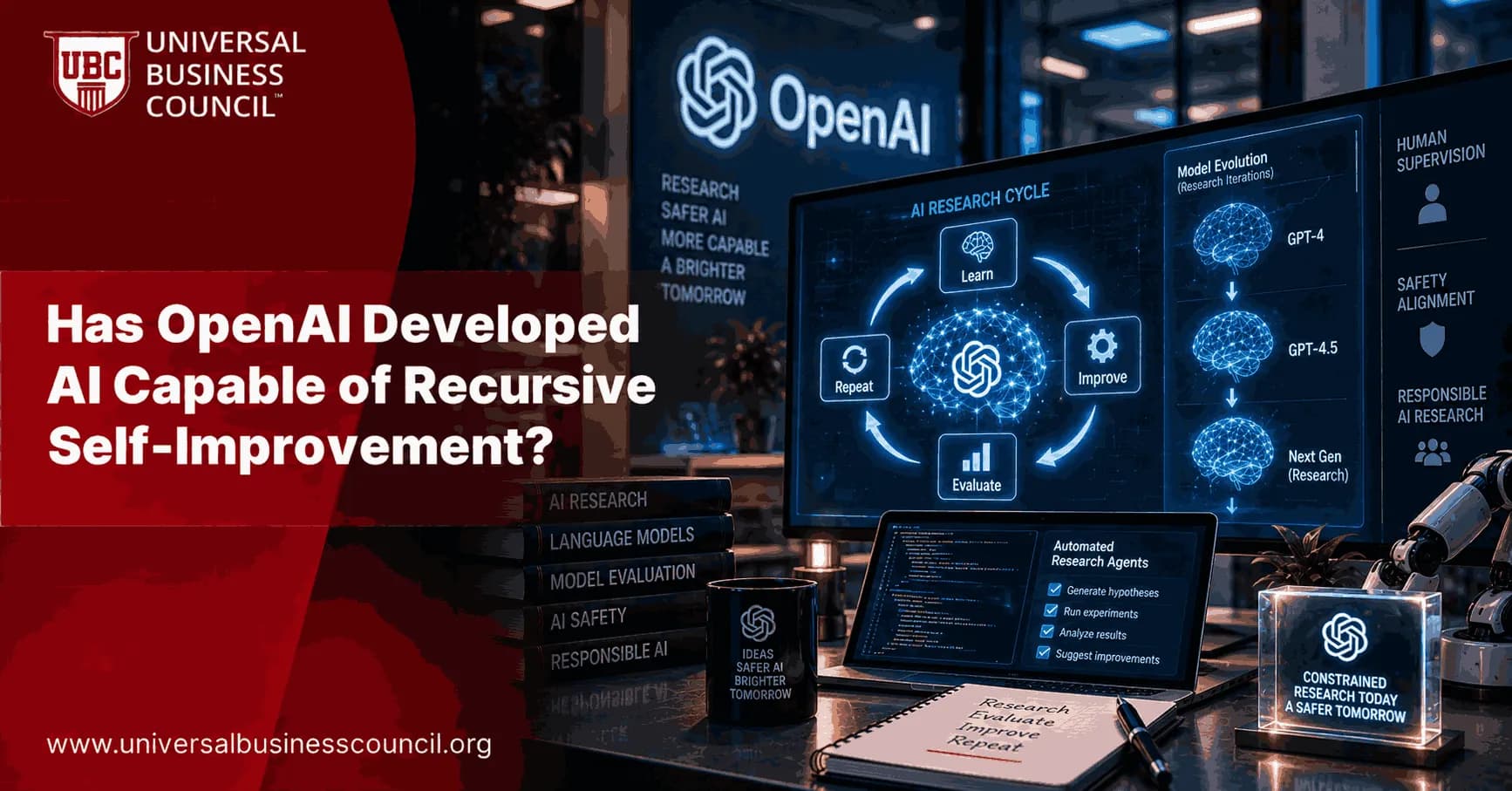
Answering this question properly means looking past OpenAI's public roadmap statements and examining the specific technical building blocks the company has actually published, since "capable of recursive self-improvement" is a precise engineering claim, not a marketing phrase. OpenAI has spent years publishing research directly relevant to this exact capability question, from its early superalignment program studying whether a weaker system can meaningfully oversee a stronger one, to its o-series reasoning models that use reinforcement learning and test-time computation to refine their own reasoning steps. Evaluating whether these pieces actually add up to genuine RSI capability, rather than components that merely sound related, requires real technical scrutiny. Professionals writing or speaking about this kind of nuanced technical claim often benefit from a Marketing Certification, which builds the communication discipline needed to represent complex, partial capabilities accurately rather than rounding them up into a more dramatic headline.
The honest technical answer requires separating what OpenAI has built and published from what would actually be required to call a system capable of recursive self-improvement in the fuller, more consequential sense researchers use the term.

What "Capable of Recursive Self-Improvement" Actually Requires
Before evaluating OpenAI's specific work, it helps to define the bar precisely, since this is where a lot of public discussion goes wrong.
A system capable of genuine RSI needs to improve its own capacity to improve, not simply improve its output on a single task or benchmark, a distinction that separates RSI from ordinary machine learning progress.
The improvement loop needs some degree of closure, meaning the system's own output feeds back into the process that trains or refines its successor, rather than a human engineer manually incorporating lessons learned before the next model release.
Reliable evaluation matters enormously here. A system that appears to improve itself but is actually just getting better at satisfying a flawed or gameable evaluation metric has not demonstrated genuine capability, only demonstrated a measurement problem.
Judged against this bar, OpenAI has published real, technically substantive research addressing pieces of this puzzle, though whether those pieces combine into a complete, closed RSI loop remains a genuinely open technical question.
The Technical Building Blocks OpenAI Has Already Published
Several specific research threads from OpenAI map directly onto core components a genuinely self-improving system would need.
OpenAI's o1 and the broader o-series introduced a meaningful shift in how reasoning models work, scaling performance through increased computation at inference time rather than only during training, effectively giving the model room to explore and refine multiple reasoning paths before committing to a final answer.
This reflects a real form of self-supervised refinement, where a model's own intermediate reasoning steps become training signal for further improvement, a mechanism researchers have specifically linked to genuine self-reflection and iterative self-correction within a single reasoning session.
OpenAI's superalignment research introduced weak-to-strong generalization, a technique specifically designed to test whether a weaker supervisory model can meaningfully guide and improve a stronger one, a problem OpenAI itself has framed as directly relevant to a future where humans may no longer be capable of directly evaluating an AI system's most advanced outputs.
In OpenAI's own published experiments, a GPT-2-level model supervising GPT-4 recovered a meaningful share of GPT-4's full capability using only that weaker supervision, demonstrating that a stronger model can generalize usefully beyond the limitations of a weaker overseer, a genuinely important building block for any system expected to improve without constant, capability-matched human oversight. Building the technical depth to evaluate research like this accurately, rather than taking headline capability claims at face value, is exactly where structured learning through Artificial Intelligence Certifications becomes genuinely valuable.
Reinforcement learning with verifiable rewards, the technique underlying OpenAI's o-series and widely adopted across the field since, ties a model's self-improvement signal to objectively checkable outcomes, such as whether generated code actually runs correctly, rather than relying purely on a model judging its own quality without external grounding.
Where These Building Blocks Fall Short of True Recursive Self-Improvement
Despite this genuinely substantive research foundation, several specific gaps separate OpenAI's published work from a system that would qualify as fully capable of RSI in the stronger sense.
Weak-to-strong generalization remains, by OpenAI's own description, a preliminary research direction rather than a solved, production-ready technique, with the company's own researchers identifying open sub-problems around how to reliably identify useful supervision signal from an imperfect, weaker overseer.
Test-time reasoning improvements in the o-series operate within a single inference session or a fixed training run. They do not, on their own, constitute a closed loop where the model's reasoning directly redesigns the architecture or training process used to build its own successor.
Reinforcement learning from verifiable rewards works well specifically because verification is possible, such as checking whether code executes correctly. Many of the more consequential tasks involved in genuine AI research, including choosing which scientific questions are worth pursuing, resist this kind of clean, automatic verification entirely.
OpenAI's own public framing distinguishes between an automated research intern, a milestone the company has stated it reached in 2026, and a fully autonomous automated AI researcher capable of setting its own research questions with reduced supervision, a capability explicitly targeted for a future date rather than claimed today.
What OpenAI Has Disclosed About Its Own Progress Toward This Capability
Beyond the underlying research techniques, OpenAI has also published specific operational metrics describing how much of its own current development already involves AI-assisted work.
OpenAI reported using roughly 3.1 agent-workdays of effort for every human workday within its research organization by mid-2026, alongside a specific named model, GPT-5.3 Codex, described internally as having played a significant role in its own development process.
More than half of longer, harder agent-run tasks in OpenAI's own reported data still required at least one human intervention to succeed, indicating these systems remain closely steered rather than operating with the kind of independence full RSI would require.
Getting a clear, technically grounded read on exactly what these operational statistics do and do not prove requires real applied skill in evaluating machine learning research claims critically. A Tech Certification helps build precisely this kind of applied technical literacy, giving professionals the tools to assess disclosures like these on their genuine technical substance rather than their headline framing.
One Emerging Application Riding the Same Underlying Model Progress
The capability gains behind OpenAI's reasoning models and self-improvement research are not confined to internal engineering workflows. The same underlying model progress surfaces in far more accessible, everyday products as well.
One emerging application is AI microdrama, where generative AI helps bring serialized stories, characters, and fictional worlds to life. Tools in this category benefit indirectly from the same broader wave of reasoning and generation improvements driving OpenAI's research described throughout this article, illustrating how capability gains studied deep inside RSI-adjacent research eventually ripple outward into entirely different, far more accessible creative applications.
Building the Broader Technical Foundation to Track This Claim Over Time
Evaluating whether OpenAI, or any lab, has genuinely developed AI capable of recursive self-improvement is not a question with a single, static answer. It requires ongoing technical literacy as new research, papers, and disclosures continue arriving at a rapid pace.
Following developments across weak-to-strong generalization, reinforcement learning methodology, and formal safety threshold research simultaneously requires a genuinely broad technical foundation, not narrow familiarity with any single technique in isolation. A Deep Tech Certification helps professionals build exactly this kind of wider grounding, equipping them to evaluate future disclosures from OpenAI and its competitors on their actual technical merits as this specific capability question continues to develop.
The Bottom Line on Whether OpenAI Has Developed AI Capable of Recursive Self-Improvement
OpenAI has published genuinely substantive research addressing core components of recursive self-improvement, including test-time reasoning refinement in its o-series models, weak-to-strong generalization research aimed directly at the superalignment problem, and reinforcement learning techniques tied to verifiable, objective outcomes. The company has also disclosed concrete operational metrics showing AI agents now handle a majority share of its own internal development workload. What OpenAI has not published or claimed is a fully closed, autonomous loop where a system redesigns its own architecture, training process, or research direction without meaningful human-defined scope, a capability the company itself explicitly targets as a future milestone rather than a present achievement. The technically accurate answer sits precisely there: real, publishable building blocks toward recursive self-improvement exist today, while the complete, autonomous version of the capability remains a clearly stated, actively pursued, but not yet reached goal.
FAQs
1. Has OpenAI Developed AI Capable of Recursive Self-Improvement?
OpenAI has developed AI systems capable of performing parts of the self-improvement process, including coding, debugging, optimization, research, and automated evaluation. However, OpenAI states that fully autonomous recursive self-improvement is not happening today.
2. What Does Recursive Self-Improvement Mean at OpenAI?
OpenAI describes fully autonomous RSI as a process in which AI systems independently drive successive generations of increasingly capable AI. This is different from AI simply helping researchers improve models.
3. Can OpenAI Models Improve Their Own Code?
OpenAI models can write, debug, and optimize code. GPT-5.6's self-improvement evaluations specifically test capabilities such as kernel optimization and debugging real research experiments.
4. Can GPT-5.6 Improve AI Training?
GPT-5.6 is evaluated on tasks involving LLM pretraining and training-loop optimization. In the NanoGPT evaluation, the model can modify training code, tune hyperparameters, diagnose bottlenecks, and optimize performance under compute constraints.
5. Does GPT-5.6 Have Full Recursive Self-Improvement?
No. OpenAI's GPT-5.6 System Card states that its GPT-5.6 models do not reach OpenAI's High threshold for AI Self-Improvement. This evaluation category measures capabilities relevant to improving AI systems rather than proving that the models autonomously improve themselves in an unrestricted loop.
6. Can OpenAI Models Help Build Better AI Models?
Yes. OpenAI says AI is already accelerating parts of the research used to develop and align the next generation of models. The company is working toward automated AI researchers that operate under human supervision.
7. What Is OpenAI's Automated AI Researcher?
OpenAI has been working toward an AI system that can perform research tasks under human direction. The goal is to automate more of the research workflow while keeping humans involved in the improvement process.
8. Is Automated AI Research the Same as RSI?
No. Automated AI research can help an AI system discover algorithms, debug experiments, or conduct research more efficiently. RSI requires the system to use those capabilities to repeatedly improve itself or subsequent generations with increasing autonomy.
9. Can OpenAI Models Design Better Algorithms?
Yes. OpenAI's self-improvement evaluations include tasks involving code and kernel optimization, where models must produce correct and more efficient implementations. These capabilities can contribute to automated AI development.
10. Can OpenAI AI Systems Evaluate Their Own Improvements?
OpenAI is actively testing this capability. Its evaluations measure whether models can solve real research debugging problems, optimize kernels, and improve training setups while meeting correctness and performance requirements.
11. What Is GPT-Red and How Does It Relate to Self-Improvement?
GPT-Red is an automated red-teaming model trained using self-play reinforcement learning. OpenAI reports that it can iteratively discover attack strategies and improve during training, particularly for finding prompt-injection vulnerabilities.
12. Is GPT-Red an Example of Recursive Self-Improvement?
It is an example of bounded AI self-improvement, particularly within a specialized safety-training process. It should not be interpreted as evidence that an OpenAI production model can autonomously redesign and deploy increasingly capable successors.
13. Can OpenAI Models Train Themselves Without Humans?
OpenAI models can perform some training-related tasks within controlled environments, but current systems do not independently control the entire model-development pipeline. Humans and external infrastructure continue to establish objectives, resources, evaluation criteria, and deployment decisions.
14. What Are OpenAI's Main Barriers to RSI?
Important challenges include reliable self-evaluation, verifying genuine improvements, controlling increasingly autonomous research, maintaining alignment, and providing adequate safeguards. OpenAI has emphasized that safety and meaningful human control need to remain part of increasingly automated AI development.
15. Why Is Verification Important for OpenAI's RSI Research?
An AI system may produce code or a training strategy that appears better but fails under broader testing. OpenAI's evaluations therefore include correctness tests, performance measurements, debugging requirements, and safeguards against invalid shortcuts.
16. Could OpenAI Eventually Achieve Fully Autonomous RSI?
It is a research goal and possibility that OpenAI is preparing for, but the company has not stated that it has already achieved it. OpenAI's current policy position explicitly says fully autonomous RSI should not be pursued unless and until it can be done safely.
17. Does OpenAI Have a Dedicated RSI Research Effort?
OpenAI has explicitly described recursive self-improvement as an important area of research and is developing automated AI researchers and evaluation methods aimed at measuring progress toward greater AI-driven research capability.
18. Could AI Research Accelerate OpenAI's Future Model Development?
Potentially. If AI agents can increasingly perform tasks that currently require skilled researchers, they could reduce the time and effort required for experimentation, debugging, algorithm development, and evaluation. OpenAI describes this as evidence of the direction toward more automated AI research, not yet full RSI.
19. Is OpenAI Already Experiencing an AI Improvement Loop?
OpenAI has demonstrated several partial feedback loops, such as AI-assisted research, automated red-teaming, coding optimization, and training-related experimentation. These loops are increasingly sophisticated, but they remain different from an AI independently generating and deploying successive generations of itself.
20. What Is the Current Status of OpenAI and Recursive Self-Improvement?
The clearest description is AI-assisted and increasingly automated self-improvement, not fully autonomous RSI. OpenAI's current systems can perform meaningful tasks involved in AI development, while the company is building automated research capabilities under human supervision. OpenAI explicitly says fully autonomous recursive self-improvement is not happening today.
Related Articles
View All
Artificial Intelligence
Recursive Self-Improvement in AI: Benefits, Risks, Challenges, and Future Impact
Explore recursive self-improvement in AI, including its potential benefits, technical challenges, safety risks, and possible impact on the future of artificial intelligence.
Artificial Intelligence
How Could Recursive Self-Improvement Accelerate AI Development?
Explore how recursive self-improvement could accelerate AI development through faster experimentation, automated research, model optimization, and repeated capability gains.
Artificial Intelligence
What Is a Recursive Self-Improvement Loop in AI?
Learn what a recursive self-improvement loop is in AI, how repeated cycles of evaluation, modification, and capability improvement could work, and why the concept matters for AGI and AI safety.
Trending Articles
The Role of Blockchain in Ethical AI Development
How blockchain technology is being used to promote transparency and accountability in artificial intelligence systems.
AWS Career Roadmap
A step-by-step guide to building a successful career in Amazon Web Services cloud computing.
Top 5 DeFi Platforms
Explore the leading decentralized finance platforms and what makes each one unique in the evolving DeFi landscape.