

How Tosheo Helps Create AI Microdramas
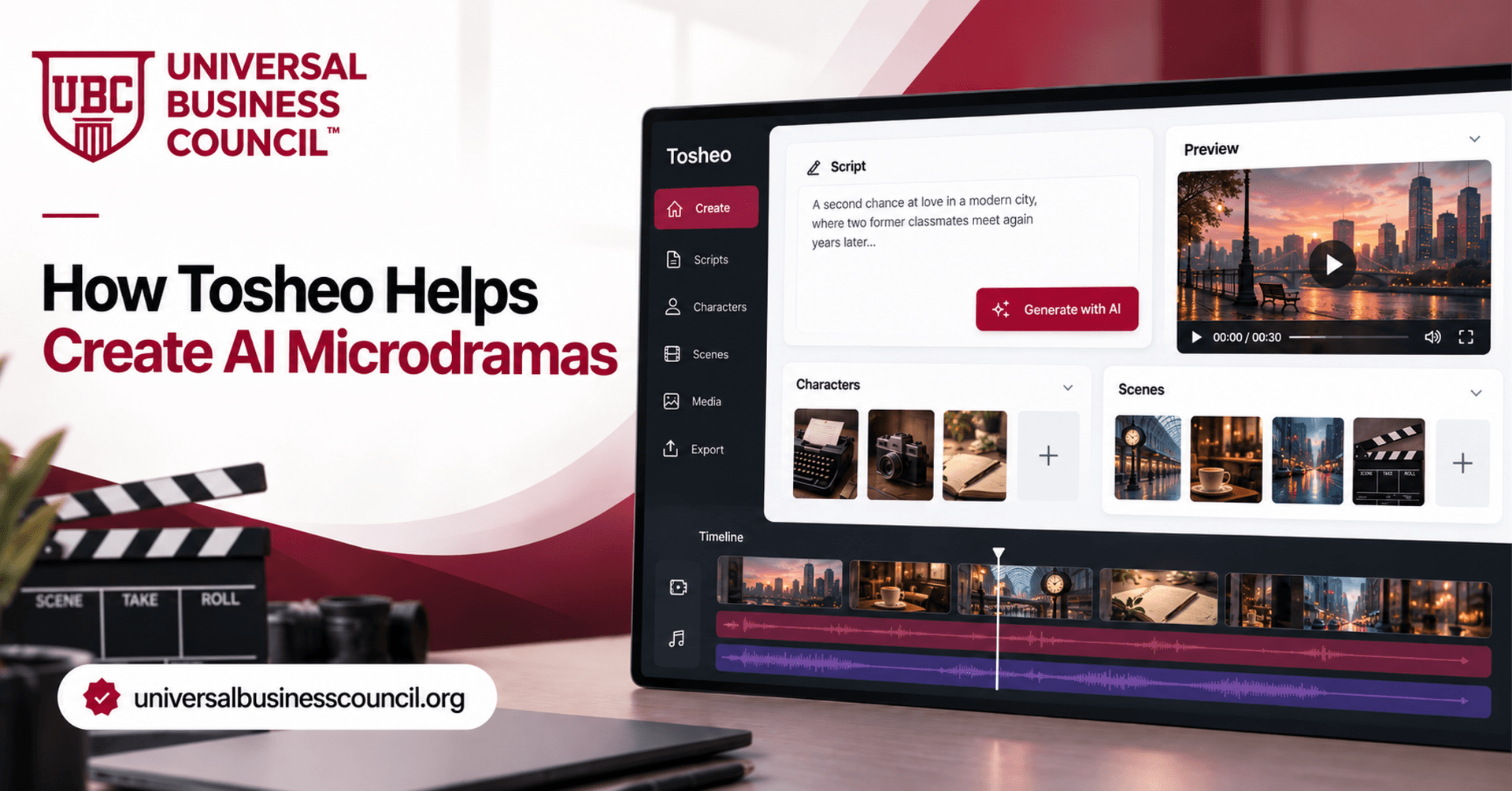
Creating a microdrama starts with a story.
It could be a one-line idea about two strangers who meet at a railway station. It could be a romance built around a secret. It could be a thriller where every episode reveals another piece of the mystery.

Traditionally, turning that idea into a finished video requires several production stages, from writing and casting to storyboarding, filming, editing and localization.
AI is changing that process.
Today, creators can use AI to develop stories, build characters, plan scenes and produce video content much faster. But generating individual clips is only one part of making a successful serialized story.
A microdrama needs continuity.
The same characters need to return. The story needs to move forward. Visual references need to remain connected. Episodes need to be reviewed before they become part of the final production.
This is where Tosheo approaches AI video creation differently.
Tosheo is an operating system for AI-native production, designed to take a production from greenlight to buyer-ready delivery. Its production workflow connects creative direction, AI-assisted production, human approvals, rights, multilingual tracks and delivery.
What Is Tosheo?
Tosheo is an AI video production platform designed around the complete production workflow rather than a single generation prompt.
The platform is built for creators, publishers, brands and production houses that want to develop AI-native stories and campaigns.
Its current production solutions include serialized story production, branded story campaigns, YouTube and short-form content, and microdramas.
For microdramas specifically, Tosheo focuses on connected episodes where recurring characters, story beats, voices, locations and other creative references can carry from one episode to the next.
This distinction is important.
A conventional AI video generator may produce a clip from a prompt.
Tosheo is designed to help take the story behind the clip through production.
Tosheo AI Video Generator: More Than a Single Prompt
The phrase Tosheo AI video generator may suggest a simple text-to-video workflow.
But Tosheo's approach is broader.
A production can begin with:
A one-line story idea
A developed story
A character
A conflict
A story bible
A branded narrative
The AI Director then helps develop the production into story, characters, storyboard and production-ready assets. Creators can review the preparation before authorizing production.
This means the process can look like:
Idea → Story → Characters → Storyboard → Production → Review → Localization → Delivery
The AI model generates the media, while Tosheo connects the surrounding production workflow.
That is the difference between generating a video and managing a production.
Tosheo AI Video Creator for Microdramas
A microdrama is not just a collection of short videos.
It is a connected story.
If a character appears in Episode 1, the audience expects the same character to remain recognisable in Episode 2.
If a relationship changes in Episode 3, that change should make sense because of what happened earlier.
If a location becomes important to the story, it should remain part of the creative world.
This is why an AI microdrama creator needs to think beyond individual prompts.
Tosheo's serialized story production approach is built around recurring characters, connected story state and planned episode arcs. Its current approach can begin with a focused five-episode pilot, with vertical episodes typically planned around 60 to 120 seconds.
Create Microdramas With Tosheo
The process of creating microdramas with Tosheo starts with the story.
You do not necessarily need a finished screenplay before beginning.
A creator can start with an idea, a story brief or an existing story bible.
From there, the production can be developed around:
Story
Define what happens and why the audience should continue watching.
Characters
Develop the recurring cast and their relationships.
Episode Arc
Decide how the story progresses across episodes.
Visual Direction
Establish locations, visual references, props and other creative elements.
Storyboard
Turn the story into a shot-by-shot production plan.
Production
Generate the required video, voice, music and other assets.
Review
Review the production before accepting the work.
Delivery
Prepare the accepted production for its intended audience and distribution channel.
Tosheo's current workflow describes these stages as brief, story and assets, storyboard, approval, production and download/release.
Tosheo AI Storytelling: Start With the Story
Good microdramas depend on storytelling.
AI can help generate content, but the story still needs a reason for the audience to care.
A strong microdrama often begins with a simple question:
What happens next?
For example:
A woman receives a voice message from her future self.
That one idea can become an entire series.
Episode 1 introduces the message.
Episode 2 reveals that another person has received one.
Episode 3 reveals information that should not be possible.
Episode 4 changes the meaning of the original message.
Episode 5 delivers the first major answer while opening another question.
This is where Tosheo AI storytelling becomes relevant.
Instead of treating every episode as an independent generation task, the production can carry characters, relationships, locations and unresolved story questions forward.
Tosheo describes its serialized story workflow as keeping character references, relationships, voices and unresolved questions connected across episodes.
Tosheo Text to Video: From Words to Scenes
Text remains one of the simplest ways to communicate a creative idea.
A creator might write:
"A young journalist waits alone at an empty railway station during heavy rain. She notices a man holding the same photograph she found in her father's belongings."
That description can become the starting point for a scene.
But turning text into a production-ready scene requires more than converting words into pixels.
The production also needs to consider:
Character identity
Location
Camera direction
Lighting
Dialogue
Mood
Story context
Continuity
This is why Tosheo text to video should be understood within a larger production workflow.
The AI Director helps translate creative intent into production decisions such as story structure, shot planning and visual direction, rather than treating every scene as an isolated prompt.
Tosheo AI Filmmaking: From Concept to Production
AI filmmaking is becoming more accessible, but professional storytelling still involves many decisions.
A creator needs to decide:
What the story is about
Who the characters are
How the audience should experience the story
Which scenes matter
Which shots should be generated
What needs to be changed
Which version is approved
Tosheo's AI filmmaking approach is therefore centered around the production rather than simply the generation model.
The AI Director can help prepare the story and production, while creators retain control over important decisions.
Tosheo's current workflow includes optional approval checkpoints and explicit decisions around cost, rights, language review and final acceptance.
Building Consistent Characters With Tosheo
Character consistency is one of the biggest challenges in AI-generated storytelling.
Suppose the main character is named Anaya.
Her appearance, voice, personality, relationships and story history need to remain connected across episodes.
Without a consistent reference, each generation can potentially introduce unwanted changes.
Tosheo addresses this through its creative canon approach.
Creative canon keeps important story and character references connected so production decisions can be carried forward.
For serialized production, this can include:
Character sheets
Voices
Locations
Props
Relationships
Story state
Visual references
The goal is simple:
The next episode should inherit the important decisions from the previous episode.
AI Microdrama Creator With Human Approval
AI can accelerate production, but human creative judgment remains important.
Tosheo includes approval points in the production workflow.
A creator can review the story and assets, approve the production direction and then authorize production.
This creates a human-in-the-loop model.
The workflow can look like:
AI preparation → Human review → Approval → Production → Review → Delivery
This is particularly useful for entertainment and branded storytelling because creative decisions can have a direct impact on the final audience experience.
Multilingual AI Microdramas
One of the opportunities for AI-native entertainment is multilingual storytelling.
A story created in one language can potentially be adapted for other audiences.
But multilingual production is more than translating dialogue.
A production may also need:
Voice adaptation
Pronunciation
Captions
Cultural context
Character references
Language-specific review
Tosheo's production approach includes language tracks within the same production, with language, voice, pronunciation, captions and review decisions connected to shared story references.
This is particularly relevant to Indian-language serialized entertainment, which is one of Tosheo's starting production areas.
Tosheo Video Creation Platform for Brands
Microdramas are not limited to entertainment companies.
Brands can also use serialized storytelling.
Instead of creating disconnected advertisements, a brand can build a recurring story around characters, situations and product moments.
For example:
Episode 1: A character discovers a problem.
Episode 2: The character tries to solve it.
Episode 3: The brand becomes part of the solution.
Episode 4: A new challenge appears.
Episode 5: The story reaches its resolution.
This creates a narrative around the brand rather than simply presenting a product.
Tosheo's branded story approach is designed around recurring stories, approved brand assets, product details, claims and legal review.
Why Tosheo Is Different From a Basic Video Generator
A basic generator can answer:
"Can you make this video?"
A production system needs to answer additional questions:
Which story does this video belong to?
Which character version is approved?
Who reviewed it?
Which language is this version for?
What rights apply?
Which shot needs repair?
Which version is ready for delivery?
This distinction becomes increasingly important as AI video production moves from experimentation to commercial use.
Tosheo explicitly positions itself as more than a one-prompt movie generator. Its focus is on AI-native production, with creative context, approvals, rights and delivery carried through the workflow.
Create AI Videos With Tosheo
If the objective is simply to experiment with a short AI-generated clip, a standalone generation tool may be enough.
If the objective is to create a connected story, however, the workflow becomes more important.
To create AI videos with Tosheo, the process can begin with a brief.
You define:
The story or campaign
The audience
The format
The episode structure
The primary language
The creative direction
Tosheo's AI Director can then help prepare the story, characters and storyboard before production is authorized.
This keeps creative intent connected to the final production.
The Future of Tosheo AI Storytelling
AI video technology will continue to evolve.
Models will become better at generating realistic motion, characters, environments and audio.
But the production challenge will also become larger.
When generating one video becomes easier, managing hundreds of connected assets becomes more important.
For serialized entertainment, the challenge will be maintaining story continuity.
For brands, it will be maintaining product and brand consistency.
For multilingual production, it will be keeping language versions connected to the original creative intent.
For production teams, it will be keeping approvals, rights and delivery organized.
This is the larger category that Tosheo is building around: AI-native production.
Learning Paths for the AI Era
AI video production sits at the intersection of technology, media and business.
Professionals looking to build their technology skills can explore Tech Certifications from Global Tech Council, which covers areas including artificial intelligence, machine learning and other emerging technologies.
For professionals interested in deep technology and advanced AI-related subjects, Deep Tech Certifications from Blockchain Council offers certification programs across blockchain, AI and emerging technologies.
For business professionals interested in AI, marketing, digital transformation and business applications, Business Certifications from Universal Business Council provide another learning path.
Frequently Asked Questions
1. What is Tosheo?
Tosheo is an operating system for AI-native production that connects creative development, AI-assisted production, human approvals, rights, multilingual production and delivery.
2. Is Tosheo an AI video generator?
Tosheo is an AI video production platform focused on the broader production workflow rather than being a simple one-prompt video generator.
3. What is the Tosheo AI video creator?
The Tosheo AI video creator workflow uses the AI Director to help turn a brief or story idea into characters, storyboards and production-ready video assets.
4. Can I create microdramas with Tosheo?
Yes. Tosheo has a dedicated microdrama production path designed around connected short-form episodes, recurring characters and planned story arcs.
5. What is an AI microdrama creator?
An AI microdrama creator is a system or workflow that helps produce serialized short-form stories using AI while maintaining story and character continuity.
6. How does Tosheo help create AI microdramas?
Tosheo connects story development, character references, episode planning, storyboards, AI production, review, localization and delivery within one production workflow.
7. Can I create AI videos with Tosheo from an idea?
Yes. Tosheo's current workflow allows creators to begin with an idea, story brief or developed script rather than requiring a finished production from the beginning.
8. Does Tosheo support text-to-video?
Tosheo uses text and creative direction as inputs to develop production plans and AI-generated media. Its workflow goes beyond simple text-to-video generation by connecting the generated assets to the wider production.
9. What is Tosheo AI filmmaking?
Tosheo AI filmmaking refers to using Tosheo's AI-native production workflow to develop stories, characters, storyboards, scenes and finished video while retaining human creative control.
10. What is Tosheo AI storytelling?
Tosheo AI storytelling focuses on carrying the story, characters and creative decisions through the production rather than generating disconnected video clips.
11. Can Tosheo maintain character consistency?
Tosheo's serialized production workflow uses character sheets, voices, locations and other reusable references to keep recurring story elements connected across episodes.
12. Can Tosheo create multilingual AI videos?
Tosheo supports multilingual production workflows in which language tracks, voices, pronunciation, captions and review decisions can remain connected to the same production.
13. Who can use Tosheo?
Tosheo is designed for independent creators, publishers, brand buyers and production houses working on AI-native stories and branded campaigns.
14. Can brands use Tosheo for video creation?
Yes. Tosheo has a branded story campaign solution designed around recurring stories, brand assets, product details, claims, legal review and market versions.
15. Can Tosheo create a complete movie from one prompt?
Tosheo does not position itself as a one-prompt movie generator. Its approach is to develop the story, production plan and assets through a governed workflow with human decision points.
16. What makes Tosheo different from an AI video generator?
A conventional generator primarily focuses on producing a video asset. Tosheo focuses on the production around the asset, including creative canon, approvals, rights, language versions and delivery.
17. Can Tosheo help create short-form AI videos?
Yes. Tosheo supports microdramas and YouTube Shorts and Reels as part of its AI-native production solutions.
18. Does Tosheo support human approval?
Yes. Tosheo's workflow includes optional approval checkpoints, with creators able to review story and production preparation before authorizing production.
19. What is Tosheo's focus in AI entertainment?
Tosheo begins with Indian-language serialized entertainment and branded stories, with microdramas forming part of its current production focus.
20. Where can I learn more about AI and emerging technologies?
Professionals can explore Tech Certifications from Global Tech Council, Deep Tech Certifications from Blockchain Council, and Business Certifications from Universal Business Council to build knowledge across technology and business applications of AI.
Conclusion
Creating an AI microdrama is not simply about generating a sequence of short videos.
The real challenge is making those videos feel like they belong to the same story.
Characters need to remain connected. Episodes need to build on one another. Creative decisions need to survive production. Language versions need to preserve the story. Approved assets need to remain traceable.
That is why Tosheo approaches AI video creation as AI-native production.
From the first story idea to the storyboard, production, human review, multilingual versions and final delivery, Tosheo is designed to keep the production connected.
If you want to explore Tosheo's AI video production workflow, visit Tosheo and start with the production path that matches your story or campaign.
Related Articles
View All
Artificial Intelligence
Create Your Own Microdrama with AI: From Story Idea to Finished Video
Learn how to create a microdrama with AI, from developing the story and script to generating visuals, voiceovers, scenes, and a finished short-form video.
Artificial Intelligence
Can AI Create a More Capable Version of Itself?
Explore whether AI can create a more capable version of itself, how automated model design and optimization work, and what technical and safety challenges still remain.
Artificial Intelligence
Can AI Create and Improve a Better Version of Itself?
Explore whether AI can create and improve better versions of itself, how self-optimization and automated model development could work, and the technical and safety challenges involved.
Trending Articles
The Role of Blockchain in Ethical AI Development
How blockchain technology is being used to promote transparency and accountability in artificial intelligence systems.
AWS Career Roadmap
A step-by-step guide to building a successful career in Amazon Web Services cloud computing.
Top 5 DeFi Platforms
Explore the leading decentralized finance platforms and what makes each one unique in the evolving DeFi landscape.