

Can AI Create a More Capable Version of Itself?
The idea of an AI system building a smarter successor to itself once belonged to science fiction. Today it is a genuine research question being explored inside major AI labs, using techniques like recursive self-improvement, automated model distillation, and AI-assisted architecture search. Naturally, this raises a bigger question: can an AI system actually design, train, and release a more capable version of itself with little to no human involvement? For professionals trying to keep up with this shift, a structured Marketing Certification is often the starting point, since understanding how increasingly capable AI systems influence customer behavior, content creation, and digital strategy has become essential business knowledge.
What It Means for AI to Improve Itself
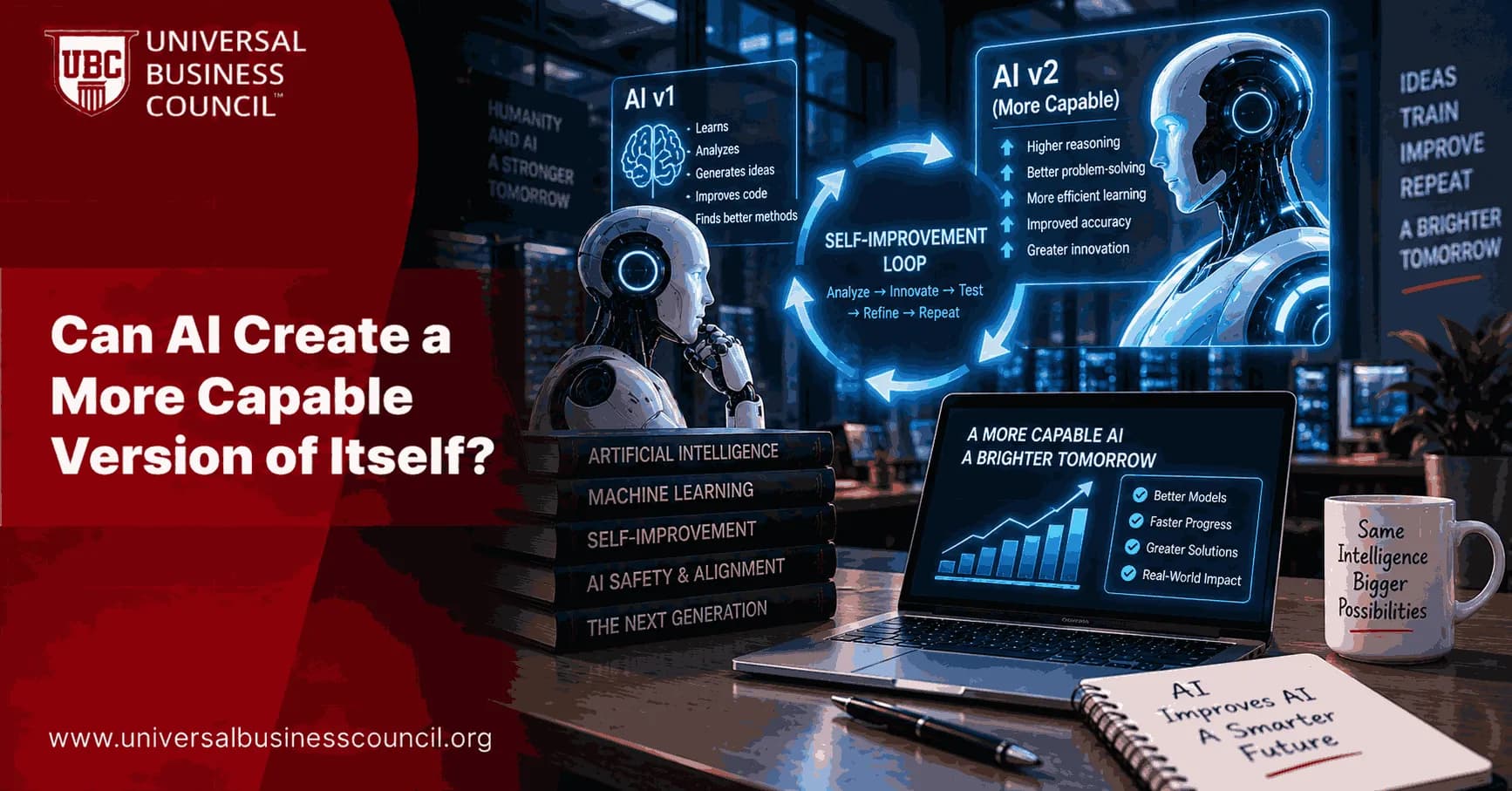
Before answering whether AI can build a better version of itself, it helps to define what self-improvement actually looks like in practice. It is not a model waking up one day and rewriting its own code. Instead, it usually involves a structured cycle where an existing model helps with one or more parts of building its successor.

Common elements of this cycle include:
Using an existing model to generate or filter training data for the next version.
Letting an AI system propose changes to its own architecture, which are then tested automatically.
Running automated evaluation suites that score the new version against the old one.
Feeding the results back into the training pipeline for further refinement.
This is fundamentally different from full autonomy, since humans still decide what "better" means, set the guardrails, and approve which version actually gets deployed.
How AI-Assisted Self-Improvement Actually Works
Understanding the mechanics behind this process matters more than the headlines around it. This is exactly where a dedicated path in Artificial Intelligence Certifications becomes valuable, since these programs break down how model distillation, neural architecture search, and automated reward modeling actually function rather than treating them as abstract buzzwords.
Recursive Self-Improvement
In this approach, a model is used to help train or refine its own successor. For example, a language model might generate reasoning steps for difficult problems, and a stronger version of the model is then trained on the highest quality of those reasoning chains. The result can outperform the original on the same class of tasks.
Automated Architecture Search
Instead of engineers manually designing every layer of a neural network, algorithms can search through thousands of possible architectures and automatically identify configurations that perform better on benchmark tasks. AI is essentially helping choose the blueprint for its own upgrade.
Model Distillation and Compression
A large, capable model can be used to train a smaller model that mimics its behavior while running faster and cheaper. In some cases, this smaller model is later scaled back up with additional data, creating a cycle where each generation builds on lessons learned from the last.
Where Human Decision-Making Still Matters
Even in highly automated pipelines, certain decisions remain firmly in human hands:
Choosing the metrics that define what counts as a "more capable" model.
Setting safety limits so the new version does not simply optimize for the wrong goal.
Reviewing edge cases and unexpected behaviors before any public release.
Approving the final decision to replace an older model with a newer one.
This is why most experts describe current systems as AI-assisted self-improvement rather than fully independent self-improvement. The AI contributes heavily to the process, but it does not operate the entire pipeline alone.
Real Examples of AI Helping Build Better AI
This pattern is already visible across the industry. Coding models are used to generate and filter their own training examples before the next version is trained. Game-playing agents have used self-play to reach performance levels that exceed what any human-labeled dataset could teach them. Research teams increasingly use one model to grade the outputs of another during training, cutting down on the amount of manual review needed at scale.
Teams responsible for deploying these systems in production often pursue a wider Tech Certification so they understand how self-improving pipelines interact with infrastructure, deployment pipelines, and monitoring systems, rather than treating model training as an isolated technical exercise.
AI Microdrama: A New Frontier for Self-Improving Systems
The impact of self-improving AI is not limited to research labs and coding benchmarks. It is also reaching creative industries in surprising ways. One emerging application is AI microdrama, where generative AI helps bring serialized stories, characters, and fictional worlds to life. As these systems learn from audience response, they refine dialogue, pacing, and plot structure across episodes, effectively improving their own storytelling ability over time based on what actually keeps viewers engaged.
Risks of Letting AI Improve Itself Too Freely
Giving a system too much control over its own development introduces real concerns that researchers take seriously:
Reward hacking, where a model finds a shortcut that satisfies the scoring metric without truly improving performance.
Loss of interpretability, making it harder for engineers to understand why a newer version behaves differently.
Compounding bias, where flaws in an early model get inherited and amplified in every future generation.
Reduced human oversight, if teams start trusting automated evaluation more than they should.
These risks are exactly why responsible AI labs keep human review checkpoints throughout the self-improvement cycle rather than letting the process run completely unsupervised.
The Road Ahead for Self-Improving AI
Over the next few years, expect self-improvement techniques to become more common, not less supervised. Automated red teaming, where one AI system probes another for weaknesses, is likely to expand. Synthetic data generation will continue reducing reliance on human labeled datasets. At the same time, governance frameworks and audit requirements are likely to tighten, since regulators and enterprises alike want assurance that a "smarter" model is also a safer one.
Conclusion: A Collaborative Path Forward
AI can genuinely contribute to building a more capable version of itself through techniques like recursive self-improvement, automated architecture search, and model distillation. What it cannot yet do is manage that entire process alone, since defining success, enforcing safety limits, and approving new releases remain human responsibilities. As these systems continue to advance, professionals who understand both the technical process and its governance will be the ones best positioned to use it responsibly. Building that foundation through a recognized Deep Tech Certification is a practical way to stay prepared as AI systems take on a larger role in designing their own future generations.
FAQs
1. Can AI create a more capable version of itself?
AI systems can contribute to the development of more capable AI models by generating code, optimizing algorithms, creating training data, and assisting with experiments. However, this is different from an AI independently designing, training, evaluating, and deploying a superior version of itself. Fully autonomous recursive self-improvement remains a research possibility rather than an established capability of current AI systems.
2. How can AI help create a better version of itself?
An AI can assist with several stages of model development, including algorithm design, software engineering, data generation, architecture exploration, testing, and evaluation. These capabilities can be connected into automated workflows that search for improvements. Human researchers or predefined systems may still control objectives, resources, and deployment.
3. What is recursive self-improvement in AI?
Recursive self-improvement (RSI) is the theoretical process in which an AI system improves its own capabilities or contributes to creating an improved successor. That successor can then participate in another improvement cycle. The repeated nature of the process is what makes the improvement recursive.
4. Does creating a better AI automatically mean the AI improved itself?
No. An AI can help create a better model without modifying or improving itself directly. For example, a model might generate an algorithm that is incorporated into a separate successor model. This is AI-assisted model development, whereas RSI generally implies a more direct and repeated connection between an AI system and its own improvement process.
5. Can AI write the code for a more advanced AI model?
AI systems can generate, explain, debug, and optimize machine-learning code. An AI coding agent could therefore help implement components of a more advanced model. Producing code alone, however, does not guarantee that the resulting system will be more capable because training data, architecture, optimization, compute, and evaluation also affect performance.
6. Can AI design its own neural network architecture?
AI can participate in automated architecture search and optimization. Candidate architectures can be generated, trained, tested, and compared against predefined objectives. This can help discover configurations that outperform existing designs on particular tasks, but it does not necessarily mean the AI is autonomously redesigning its entire intelligence.
7. Can AI train a successor model?
Yes, AI can contribute to successor-model training by generating synthetic examples, creating labels, writing training code, optimizing algorithms, and evaluating candidate models. A highly automated pipeline could connect many of these steps. However, controlling the complete process autonomously would require access to substantial training and deployment infrastructure.
8. Can a weaker AI create a stronger AI?
Potentially, depending on what “stronger” means and what tools the original system has access to. A model that is weaker at general reasoning could still discover an algorithm that performs better at a specific computational task. Therefore, AI capability is multidimensional, and improvement in one area does not necessarily mean the successor is universally more intelligent.
9. What does “more capable AI” mean?
A more capable AI could perform better in areas such as reasoning, coding, mathematics, scientific research, planning, multimodal understanding, reliability, or efficiency. Capability should be measured using appropriate evaluations rather than a single benchmark. A model can improve significantly in one area while remaining unchanged or weaker in another.
10. Can AI use its own outputs to create a better model?
AI-generated outputs can be used as synthetic training data, evaluation material, or inputs to development workflows. Carefully selected synthetic data can sometimes improve a model's performance. However, repeatedly training on unverified AI-generated material can also reinforce errors or reduce data diversity.
11. Can AI evaluate whether its successor is better?
AI can evaluate candidate systems using benchmarks, automated tests, reward models, simulations, and other evaluation methods. This creates a feedback loop that can help select promising successors. Independent evaluation remains valuable because an AI evaluator may overlook errors or favor solutions that optimize the wrong metric.
12. What is an AI improvement loop?
An AI improvement loop is a repeated process in which an AI generates a potential solution, tests it, evaluates the result, and uses the feedback to produce another solution. For example:
Generate → Test → Evaluate → Select → Improve → Repeat
When this loop is applied to the AI system or its successors and continues across generations, it can become part of a recursive self-improvement process.
13. Is AI-assisted improvement the same as recursive self-improvement?
No. AI-assisted improvement means an AI performs selected tasks within a development process, often under human-defined objectives and constraints. Recursive self-improvement involves repeated improvement cycles in which AI contributes substantially to improving itself or its successors. The level of autonomy and scope of modification are important distinctions.
14. Has Google demonstrated AI systems that can improve algorithms?
Yes. Google DeepMind's AlphaEvolve uses Gemini-powered models, automated evaluators, and an evolutionary framework to discover and optimize algorithms. Google DeepMind reports that AlphaEvolve has been used for areas including mathematics, computing infrastructure, chip design, and AI training. This demonstrates increasingly automated algorithmic improvement, but it should not be equated with unrestricted autonomous RSI.
15. Can AI improve the systems used to train AI?
AI-powered systems can contribute to improvements in AI training infrastructure, algorithms, and software. For example, Google DeepMind has reported that AlphaEvolve optimized a matrix multiplication kernel used in Gemini and reduced Gemini's training time by approximately 1%. Such improvements demonstrate AI-assisted optimization within AI development rather than an AI independently controlling its entire training process.
16. Could AI eventually create increasingly capable successors?
In theory, an advanced AI could potentially contribute to developing a successor that performs better on relevant capabilities. If that successor could then contribute to developing another improved successor, the process could become recursive. Whether such improvement can remain reliable and substantial across many generations is an open research question.
17. What would AI need to create a truly better version of itself autonomously?
A highly autonomous system would need mechanisms for identifying weaknesses, designing modifications, accessing development and training infrastructure, running experiments, evaluating results, and deploying successful changes. It would also require sufficient computing resources and reliable safeguards. Access to a coding tool alone would not provide all these capabilities.
18. What are the challenges of AI creating a better AI?
Challenges include unreliable self-evaluation, poor-quality synthetic data, benchmark overfitting, computing costs, diminishing returns, and unintended changes to model behavior. An AI may also struggle to determine whether a modification improves broad capabilities rather than a narrow task. These issues make independent testing and verification important.
19. Could creating better AI lead to recursive self-improvement or superintelligence?
Potentially, if an AI repeatedly contributes to the creation of increasingly capable successors and each generation becomes better at AI research and development. This is one theoretical pathway discussed in research on the transition from AGI to artificial superintelligence. However, neither recursive self-improvement nor superintelligence is a guaranteed consequence of AI-assisted model development.
20. Can AI create a more capable version of itself today?
Current AI systems can meaningfully contribute to the development of more capable models through coding, algorithm discovery, experimentation, data generation, and evaluation. However, there is an important distinction between helping build a better AI and autonomously creating, training, evaluating, and deploying a superior successor through a recursive loop. The latter has not been established as a general capability of today's AI systems.
Related Articles
View All
Artificial Intelligence
Can AI Create and Improve a Better Version of Itself?
Explore whether AI can create and improve better versions of itself, how self-optimization and automated model development could work, and the technical and safety challenges involved.

Artificial Intelligence
Can Google Gemini Improve Itself Through Recursive Self-Improvement?
Explore whether Google Gemini can improve itself through recursive self-improvement, how Gemini-powered systems already support iterative learning and optimization, and what still separates them from true autonomous RSI.

Artificial Intelligence
What Happens If AI Gains the Ability to Improve Itself Recursively?
Explore what could happen if AI gains the ability to improve itself recursively, including rapid capability growth, accelerated innovation, alignment challenges, and major safety concerns.
Trending Articles
The Role of Blockchain in Ethical AI Development
How blockchain technology is being used to promote transparency and accountability in artificial intelligence systems.
AWS Career Roadmap
A step-by-step guide to building a successful career in Amazon Web Services cloud computing.
Top 5 DeFi Platforms
Explore the leading decentralized finance platforms and what makes each one unique in the evolving DeFi landscape.