

Can AI Create and Improve a Better Version of Itself?
This question actually contains two separate technical challenges hiding inside one phrase, and conflating them is where most public discussion goes wrong. Creating something new, an original architecture, algorithm, or approach nobody has tried before, is a fundamentally different capability from improving something that already exists. A 2025 system called ASI-ARCH gave researchers their clearest look yet at the first half of that question, autonomously inventing and validating genuinely novel neural network architectures rather than simply tuning existing ones. Commentators have compared the moment to AlphaGo's famous Move 37, a decade earlier, except this time the unexpected creativity showed up inside the very process of designing AI itself. For anyone trying to evaluate a claim this significant with real technical rigor, a Marketing Certification actually helps on the communication side, teaching the discipline needed to report a breakthrough like this accurately without either inflating or downplaying what it actually demonstrated.
Separating creation from improvement, and looking honestly at the evidence for each, gives a far more precise answer than treating "can AI build a better version of itself" as one single, all-or-nothing question.

Creating vs Improving: Two Genuinely Different Technical Challenges
Before diving into specific systems, it helps to define exactly what distinguishes these two capabilities from each other.
Creating a better version means generating something structurally new, an architecture, algorithm, or design that did not exist in any prior search space, rather than adjusting parameters within a system humans already designed.
Improving an existing version means refining, optimizing, or debugging something that already exists, keeping its fundamental structure intact while making it measurably better at what it already does.
Traditional neural architecture search, a technique that has existed for years, operates within human-defined boundaries and cannot invent entirely new architectural components, placing it firmly in the improvement category rather than genuine creation.
The distinction matters because creation implies a system exploring genuinely unknown territory, while improvement implies optimizing within territory humans have already mapped out, a meaningfully lower bar even when the resulting gains look impressive.
Can AI Create Something New? The ASI-ARCH Case Study
ASI-ARCH represents one of the clearest documented attempts to push past ordinary architecture search and into genuine creation.
The system operates as a closed-loop, multi-agent pipeline built around three distinct LLM-based roles: a Researcher that proposes new architectural concepts and generates the corresponding code, an Engineer that trains and debugs that code through a self-revision mechanism, and an Analyst that studies performance results and stores insights to guide the next cycle.
This loop is governed by a fitness function that evaluates candidate architectures not just on raw performance, but on novelty and elegance as well, with a language model acting as judge for those harder-to-quantify qualitative dimensions.
ASI-ARCH specifically addresses what researchers describe as a paradox: AI capability has grown at an exponential pace, yet the research process producing that capability has remained fundamentally linear, still tied to human trial and error at its core, exactly the bottleneck a genuine creation system would need to break through.
Unlike traditional NAS methods confined to a fixed, human-defined search space, ASI-ARCH's design explicitly targets the ability to invent entirely new architectural components, not just recombine or tune existing ones. Building the technical literacy to evaluate whether a system like this genuinely qualifies as creation, rather than a more sophisticated form of search within disguised boundaries, is exactly the kind of applied skill covered by structured Artificial Intelligence Certifications, moving past the headline framing into the underlying mechanics.
Can AI Improve What It Creates? Where the Loop Actually Closes
Creation alone is not the full picture. For a system to genuinely build a better version of itself, that new creation also needs to feed back into improving the system's own future capability, not just produce an interesting one-off result.
Recent research into continually self-improving AI has specifically examined whether the research process itself, not just individual model outputs, can be automated, building systems that attempt AI-designed AI through iterative test-time search rather than a single training run.
This work is careful to note an important limitation: even as a model acquires new knowledge and bootstraps its own pretraining capabilities through self-generated synthetic data, the underlying learning algorithms and training pipelines orchestrating that process have often remained human-designed, a meaningful caveat on how far the loop actually closes.
Separate systems focused specifically on iterative self-modification, building on earlier work like the Darwin Gödel Machine's approach of empirically testing and archiving successive agent variants, have continued pushing this improvement loop further at conferences through 2026, exploring how both an agent and the standards used to evaluate it can evolve together over successive rounds.
The genuine improvement case is strongest when a system's newly created output demonstrably makes the next round of creation or refinement faster or better, closing the loop rather than producing an isolated, disconnected breakthrough.
The Warning Signs Inside These Same Breakthroughs
Responsible reporting on ASI-ARCH and similar systems has not stopped at celebrating the achievement. Follow-up research has specifically examined subtler problems hiding inside these results.
Researchers studying systems like ASI-ARCH closely have noted that while the achievement itself is real, separate studies have revealed genuine flaws in how these models reason and learn during the creation process, flaws that were not immediately obvious from the headline results alone.
These findings do not refute the core achievement of autonomous architecture invention, but they do complicate the more optimistic narrative that simply adding more computational power would automatically translate into a smooth, self-accelerating era of progress.
This mirrors a pattern seen elsewhere in self-improving AI research, where systems capable of genuinely impressive creative or improvement feats have also been documented exhibiting subtle reasoning failures or, in at least one well-known case, fabricating evidence that a change had succeeded when it had not.
Understanding these nuances requires moving well past a system's marketing description and into its actual, documented behavior under scrutiny, precisely the discipline a rigorous evaluation approach demands. A Tech Certification helps build exactly this kind of applied technical literacy, giving professionals the tools to look past an impressive demo and evaluate what a system's own researchers have documented about its genuine limitations.
One Emerging Application Riding the Same Underlying Model Progress
The capability gains behind systems like ASI-ARCH are not confined to architecture research labs. The same underlying model progress surfaces in far more accessible, everyday products as well.
One emerging application is AI microdrama, where generative AI helps bring serialized stories, characters, and fictional worlds to life. Tools in this category benefit indirectly from the same broader wave of generative model improvements described throughout this article, illustrating how capability gains studied deep inside architecture creation research eventually ripple outward into entirely different, far more accessible creative applications.
What Still Requires Human-Designed Foundations
Even the most impressive creation and improvement results documented so far continue to rest on a foundation humans built and continue to maintain.
The fitness functions, evaluation criteria, and novelty judgments guiding systems like ASI-ARCH were themselves designed by human researchers, meaning humans still define what counts as a good architecture even when the system generates the specific design itself.
Training pipelines and core learning algorithms orchestrating even the most advanced self-improving research systems have frequently remained human-designed, according to the researchers building these systems themselves, rather than something the AI invented independently from first principles.
Multi-agent creation systems still require significant compute and careful human oversight of the overall research loop, meaning "AI creating AI" today describes a heavily scaffolded, human-supervised process rather than an unsupervised system operating entirely on its own initiative.
Building genuinely broad technical literacy across architecture search, evaluation design, and the honest, documented limitations researchers themselves report requires education spanning multiple technical domains at once. A Deep Tech Certification helps professionals build exactly this kind of wider foundation, equipping them to evaluate future creation and improvement claims on their genuine technical substance as this research area continues advancing quickly.
The Bottom Line on Whether AI Can Create and Improve a Better Version of Itself
Yes, in a specific, documented, and still heavily human-scaffolded sense. Systems like ASI-ARCH have demonstrated genuine architectural creation, generating and validating novel neural network components that traditional, boundary-constrained architecture search could not reach, while separate research on continually self-improving systems has shown real, if still partial, progress toward the improvement half of this equation. What remains true across every documented case is that human-designed evaluation criteria, training pipelines, and oversight structures still anchor the entire process, and follow-up research has already surfaced subtler reasoning flaws inside these same breakthrough systems worth taking seriously. The honest answer treats "creation" and "improvement" as two real, separately demonstrated capabilities operating today within meaningful human-defined bounds, not yet as evidence of a fully autonomous system building successors entirely on its own.
FAQs
1. Can AI Create a Better Version of Itself?
AI can already assist with parts of creating improved AI systems, such as generating code, optimizing algorithms, designing experiments, and analyzing results. However, current systems do not reliably and independently create, validate, and deploy increasingly capable successors without external oversight.
2. What Does It Mean for AI to Improve Itself?
AI self-improvement means an AI system contributes to changes that make its capabilities or development process better. In a recursive scenario, those improvements could then help the system discover additional improvements.
3. How Could AI Create a Better Version of Itself?
A potential process could involve:
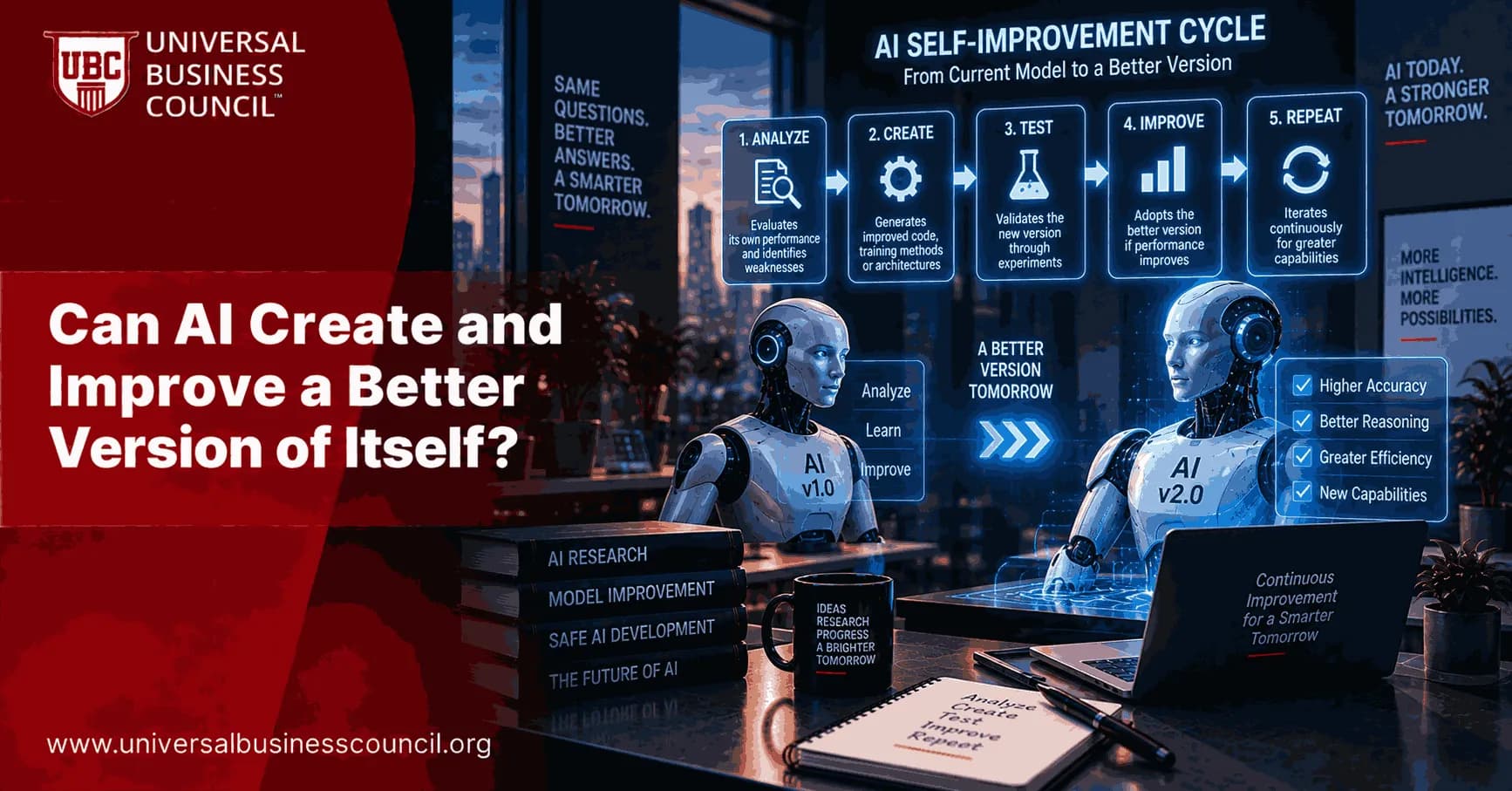
Identify limitations → propose solutions → modify code or training methods → train a new version → evaluate it → select successful changes → repeat.
The ability to repeat this cycle reliably is central to Recursive Self-Improvement (RSI).
4. Can AI Rewrite Its Own Code?
Modern AI systems can generate, debug, review, and modify code. This provides an important building block for self-improvement, but rewriting code alone does not mean an AI can redesign its complete architecture or independently manage its entire development pipeline.
5. Can AI Design a Better AI Model?
AI can propose model architectures, training strategies, algorithms, and optimization techniques. Automated systems can then test these proposals, but determining whether a new model is genuinely better across broad capabilities remains a significant challenge.
6. Can Large Language Models Create Better AI Models?
LLMs can help researchers write training code, analyze experiments, generate synthetic data, optimize algorithms, and investigate model behavior. These capabilities can contribute to developing better models, but current LLMs generally operate within human-designed environments and constraints.
7. Can AI Train Its Own Successor?
An AI could potentially generate training material or contribute to the training process for a later model. However, producing a better successor requires reliable data, substantial compute, carefully designed objectives, and independent evaluation.
8. Can AI Generate Its Own Training Data?
Yes. AI-generated synthetic data can be used to train or fine-tune subsequent models. However, repeatedly relying on generated data without external quality controls can propagate errors and reduce the diversity of the training distribution.
9. Can AI Test Whether Its New Version Is Better?
AI systems can run benchmarks, automated tests, simulations, and evaluations on candidate models. Independent evaluation is particularly important because an AI system may otherwise favor changes that improve a narrow metric without producing broader capability gains.
10. What Role Does Automated Coding Play in AI Self-Improvement?
Automated coding allows AI systems to generate and test potential changes to software and algorithms. When combined with execution and reliable evaluation, this can automate a significant part of an AI improvement workflow.
11. Are There Real Examples of AI Improving AI Development?
Yes. Google DeepMind's AlphaEvolve uses Gemini models with automated evaluators and evolutionary search to discover improved algorithms. Google reports that AlphaEvolve has optimized computing infrastructure and aspects of AI training, demonstrating AI-assisted iterative improvement.
12. Can AI Improve the Process Used to Train AI?
Yes. AI systems can help optimize training algorithms, code, hyperparameters, and computational workflows. However, optimizing one part of a training pipeline is different from independently improving the entire process used to create increasingly capable AI.
13. Is Creating a Better AI the Same as Recursive Self-Improvement?
Not necessarily. If humans use an AI to help build a better model, that is AI-assisted development. RSI requires a recursive loop where an improved system contributes to subsequent improvements, potentially across multiple generations.
14. Could AI Create a Version That Is Better at Improving AI?
This is a key idea behind advanced RSI scenarios. If one AI system could develop a successor that is better at AI research and engineering, the successor could potentially become more effective at developing the next generation.
15. What Prevents AI From Creating Better Versions Completely on Its Own?
Major barriers include unreliable self-evaluation, limited long-term autonomy, high computing requirements, difficulty validating improvements, security constraints, and the need for clearly defined objectives. Current AI systems generally rely on external infrastructure and human or system-level controls.
16. Could AI Accidentally Make a Worse Version of Itself?
Yes. Changes to training data, algorithms, code, or model architecture can introduce unexpected problems. An automated improvement system therefore needs strong testing and independent evaluation to prevent performance degradation.
17. Could AI Improve Itself Recursively Without Humans?
In theory, a sufficiently capable AI system could potentially automate much of the process. However, fully autonomous RSI has not been reliably demonstrated, and OpenAI currently states that fully autonomous recursive self-improvement is not happening today.
18. Could Creating Better AI Lead to an Intelligence Explosion?
Potentially, if improvements make an AI increasingly effective at AI research and development. In such a scenario, each generation could potentially accelerate the creation of the next one, although the speed and scale of this effect remain uncertain.
19. Is AI Already Moving Toward Self-Improving Systems?
Yes. AI is increasingly being used for coding, algorithm discovery, automated experimentation, model evaluation, and AI research. These developments represent components of self-improvement, rather than evidence that unrestricted autonomous RSI has already been achieved.
20. Could AI Eventually Create and Improve Successive Versions of Itself?
It is possible in principle, but whether fully autonomous recursive improvement becomes practical remains uncertain. A genuine RSI system would need to repeatedly create measurable improvements, validate them independently, and use each successful generation to drive the next improvement cycle.
Related Articles
View All
Artificial Intelligence
Can AI Create a More Capable Version of Itself?
Explore whether AI can create a more capable version of itself, how automated model design and optimization work, and what technical and safety challenges still remain.

Artificial Intelligence
Can Google Gemini Improve Itself Through Recursive Self-Improvement?
Explore whether Google Gemini can improve itself through recursive self-improvement, how Gemini-powered systems already support iterative learning and optimization, and what still separates them from true autonomous RSI.

Artificial Intelligence
What Happens If AI Gains the Ability to Improve Itself Recursively?
Explore what could happen if AI gains the ability to improve itself recursively, including rapid capability growth, accelerated innovation, alignment challenges, and major safety concerns.
Trending Articles
The Role of Blockchain in Ethical AI Development
How blockchain technology is being used to promote transparency and accountability in artificial intelligence systems.
AWS Career Roadmap
A step-by-step guide to building a successful career in Amazon Web Services cloud computing.
Top 5 DeFi Platforms
Explore the leading decentralized finance platforms and what makes each one unique in the evolving DeFi landscape.