

Responsible AI in Customer Service: Safe and Trustworthy AI Chatbots

A chatbot is often the first, and sometimes the only, representative a customer ever talks to. When it works well, people get fast answers at any hour. When it fails, the company is judged by what its bot just said. This guide covers responsible AI in customer service: how to build safe and trustworthy AI chatbots, what to put around them and how to keep humans and customers at the center. For readers who want a formal credential alongside the practice, the Certified Responsible AI Expert program is a good place to begin.
What is responsible AI in customer service?
Responsible AI in customer service means deploying chatbots, voice assistants and agent-support tools in ways that are accurate, safe, private, fair and honest about what they are. It also means making sure customers can always reach a person when they need one.

Customer service is a high-contact, high-trust function. Mistakes happen in public, in writing and at scale. A bot that invents a refund policy or mishandles a complaint can create real costs, and in some cases the company may be held to what its assistant said.
Where AI is used in service
Website and app chatbots for common questions
Voice assistants and automated phone menus
Email and ticket triage and routing
Suggested replies and summaries for human agents
Sentiment analysis of calls and messages
Knowledge base search and article drafting
Quality monitoring of agent conversations
What can go wrong
Confident wrong answers about prices, policies, eligibility or timelines
Leaking one customer's details to another
Offensive, biased or inappropriate replies
Customers trapped in loops with no route to a person
Manipulation by users who trick the bot into unauthorized promises
Poorer service for customers with accents, disabilities or limited language skills
Quiet collection of sensitive data without a clear purpose
Principles for trustworthy chatbots
Be honest about being a bot
Tell customers they are talking to an AI, and do not give the system a human name and persona that implies otherwise. Rules in several places require disclosure, and it builds trust either way.
Stay accurate
Ground answers in an approved, current knowledge base instead of letting the model improvise. Show sources when you can, and set the bot to say it does not know rather than guess. Assign owners to the content so policies stay up to date.
Protect customer data
Verify identity before sharing account details
Give the bot access only to the data it needs
Mask sensitive items such as payment details in logs
Set retention limits for transcripts
Check how vendors use conversation data, including for model training
Treat customers fairly
Test the bot across languages, dialects, writing styles and accessibility needs. Make sure service quality does not depend on who the customer is, and offer channels that work for people who cannot use a chatbot.
Always offer a human
Provide a clear, easy route to a person, especially for complaints, billing disputes, vulnerable customers and anything the bot cannot resolve. Pass along the conversation so customers do not have to repeat themselves.
Controls that keep chatbots in bounds
Scope and guardrails
Define what the bot may and may not discuss, block off-topic or harmful requests and filter unsafe output. Never allow it to make binding commitments, such as refunds or contract changes, unless a defined process backs them.
Security
Expect attempts to manipulate the bot, including prompt injection. Limit its access to systems, require approvals for actions that move money or change accounts and monitor for abuse.
Escalation triggers
Route to a person when the customer is upset, repeats a question, mentions safety, health or legal issues, or when the bot's confidence is low.
Testing and monitoring
Test with real customer questions, tricky edge cases and hostile inputs before launch. After launch, review samples of conversations, track resolution rates, escalation rates and complaints, and watch for topics where answers go wrong. Rerun tests after any change to the model, prompts or knowledge base.
Useful measures
Share of issues resolved without a human, and customer satisfaction on those
Accuracy of answers on a reviewed sample
How quickly customers reach a person when they ask
Complaints about the bot, and how fast they are fixed
Incidents involving data exposure or inappropriate replies
Supporting human agents
AI tools that suggest replies or summarize calls help staff, but agents should still check what they send. Use sentiment and quality scores to coach, not to punish, be open with employees about what is monitored and avoid letting scores drive unfair evaluation.
Brand voice and customer experience
A chatbot speaks for the brand, so tone, wording and promises need to match company values. Customer experience and marketing teams should help write the rules. Those who want to broaden their grounding can look at the Certified Digital Marketing Expert program.
Skills, records and trusted people
Teams that build and tune assistants benefit from solid engineering skills, and the programming and technology certifications from Global Tech Council can help provide them. Conversation logs and complaint records are more valuable when they cannot be quietly altered, and those interested in tamper-evident storage can explore the deep tech certifications from Blockchain Council. Because service staff and contractors handle customer data, careful screening matters, and HireValid can help verify backgrounds and credentials.
Conclusion: earning trust with responsible AI in customer service
Responsible AI in customer service comes down to making sure the bot is honest, accurate, private, fair and never a dead end. Tell customers they are talking to an AI, ground answers in an owned and current knowledge base, verify identity before sharing details, limit data access and retention, test across languages and abilities and offer a clear path to a person. Around those principles sit practical controls: defined scope, guardrails, no binding promises without a process behind them, security against manipulation and escalation triggers for upset customers and sensitive topics.
Testing and monitoring keep the system honest over time. Use real questions and hostile inputs before launch, then sample conversations, track resolution, accuracy, escalation and complaints and retest after every change. Treat human agents fairly when AI scores their work. Begin by reviewing your current chatbot against three questions: does it say it is a bot, does it answer only from approved content and can every customer reach a person in one step? The Certified Responsible AI Expert program mentioned earlier can help your team build deeper skills in responsible AI in customer service.
FAQs
1. What is responsible AI in customer service?
Using chatbots and AI tools in service that are accurate, safe, private, fair and open about being AI.
2. Must a chatbot say it is a bot?
Yes, as good practice and increasingly by rule. Do not imply the customer is talking to a person.
3. How do we stop a chatbot from giving wrong answers?
Ground it in an approved knowledge base, allow it to say it does not know and test regularly.
4. Can a company be held to what its chatbot says?
It can be, so avoid letting the bot make commitments outside defined policies.
5. How do we protect customer data in chats?
Verify identity, limit access, mask sensitive fields and set retention limits.
6. Can chat transcripts be used to train models?
Only if law, consent and vendor terms allow it. Check carefully.
7. When should the bot hand over to a person?
For complaints, upset customers, repeated failures, safety, legal or health topics and low confidence.
8. How do we make service fair for all customers?
Test across languages and accessibility needs, and offer alternative channels.
9. What is prompt injection in a chatbot?
An attempt to trick the bot into ignoring its rules or revealing information.
10. Should bots be allowed to issue refunds?
Only through a defined process with limits and approvals.
11. How often should we test the chatbot?
Before launch, after every change and on a regular schedule.
12. What metrics should we track?
Resolution, answer accuracy, escalation, time to reach a person, complaints and incidents.
13. Are voice assistants covered too?
Yes. The same principles apply, with extra care for recording consent and accents.
14. Is sentiment analysis of calls acceptable?
It can be, with transparency, proportionate use and legal compliance, and it should not drive unfair evaluation.
15. Who owns the chatbot?
A named service leader, with support from IT, security, legal and content owners.
16. How do we keep the knowledge base current?
Assign owners, set review dates and remove outdated articles.
17. What happens if the bot leaks data?
Follow your incident process: contain, investigate, notify as required and fix the cause.
18. Can chatbots support vulnerable customers?
With care. Detect signs of distress and route to trained people.
19. Can small businesses use chatbots responsibly?
Yes, with a limited scope, clear disclosure and easy access to a person.
20. Where can I learn more?
Training such as the Certified Responsible AI Expert program and guidance from consumer and data protection authorities.
Related Articles
View All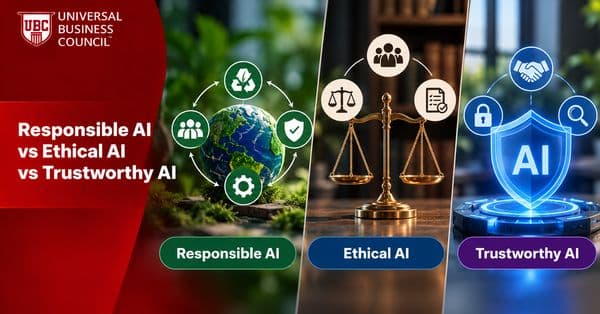
Artificial Intelligence
Responsible AI vs Ethical AI vs Trustworthy AI: Key Differences
Understand the differences between responsible AI, ethical AI, and trustworthy AI, including their definitions, principles, and applications. Explore how these approaches address fairness, transparency, accountability, privacy, and safety to guide the development and use of reliable artificial intelligence systems.

Artificial Intelligence
Federated Learning and Responsible AI: Benefits, Risks and Limitations
Explore how federated learning supports responsible AI by allowing machine learning models to train across decentralized data sources without directly sharing raw data. Learn about its benefits for privacy and collaboration, along with risks, technical limitations, security concerns, and practical applications.

Artificial Intelligence
Responsible AI Data Governance: Quality, Consent and Provenance
Explore how responsible AI data governance supports reliable and ethical AI systems through data quality, informed consent, and data provenance. Learn how organizations can manage training data, protect individual privacy, track data origins, reduce bias, and maintain accountability throughout the AI lifecycle.
Trending Articles
The Role of Blockchain in Ethical AI Development
How blockchain technology is being used to promote transparency and accountability in artificial intelligence systems.
AWS Career Roadmap
A step-by-step guide to building a successful career in Amazon Web Services cloud computing.
Top 5 DeFi Platforms
Explore the leading decentralized finance platforms and what makes each one unique in the evolving DeFi landscape.