

What Is Generative AI and How Does It Work?

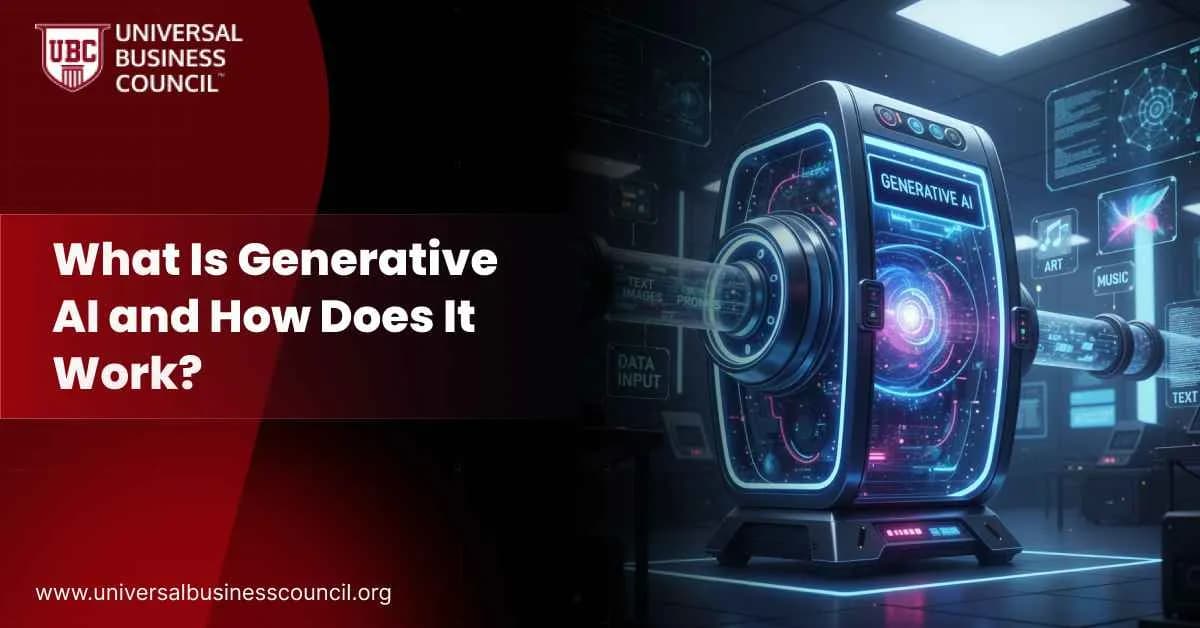
What Generative AI Really Means
Unlike traditional AI that classifies or predicts, generative AI learns patterns from massive datasets and then produces original outputs. That might be an image of a product that has never existed, a marketing email drafted in seconds, or a synthetic data set used to test systems. This makes it especially valuable in industries where creativity, scale, and personalization are crucial. The models behind generative AI, often called foundation models, are trained on diverse data sources. They become adaptable across tasks, from writing and summarization to generating 3D designs. As adoption spreads, people are exploring new ways to fine-tune these models for specific fields like healthcare, architecture, or entertainment.How Generative AI Works Step by Step
To understand how it works, it helps to break it down into stages:Training on Large Data
Generative AI models are exposed to massive amounts of text, images, audio, or video. They study the structure, patterns, and relationships inside the data. This training is usually unsupervised or semi-supervised, meaning the system doesn’t need perfectly labeled data.Architectures Powering the Models
There are several popular approaches:- GANs (Generative Adversarial Networks): a generator creates outputs, while a discriminator checks if they look real. Both improve by competing with each other.
- VAEs (Variational Autoencoders): compress data into a simpler form, then reconstruct it to allow controlled generation.
- Diffusion Models: start from random noise and gradually refine it into a clear output, commonly used in image and video tools today.
Using Prompts
Once trained, the model generates output based on instructions, often called prompts. For example, “Write a bedtime story about space travel” or “Create a watercolor painting of a mountain.” Conditioning can guide the style or tone of the result.Fine-Tuning
After the base training, the model is often fine-tuned with domain-specific data. This is how businesses get tools specialized in law, healthcare, finance, or other industries.Output Generation
Finally, the system generates new content — text, an image, a piece of music, or a simulation. For high-risk uses, post-processing and human checks are added to ensure accuracy, fairness, and safety.Types of Generative AI Models and Their Uses
| Model Type | Typical Applications |
| GANs (Generative Adversarial Networks) | Image generation, art, video effects |
| VAEs (Variational Autoencoders) | Synthetic data, anomaly detection, controlled outputs |
| Diffusion Models | High-quality image and video creation |
| Transformers (LLMs) | Chatbots, writing, summarization, translation |
| Multimodal Models | Text-to-image, text-to-video, interactive assistants |
| Reinforcement Learning Enhanced Models | Game development, adaptive simulations |
| Domain-Specific Fine-Tuned Models | Legal text drafting, medical imaging, financial reports |
| Lightweight Distilled Models | Mobile apps, edge computing, on-device AI |
| Hybrid Systems (Human + AI) | Content review, customer service, creative collaboration |
| Experimental Models | 3D design, scientific simulations, architectural planning |
The Latest Developments
Generative AI is moving quickly in 2025. Multimodal models are leading the charge, producing not only text but also visuals and sound in a single flow. Enterprises are also scaling data strategies, because the success of these systems depends heavily on clean, diverse training material. Another trend is efficiency. Training giant models is expensive, so developers are exploring model compression and lighter versions that can run on smaller devices. This opens the door for wider use, even outside large corporations. Ethics and safety remain big topics. Questions around bias, copyright, and misinformation have made responsible deployment just as important as technical progress. Governments and companies are now working together to create guardrails.Applications Across Industries
Generative AI is everywhere. In content creation, it writes blogs, scripts, and translations. In design and marketing, it creates images, videos, and brand mockups. In software, it powers code generation and accelerates development. For engineering and architecture, it enables simulations and prototypes. It is also gaining ground in healthcare, where synthetic data helps test systems without exposing sensitive patient records. For anyone interested in applying data-driven solutions to these industries, a Data Science Certification can provide the expertise needed to work with AI systems effectively.Why This Technology Matters
Generative AI matters because it changes how humans work with machines. It’s no longer just about automation; it’s about co-creation. This means businesses, creators, and researchers can achieve more in less time, while still needing to balance the risks of misuse. Professionals who want to build careers around these technologies should explore advanced upskilling. A deep tech certification can give a solid foundation in emerging AI tools and help navigate the next wave of digital transformation.Final Thoughts
Generative AI is not just a buzzword. It is a practical technology that is already shaping how we write, design, communicate, and solve problems. By understanding how it works, and by developing the right skills, individuals and organizations can move beyond curiosity into real impact.Related Articles
View AllArtificial Intelligence
Decision AI vs Generative AI
Compare Decision AI and generative AI to understand how decision-focused systems evaluate options and drive actions while generative models create text, images, code, and other content.
Artificial Intelligence
Decision Intelligence vs Generative AI
Compare decision intelligence and generative AI to understand how decision-focused systems optimize actions and outcomes while generative models create text, images, code, and other content.
Artificial Intelligence
Is Jev Generative AI?
Is Jev generative AI? Learn why Jev differs from traditional generative models and how its System One architecture produces typed, probabilistic decisions for software.
Trending Articles
The Role of Blockchain in Ethical AI Development
How blockchain technology is being used to promote transparency and accountability in artificial intelligence systems.
AWS Career Roadmap
A step-by-step guide to building a successful career in Amazon Web Services cloud computing.
Top 5 DeFi Platforms
Explore the leading decentralized finance platforms and what makes each one unique in the evolving DeFi landscape.