

AI Features in Google Ads Explained: Smart Bidding, PMax, and Automation
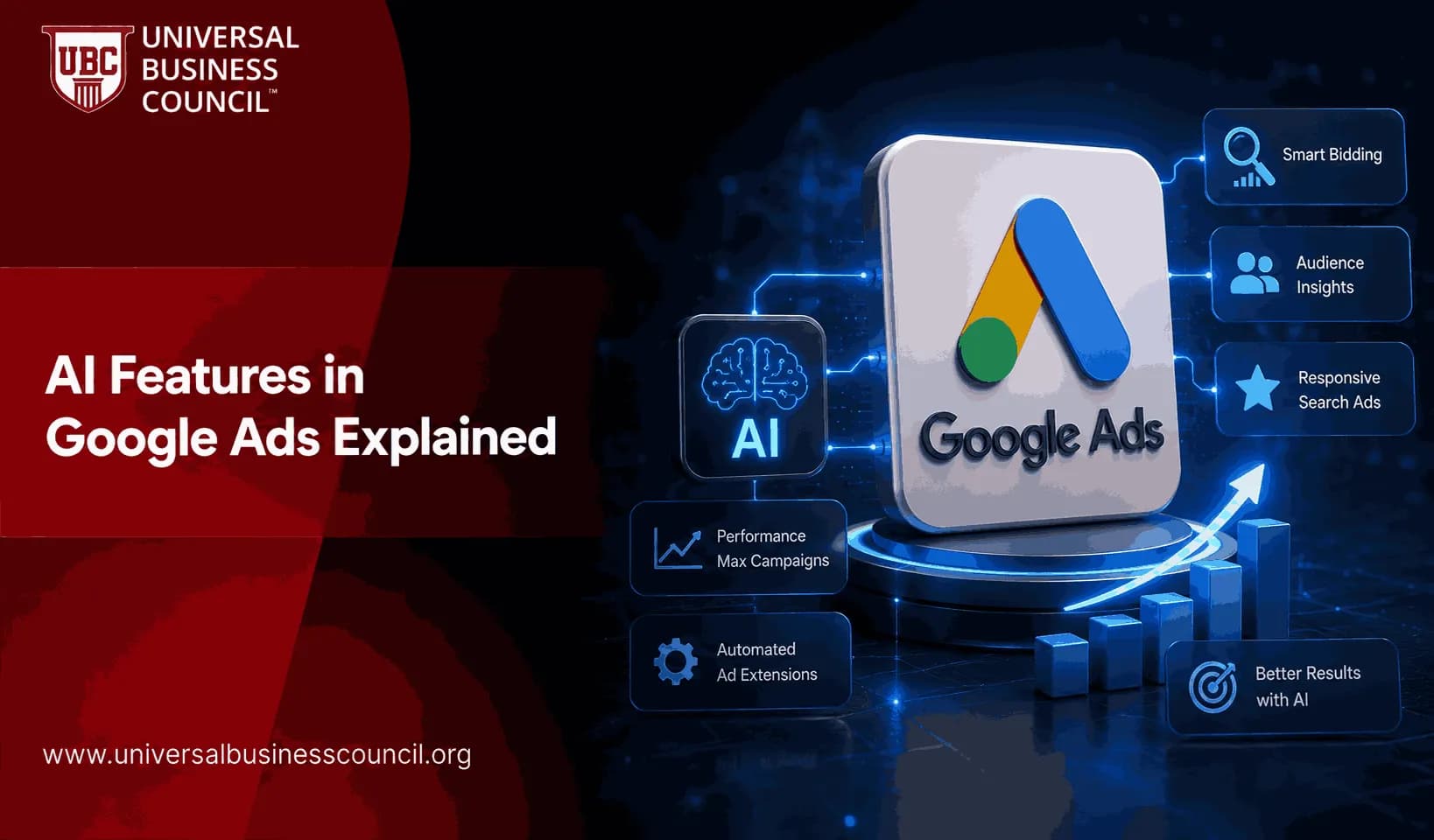
AI features in Google Ads now decide far more than bids. They influence which queries you enter, which channels get budget, which assets appear, and how Google values each auction. That is useful. It is also risky if your conversion tracking is messy or your goals are vague.
The shift is simple. You no longer manage every keyword, placement, and bid by hand. You manage inputs, constraints, measurement, and business judgment. Smart Bidding, Performance Max, and AI Max for Search all work best when you feed Google clean data and set firm guardrails.

As AI takes on a larger role in campaign management, advertisers need a stronger understanding of automation, bidding strategies, conversion tracking, and performance analysis. Many professionals build these practical skills through a Certified Google Ads Expert credential, helping them use Google's AI features strategically rather than relying on automation alone.
How Google Ads uses AI today
Google Ads automation focuses on three jobs:
Where ads show: Performance Max, Broad Match, and AI Max expand reach across queries and channels.
How bids are set: Smart Bidding predicts conversion probability at auction time and changes bids accordingly.
What creative runs: Google combines headlines, descriptions, images, video, landing pages, and audience context to select ad variations.
Google increasingly groups advanced automation under the AI Max label, including Performance Max, Smart Bidding, and Gemini-powered creative models announced around Google Marketing Live 2025. In plain terms, Google wants advertisers to set goals and supply data, then let its systems handle more of the execution.
That does not mean you should switch everything on and walk away. I have watched accounts burn budget because a secondary conversion, say a newsletter signup, carried the same value as a qualified sales lead. Smart Bidding did exactly what it was told. The instruction was just bad.
Smart Bidding: auction-time AI for CPA and ROAS goals
What Smart Bidding does
Smart Bidding is Google's automated bidding system for conversion and conversion value goals. Google describes it as auction-time bidding, which means the system evaluates each auction on its own rather than applying one fixed bid across a whole keyword or ad group.
Common Smart Bidding strategies include:
Target CPA
Target ROAS
Maximize conversions
Maximize conversion value
The model reads signals such as device, location, location intent, query text, browser, language, remarketing list membership, and search partner context. For Hotel Ads, it can also use itinerary and hotel attributes.
What changed recently
Enhanced CPC was retired in early 2025, which pushed advertisers away from semi-automated bidding and toward full Smart Bidding. Google has also added more steering options, including Target ROAS bands under an Exploration framework, where you can define a preferred range such as 450 to 550 percent ROAS.
That range matters. Set a rigid target too aggressively and the model may choke volume. Set it too loose and it may buy traffic that looks cheap but never turns into revenue.
When Smart Bidding works, and when it struggles
Smart Bidding needs enough trustworthy conversion data. Many paid search managers find that campaigns with fewer than roughly 30 conversions per month lack the volume for stable learning. That is not a formal Google rule, but it holds up in smaller accounts again and again.
Use Smart Bidding when:
You track the right primary conversions.
You have enough conversion volume for learning.
Your CPA or ROAS target reflects actual margin, not wishful thinking.
You can sit through a learning period without panicking after two bad days.
Be careful when lead quality is uneven. If sales accepts only 20 percent of form fills, import qualified leads or closed deals from Salesforce, HubSpot, or another CRM into Google Ads. Otherwise the algorithm optimizes toward the cheapest forms, not the best customers.
Getting the most from AI-powered advertising also requires a broader understanding of customer acquisition, marketing analytics, budgeting, and business strategy. A Certified Digital Marketing Expert program helps professionals connect Google Ads automation with wider digital marketing objectives, ensuring AI decisions support measurable business growth rather than isolated campaign metrics.
Performance Max: AI across Search, YouTube, Display, Discover, Gmail, and Maps
What PMax is
Performance Max, often called PMax, is Google's goal-based campaign type that can serve across all Google inventory from one campaign. It is designed to complement keyword-based Search, not fully replace it.
You give PMax:
A conversion goal, such as purchases, leads, or store visits
A budget
Assets, including headlines, descriptions, images, logos, and video
Audience signals and feeds, where relevant
Google then assembles ad combinations, allocates budget, sets bids through Smart Bidding, and decides where to show ads. It applies automation across bidding, budget optimization, audiences, creatives, and attribution.
Performance Max results and trade-offs
Google has published PMax case studies showing real gains. A sustainability-focused brand reported 60 percent growth in conversions and 59 percent growth in revenue after using Performance Max to distribute video and imagery across Google channels. Discovery+ reported a 21 percent drop in CPA compared with its previous non-branded Search campaigns.
Those are case studies, not universal benchmarks. PMax can perform well when you have product feeds, strong creative, clear conversion values, and enough transaction data. It can also disappoint when you need tight query control, strict placement visibility, or clean separation between branded and non-branded demand.
To be blunt, PMax is the wrong first move for an account that cannot explain its own conversion tracking. Fix measurement first. Then test automation.
What to monitor in PMax
Check these weekly:
Asset group performance: Replace weak headlines, thin images, and auto-generated video that looks off-brand.
Search term insights: Watch for brand-heavy results that inflate performance.
New customer acquisition settings: Use them carefully, especially if repeat buyers dominate revenue.
Feed quality: For e-commerce, product titles, images, prices, and availability can make or break PMax.
A small but painful mistake: dumping all products into one asset group when margins differ wildly. If one category runs a 12 percent margin and another runs 45 percent, the same ROAS target is too weak for one and too strict for the other.
AI Max for Search: keywordless expansion with more Search control
AI Max for Search campaigns is a feature suite introduced globally in beta in 2025. It is not a separate campaign type. It sits inside your existing Search campaigns and expands matching beyond your keyword list using broad match and keywordless technology.
Google reports that advertisers turning on AI Max typically see 14 percent more conversions or conversion value at similar CPA or ROAS. For campaigns that mostly used exact and phrase match, Google reports a typical uplift of 27 percent.
What AI Max includes
Search term matching: Finds relevant queries beyond your current keywords.
Text customization: Generates headlines and descriptions from landing pages, existing ads, and keywords.
Locations of interest: Targets people based on geographical intent at ad group level.
Brand controls: Let you include or exclude brand associations at campaign and ad group level.
AI Max is useful when you want broader Search coverage but are not ready to hand budget to a fully cross-channel system like PMax. It also gives you more diagnostic value than PMax because it stays inside Search, where search term reporting and channel controls are clearer.
Automation outside Google Ads
Third-party AI agents are starting to sit above Google Ads and manage accounts around the clock. Tools such as Ryze AI are pitched as systems that adjust bids, pause poor performers, reallocate budgets, and flag anomalies.
Use caution here. Extra automation can help large accounts, especially when you need anomaly detection at 2 a.m. It can also create conflicts if one system changes budgets while Smart Bidding is still learning. Before adding another AI layer, decide who owns each decision: Google, the external tool, or you.
AI-driven advertising increasingly depends on technologies such as APIs, cloud infrastructure, CRM integrations, machine learning, analytics platforms, and privacy-aware data management. A broader Tech Certification can help marketers understand these technical systems and make more informed decisions when implementing AI-powered advertising workflows.
Governance checklist for AI features in Google Ads
If you manage paid media professionally, your value is shifting from manual tweaking to governance. Run through this checklist before scaling Smart Bidding, PMax, or AI Max:
Audit conversion actions: Mark only business-critical actions as primary.
Import quality data: Connect CRM stages, offline conversions, or revenue values where possible.
Set realistic targets: Base CPA and ROAS on margin, sales cycle, and customer lifetime value.
Use exclusions and controls: Apply brand controls, negative keywords where available, location settings, and budget caps.
Segment by business logic: Separate campaigns or asset groups when products, regions, or margins behave differently.
Review search terms and assets: Automation still needs human judgment on relevance and brand fit.
For deeper capability, connect this topic to Universal Business Council digital marketing certification pathways and related courses on marketing analytics, campaign management, and performance measurement. These are the skills employers now expect from paid media specialists: not just platform familiarity, but measurement discipline and sound decisions.
The practical next step
Start with one campaign where conversion tracking is clean and volume is steady. Test Smart Bidding or AI Max before moving budget into PMax. Give the test at least two to four weeks, watch CPA, ROAS, conversion quality, and search term relevance, then decide with data. If you are building a career in paid media, make Google Ads automation, analytics, and conversion governance part of your next certification plan with Universal Business Council.
As artificial intelligence, predictive analytics, autonomous marketing systems, and privacy-enhancing technologies continue to reshape digital advertising, professionals who combine marketing expertise with technical knowledge will be better positioned for future leadership roles. A Deep Tech Certification provides structured learning in these emerging technologies, helping marketers stay ahead as AI becomes an even more important part of performance marketing.
FAQs
1. What AI features are available in Google Ads?
Google Ads includes a range of AI-powered features designed to help advertisers optimize campaigns more efficiently. These include Smart Bidding, Performance Max (PMax), Responsive Search Ads, AI-assisted asset generation, audience optimization, budget recommendations, predictive insights, and automated campaign optimization.
2. What is Smart Bidding in Google Ads?
Smart Bidding is a collection of automated bidding strategies that use machine learning to optimize bids for specific campaign goals, such as conversions or conversion value. The system evaluates numerous contextual signals during each auction to determine an appropriate bid based on the selected objective.
3. How does Smart Bidding work?
Smart Bidding analyzes signals such as device type, location, time of day, language, audience characteristics, browser, operating system, and historical campaign performance. It uses these signals to estimate the likelihood of achieving the advertiser's desired outcome for each auction.
4. What bidding strategies are included in Smart Bidding?
Common Smart Bidding strategies include Maximize Conversions, Maximize Conversion Value, Target CPA (Cost Per Acquisition), and Target ROAS (Return on Ad Spend). The most appropriate strategy depends on campaign goals, available conversion data, and business objectives.
5. What is Performance Max (PMax)?
Performance Max is a goal-based campaign type that allows advertisers to access Google's entire advertising inventory from a single campaign. Ads can appear across Google Search, YouTube, Display, Discover, Gmail, Maps, and other eligible Google properties, with AI helping determine where ads are most likely to perform.
6. How does Performance Max optimize campaigns?
Performance Max uses AI to evaluate audience signals, creative assets, conversion data, and campaign objectives to automatically allocate budgets, choose placements, and optimize bids. Advertisers provide high-quality assets and business goals while Google's AI manages delivery across channels.
7. What are audience signals in Performance Max?
Audience signals are inputs provided by advertisers to help Google's AI understand which types of users may be most relevant at the beginning of campaign learning. These signals guide initial optimization but do not permanently restrict where ads can be shown.
8. What are Responsive Search Ads?
Responsive Search Ads allow advertisers to provide multiple headlines and descriptions. Google's AI automatically tests different combinations to determine which messaging is most relevant for individual users and search queries.
9. How does AI improve ad creative?
AI can help generate, combine, and optimize advertising assets such as headlines, descriptions, images, and other creative elements. Advertisers should review AI-generated content to ensure it accurately represents their brand, products, and marketing objectives.
10. Can AI optimize campaign budgets?
Yes. Google Ads uses AI to recommend budget allocation based on campaign performance, conversion opportunities, and historical trends. While automation can improve efficiency, marketers should continue monitoring budgets to ensure spending aligns with business priorities.
11. How does AI improve audience targeting?
AI evaluates user behavior, intent signals, demographics, interests, previous interactions, and other contextual information to identify audiences that may be more likely to convert. This helps advertisers reach relevant users while adapting to changing customer behavior.
12. Is conversion tracking necessary for AI-powered campaigns?
Yes. Accurate conversion tracking is essential because AI optimization relies on reliable performance data. Incomplete or inaccurate conversion tracking may reduce the effectiveness of automated bidding and campaign recommendations.
13. What role does first-party data play in AI optimization?
First-party data, such as customer lists and website interactions collected with appropriate consent and in compliance with applicable privacy regulations, can help improve audience understanding and campaign optimization. As privacy standards evolve, responsibly managed first-party data continues to grow in importance.
14. What are the advantages of AI automation in Google Ads?
AI automation can improve operational efficiency by managing bids, testing creative combinations, optimizing placements, identifying trends, and adapting campaigns more quickly than manual adjustments alone. These capabilities allow marketers to spend more time on strategic planning and creative development.
15. Are there limitations to AI-powered advertising?
Yes. AI depends on high-quality inputs, sufficient conversion data, relevant creative assets, and clearly defined business objectives. Automation does not eliminate the need for human oversight, strategic decision-making, or regular campaign reviews.
16. What metrics should marketers monitor when using AI?
Important metrics include conversion rate, cost per acquisition (CPA), return on ad spend (ROAS), conversion value, click-through rate (CTR), impression share, asset performance, budget utilization, and overall business outcomes rather than automation alone.
17. What common mistakes should advertisers avoid?
Common mistakes include launching automated campaigns without conversion tracking, providing limited creative assets, ignoring search insights and performance reports, relying entirely on automation without review, and making frequent major changes during the campaign learning period.
18. How can marketers get the best results from Smart Bidding and PMax?
Marketers should define clear goals, implement accurate conversion tracking, supply diverse and high-quality creative assets, use meaningful audience signals, monitor performance regularly, and make data-driven refinements instead of frequent reactive changes.
19. How is AI expected to shape Google Ads in the future?
AI is expected to continue expanding its role in campaign optimization, predictive analytics, creative generation, audience modeling, and cross-channel advertising. Google regularly introduces new AI capabilities, so marketers should stay informed through official product announcements and documentation.
20. What should marketers know about AI features in Google Ads?
AI features such as Smart Bidding, Performance Max, Responsive Search Ads, and automated optimization can help advertisers improve efficiency, scale campaigns, and make more informed decisions when supported by accurate data and thoughtful strategy. The strongest results typically come from combining Google's automation with clear business objectives, high-quality creative assets, reliable measurement, and ongoing human oversight. AI can process enormous amounts of data remarkably quickly, but it still benefits from marketers who remember that customers are people rather than just another optimization signal. A surprisingly timeless concept in digital advertising.
Related Articles
View All
Digital Marketing
Google Ads Bidding Strategies Explained for Beginners
Beginner guide to Google Ads bidding strategies, including Manual CPC, Maximize Clicks, Target CPA, Target ROAS, and when to use each.

Digital Marketing
Google Ads Assets Explained: How Extensions Improve Campaign Results
Learn how Google Ads assets, formerly ad extensions, improve visibility, CTR, Ad Rank, and conversions with practical asset types and setup guidance.

Digital Marketing
Google Ads Remarketing Guide: How to Re-Engage Website Visitors
A practical Google Ads remarketing guide for re-engaging website visitors with audience segmentation, dynamic ads, RLSA, first-party data, and better measurement.
Trending Articles
The Role of Blockchain in Ethical AI Development
How blockchain technology is being used to promote transparency and accountability in artificial intelligence systems.
AWS Career Roadmap
A step-by-step guide to building a successful career in Amazon Web Services cloud computing.
Top 5 DeFi Platforms
Explore the leading decentralized finance platforms and what makes each one unique in the evolving DeFi landscape.