

Google Ads Bidding Strategies Explained for Beginners
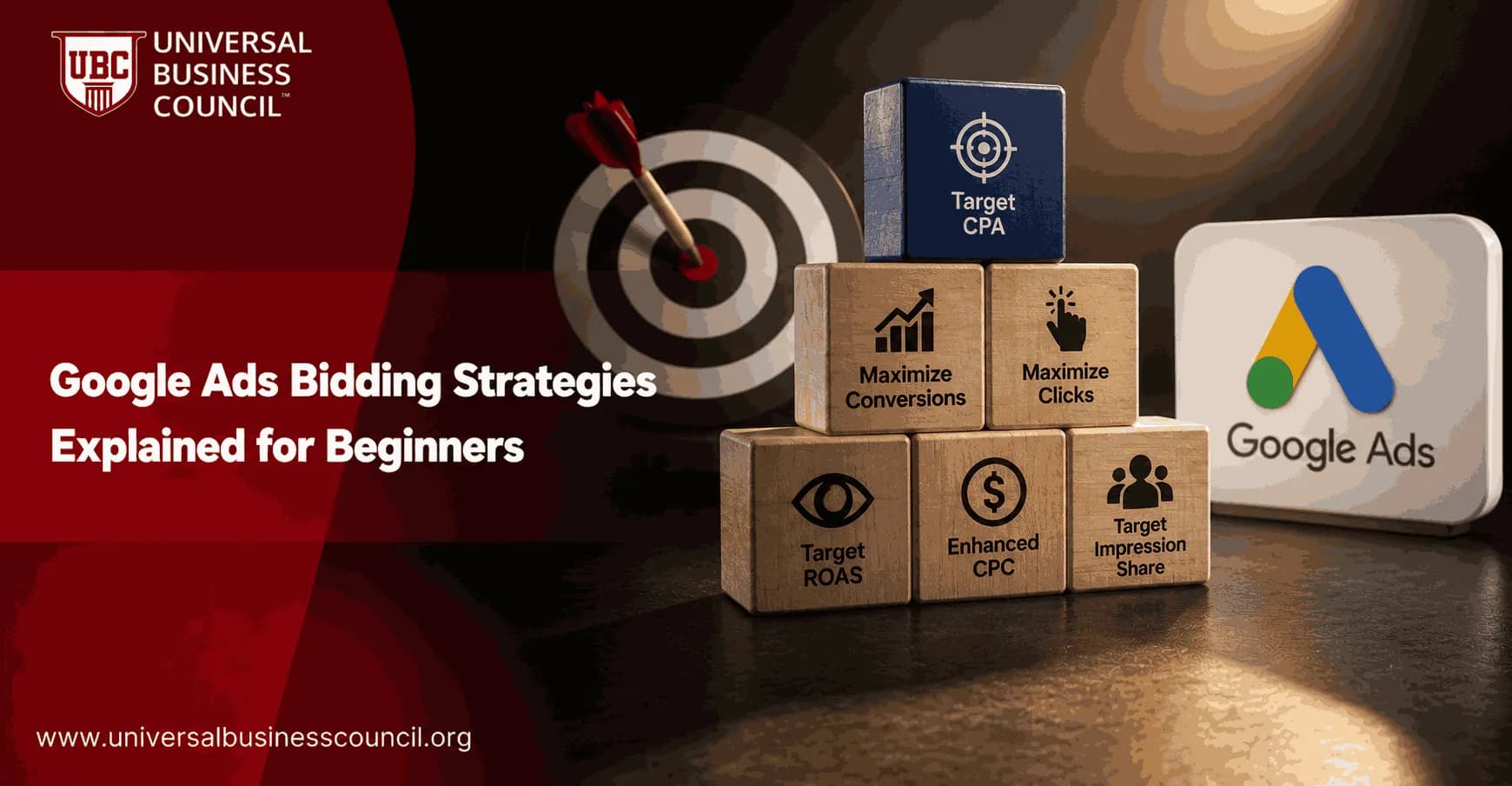
Google Ads bidding strategies decide how your budget is spent in each ad auction. Pick the wrong one and a campaign can look busy while producing weak leads, expensive clicks, or revenue that never covers the media cost. Pick the right one and the account gets easier to manage, because the bidding method matches the business goal.
Here is the practical version. Beginners should learn Manual CPC, Maximize Clicks, Maximize Conversions, Target CPA, Maximize Conversion Value, and Target ROAS first. Those six cover most search, lead generation, and ecommerce campaigns. The rest matter too, but usually after you understand the basics.

As Google Ads continues to rely more on automation and auction-time optimization, professionals benefit from understanding bidding strategies, campaign structure, Quality Score, and conversion tracking in greater depth. A Certified Google Ads Expert credential helps build these practical skills, making it easier to select and manage bidding strategies that align with real business objectives.
What bidding means in Google Ads
Google Ads runs on an auction. Each time a search happens or an ad placement opens up, advertisers compete for that impression. Your bid is the most you are willing to pay for a click, a view, or a thousand impressions, depending on the campaign type.
You usually do not pay your full bid. Your actual cost depends on competition, ad quality, the expected impact of your ad assets, and Ad Rank. Google explains this in its Help documentation on ad auctions and bidding.
For a beginner, remember three things:
Your bid is not your goal. A $2 click is fine if it creates profitable leads. A $0.20 click is waste if nobody buys.
Bidding cannot fix weak targeting. Bad keywords and poor landing pages still burn budget.
Automation needs clean data. If conversion tracking is wrong, smart bidding optimizes toward the wrong signals.
The two broad types of Google Ads bidding strategies
Manual bidding
Manual bidding gives you direct control. You set bids yourself, often at the keyword or ad group level. This helps when a campaign is new, data is thin, or you want to understand which searches are worth paying for.
The trade-off is time. Manual bidding demands monitoring. You need to check search terms, impression share, Quality Score, CPC trends, and conversion performance. Skip that work and the account drifts.
Smart bidding
Smart bidding uses Google machine learning to adjust bids at auction time. The system reads signals like device, location, time of day, browser, audience lists, and past conversion behavior. Google Ads Help describes Target CPA, Target ROAS, Maximize Conversions, and Maximize Conversion Value as smart bidding strategies built around conversion or value outcomes.
Smart bidding is powerful when tracking is reliable. It is not magic. To be blunt, switching a messy account to automation often just helps the system waste money faster.
Choosing the right bidding strategy also requires a broader understanding of customer acquisition, attribution, campaign planning, and marketing performance across channels. A Certified Digital Marketing Expert credential helps professionals develop these capabilities, allowing them to connect Google Ads optimization with wider digital marketing goals.
Core bidding strategies for beginners
Manual CPC
Manual CPC lets you set the maximum cost per click for keywords or ad groups. It gives you the most control over what you are willing to pay.
Best for: new search campaigns, small budgets, and early keyword testing.
Watch out for: slow optimization. You need to adjust bids based on real results. If a keyword has 80 clicks and no conversions, do not admire the traffic. Cut the bid, tighten the match type, or pause it.
Enhanced CPC
Enhanced CPC, often called ECPC, starts with your manual bids and lets Google raise or lower them when a click looks more or less likely to convert. It sits between manual control and full automation.
Best for: campaigns with some conversion history where you still want bid control.
Watch out for: weak base bids. ECPC still depends on the structure you build. Poor keyword grouping and broad targeting make its job harder.
Maximize Clicks
Maximize Clicks tells Google to get as many clicks as possible within your budget. It is simple and useful when you need traffic data quickly.
Best for: early data collection, awareness, and low-risk testing.
Watch out for: cheap clicks with no intent. I have audited accounts where Maximize Clicks filled the reports with traffic from loose match terms, while the sales team complained that the leads were students, job seekers, and vendors. The campaign looked active. It was not productive.
If you use Maximize Clicks, set a maximum CPC bid limit where available and review the search terms report often.
Maximize Conversions
Maximize Conversions asks Google to get the most conversions possible within your budget. You do not set a target cost per acquisition at first.
Best for: lead generation campaigns with working conversion tracking and steady conversion volume.
Watch out for: unstable data. A common practitioner benchmark is to wait until a campaign or account is generating around 30 conversions per month before leaning heavily on smart bidding. That is not a rule, but it is a sensible threshold.
Also check what counts as a conversion. If newsletter signups, phone clicks, and qualified demo requests are all weighted equally, the system may chase the easiest action instead of the best one.
Target CPA
Target CPA means Target Cost Per Acquisition. You tell Google the average amount you want to pay for each conversion, such as $40 per lead. Google then adjusts bids to bring the average CPA near that target over time.
Best for: mature lead generation campaigns with a known cost per lead target.
Watch out for: targets that are too aggressive. If your campaign has been producing leads at $80, setting a $25 Target CPA on Monday will often choke traffic by Wednesday. Start close to recent performance, then reduce gradually.
Maximize Conversion Value
Maximize Conversion Value focuses on total value, not conversion count. For ecommerce, that usually means revenue. A $300 order matters more than a $20 order, so Google bids with value in mind.
Best for: ecommerce campaigns and any account where different conversions carry different values.
Watch out for: poor value tracking. If your conversion values are missing, duplicated, or disconnected from real order value, this strategy loses its edge. Check GA4, Google Tag Manager, and your Google Ads conversion settings before you switch.
Target ROAS
Target ROAS means Target Return On Ad Spend. Set a 400 percent Target ROAS and you are asking Google to aim for $4 in conversion value for every $1 in ad spend.
Best for: ecommerce accounts with consistent revenue tracking, enough conversion volume, and clear margin expectations.
Watch out for: vanity ROAS. A high target can cut sales volume if it is unrealistic. If leadership tracks profit, not just revenue, make sure your ROAS target reflects gross margin, returns, discounts, and fulfillment cost.
Visibility and awareness bidding options
Target Impression Share
Target Impression Share aims to show your ad in a chosen location, such as the absolute top of the search results, for a target share of eligible impressions. It is often used for branded search terms.
Best for: protecting brand presence when competitors bid on your name.
Wrong choice for: direct response campaigns where cost per lead or revenue matters more than visibility.
CPM, tCPM, vCPM, and CPV
Display and video campaigns use different bidding models:
CPM: cost per thousand impressions.
tCPM: target cost per thousand impressions.
vCPM: cost per thousand viewable impressions.
CPV: cost per view, commonly used for YouTube campaigns. Google Ads documentation notes that a video view can be charged when someone watches 30 seconds, watches the full video if it is shorter, or interacts with the ad.
Use these when your goal is reach, visibility, or video engagement. Do not judge them only by last-click conversions.
Standard vs portfolio bid strategies
A standard bidding strategy applies to one campaign. That is enough for many small accounts.
A portfolio bidding strategy applies one shared strategy across multiple campaigns. Google Ads API documentation describes portfolio strategies as shared BiddingStrategy resources that can manage campaigns with common goals.
Use portfolio bidding when several campaigns share the same Target CPA or Target ROAS. A B2B company running separate search campaigns for consulting, implementation, and support might use one portfolio Target CPA if all three produce the same type of qualified sales lead.
Effective campaign automation also depends on technical knowledge beyond advertising, including analytics implementation, tag management, APIs, data integration, and marketing technology platforms. A Tech Certification helps professionals strengthen these complementary skills, enabling more accurate measurement and better-informed optimization decisions.
A beginner-friendly path to choosing a bid strategy
Start with the business goal. Need traffic? Use Maximize Clicks carefully. Need leads? Build toward Maximize Conversions or Target CPA. Need revenue? Use Maximize Conversion Value or Target ROAS.
Check tracking first. Test Google Ads conversions, GA4 events, form submissions, call tracking, and ecommerce values.
Use Manual CPC for early learning. This helps when you have no conversion history and need keyword-level control.
Move to smart bidding when data is stable. Around 30 conversions per month is a practical benchmark for many beginner accounts.
Give the algorithm time. After a major bidding change, wait several weeks before making another big adjustment. Many practitioners use about 4 weeks as a stabilization window.
Do not set fantasy targets. Base Target CPA and Target ROAS on recent performance, then improve in steps.
Common mistakes that waste budget
Optimizing for the wrong conversion. A page view is not a lead. A lead is not always a qualified opportunity.
Changing bidding strategies too often. Every major change can restart learning and blur the data.
Ignoring Quality Score and landing page experience. Bidding higher is an expensive way to compensate for weak relevance.
Using Target ROAS without clean revenue data. Bad values create bad bidding decisions.
Comparing campaigns with different goals. A YouTube CPV campaign and a search Target CPA campaign should not be judged by the same short-term metric.
How this fits professional digital marketing training
If you are building a career in paid media, Google Ads bidding is not just a platform setting. It tests your grasp of CAC, LTV, conversion rate, attribution, campaign structure, and measurement quality. These are the same concepts covered across Universal Business Council digital marketing, analytics, and marketing management learning pathways, and they connect naturally with broader topics such as performance marketing strategy and marketing ROI.
Certification candidates often get tripped up by scenario questions. The wording may describe an ecommerce store with different order values, then offer Maximize Conversions as an answer. That sounds reasonable, but Maximize Conversion Value or Target ROAS is usually the better fit when revenue value is the goal.
Final advice: pick the strategy that matches the job
Use Manual CPC when you need control. Use Maximize Clicks when you need early traffic data, but watch query quality. Use Maximize Conversions for lead volume after tracking is stable. Use Target CPA when you know the acceptable cost per lead. Use Maximize Conversion Value or Target ROAS when revenue values are accurate.
Your next step: audit one active campaign today. Check its goal, conversion tracking, last 30 days of conversion volume, and current bidding strategy. If those four items do not line up, fix that before increasing the budget.
As AI-powered bidding, privacy-first measurement, and advanced marketing technologies continue to evolve, professionals who understand the underlying technology will be better equipped to adapt. A Deep Tech Certification provides valuable knowledge of emerging technologies, helping marketers and technical teams make more informed decisions when working with modern advertising platforms and intelligent automation.
FAQs
1. What are Google Ads bidding strategies?
Google Ads bidding strategies determine how much you're willing to bid in ad auctions to achieve your advertising goals. Google offers both manual and AI-powered automated bidding options that optimize bids based on campaign objectives such as clicks, conversions, impressions, or return on ad spend (ROAS).
2. Why are bidding strategies important?
Your bidding strategy directly affects ad visibility, campaign costs, traffic quality, and overall performance. Choosing the right strategy helps align your advertising budget with your business goals while improving campaign efficiency.
3. What is Manual CPC bidding?
Manual Cost Per Click (Manual CPC) allows advertisers to set maximum bids for individual keywords or ad groups. It offers greater control over spending but requires ongoing monitoring and optimization to remain competitive.
4. What is Maximize Clicks bidding?
Maximize Clicks is an automated bidding strategy that aims to generate as many clicks as possible within your daily budget. It is commonly used to increase website traffic, especially for newer campaigns focused on building visibility.
5. What is Maximize Conversions bidding?
Maximize Conversions uses Google's machine learning to automatically adjust bids in an effort to generate the highest possible number of conversions within your available budget. It works best when accurate conversion tracking is already in place.
6. What is Target CPA bidding?
Target Cost Per Acquisition (Target CPA) automatically sets bids to help achieve conversions at an average cost close to your desired CPA. Performance depends on historical conversion data and sufficient campaign activity for Google's AI to optimize effectively.
7. What is Target ROAS bidding?
Target Return on Ad Spend (Target ROAS) focuses on maximizing conversion value while aiming for a specified return on advertising investment. It is commonly used by e-commerce businesses that track purchase values and revenue.
8. What is Maximize Conversion Value?
Maximize Conversion Value automatically adjusts bids to generate the greatest total conversion value within your budget. This strategy is particularly useful for businesses where conversions have different monetary values.
9. What is Target Impression Share?
Target Impression Share is designed to increase ad visibility by aiming to show ads at a chosen location on the search results page, such as the top of the page or absolute top position. It is often used for brand awareness campaigns.
10. What is Enhanced CPC (ECPC)?
Enhanced CPC is a semi-automated bidding strategy that adjusts manual bids based on the estimated likelihood of a conversion. It combines advertiser control with Google's machine learning to improve conversion potential.
11. Which bidding strategy is best for beginners?
Many beginners start with Maximize Clicks to build traffic or Manual CPC to learn campaign management. Once reliable conversion data is available, automated strategies such as Maximize Conversions or Target CPA may become more effective.
12. How does AI improve bidding?
Google's AI analyzes signals such as device type, location, search intent, time of day, audience characteristics, and historical performance to automatically adjust bids in real time. These automated decisions aim to improve campaign efficiency while supporting the selected bidding objective.
13. How important is conversion tracking?
Accurate conversion tracking is essential for most automated bidding strategies. Without reliable conversion data, Google's machine learning has limited information to optimize bids effectively.
14. Can bidding strategies reduce advertising costs?
The right bidding strategy may improve campaign efficiency and help lower cost per conversion over time. However, no bidding strategy guarantees lower costs, as results depend on competition, Quality Score, targeting, budget, and market conditions.
15. How often should advertisers change bidding strategies?
Frequent changes can disrupt campaign learning and performance analysis. It is generally advisable to allow sufficient time for campaigns to collect meaningful data before evaluating whether a different bidding strategy is appropriate.
16. What metrics should beginners monitor?
Key performance indicators include clicks, impressions, click-through rate (CTR), conversions, conversion rate, cost per click (CPC), cost per acquisition (CPA), return on ad spend (ROAS), Quality Score, and impression share.
17. What common bidding mistakes should beginners avoid?
Common mistakes include changing strategies too frequently, ignoring conversion tracking, setting unrealistic CPA or ROAS targets, using broad targeting without optimization, failing to review search terms, and evaluating campaigns before enough performance data has accumulated.
18. What trends are shaping Google Ads bidding in 2026?
Key trends include AI-powered Smart Bidding, first-party data strategies, Enhanced Conversions, privacy-focused measurement, predictive bidding models, Consent Mode, cross-device attribution, Performance Max optimization, and server-side tracking.
19. How do I choose the right bidding strategy for my business?
Choose a strategy based on your primary objective. Businesses focused on website traffic may prioritize clicks, while lead generation campaigns often optimize for conversions, and e-commerce advertisers frequently use conversion value or ROAS-based strategies.
20. What is the long-term outlook for Google Ads bidding strategies?
AI-driven bidding is expected to become increasingly sophisticated as Google continues enhancing automation and privacy-aware measurement. Advertisers who combine accurate conversion tracking, high-quality creative assets, relevant landing pages, and thoughtful campaign management with appropriate bidding strategies may achieve stronger long-term results. Letting AI adjust bids is convenient, but giving it accurate conversion data is still the part where humans have to remember which buttons matter.
Related Articles
View All
Digital Marketing
AI Features in Google Ads Explained: Smart Bidding, PMax, and Automation
Understand AI features in Google Ads, including Smart Bidding, Performance Max, AI Max for Search, automation trade-offs, and governance tips.

Digital Marketing
Google Ads for B2B Lead Generation: Campaign Strategies That Work
Learn how to use Google Ads for B2B lead generation with intent-led Search, Smart Bidding, Performance Max, CRM tracking, and better landing pages.

Digital Marketing
Google Ads for E-commerce Stores: Strategies to Increase Sales Profitably
Learn how to use Google Ads for e-commerce stores with Shopping, Search, Performance Max, Smart Bidding, feed optimization, and ROAS control.
Trending Articles
The Role of Blockchain in Ethical AI Development
How blockchain technology is being used to promote transparency and accountability in artificial intelligence systems.
AWS Career Roadmap
A step-by-step guide to building a successful career in Amazon Web Services cloud computing.
Top 5 DeFi Platforms
Explore the leading decentralized finance platforms and what makes each one unique in the evolving DeFi landscape.