Broad Match vs Phrase Match vs Exact Match in Google Ads
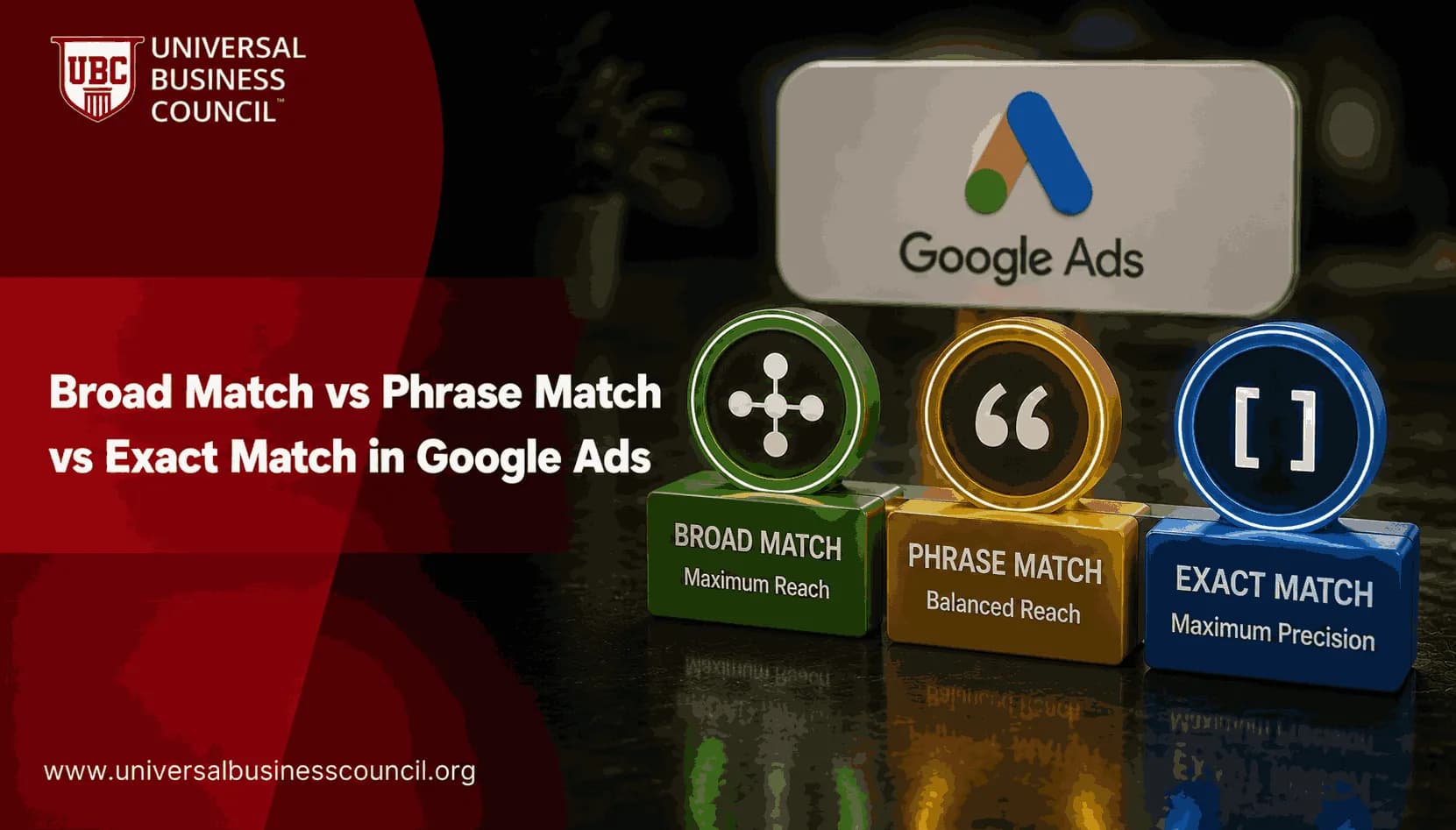
Broad Match vs Phrase Match vs Exact Match is not a textbook choice anymore. In Google Ads, match types now decide how much you trust Google's intent matching and Smart Bidding versus how tightly you want to control which queries make your ad eligible. The practical answer is simple. Broad match is the scale option. Exact match is the control layer. Phrase match has become harder to justify in many accounts.
That does not mean you should switch every keyword to broad match tomorrow. Please do not. The right structure depends on your conversion data, budget, sales cycle, and how expensive a bad click is for your business.

Understanding when to use broad, phrase, or exact match requires more than knowing their definitions. It also involves campaign structure, keyword strategy, Smart Bidding, and conversion tracking. A Certified Google Ads Expert credential helps professionals develop these practical skills, making it easier to choose the right match types for different business goals and account structures.
What Google Ads match types actually mean
Google defines keyword match types as settings that determine how closely a user's search query must relate to your keyword before your ad can enter the auction. There are three positive match types: broad match, phrase match, and exact match.
Broad match
Broad match is the default keyword match type in Google Ads. You enter the keyword with no special symbols, such as tennis shoes.
Your ad may show for searches related to the keyword's meaning, even when the query does not contain the same words. For example, tennis shoes might match searches like best sneakers for clay court or running shoes for tennis if Google reads the intent as relevant.
Broad match gives you the widest reach. It also gives you the least direct query control. That trade-off is only acceptable when your conversion tracking and bidding strategy are clean.
Phrase match
Phrase match uses quotation marks, such as "tennis shoes". It can match searches that carry the meaning of the phrase, with extra words before or after.
Since Google folded broad match modifier into phrase match in 2021, phrase match has become looser than many advertisers remember. It is no longer the tidy middle ground it once was. In some accounts it behaves close enough to broad match that you still need frequent search term reviews.
Exact match
Exact match uses brackets, such as [tennis shoes]. It can match searches with the same meaning or intent, including close variants. So exact match is not perfectly exact anymore.
Even so, exact match is still the strongest steering tool. Use it to protect high-value terms, brand queries, bottom-funnel service searches, or keywords where one irrelevant lead can waste a sales team's afternoon.
Broad Match vs Phrase Match vs Exact Match: quick comparison
Broad match: Highest reach, lowest manual control, best for discovery and scale with Smart Bidding.
Phrase match: Moderate reach and control, but less distinct after the 2021 broad match modifier change.
Exact match: Lowest reach, highest control, best for critical and high-intent queries.
Think of it this way. Broad match asks Google to find people with this intent. Exact match says stay close to this query. Phrase match sits between them, but the middle keeps getting squeezed.
Why broad match has gained ground
Broad match used to be risky in a lot of accounts. Years ago it often meant paying for loosely related searches, then cleaning up the mess with negative keywords. That still happens when tracking is poor. But Google's machine learning has changed how broad match works.
Google now uses signals such as query meaning, landing page content, ad relevance, user behaviour, and conversion patterns to decide when broad match should enter an auction. Paired with Smart Bidding, especially target CPA or target ROAS, broad match can find converting queries that a hand-built keyword list would miss.
Industry data suggests broad match often produces lower average CPCs than phrase or exact match. Google has also reported that advertisers who upgrade exact match keywords to broad match in target CPA campaigns tend to see more conversions. Case studies are not universal proof, but they explain why Google's product direction is so clear.
Here is the catch. Broad match only works when the algorithm gets reliable feedback. If your account counts newsletter sign-ups, accidental form submissions, and qualified sales leads as equal conversions, Smart Bidding will optimise toward noise. It will get very good at finding bad leads.
Match type decisions also fit into a broader digital marketing strategy that includes customer intent, attribution, audience segmentation, and campaign optimization across channels. A Certified Digital Marketing Expert credential helps professionals strengthen these capabilities, ensuring paid search campaigns contribute to measurable business outcomes rather than traffic alone.
Why phrase match is losing its old role
Phrase match used to be the safe compromise. Not too wide. Not too narrow. Plenty of PPC managers built entire account structures around it.
The problem is that its value has weakened. Since the broad match modifier was absorbed, phrase match has crept wider, and in many auctions it costs more than broad match can reach the same intent for. The argument is blunt. Phrase match advertisers may be paying more for auctions that broad match can often win at lower cost.
Practitioners have also seen phrase match pull in queries that feel unexpectedly loose, including competitor terms or adjacent intent. I have watched this in audits where a phrase keyword built around CRM software started spending on comparison and login-style queries that should never have been treated as equal commercial intent. The wasted spend was not dramatic on day one. It was worse. Quiet, steady, and easy to miss until the month-end CPA review.
Phrase match is not useless. It can still help newer accounts limit exposure while testing a market. It can work for advertisers who want a cautious expansion path. But if you already have strong conversion data, phrase match is often the least attractive option. Not as scalable as broad, not as controlled as exact.
Where exact match still earns its place
Exact match is the keyword type I would protect in B2B, niche services, regulated sectors, and high-ticket lead generation. When a click costs 40 USD and a sales-qualified lead is rare, precision matters.
Use exact match for:
Brand terms and product names
Top converting search terms from your search term report
High-intent service keywords, such as enterprise payroll software demo
Legal, medical, financial, or technical searches where the wording signals qualification
Queries that sales leadership already recognises as valuable
Exact match also helps with reporting discipline. Leadership rarely asks how many broad-match semantic variants you covered. They ask about CPA, ROAS, pipeline value, conversion rate, CAC, LTV, and lead quality. Exact match lets you isolate the terms that actually move those numbers.
How to choose the right match type
If your account is new
Start with exact match and a few selected phrase match keywords for your core commercial terms. Keep the budget focused. Your first job is not scale. It is learning which queries convert and which leads are worth paying for.
Review the search term report at least twice a week during launch. Add negative keywords for job seekers, free resources, support queries, login terms, and competitor names if they do not fit your strategy.
If your account has reliable conversion data
Test broad match with Smart Bidding. Do it in a controlled way, not as an act of faith.
Choose one campaign with stable conversion volume.
Use target CPA or target ROAS if the account has enough data.
Keep exact match keywords for proven high-value queries.
Add broad match versions of selected themes.
Monitor search terms, CPA, conversion value, and lead quality.
Give the test enough time, usually several conversion cycles.
Do not judge broad match after three days unless it is clearly breaking the budget. Smart Bidding needs feedback. But do not ignore obvious waste either. Automation is not a substitute for judgment.
Modern Google Ads campaigns also rely on technical expertise in analytics, CRM integrations, conversion tracking, APIs, and marketing technology platforms. A Tech Certification helps professionals build these complementary skills, enabling more accurate measurement and better-informed optimization decisions as campaign automation continues to evolve.
If you sell B2B or high-value services
Be stricter. Broad match can work, but only if offline conversion tracking is in place. Import qualified leads, opportunities, or revenue from Salesforce, HubSpot, or another CRM. If Google only sees form fills, it may optimise for students, vendors, or tiny companies that will never buy.
Common mistakes advertisers make
Using broad match without Smart Bidding: this is usually where waste starts.
Treating all conversions as equal: a demo request and a low-value download should not carry the same signal.
Assuming exact match means exact wording: Google matches the same meaning and close variants.
Ignoring negative keywords: broad and phrase both need active exclusions.
Keeping old SKAG structures: single keyword ad groups often restrict learning and create needless management work in modern Google Ads.
Certification candidates often miss one detail. Negative keyword match types do not behave the same way as positive match types. If you are preparing for a Google Ads or digital marketing assessment, study that distinction carefully. It shows up in practical campaign questions.
A practical match type framework
Use this decision model when building or restructuring campaigns:
Use broad match when you have conversion volume, clean tracking, Smart Bidding, and a goal to increase total conversions.
Use phrase match when you need cautious expansion but are not ready to trust broad match fully.
Use exact match when the query is high intent, high value, brand-sensitive, or quality-critical.
For most mature accounts, the strongest setup is broad match for discovery and scale, exact match for control, and a smaller role for phrase match. That is my position. Phrase match still has its uses, but it should not be the default comfort blanket for advertisers who have not updated their approach since broad match modifier disappeared.
What to learn next
If you manage paid search, connect match type strategy to measurement. Learn Google Analytics 4 events, Google Ads conversion actions, offline conversion imports, target CPA, target ROAS, and CRM-based lead scoring. Match types are only one part of the system.
For structured learning, use this topic as a bridge into Universal Business Council digital marketing and performance marketing training, including programmes covering paid media strategy, marketing analytics, campaign optimisation, and digital marketing management.
Your next step: pull the last 30 days of search terms, sort by cost, and mark each query as keep, exclude, or promote to exact match. That one exercise will tell you more about Broad Match vs Phrase Match vs Exact Match than another week of theory.
As AI-powered search, intelligent bidding, and privacy-first measurement reshape digital advertising, marketers who understand the underlying technologies will be better prepared for future changes. A Deep Tech Certification provides valuable knowledge of emerging technologies, helping professionals make informed decisions when working with advanced advertising platforms, automation, and data-driven marketing systems.
FAQs
1. What are keyword match types in Google Ads?
Keyword match types determine how closely a user's search query must match your selected keywords before your ad is eligible to appear. Google Ads primarily offers Broad Match, Phrase Match, and Exact Match, each providing different levels of reach and control.
2. What is Broad Match in Google Ads?
Broad Match is the default keyword match type and allows Google to show your ads for searches related to your keyword, including synonyms, related concepts, and searches that reflect the user's intent. It offers the widest reach but may also generate less targeted traffic if not managed carefully.
3. What is Phrase Match?
Phrase Match allows your ads to appear for searches that include the meaning of your keyword or close variations while preserving the general intent of the phrase. It offers a balance between reach and targeting, making it a popular choice for many advertisers.
4. What is Exact Match?
Exact Match provides the greatest level of keyword control by targeting searches that closely match the meaning or intent of your chosen keyword. While Google may still include close variants, Exact Match generally focuses on highly relevant search queries.
5. How do the three match types differ?
Broad Match delivers the widest audience reach, Phrase Match balances flexibility with relevance, and Exact Match offers the most precise targeting. The best option depends on campaign objectives, budget, and the level of control an advertiser wants over search traffic.
6. Which match type is best for beginners?
Phrase Match is often a practical starting point because it balances traffic volume with relevance. Beginners can gradually expand into Broad Match or refine campaigns with Exact Match as they gather performance data and optimize their accounts.
7. When should I use Broad Match?
Broad Match may be useful when expanding reach, discovering new keyword opportunities, or using AI-powered Smart Bidding strategies. Regular review of search term reports and negative keywords is important to maintain traffic quality.
8. When should I use Phrase Match?
Phrase Match is well suited for lead generation, service businesses, and campaigns that require a balance between audience size and search relevance. It can help advertisers reach users with similar intent while maintaining reasonable targeting control.
9. When should I use Exact Match?
Exact Match is often preferred for high-value keywords, campaigns with limited budgets, branded searches, and situations where advertisers want greater control over search intent and conversion quality.
10. How does Google interpret keyword intent?
Google uses machine learning to understand the meaning behind search queries rather than relying solely on identical keyword wording. This allows ads to appear for searches with similar intent, depending on the selected match type.
11. How do negative keywords work with match types?
Negative keywords prevent ads from showing for unwanted or irrelevant searches. They are especially important when using Broad Match because they help reduce wasted ad spend and improve campaign efficiency.
12. Which match type usually has the lowest CPC?
There is no universal answer. Exact Match may reduce wasted clicks by targeting more relevant searches, while Broad Match can sometimes benefit from AI optimization. Actual CPC depends on Quality Score, competition, bidding strategy, and market conditions.
13. How do match types affect conversions?
Exact Match often attracts highly qualified traffic, Phrase Match provides a balance of volume and relevance, and Broad Match may uncover new conversion opportunities. Advertisers should evaluate performance using conversion data rather than click volume alone.
14. Should I use all three match types together?
Many advertisers use a combination of match types across different campaigns or ad groups. This approach can help balance audience reach, keyword discovery, and precise targeting while allowing ongoing optimization based on performance.
15. How does AI influence keyword matching?
Google's AI analyzes user intent, search context, device, location, and historical performance to improve keyword matching and bidding decisions. AI-powered Smart Bidding often works well alongside Broad Match when supported by reliable conversion tracking.
16. What metrics should I monitor for different match types?
Track click-through rate (CTR), cost per click (CPC), conversions, conversion rate, cost per acquisition (CPA), return on ad spend (ROAS), Quality Score, impression share, and search term reports to evaluate keyword performance.
17. What common mistakes should advertisers avoid?
Common mistakes include relying only on Broad Match without negative keywords, using Exact Match for every keyword, failing to review search terms, poor campaign organization, weak landing pages, and changing match types too frequently without sufficient performance data.
18. What trends are shaping keyword targeting in 2026?
Key trends include AI-powered intent matching, Smart Bidding, first-party data strategies, Enhanced Conversions, privacy-focused measurement, predictive audience targeting, Performance Max integration, and increased automation in keyword optimization.
19. Which match type delivers the best ROI?
The best return on investment depends on campaign goals, industry competition, keyword selection, bidding strategy, landing page quality, and conversion optimization. Successful advertisers regularly test different match types and make decisions based on performance data rather than assumptions.
20. What is the best long-term strategy for using keyword match types?
A balanced strategy often combines Phrase Match for scalable growth, Exact Match for high-intent searches, and Broad Match for keyword discovery, supported by strong negative keyword management, AI-assisted bidding, and continuous optimization. Google keeps making keywords smarter, which means advertisers now spend almost as much time understanding search intent as they do choosing the actual words.
Related Articles
View All
Digital Marketing
Google Ads Remarketing Guide: How to Re-Engage Website Visitors
A practical Google Ads remarketing guide for re-engaging website visitors with audience segmentation, dynamic ads, RLSA, first-party data, and better measurement.
Digital Marketing
Google Ads Landing Pages: Best Practices for 2026
Learn how to build Google Ads landing pages that match search intent, load fast on mobile, improve conversion tracking, and support smarter campaign optimization.

Digital Marketing
How to Write High-Converting Google Ads Copy That Filters for Better Clicks
Learn how to write Google Ads copy that matches intent, proves value, improves lead quality, and works with responsive search ads and AI-assisted testing.
Trending Articles
The Role of Blockchain in Ethical AI Development
How blockchain technology is being used to promote transparency and accountability in artificial intelligence systems.
AWS Career Roadmap
A step-by-step guide to building a successful career in Amazon Web Services cloud computing.
Top 5 DeFi Platforms
Explore the leading decentralized finance platforms and what makes each one unique in the evolving DeFi landscape.