

Google Ads Certification Guide: How to Prepare and Pass
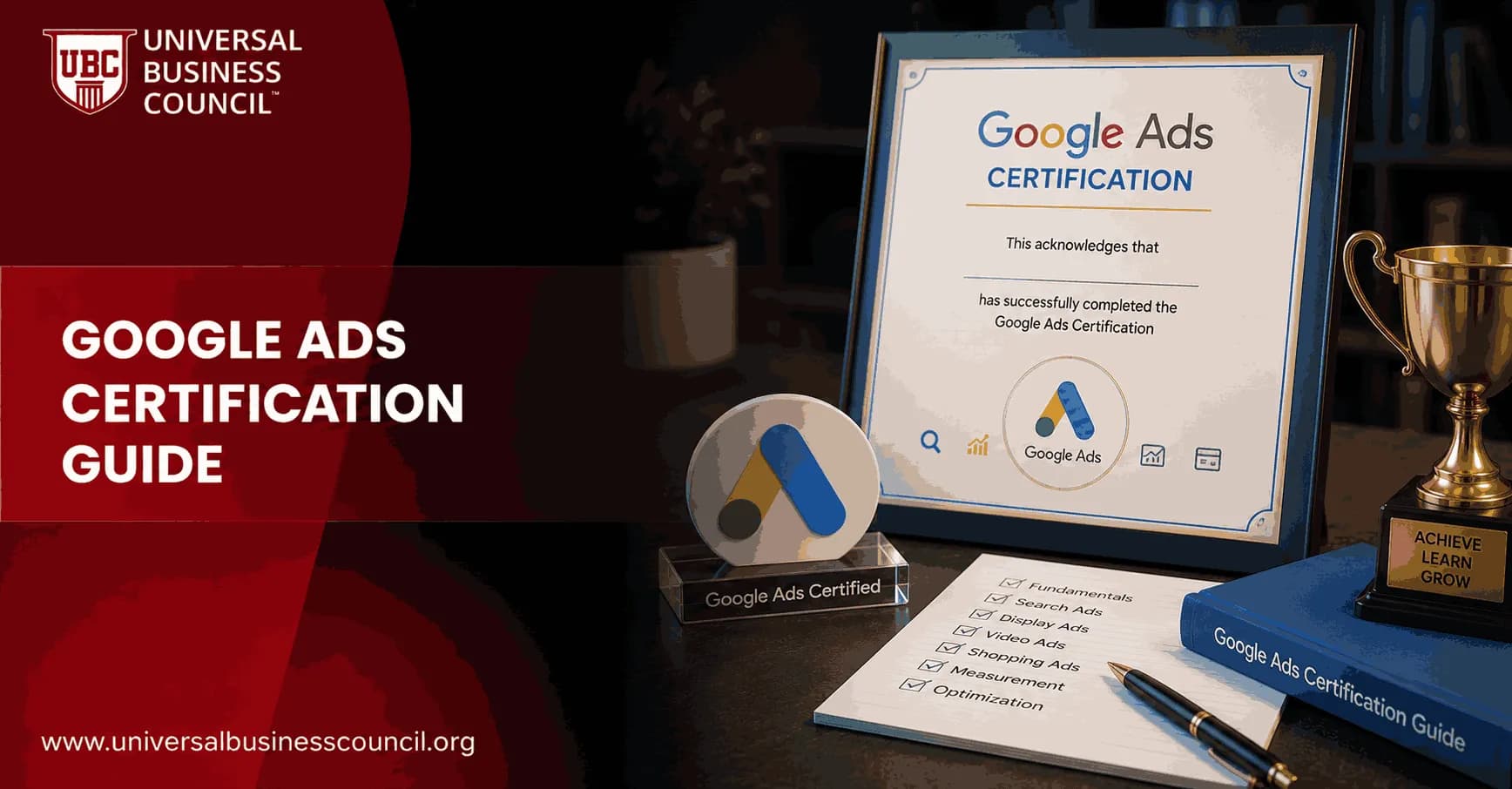
Google Ads certification is Google's free professional accreditation for people who want to prove they can plan, run, measure, and improve campaigns across Google Ads products. The exams run through Google Skillshop, need an 80 percent score to pass, and stay valid for 12 months. If you work in paid search, ecommerce, agency account management, or marketing analytics, this is one of the first credentials worth earning.
Do not treat it as a badge hunt. The exam is far easier once you have opened a campaign, set a bid strategy, checked conversion actions, and watched how fast a bad keyword match can burn budget. I have seen junior marketers explain Quality Score flawlessly in theory, then miss the real problem in an account: the conversion action was counting every contact-page visit as a lead. That kind of mistake is exactly why hands-on practice matters.

Alongside Google's official certifications, many professionals also pursue a Certified Google Ads Expert credential to strengthen their practical understanding of campaign strategy, optimization techniques, audience targeting, and conversion-focused advertising. Combining structured learning with hands-on account experience helps build confidence in managing real-world campaigns.
What Google Ads Certification Is
Google Ads certifications are professional accreditations offered by Google through Skillshop, its official training and assessment platform. Google presents the credential as recognition that you understand online advertising at a professional level.
When you pass, you get a digital certificate you can add to LinkedIn, a resume, an agency profile, or an internal training record. Employers and clients tend to value it because Google Ads remains a core platform for search, video, display, app, and shopping campaigns.
Current Exam Format and Rules
The logistics are simple, but know them before exam day.
Platform: Google Skillshop
Cost: Free
Format: Timed online multiple-choice assessment
Passing score: 80 percent
Typical duration: 75 minutes
Retake rule: You can retake after one day if you fail
Validity: 12 months
Languages: Available in multiple languages through Skillshop
Google's support documentation flags a detail candidates often miss: once the timer starts, it cannot be paused. If your browser closes or your connection drops, the assessment may expire and you will wait one day before trying again. Use a stable connection. Close Slack. Silence your phone.
Which Google Ads Certification Should You Take First?
Start with the certification closest to the work you do or want to do. Do not take all of them at once just because they are free.
Core Google Ads certifications
Google's product certifications typically cover these areas:
Google Ads Search: Best for SEM specialists, lead generation marketers, and anyone managing keyword-based campaigns.
Google Ads Display: Useful for awareness, remarketing, and audience-based media planning.
Google Ads Video: Relevant if you run YouTube campaigns for reach, consideration, or performance.
Shopping ads: Best for ecommerce teams working with product feeds and merchant data.
Google Ads Apps: Useful for mobile app install and engagement campaigns.
Google Ads Measurement: Important for analysts, performance marketers, and managers responsible for conversion tracking and attribution.
Google has also added AI-focused certifications, including AI-Powered Performance Ads and AI-Powered Shopping Ads. Names and counts change as Google updates Skillshop, so always check the current catalog inside your Skillshop account.
My practical recommendation
New to paid media? Start with Google Ads Search. Search forces you to understand intent, match types, ad relevance, landing pages, conversion tracking, and bidding. That foundation carries straight into Shopping, Performance Max, Display, and Video.
If you already work in ecommerce, take Shopping next. If you report to leadership on CAC, ROAS, pipeline, or LTV, move Measurement higher on your list. Measurement is not glamorous, but it prevents expensive reporting arguments later.
While platform-specific knowledge is valuable, successful advertisers also benefit from understanding the wider digital marketing landscape. A Certified Digital Marketing Expert program can help professionals develop expertise in customer acquisition, analytics, content strategy, and performance marketing, allowing them to connect Google Ads campaigns with broader business objectives.
What the Exams Actually Test
The exams test both product knowledge and decision-making. You need to know what a feature does, when to use it, and which objective it supports.
Expect questions on topics such as:
Campaign objectives and campaign types
Keyword match types and search intent
Responsive search ads and ad strength
Assets, previously called extensions
Optimization score and recommendations
Smart Bidding strategies such as Target CPA and Target ROAS
Audience targeting and remarketing
Conversion tracking and attribution
Performance Planner and forecasting
AI-powered campaign optimization
The Google Ads Search exam is a multiple-choice assessment with a 75-minute limit and an 80 percent passing threshold, drawn from a larger question pool. Memorizing a small answer sheet is a poor strategy. You need the concepts.
How to Prepare for Google Ads Certification
1. Create your Skillshop account
Use the Google account you want tied to your certificate. Go to Skillshop, choose your certification, and review the recommended learning path. Complete the modules even if you already manage campaigns. The exam wording follows Google's own training language.
2. Study with a topic checklist
Do not study randomly. Build a checklist and mark each topic green, yellow, or red.
Green: You can explain it and apply it in an account.
Yellow: You recognize it but may confuse details.
Red: You would guess under exam pressure.
Common red topics: attribution models, bidding strategy selection, broad match paired with Smart Bidding, and the difference between observation and targeting settings for audiences.
3. Build a mock campaign
No live account? Create a Google Ads account and build a campaign without launching it. Set a daily budget, choose locations, write ads, add keywords, select a bid strategy, and review conversion settings.
This is where the exam starts making sense. You will see that a campaign is not just keywords and ads. It is budget, targeting, bidding, creative, measurement, and landing page fit. Miss one piece and performance suffers.
4. Use outside resources carefully
Skillshop should be your main source. Add current YouTube walkthroughs, structured explainer courses, and recent practitioner articles when a topic is unclear. Avoid outdated dumps or answer lists. Google changes product names, interface flows, and best-practice guidance often.
A good rule: if a resource still treats manual CPC as the default answer for most performance problems, check its date.
5. Take notes in exam language
Write short notes that connect feature to business use. For example:
Target CPA: Use when you want conversions at a target cost and have enough conversion data.
Target ROAS: Use when conversion values are tracked and revenue efficiency matters.
Phrase match: Use when you want more control than broad match but more reach than exact match.
Performance Planner: Forecasts campaign performance and budget impact.
These notes are faster to revise than paragraphs copied from the course.
Modern digital advertising relies on far more than campaign management alone. Analytics platforms, APIs, AI-powered automation, cloud technologies, privacy frameworks, and CRM integrations all influence campaign performance. Complementing marketing expertise with a broader Tech Certification can help professionals better understand these technical systems and make more informed optimization decisions.
A 7-Day Study Plan That Works
Day 1: Set up Skillshop, choose your exam, skim the full learning path, and take baseline notes.
Day 2: Study campaign objectives, account structure, and campaign types.
Day 3: Study keywords, match types, ads, assets, and Quality Score factors.
Day 4: Study bidding, budgets, optimization score, and Performance Planner.
Day 5: Study audiences, remarketing, conversion tracking, and attribution.
Day 6: Build or review a mock campaign. Then revise weak topics.
Day 7: Take the exam in one sitting. If you fail, use the one-day retake window to repair gaps.
If you already manage campaigns, you may pass with less time. If you are new, give yourself two weeks. Speed is not the point. Competence is.
Exam-Day Tips to Pass
Use a quiet room: You need 75 uninterrupted minutes.
Read the last sentence first: Many questions bury a scenario, but the final line tells you what Google is really asking.
Watch for multi-select wording: Some questions want more than one correct answer.
Think in objectives: Awareness, leads, sales, app installs, and store visits often point to different campaign types.
Do not overthink simple product questions: Some are direct checks of terminology.
Flag uncertainty: If the platform allows review, return later. If not, choose the best answer and keep moving.
You need at least 80 percent. On a 50-question exam, that means you can miss only about 10. Time is generous if you do not get stuck.
Why Certification Matters Beyond the Exam
Certification alone will not lift your conversion rate. Better account structure, cleaner measurement, stronger landing pages, and smarter bidding do the real work. The credential proves you understand the levers; the results come from pulling them well.
Still, certification gives you a shared operating language. In agencies, it helps account managers talk with clients about ROAS, CPA, impression share, and optimization score. In-house, it helps teams challenge bad assumptions, such as raising budget before fixing conversion tracking.
For broader career development, pair Google Ads certification with training in marketing strategy, analytics, and customer acquisition. Universal Business Council offers certifications in digital marketing, management, analytics, and business strategy that build on this foundation.
Keep Your Certification Current
Google Ads certifications expire after 12 months. Put the renewal date on your calendar. The renewal is not busywork. Google Ads changes fast, especially around AI-powered campaigns, automated bidding, measurement, privacy, and attribution.
Take the Search certification first if you need a strong paid media base. Add Measurement if you report performance to managers or clients. Then choose Shopping, Video, Display, Apps, or an AI-powered certification based on the campaigns you actually manage. Open Skillshop today, pick one exam, and build a mock campaign before you sit for it.
As artificial intelligence, automation, predictive analytics, and privacy-enhancing technologies continue to reshape digital advertising, marketers who understand both strategy and technology will have a growing advantage. A Deep Tech Certification provides structured learning in emerging technologies that increasingly influence advertising platforms, customer engagement, and data-driven business decision-making.
FAQs
1. What is Google Ads certification?
Google Ads certification is a professional credential that demonstrates an individual's knowledge of Google Ads products, campaign management, and advertising best practices. Certifications are offered through Google's learning platform and are intended to validate proficiency across various advertising solutions.
2. Why should you earn a Google Ads certification?
A Google Ads certification can strengthen your resume, demonstrate your digital advertising knowledge, and increase credibility with employers, clients, or business partners. While certification does not guarantee employment or campaign success, it shows a commitment to learning and professional development.
3. Who should get Google Ads certified?
Google Ads certification is valuable for digital marketers, freelancers, agency professionals, business owners, marketing students, e-commerce managers, consultants, and anyone responsible for managing online advertising campaigns.
4. Where can you take the Google Ads certification exam?
Google Ads certifications are typically available through Google's official learning platform, Google Skillshop. Candidates can access learning resources, prepare for assessments, and earn certifications after successfully completing the required exams.
5. What Google Ads certifications are available?
Google offers certifications covering several advertising solutions, including Search, Display, Video, Shopping Ads, Apps, Measurement, and AI-powered campaign types such as Performance Max. The available certifications may change over time as Google updates its products and training programs.
6. How long does it take to prepare for Google Ads certification?
Preparation time depends on your experience level. Beginners may need several days or weeks of structured study and hands-on practice, while experienced advertisers often require less preparation to review platform updates and certification objectives.
7. What topics are covered in the certification exams?
Certification exams commonly cover campaign setup, keyword targeting, bidding strategies, audience targeting, ad formats, conversion tracking, campaign optimization, measurement, budgeting, AI-powered features, and Google Ads best practices.
8. Is Google Ads certification free?
Google has historically made many of its Google Ads certifications available at no cost through its official training platform. Candidates should refer to Google's current certification information for the latest details on availability and program requirements.
9. How difficult is the Google Ads certification exam?
The exams are generally considered accessible for individuals who have studied the official materials and gained practical experience with Google Ads. Understanding campaign strategy and applying concepts in real-world scenarios is often more valuable than memorizing definitions.
10. How can beginners prepare effectively?
Beginners should work through the official learning modules, practice building campaigns, explore the Google Ads interface, review key advertising concepts, and reinforce learning by analyzing campaign reports and performance metrics.
11. Does certification improve job opportunities?
A Google Ads certification can enhance your professional profile and demonstrate foundational expertise to employers or clients. However, hiring decisions typically consider additional factors such as practical experience, analytical skills, communication abilities, and measurable campaign results.
12. How important is hands-on experience?
Hands-on experience is essential because managing live campaigns teaches skills that extend beyond certification content. Working with budgets, optimization strategies, reporting, and performance analysis builds practical expertise that complements formal training.
13. What role does AI play in modern Google Ads certification?
Modern Google Ads training increasingly includes AI-powered features such as automated bidding, Performance Max campaigns, responsive search ads, audience optimization, predictive insights, and campaign recommendations. Understanding how to use automation effectively while maintaining strategic oversight is an important skill.
14. What metrics should certified professionals understand?
Certified professionals should understand metrics including impressions, clicks, click-through rate (CTR), cost per click (CPC), conversion rate, cost per acquisition (CPA), return on ad spend (ROAS), Quality Score, impression share, and conversion value.
15. How often should certifications be renewed?
Google periodically updates its certification requirements to reflect changes in advertising products and best practices. Professionals should monitor Google's official certification platform for current renewal policies and expiration timelines.
16. Can certification help freelancers and agencies?
Yes. Certification can demonstrate platform knowledge and build credibility with prospective clients. For freelancers and agencies, combining certification with successful case studies, transparent reporting, and measurable campaign outcomes is often the strongest way to establish trust.
17. What mistakes should certification candidates avoid?
Common mistakes include relying solely on memorization, skipping practical campaign experience, overlooking new AI-powered features, ignoring measurement concepts, failing to review updated learning materials, and rushing through exam questions without careful reading.
18. How does Google Ads certification support career growth?
Certification can support career development by strengthening professional credentials, expanding digital marketing knowledge, and providing a foundation for more advanced advertising skills. It may also complement broader expertise in SEO, analytics, content marketing, and marketing automation.
19. What should you learn after becoming certified?
After certification, professionals should continue developing skills in conversion rate optimization (CRO), landing page optimization, advanced audience targeting, attribution modeling, Google Analytics, AI-assisted campaign management, and integrated digital marketing strategies.
20. Is Google Ads certification worth it?
For many marketers, business owners, and advertising professionals, Google Ads certification is a worthwhile investment of time because it provides structured learning, validates core platform knowledge, and supports ongoing professional development. While certification alone is not a substitute for real-world experience, combining it with practical campaign management, continuous learning, and data-driven optimization can help build long-term success in digital advertising. The certificate may open a door, but consistently delivering strong campaign results is what persuades people to keep inviting you back inside.
Related Articles
View All
Digital Marketing
Google Ads Remarketing Guide: How to Re-Engage Website Visitors
A practical Google Ads remarketing guide for re-engaging website visitors with audience segmentation, dynamic ads, RLSA, first-party data, and better measurement.
Digital Marketing
Google Ads PPC Guide: How Pay-Per-Click Advertising Works
Learn how Google Ads PPC works, from keywords and auctions to CPC, campaign types, tracking, optimization, and practical PPC strategy.
Digital Marketing
Google Ads for Small Businesses: A Limited Budget Guide
A practical Google Ads guide for small businesses with limited budgets, covering CPC planning, search campaigns, tracking, bidding, keywords, and optimization.
Trending Articles
The Role of Blockchain in Ethical AI Development
How blockchain technology is being used to promote transparency and accountability in artificial intelligence systems.
AWS Career Roadmap
A step-by-step guide to building a successful career in Amazon Web Services cloud computing.
Top 5 DeFi Platforms
Explore the leading decentralized finance platforms and what makes each one unique in the evolving DeFi landscape.