

Food Handler Professional Exam Tips to Study and Pass with Confidence
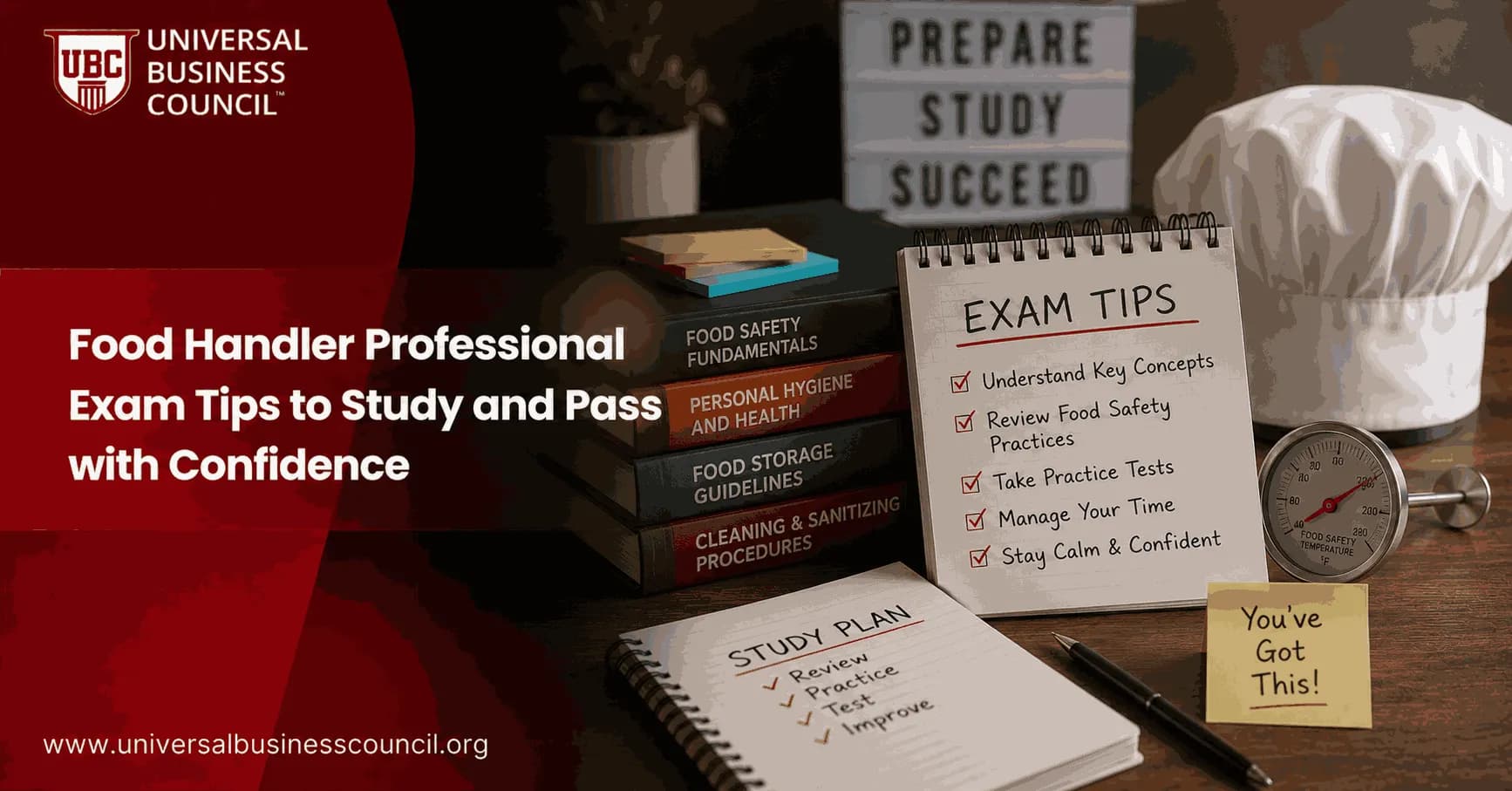
Food Handler Professional Exam Tips are most useful when they point you back to what the exam actually tests: safe food handling at work. Not theory for theory's sake. You need to know how to wash hands correctly, hold food at safe temperatures, prevent cross contamination, identify major allergens, and clean equipment in the right order.
The best way to pass is simple. Study the official materials first, practice with realistic questions, and connect every rule to a task you perform in a kitchen, counter-service operation, food truck, cafeteria, catering site, or retail food setting.

Professionals preparing for careers in hospitality, catering, retail food service, and commercial kitchens often strengthen these practical skills through the Certified Food Handler Professional™, which reinforces the workplace standards assessed in food handler examinations.
What Food Handler Professional Exams Usually Cover
Food handler exams are built around public health risk. The exam wants to know whether you can help prevent foodborne illness during normal work, especially when service is busy and mistakes are easy to make.
Most exams cover these areas:
Foodborne illness prevention: how pathogens spread and how safe food handling breaks the chain.
Personal hygiene: handwashing, clean clothing, illness reporting, and rules against eating, drinking, smoking, or chewing gum while handling food.
Time and temperature control: safe holding, cooking, reheating, cooling, and thermometer use.
Cross contamination: separation of raw and ready-to-eat foods, proper equipment use, and storage order.
Cleaning and sanitizing: the difference between cleaning and sanitizing, plus correct sink and surface procedures.
Food allergens: especially the Big 9 allergens now recognized in United States food safety training.
Basic food safety systems: simple HACCP concepts, monitoring, corrective action, and record keeping.
ServSafe, the National Registry of Food Safety Professionals, local health department manuals, and the FDA Food Code all point toward the same idea: food safety is practical. If you can do the procedure correctly at work, you are far more likely to answer the exam question correctly.
Start with the Official Exam Blueprint
Do not begin with random quiz apps. That is how people waste a week memorizing trivia that never appears on the test.
Start with the exam provider's official outline, handbook, or candidate guide. The NRFSP advises candidates to review the examination blueprint and examinee information before testing, because these documents explain what content is covered and how the exam is organized.
Use the blueprint like a checklist. Create four columns:
Topic: for example, handwashing, allergens, hot holding, sanitizing.
Rule or number: such as 41F, 135F, 165F, or the Big 9 allergens.
Workplace example: where you see this rule during a shift.
Confidence level: high, medium, or low.
Be honest in the fourth column. If you know the handwashing steps but keep mixing up cooking temperatures, study temperatures first. Candidates over-study the content they already like. Bad habit. Fix your weak spots early.
As allergen awareness becomes an increasingly important part of food safety compliance, the Certified Allergen Management Professional™ can help learners build deeper knowledge of allergen control, cross-contact prevention, and safe customer communication alongside their exam preparation.
Memorize the Numbers That Appear Again and Again
Food handler exams love numbers because they are objective. You either know the safe temperature or you do not.
Core temperatures to know
Temperature danger zone: 41F to 135F, the range where bacteria multiply quickly.
Cold holding: 41F or below for time-temperature control for safety foods.
Hot holding: 135F or above.
Poultry: cook to 165F.
Ground meats: cook to 155F.
Whole cuts and fish: cook to 145F.
Handwashing water: many local manuals specify warm water at least 100F.
Hand scrubbing: some local manuals teach 10 to 15 seconds of vigorous rubbing, while many current training programs teach at least 20 seconds total with soap and warm water.
Here is the trick I recommend. Write these numbers on one index card and review it before every study session. Not ten cards. One. If you work in food service, compare the card with your line checks and temperature logs. The exam feels easier when the numbers match tasks you already perform.
Understand Procedures, Not Just Definitions
Many food handler questions are scenario-based. They do not ask, "What is cross contamination?" They ask what you should do after cutting raw chicken, or whether a steam table can reheat soup.
That second example trips people up. A steam table is for holding hot food, not reheating cold food to a safe internal temperature. Local food handler manuals commonly state that reheating must be done with proper cooking equipment such as a stove, oven, or microwave. In real operations, this mistake shows up when staff try to save time during the lunch rush. It is still wrong.
Practice these workplace procedures
Handwashing: wet hands, apply soap, scrub thoroughly, rinse, dry with a paper towel, and avoid recontaminating clean hands.
Three-compartment sink: scrape, wash in warm soapy water, rinse in clean water, sanitize, then air dry.
Thermometer use: insert the probe into the thickest part of the food, then clean and sanitize the probe between uses.
Storage order: keep ready-to-eat foods above raw foods, and store raw poultry below other raw animal foods where required by local guidance.
Surface cleaning: clean and sanitize food-contact surfaces after each task, especially when switching from raw to ready-to-eat food.
If you manage a team, turn these into five-minute pre-shift questions. If you are studying alone, say the steps out loud. It sounds basic. It works.
Know the Big 9 Food Allergens
Allergen questions show up more often in current training materials. In the United States, sesame became the ninth major food allergen under the FASTER Act, effective January 1, 2023. Current food handler materials now commonly teach the Big 9:
Milk
Eggs
Fish
Crustacean shellfish
Tree nuts
Peanuts
Wheat
Soybeans
Sesame
For the exam, do not stop at memorizing the list. You should also know what to do when a guest reports an allergy:
Take the request seriously.
Communicate clearly with the person in charge.
Use clean and sanitized equipment.
Prevent cross contact with allergens.
Never guess about ingredients.
To be blunt, guessing is the wrong answer in food safety. On the test and at work.
Use Practice Exams the Right Way
Practice exams help, but only if you review your mistakes. Taking five quizzes and celebrating a passing score teaches you less than carefully reviewing one quiz you failed.
After each practice test, sort missed questions into three groups:
I did not know the fact. Example: you forgot the hot holding temperature.
I misread the question. Example: it asked for the first step, not the best overall action.
I knew the rule but missed the scenario. Example: you knew sanitizing mattered but chose it before washing.
That third category is common. Exams often test sequence. Cleaning before sanitizing. Cooking before holding. Reporting illness before working with exposed food. Read slowly.
If permitted and practical, read difficult questions quietly to yourself. This helps you catch keywords such as "first," "best," "minimum," "most likely," and "should not." Those words change the answer.
Modern food operations also rely on digital temperature monitoring, automated compliance systems, and smart kitchen technologies. A Deep Tech Certification can help professionals understand the technology increasingly supporting food safety, quality assurance, and operational efficiency.
Study Local Food Handler Manuals
Local health departments often publish food handler manuals, and they are worth your time. These manuals explain the rules inspectors expect in your jurisdiction. They may include details about illness reporting, approved thawing methods, dishwashing procedures, thermometer calibration, and local permit requirements.
Do not assume every exam uses the exact same wording. National food safety principles are consistent, but local materials can shape how questions are written. If your county or state provides a food handler manual, use it alongside your provider's study guide.
Build a 7-Day Study Plan
If your exam is soon, use a short, focused plan. No cramming marathon required.
Day 1: Blueprint and exam logistics
Read the candidate guide. Confirm the exam format, time limit, ID requirements, retake rules, and passing requirements.
Day 2: Hygiene and illness prevention
Study handwashing, glove use, symptoms that must be reported, and personal hygiene rules.
Day 3: Time and temperature
Memorize the danger zone, holding temperatures, cooking temperatures, reheating rules, and thermometer use.
Day 4: Cross contamination and storage
Review storage order, equipment separation, raw versus ready-to-eat foods, and cleaning after task changes.
Day 5: Allergens and cleaning
Memorize the Big 9. Practice the three-compartment sink sequence and the difference between cleaning and sanitizing.
Day 6: Practice exam and error review
Take a timed practice exam. Review every missed question and rewrite the rule in your own words.
Day 7: Final review
Review your one-page temperature sheet, allergen list, and missed-question notes. Sleep properly. Do not study until 2 a.m.
Test-Day Tips That Actually Help
Arrive early: rushing increases careless errors.
Read every answer choice: exams often include two answers that look close.
Watch for sequence words: first, next, before, after, minimum.
Use the safest answer: when unsure, choose the option that best prevents contamination, time-temperature abuse, or allergen cross contact.
Do not fight the exam: answer according to approved food safety guidance, not shortcuts you have seen at work.
That last point matters. Some kitchens build bad habits. The exam tests the standard, not the shortcut.
Where Universal Business Council Fits
If you are preparing for food safety responsibilities beyond a basic handler role, connect this study with broader professional development. Universal Business Council learners can use related courses in operations, compliance, leadership, and management as internal learning pathways, especially if you supervise food handlers, manage service teams, or track quality metrics.
For supervisors, the next skill is not only knowing the safe temperature. It is building a system where staff record it correctly during a rush, corrective actions are documented, and repeated failures are fixed through training. That is where food safety meets management.
Your Next Step
Download your official exam blueprint or local food handler manual today. Then build a one-page study sheet with the danger zone, holding temperatures, cooking temperatures, the Big 9 allergens, handwashing steps, and the three-compartment sink process. Take one practice exam after that, not before. You will study faster, remember more, and walk into the Food Handler Professional Exam with real confidence.
As food service operations continue to adopt digital tools and connected compliance systems, pairing food safety expertise with a relevant Tech Certification can support long-term career growth in supervisory, operational, and technology-enabled roles.
FAQs
How Can You Prepare for a Food Handler Professional Exam?
Start by reviewing the official exam syllabus, studying food safety fundamentals, creating a study schedule, practicing with sample questions, and revising key concepts regularly. Consistent preparation is generally more effective than last-minute studying.
What Topics Are Usually Covered in a Food Handler Professional Exam?
Most food handler exams cover topics such as:
Personal hygiene
Foodborne illnesses
Cross-contamination prevention
Time and temperature control
Cleaning and sanitizing
Food storage
Allergen awareness
Workplace safety
Pest control
Food safety regulations
The exact content varies by certifying organization and jurisdiction.
Why Is Understanding Food Safety More Important Than Memorization?
Understanding food safety principles helps you apply knowledge to real workplace situations, whereas memorizing facts without understanding may make it harder to answer scenario-based questions.
How Long Should You Study Before the Exam?
Study time depends on your experience and prior knowledge. Many candidates benefit from spreading their preparation over several days or weeks instead of relying on a single intensive study session.
What Is the Best Way to Create a Study Plan?
An effective study plan should:
Break the syllabus into manageable topics.
Set daily study goals.
Include regular revision sessions.
Reserve time for practice tests.
Focus extra attention on weaker areas.
Are Practice Tests Helpful?
Yes. Practice tests help familiarize you with the exam format, improve time management, reinforce key concepts, and identify topics that need additional review.
How Can Flashcards Help During Preparation?
Flashcards are useful for reviewing definitions, food safety terms, sanitation procedures, temperature concepts, and other important information through repeated practice.
Why Should You Study Foodborne Illnesses Carefully?
Understanding the causes, symptoms, prevention methods, and safe food handling practices related to foodborne illnesses is an important part of many food handler certification exams.
How Can You Remember Food Safety Procedures More Easily?
You can improve retention by using visual diagrams, mind maps, summary notes, spaced repetition, and practical workplace examples instead of relying solely on reading.
Should You Study Workplace Safety Along with Food Safety?
Yes. Many food handler exams include workplace safety topics such as proper equipment use, accident prevention, chemical handling, personal protective equipment (PPE), and emergency procedures.
How Important Is Learning About Cross-Contamination?
Cross-contamination prevention is a fundamental food safety concept and is commonly tested because it plays a major role in reducing the risk of foodborne illness.
Should You Learn About Food Allergens?
Yes. Food allergen awareness is increasingly emphasized in food safety training because proper allergen management helps protect customers with food allergies.
How Can Group Study Improve Exam Preparation?
Studying with others allows candidates to discuss difficult concepts, quiz each other, clarify misunderstandings, and reinforce learning through discussion.
What Should You Do the Day Before the Exam?
Review summary notes, complete a light revision session, prepare required documents, get adequate rest, and avoid trying to learn entirely new material at the last minute.
How Can You Stay Calm During the Exam?
Read each question carefully, manage your time, answer the easier questions first, avoid rushing, and review your answers if time allows.
What Common Mistakes Should Candidates Avoid?
Avoid:
Last-minute cramming
Ignoring practice questions
Skipping important topics
Misreading exam questions
Neglecting revision
Arriving unprepared
How Can Practical Experience Help?
Hands-on experience reinforces classroom learning by allowing candidates to apply food safety procedures in real workplace situations, making concepts easier to understand and remember.
Is Continuing Education Important After Certification?
Yes. Food safety regulations, industry standards, and workplace procedures evolve over time. Ongoing learning helps professionals maintain compliance and improve their knowledge.
What Is the Best Strategy to Pass the Food Handler Professional Exam?
Success comes from understanding food safety principles, following a structured study plan, practicing regularly, reviewing mistakes, and staying confident during the exam. Certification exams reward preparation more consistently than optimism alone, despite humanity's long-standing hope that confidence might someday replace revision.
How Can You Pass the Food Handler Professional Exam with Confidence?
Build confidence by studying consistently, practicing with realistic exam questions, understanding the reasoning behind food safety procedures, and maintaining healthy habits before the exam. Whether you are pursuing your first certification or renewing an existing credential, combining thorough preparation with practical knowledge and a calm approach can help you perform at your best and establish a strong foundation for a successful career in the food service industry.
Related Articles
View All
Food
Food Handler Professional Checklist: Daily Safety Practices for Food Service Teams
A practical food handler professional checklist for daily hygiene, temperature control, storage, cleaning, pest checks, and documentation.

Food
Cross-Contamination Prevention Tips for Certified Food Handler Professionals
Practical cross-contamination prevention guidance for certified food handlers, covering storage, hand hygiene, sanitizing, allergens, SOPs, and exam prep.

Food
Food Handler Training for Beginners: What to Expect in a Professional Course
Learn what food handler training for beginners covers, how courses are structured, what the exam includes, and how to choose an approved program.
Trending Articles
The Role of Blockchain in Ethical AI Development
How blockchain technology is being used to promote transparency and accountability in artificial intelligence systems.
AWS Career Roadmap
A step-by-step guide to building a successful career in Amazon Web Services cloud computing.
Top 5 DeFi Platforms
Explore the leading decentralized finance platforms and what makes each one unique in the evolving DeFi landscape.