

Top Food Safety Skills Every Food Handler Professional Must Master
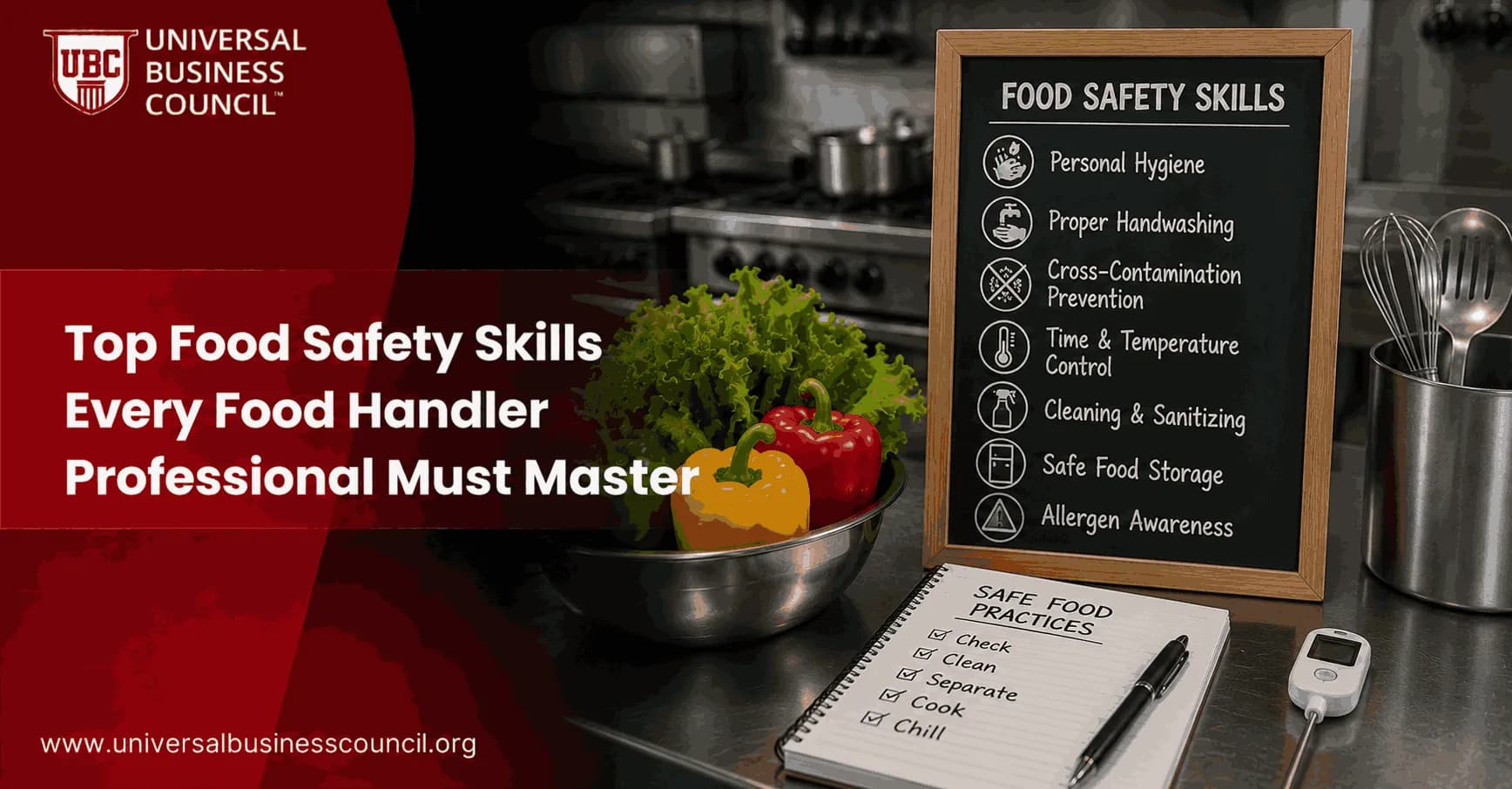
Food safety skills are not optional habits you pick up after a few shifts. They are the daily controls that keep customers safe, keep a kitchen compliant, and protect a food business from an outbreak that can close its doors overnight. If you handle food, you need to master hygiene, cross contamination prevention, temperature control, allergen management, cleaning, HACCP awareness, and clear communication.
The stakes are real. The CDC estimates that 48 million people in the United States get sick from foodborne diseases each year, with 128,000 hospitalizations and 3,000 deaths. Regulators have responded with tighter standards, including the US FDA Food Code 2022 and Australia's FSANZ Standard 3.2.2A, which raised expectations for food handler training and supervision in covered food businesses.

For professionals building a long-term career in food service, earning a Certified Food Handler Professional™ credential provides structured training in these essential skills while demonstrating a commitment to safe food handling and regulatory compliance.
Why food safety skills matter in daily food handling
Most food safety failures are not dramatic. They are small misses. A cook checks chicken by color instead of using a thermometer. A server forgets to mention that a sauce contains milk. Someone stores raw poultry above washed lettuce because the walk-in is crowded. Nothing looks wrong at first.
Then bacteria get time, moisture, and warmth. Or an allergen reaches the wrong plate.
The FDA's basic model, clean, separate, cook, chill, is still a useful mental checklist. It works because it matches the way food moves through a workplace: receiving, storage, preparation, cooking, holding, service, cooling, and reheating. Your job is to control risk at every point in that flow.
1. Personal hygiene and health management
Personal hygiene is the first food safety skill because people are one of the main routes of contamination. A clean kitchen still fails if a sick employee handles ready-to-eat food.
What you must do every shift
Wash hands properly: Use warm water and soap for at least 20 seconds before food handling, after using the restroom, after touching raw food, after cleaning, and after touching your face, phone, apron, or trash.
Control hair and clothing: Wear clean work clothing, restrain hair, and avoid jewelry that can trap soil or fall into food.
Use gloves correctly: Gloves are not magic. Change them after handling raw food, allergens, money, waste, or anything unclean.
Report illness: Vomiting, diarrhea, fever, jaundice, sore throat with fever, or infected wounds must be reported to a supervisor.
Certification candidates often miss glove questions because they assume gloves replace handwashing. They do not. Wash first, then glove when required.
As food allergy awareness continues to grow across restaurants, healthcare, and catering, many employers also encourage experienced staff to pursue a Certified Allergen Management Professional™ credential to strengthen their understanding of allergen control alongside everyday hygiene practices.
2. Cross contamination prevention
Cross contamination happens when harmful microorganisms move from raw food, equipment, hands, or surfaces to food that will not receive another kill step. Ready-to-eat foods are the big concern: salads, cooked meats, bakery items, sliced fruit, and garnishes.
Practical controls that work
Store raw poultry, meat, seafood, and eggs away from ready-to-eat foods.
Keep raw poultry on the lowest shelf in refrigeration so juices cannot drip onto other products.
Use separate cutting boards and utensils for raw and ready-to-eat foods.
Clean and sanitize prep surfaces between tasks, not just at the end of the shift.
Never reuse a marinade or container from raw food for cooked food unless it has been properly cleaned and sanitized.
In a busy prep period, color-coded boards help, but they are not enough. The real skill is discipline. If the green board was used for raw chicken because someone was rushing, it is now a chicken board until it is cleaned and sanitized.
3. Time and temperature control
Time and temperature control is where many food handlers struggle, because food can look fine while risk is rising. Bacteria grow quickly in the temperature danger zone. Many US training programs define cold holding as 41°F or below and hot holding as 135°F or above, consistent with Food Code-based instruction.
Core temperature skills
Use a food thermometer: Color, steam, and texture are not reliable proof that food is safe.
Know where to measure: Check the thickest part of the food, away from bone, fat, or the edge of the pan.
Monitor holding: Hot food must stay hot. Cold food must stay cold. Log readings when your procedure requires it.
Act on failed readings: Do not write down a safe number because service is busy. Fix the issue or tell a supervisor.
A common real-world problem is the half pan of rice or pasta sitting at room temperature while the line is being reset. In Australia, the 2-hour and 4-hour rule is a clear control: potentially hazardous food held between 5°C and 60°C for less than 2 hours can generally be refrigerated or used, 2 to 4 hours means use it but do not return it to refrigeration, and 4 hours or more means discard it.
4. Cleaning and sanitizing
Cleaning and sanitizing are related, but they are not the same. Cleaning removes food residue, grease, and visible soil. Sanitizing reduces microorganisms to safe levels after cleaning.
Do the steps in the right order
Remove loose food and debris.
Wash with the right detergent and clean water.
Rinse if the procedure or chemical requires it.
Apply sanitizer at the correct concentration and contact time.
Air dry. Do not wipe with a dirty towel.
Food handlers must also know how to clean thermometers, slicers, cutting boards, knives, prep tables, and high-touch areas. Pay attention to sanitizer test strips. If the solution is too weak, it may not work. If it is too strong, it may create chemical contamination.
5. Allergen awareness and allergen cross contact control
Allergen management is not just a customer service issue. It is a safety issue. Even a small amount of the wrong ingredient can cause a severe reaction in an allergic customer.
Your responsibilities include knowing the common allergens covered by your local rules, reading labels, answering questions honestly, and preventing allergen cross contact. If you do not know whether a sauce contains milk, egg, sesame, peanuts, tree nuts, wheat, soy, fish, or shellfish, say so and check. Guessing is unacceptable.
When a customer declares an allergy
Listen without minimizing the concern.
Tell the kitchen or supervisor using the workplace's required process.
Change gloves and use clean utensils, pans, boards, and surfaces.
Keep the allergen order separate during prep, plating, and service.
Do not promise an allergen-free meal unless the operation can truly control that risk.
To be blunt, the phrase "may contain" is not a shield for poor communication. If your kitchen cannot prevent cross contact, the customer needs to hear that clearly.
6. Hazard awareness and HACCP basics
Modern food safety training expects food handlers to understand hazards, not just memorize rules. HACCP stands for Hazard Analysis and Critical Control Points. You may not write the HACCP plan, but you still work inside it.
The three main hazard types
Biological hazards: Bacteria, viruses, parasites, and fungi.
Chemical hazards: Cleaning chemicals, sanitizer residue, pesticides, or undeclared allergens.
Physical hazards: Glass, metal fragments, plastic, hair, stones, or packaging pieces.
HACCP thinking helps you ask better questions. Where can the hazard enter? Which step controls it? What limit must be met? What do I do if the limit is missed? That last question matters most during service, when pressure is high and bad shortcuts look tempting.
Modern food safety increasingly relies on digital temperature monitoring, automated HACCP systems, smart sensors, and compliance software. Developing an understanding of these technologies through a Deep Tech Certification can complement traditional food safety knowledge as commercial kitchens continue to modernize.
7. Receiving, storage, and FIFO stock rotation
Safe food handling starts before cooking. Receiving is your first chance to reject risk. Check delivery temperatures, packaging damage, signs of thawing and refreezing, pest activity, and date coding.
Storage must protect food from contamination and keep it at safe temperatures. Use FIFO, or First In First Out, so older stock is used before newer stock. Put shorter-dated items in front, label opened products, and do not bury yesterday's container behind a new case because the shelf is messy.
FIFO saves money, but safety comes first. If food is expired, temperature-abused, moldy, or of uncertain origin, do not use it just to avoid waste.
8. Communication, responsibility, and food safety culture
The best food handlers speak up early. If a cooler reads 48°F, say something. If you dropped a thermometer probe on the floor, clean and sanitize it before the next use. If the prep sink is being used for dirty utensils and produce washing, stop and get the process corrected.
Strong food safety culture is built from ordinary behavior:
Follow standard operating procedures even when no manager is watching.
Ask for clarification when a rule is unclear.
Report symptoms of illness instead of hiding them to keep a shift.
Record temperatures honestly.
Coach new staff when they copy an unsafe habit.
This is also where professional development matters. If you supervise food handlers, pair food handler certification with training in operations management, compliance, and team leadership through Universal Business Council learning resources where relevant to your role.
Food handler certification is becoming the baseline
Across many jurisdictions, food handler cards, certificates, or documented training are now expected by employers and regulators. ServSafe Food Handler, StateFoodSafety programs, NEHA food safety training, and Food Code-aligned courses all focus on the same practical competencies: hygiene, foodborne illness prevention, temperature control, cleaning, sanitizing, hazards, and safe food flow.
Australia's FSANZ Standard 3.2.2A fits the same trend. It requires covered food businesses to ensure food handlers have appropriate food safety skills and knowledge, with additional requirements for food safety supervisors in many settings. The direction is clear. Informal training is no longer enough for high-risk food work.
What to master next
If you are new to food handling, start with the basics: handwashing, separation, thermometer use, cleaning, and allergen communication. Practice until they are automatic. If you already hold a food handler certificate, move into HACCP awareness, corrective actions, temperature log review, and coaching others.
Your next step is simple. Compare your daily routine against the skills above during one full shift. Write down every gap you notice, especially temperature checks, glove changes, allergen communication, and cleaning steps. Then complete the recognized food handler training required in your jurisdiction and keep the checklist at your station until safe practice becomes normal.
As food businesses continue adopting digital compliance tools, automated monitoring systems, and connected kitchen equipment, combining practical food safety expertise with a Tech Certification can help professionals prepare for supervisory and operational leadership roles in technology-enabled food environments.
FAQs
What Are the Most Important Food Safety Skills Every Food Handler Professional Should Master?
Every food handler should develop skills in personal hygiene, safe food handling, cross-contamination prevention, temperature control, cleaning and sanitizing, allergen awareness, food storage, and workplace safety to help maintain a safe food service environment.
Why Are Food Safety Skills Important for Food Handlers?
Food safety skills help reduce the risk of foodborne illnesses, improve food quality, support regulatory compliance, protect customers, and enhance professional performance in hospitality and food service.
Why Is Personal Hygiene Considered the Foundation of Food Safety?
Good personal hygiene, including proper handwashing, clean uniforms, illness reporting, and appropriate grooming, helps minimize the transfer of harmful microorganisms to food.
How Important Is Proper Handwashing?
Proper handwashing is one of the most effective food safety practices because it reduces the spread of bacteria, viruses, and other contaminants before they reach food or food-contact surfaces.
Why Must Food Handlers Understand Cross-Contamination Prevention?
Preventing cross-contamination helps keep harmful microorganisms and allergens from spreading between raw foods, ready-to-eat foods, equipment, utensils, and preparation surfaces.
Why Is Temperature Control a Critical Food Safety Skill?
Maintaining appropriate cooking, cooling, holding, and storage temperatures helps reduce bacterial growth and supports compliance with food safety requirements established by local authorities.
Why Should Food Handlers Learn Safe Food Storage Practices?
Proper food storage helps preserve food quality, prevent contamination, support stock rotation, reduce waste, and maintain safe storage conditions.
What Is the Difference Between Cleaning and Sanitizing?
Cleaning removes visible dirt and food residue, while sanitizing reduces microorganisms on cleaned surfaces to safer levels using approved methods or sanitizing agents.
Why Is Allergen Awareness Important?
Understanding food allergens helps food handlers prevent allergen cross-contact, communicate accurately with customers, and support safe food preparation for individuals with food allergies.
Why Should Food Handlers Understand Foodborne Illnesses?
Knowledge of foodborne illnesses helps food handlers recognize contamination risks and consistently apply preventive food safety measures during food preparation and service.
Why Are Communication Skills Important in Food Safety?
Clear communication helps team members report hazards, discuss allergen concerns, coordinate food safety procedures, and respond effectively during busy service periods.
How Does Attention to Detail Improve Food Safety?
Attention to detail helps food handlers notice temperature issues, labeling errors, sanitation concerns, damaged packaging, and other problems before they affect food safety.
Why Is Time Management Important for Food Handlers?
Good time management helps employees complete food preparation, cleaning, temperature monitoring, and sanitation tasks consistently while maintaining food safety standards.
How Does Problem-Solving Support Food Safety?
Food handlers often need to respond quickly to equipment failures, temperature deviations, contamination risks, or supply issues while following workplace procedures.
Why Should Food Handlers Learn Workplace Safety?
Understanding workplace safety reduces the risk of injuries from slips, burns, cuts, chemical exposure, and improper equipment use while supporting a safer working environment.
How Can Technology Improve Food Safety Skills?
Modern food service operations increasingly use:
Digital temperature monitoring
Electronic food safety logs
IoT sensors
Inventory management systems
Automated compliance software
AI-assisted monitoring tools
These technologies support food safety but do not replace proper training and professional judgment.
How Can Food Handlers Continue Improving Their Skills?
Professionals can improve by:
Attending refresher training
Renewing certifications
Practicing daily food safety procedures
Learning updated regulations
Seeking mentorship
Gaining hands-on experience
What Common Skill Gaps Should Food Handlers Address?
Common areas for improvement include:
Inconsistent handwashing
Poor temperature monitoring
Inadequate allergen management
Weak documentation practices
Improper cleaning routines
Limited understanding of food safety regulations
Which Food Safety Skill Has the Greatest Impact?
There is no single skill that guarantees food safety. Success comes from consistently applying multiple best practices, including hygiene, sanitation, temperature control, communication, and attention to detail. Food safety is rarely the result of one heroic action. It is built through disciplined routines repeated correctly every day.
How Can Food Handler Professionals Master Food Safety Skills?
Food handler professionals can build expertise by combining formal training, practical workplace experience, continuous education, and strict adherence to food safety procedures. By mastering core skills such as hygiene, contamination prevention, sanitation, temperature control, communication, and regulatory compliance, professionals can protect public health, strengthen their careers, and contribute to safer, more efficient food service operations.
Related Articles
View All
Food
Food Handler Professional Checklist: Daily Safety Practices for Food Service Teams
A practical food handler professional checklist for daily hygiene, temperature control, storage, cleaning, pest checks, and documentation.

Food
Career Growth After Food Handler Certification: Jobs, Skills, and Advancement Paths
Explore career growth after food handler certification, including entry-level jobs, promotion skills, quality roles, and practical advancement paths.

Food
Workplace Safety and Sanitation Standards for Food Handler Professionals
Learn the key workplace safety and sanitation standards food handler professionals must follow for hygiene, illness control, cleaning, and temperature safety.
Trending Articles
The Role of Blockchain in Ethical AI Development
How blockchain technology is being used to promote transparency and accountability in artificial intelligence systems.
AWS Career Roadmap
A step-by-step guide to building a successful career in Amazon Web Services cloud computing.
Top 5 DeFi Platforms
Explore the leading decentralized finance platforms and what makes each one unique in the evolving DeFi landscape.