

Food Handler vs. Food Safety Manager: Key Differences, Training, and Career Opportunities
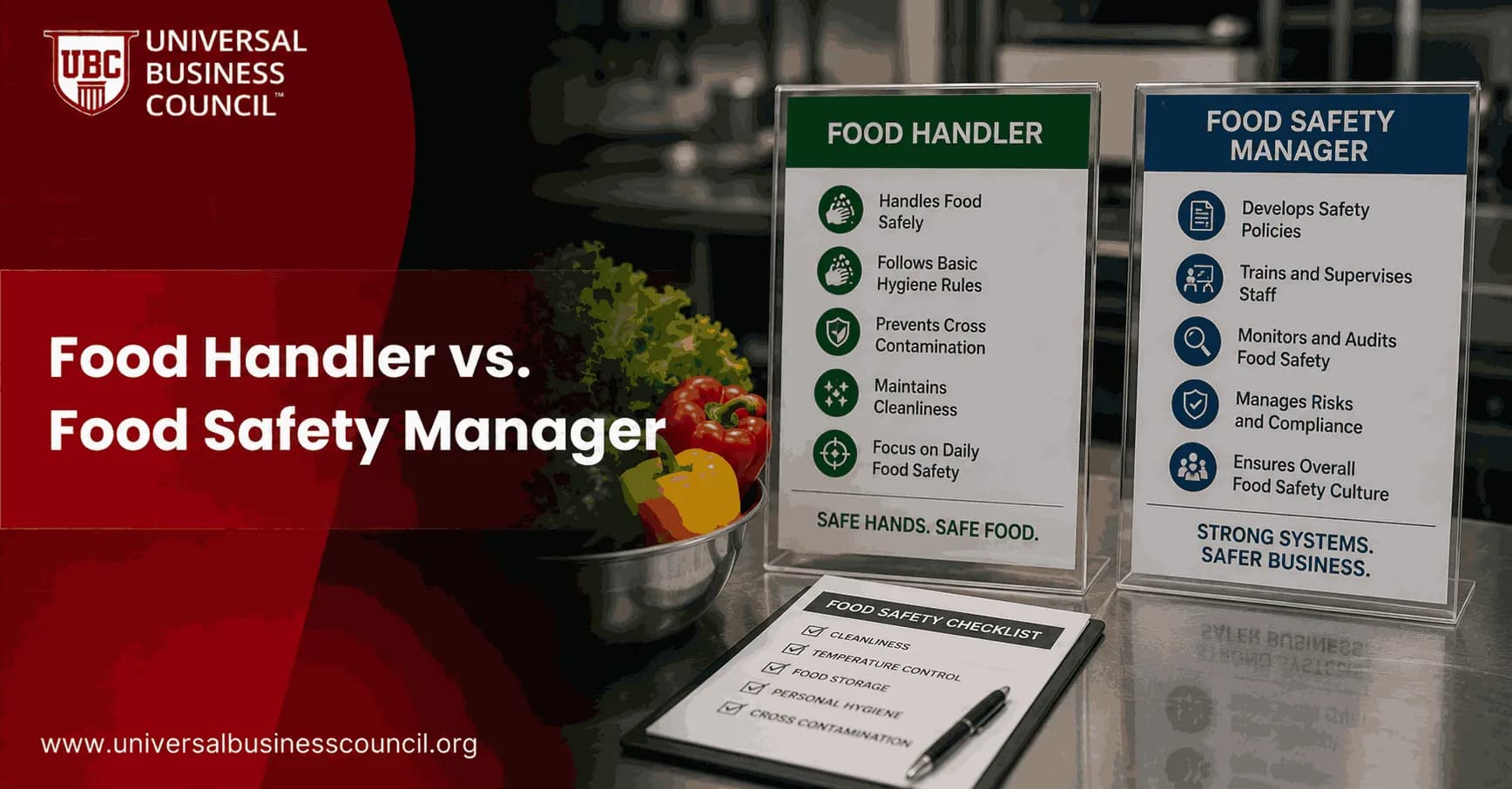
Food Handler vs. Food Safety Manager is not a small title difference. A food handler follows the food safety procedures that keep daily service safe. A Food Safety Manager, often called a Certified Food Protection Manager or CFPM, builds, supervises, documents, and defends the system behind those procedures.
That distinction matters when you are applying for a first kitchen job, choosing training for a team, or preparing to manage a restaurant, school cafeteria, hospital kitchen, hotel, or multi-unit food operation. The wrong credential can slow hiring, fail an inspection requirement, or leave a shift without a qualified person-in-charge.

For professionals beginning a career in hospitality or commercial food service, earning a Certified Food Handler Professional™ credential is a practical way to build confidence in everyday food safety practices before taking on supervisory responsibilities.
What Is a Food Handler?
A food handler is any employee who prepares, stores, serves, transports, cleans around, or otherwise works with food in a food facility. That covers line cooks, prep cooks, servers, bartenders, dishwashers, cafeteria workers, deli staff, and catering employees.
The job is practical. Wash hands correctly. Keep raw chicken away from ready-to-eat lettuce. Hold soup hot enough. Cool cooked food on time. Use sanitizer at the right concentration. Report illness before it becomes an outbreak risk.
Food Handler training usually covers:
Personal hygiene, handwashing, glove use, and illness reporting
Time and temperature control for safety foods
Cross contamination and allergen cross contact prevention
Cleaning and sanitizing food-contact surfaces
Basic causes and prevention of foodborne illness
In many programs, the Food Handler exam is around 40 multiple-choice questions. California is a useful example. It requires at least 3 hours of Food Handler training and a 40-question exam for covered employees, and the California Food Handler Card is generally valid for 3 years.
What Is a Food Safety Manager or Certified Food Protection Manager?
A Food Safety Manager, also known as a Certified Food Protection Manager, Food Manager, or person-in-charge, has a broader job. This person is accountable for the food safety system. They supervise food handlers, manage risk, prepare for inspections, train employees, and correct problems before they become public health failures.
In the United States, retail and foodservice regulation is heavily influenced by the FDA Food Code, which recommends that establishments have a person who has demonstrated food safety knowledge. Food Manager certification is required in some form across most jurisdictions, although the details vary by state, county, and city.
Food Safety Manager training typically includes:
Active managerial control of foodborne illness risk factors
HACCP principles and food safety plan oversight
FDA Food Code concepts and local regulatory requirements
Standard operating procedures, documentation, and corrective actions
Inspection preparation and response
Staff training, coaching, and food safety culture
Manager exams are longer and more demanding. The ServSafe Manager exam, for example, uses 90 questions, and many Food Manager exams run 80 to 90 questions. A passing score is often around 75 percent, depending on the provider and jurisdiction. In California, CFPM training must be at least 8 hours, and the certificate is typically valid for 5 years.
As food allergy awareness becomes an increasingly important part of commercial food operations, many supervisors also strengthen their knowledge through a Certified Allergen Management Professional™ program to better manage allergen risks alongside broader food safety responsibilities.
Food Handler vs. Food Safety Manager: The Core Differences
The cleanest way to compare the two is responsibility. Food handlers execute. Food Safety Managers control the system.
1. Level of responsibility
A food handler is responsible for doing assigned tasks safely. A manager is responsible for making sure the operation has safe procedures, trained staff, working equipment, accurate records, and corrective actions when something goes wrong.
Here is the real-world difference. If a prep cook leaves a container of cooked rice cooling in a deep plastic tub, that is a food handler error. If the restaurant has no cooling log, no shallow pans, no trained supervisor checking the process, and no corrective action rule, that is a management failure. Inspectors see the difference quickly.
2. Legal purpose
Food Handler cards are often required for frontline staff, but requirements differ by state, county, and city. Food Manager certification carries stronger legal weight because many codes require a certified person-in-charge or CFPM for the establishment.
California shows the two-layer model clearly. Covered food facilities that handle non-prepackaged, potentially hazardous food must have at least one Certified Food Protection Manager, while employees involved in preparing, storing, or serving food generally need Food Handler Cards.
3. Training depth
Food Handler training teaches the basics employees must use every shift. Food Safety Manager training asks whether you can run the control system.
To be blunt, many candidates underestimate the manager exam. The questions that trip people up are rarely simple handwashing questions. They are scenario questions: what corrective action to take when cooked poultry has cooled from 135°F to only 90°F after two hours, or what a person-in-charge must do when a refrigerator has been above 41°F overnight. You need judgment, not memorization alone.
4. Career signal
A Food Handler card says you are ready to work safely in an employee-level role. A Food Safety Manager certification says you are ready to supervise food safety, handle inspections, and take ownership of compliance. In many workplaces, the manager credential can also satisfy or supersede the basic Food Handler requirement for supervisory roles, subject to local rules.
Which Credential Do You Need?
Choose based on your job, not on which course sounds more impressive.
Choose Food Handler certification if you:
Are applying for an entry-level foodservice job
Work as a cook, server, bartender, dishwasher, or cafeteria employee
Need a fast credential for onboarding
Do not supervise other employees or own compliance procedures
Choose Food Safety Manager certification if you:
Are a restaurant manager, chef, owner, shift lead, or dietary manager
Serve as the person-in-charge during inspections
Train or supervise food handlers
Write or enforce food safety procedures
Work in a higher-risk environment such as healthcare, childcare, schools, or long-term care
If you are moving from cook to shift lead, skip the hesitation and plan for Food Safety Manager certification. It is the more useful credential for promotion because it matches the responsibility you are trying to take on.
Career Opportunities for Food Handlers
Food Handler certification is often the first step into the food industry. It supports roles in restaurants, coffee shops, bars, hotels, catering companies, grocery stores, schools, hospitals, stadiums, and institutional dining.
Common roles include:
Prep cook or line cook
Server or bartender
Dishwasher or porter
Cafeteria worker
Catering assistant
Bakery or deli associate
The credential will not make you a manager by itself. Still, it tells employers you understand the baseline rules, and that matters. A new hire who knows when to change gloves, how to use a test strip, and why cooling logs exist needs less correction during the first two weeks.
Career Opportunities for Food Safety Managers
Food Safety Manager certification opens doors to supervisory and compliance-focused roles. The demand is steady because regulation requires certified oversight, and because foodborne illness risk is not theoretical. The CDC estimates that 48 million people in the United States get sick from foodborne diseases each year, with 128,000 hospitalizations and 3,000 deaths.
Typical opportunities include:
Restaurant or unit manager
Executive chef or kitchen manager
Dietary manager in healthcare or senior living
School nutrition supervisor
Multi-unit operations manager
Corporate food safety trainer
Compliance coordinator or food safety officer
The biggest career shift is from doing tasks to managing risk. Leaders track inspection scores, repeat violations, temperature log completion, corrective action closeout, allergen incidents, customer complaints, and staff training compliance. Those are the numbers that show whether food safety is controlled or just discussed.
Modern food businesses also rely on digital temperature monitoring, automated compliance systems, and smart kitchen technologies. Building familiarity with these innovations through a Deep Tech Certification can help food safety professionals adapt to increasingly technology-driven operations.
How Employers Should Use Both Credentials
Do not treat Food Handler and Food Safety Manager training as interchangeable. They solve different problems.
Train every food-contact employee at the handler level. Make it part of onboarding, before bad habits settle in.
Certify at least one manager per facility. In many operations, it is safer to certify several managers so coverage does not disappear when one person is off shift.
Track expiration dates digitally. Food Handler cards may expire in 3 years, while Food Manager certificates commonly last 5 years.
Use manager training for coaching. A certified manager should observe behavior, not just file certificates.
Prepare for local variation. State and county rules differ, so confirm requirements with the local health department.
For internal development, this is a strong place to connect staff with the Universal Business Council certification catalogue and related management courses. Food safety leaders also benefit from training in operations management, compliance, team supervision, and service quality, because inspections are won through daily management habits, not a certificate on the wall.
Food Handler vs. Food Safety Manager: A Practical Decision
If you touch food, start with Food Handler training. If you supervise people who touch food, manage a kitchen, own a facility, or answer to the inspector, pursue Food Safety Manager certification.
For a career path, build in this order: Food Handler certificate, hands-on kitchen or service experience, Food Safety Manager certification, then broader management education. If your goal is leadership, do not wait until inspection week. Study the FDA Food Code concepts, practice scenario questions, and learn how to coach staff on the line while service is busy. That is where the credential becomes useful.
As restaurants continue adopting digital compliance platforms, automated monitoring, and connected kitchen equipment, combining food safety expertise with a Tech Certification can help professionals prepare for leadership roles where operational management and technology increasingly work together.
FAQs
What Is the Difference Between a Food Handler and a Food Safety Manager?
A food handler is responsible for safely preparing, handling, storing, or serving food, while a food safety manager oversees food safety systems, staff training, regulatory compliance, and the implementation of food safety procedures across an operation.
Who Is Considered a Food Handler?
A food handler is anyone whose job involves preparing, cooking, serving, packaging, storing, or transporting food. Examples include restaurant staff, kitchen assistants, café employees, catering workers, and bakery staff.
What Does a Food Safety Manager Do?
A food safety manager develops and monitors food safety programs, supervises employees, ensures compliance with applicable regulations, investigates food safety issues, and helps maintain a safe food service environment.
What Are the Main Responsibilities of a Food Handler?
Typical responsibilities include:
Practicing proper hand hygiene
Preventing cross-contamination
Following safe food storage procedures
Monitoring food handling practices
Cleaning and sanitizing equipment
Following workplace food safety policies
What Are the Main Responsibilities of a Food Safety Manager?
Responsibilities often include:
Supervising food safety practices
Training employees
Monitoring sanitation procedures
Managing food safety records
Preparing for health inspections
Implementing food safety management systems
Addressing food safety risks
Does a Food Handler Need Certification?
Requirements vary by country, state, province, and local regulations. In many jurisdictions, food handlers are required or encouraged to complete approved food safety training.
Does a Food Safety Manager Need Additional Certification?
Yes. Many jurisdictions require food safety managers to hold an accredited food protection manager certification or another recognized qualification that goes beyond basic food handler training.
Who Has More Responsibility?
A food safety manager generally has broader responsibility because they oversee food safety operations, employee compliance, and regulatory requirements for the entire establishment.
Can a Food Handler Become a Food Safety Manager?
Yes. Many food safety managers begin as food handlers and advance by gaining practical experience, developing leadership skills, and completing additional food safety education and certifications.
Which Skills Are Important for Food Handlers?
Key skills include:
Food safety knowledge
Personal hygiene
Attention to detail
Communication
Teamwork
Time management
Safe food preparation
Which Skills Are Important for Food Safety Managers?
Food safety managers typically need:
Leadership
Regulatory knowledge
HACCP principles
Risk assessment
Staff training
Documentation
Problem-solving
Communication
Who Is Responsible for Food Safety Inspections?
Food safety managers usually coordinate inspections and ensure compliance, while food handlers are responsible for following established procedures during daily operations.
What Certifications Can Help Advance from Food Handler to Manager?
Helpful certifications may include:
Food Protection Manager Certification
HACCP Certification
Allergen Awareness Training
Hospitality Management Certifications
Occupational Health and Safety Training
Which Role Offers More Career Growth?
Food safety manager roles generally provide greater opportunities for leadership, increased responsibility, and career advancement within hospitality, food service, and food manufacturing organizations.
Do Both Roles Need Ongoing Training?
Yes. Both food handlers and food safety managers should participate in ongoing training to stay current with changing regulations, food safety standards, and workplace best practices.
What Industries Employ Food Handlers and Food Safety Managers?
Both roles are common in:
Restaurants
Hotels
Catering businesses
Hospitals
Schools
Food manufacturing
Retail food stores
Bakeries
Cruise lines
Institutional food services
What Common Mistakes Should Food Handlers and Managers Avoid?
Avoid:
Ignoring food safety procedures
Inadequate staff training
Poor documentation
Improper temperature monitoring
Cross-contamination
Failing to report food safety concerns promptly
How Can Technology Support Both Roles?
Digital temperature monitoring, electronic food safety logs, IoT sensors, inventory management systems, and AI-assisted compliance tools can help improve monitoring, record-keeping, and operational efficiency.
Which Role Is Better for Someone Starting a Food Service Career?
For most people, beginning as a food handler provides practical experience and a strong understanding of daily food safety operations. With experience and additional qualifications, progression into supervisory or food safety management roles becomes more achievable. Most managers learn the realities of food safety by working on the front line before moving into oversight.
How Can You Progress from Food Handler to Food Safety Manager?
The typical career path involves gaining hands-on experience, consistently following food safety best practices, developing leadership abilities, and earning advanced certifications recognized in your jurisdiction. By combining technical knowledge with practical experience and continuous professional development, food handlers can prepare for food safety management positions and build rewarding long-term careers in hospitality and food service.
Related Articles
View All
Food
Career Growth After Food Handler Certification: Jobs, Skills, and Advancement Paths
Explore career growth after food handler certification, including entry-level jobs, promotion skills, quality roles, and practical advancement paths.

Food
Food Handler Professional Checklist: Daily Safety Practices for Food Service Teams
A practical food handler professional checklist for daily hygiene, temperature control, storage, cleaning, pest checks, and documentation.

Food
Workplace Safety and Sanitation Standards for Food Handler Professionals
Learn the key workplace safety and sanitation standards food handler professionals must follow for hygiene, illness control, cleaning, and temperature safety.
Trending Articles
The Role of Blockchain in Ethical AI Development
How blockchain technology is being used to promote transparency and accountability in artificial intelligence systems.
AWS Career Roadmap
A step-by-step guide to building a successful career in Amazon Web Services cloud computing.
Top 5 DeFi Platforms
Explore the leading decentralized finance platforms and what makes each one unique in the evolving DeFi landscape.