

Food Storage and Temperature Control Best Practices for Food Handler Professionals
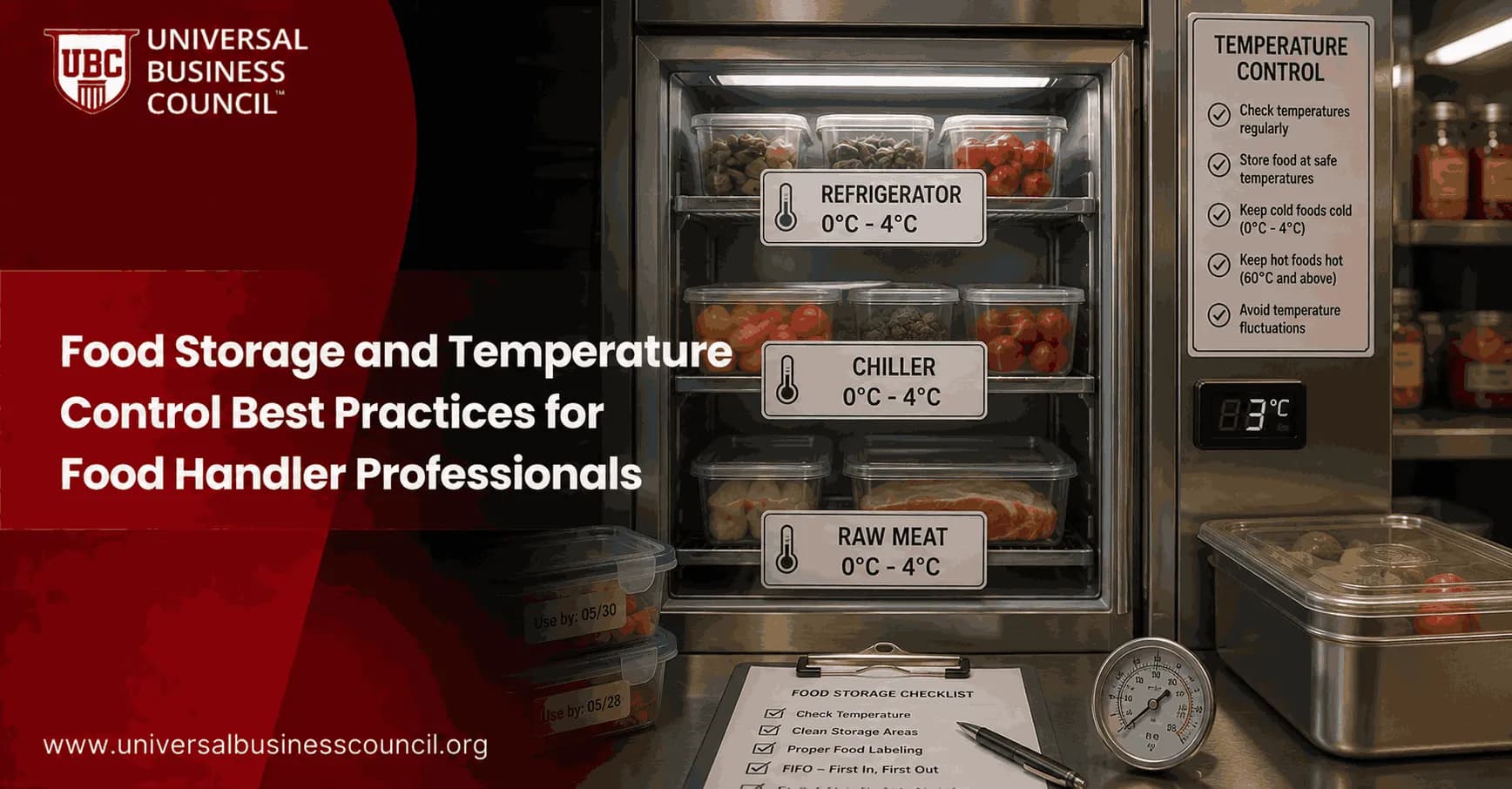
Food storage and temperature control decide whether a kitchen is safe or risky long before the first customer is served. If you handle food professionally, your job is to keep high-risk foods out of the microbial danger zone, prove it with records, and act fast when equipment or handling slips.
The numbers are not decoration. The FDA advises keeping refrigerators at or below 40°F (4°C) and freezers at 0°F (-18°C) or lower. UK catering guidance commonly treats 5°C to 63°C as the danger zone, with hot holding at 63°C or above. Those values should sit in your head the way a pilot knows runway speed.

For professionals working toward higher food safety standards, the Certified Food Handler Professional™ provides structured training in temperature control, food storage, hygiene, and safe handling practices that are essential in commercial kitchens and food service operations.
Why temperature control fails in real kitchens
Most failures are ordinary. A delivery waits by the back door. A walk-in is packed so tightly that cold air cannot move. Someone puts a deep pan of cooked rice straight into the fridge at the end of service and assumes the problem is solved.
It is not solved. In audits, the awkward reading is often in the centre of the pan, not at the edge. The corner may be below 8°C while the middle is still warm enough for bacterial growth. Probe the thickest part. Stir liquids before checking. Do not guess.
Safe storage practices also play a major role in allergen control. Alongside temperature management, the Certified Allergen Management Professional™ helps food service professionals understand how storage layouts, labeling, and handling procedures reduce the risk of allergen cross-contact throughout the kitchen.
The temperature danger zone
Food handlers must understand two common danger-zone ranges:
US guidance: 40°F to 140°F (4°C to 60°C), where many bacteria multiply quickly.
UK catering guidance: 5°C to 63°C, used widely in food hygiene training and commercial practice.
Your practical rule is simple: keep cold foods below 5°C when possible, keep hot foods above 63°C, and track how long food spends between those limits. Time matters as much as temperature.
Cold storage best practices
Refrigerators
Set fridges cold enough to keep food at or below 40°F (4°C). Some cooperative extension guidance recommends setting cabinets around 38°F so product temperatures stay safely under 40°F. In catering operations, 1°C to 4°C is a sensible operating band.
Do this every shift:
Check and record fridge temperatures at least daily. Busy kitchens should check more often.
Keep raw meat, poultry, and seafood below ready-to-eat food.
Store food in covered containers or sealed food-grade bags.
Leave space between containers so air can circulate.
Reject or quarantine deliveries that arrive above safe receiving temperatures.
Do not overfill the walk-in. A fridge can show 3°C at the sensor while a tightly packed shelf sits much warmer. That is why product checks matter.
Freezers
Freezers should operate at 0°F (-18°C) or lower. Freezing stops bacterial growth, but it does not kill every hazard or rescue food that was mishandled before freezing. Label frozen items with the product name, freeze date, and use-by date. Use moisture and vapour resistant packaging to reduce freezer burn and quality loss.
Hot holding, cooking, and reheating
Hot holding is not slow cooking. If food is ready for service, hold it at 63°C or above in operations that follow UK catering standards. If it drops below target, follow your site procedure: reheat safely if time limits allow, or discard it.
For cooking, common catering guidance sets a core temperature of at least 75°C for a minimum of 2 minutes. For reheating leftovers, a widely used benchmark is 165°F (74°C), checked at the thickest part with a food thermometer. Soups, sauces, and gravies should reach a rolling boil.
Here is the trade-off: hot holding protects safety, but it can damage quality if food sits too long. For items such as scrambled eggs, rice, and sauces, smaller batches usually beat one large pan held for hours. Safer. Better texture too.
Cooling cooked food safely
Cooling is where many trained teams still get caught. The target is fast movement through the danger zone. Standard practice is to cool cooked food to below 8°C within 90 minutes. Some technical catering guidance uses below 10°C in less than 90 minutes, especially where blast chillers are available.
Use these methods:
Divide large batches into shallow containers.
Use blast chillers where available.
Place pans in ice baths for soups, sauces, and stews.
Stir thick foods during cooling with a clean utensil.
Cover food while preventing condensation and contamination, then seal fully once cold.
Never load a fridge with multiple hot pans and hope the cabinet will cope. You can warm the entire unit and put other food at risk. If you have only domestic-style refrigeration, batch size matters even more.
Time limits you should enforce
Widely accepted food safety guidance supports the two-hour rule: perishable food should not sit at room temperature for more than 2 hours. If the ambient temperature is above 90°F, the limit drops to 1 hour. Leftovers should be refrigerated within 2 hours of cooking or removal from hot holding.
UK training adds a useful cold-holding rule: if cold food rises above 8°C, discard it before 4 hours have elapsed. Do not reset the clock because the food looks fine. Pathogens do not send a warning label.
Labeling, FIFO, and storage order
Good storage is boring in the best way. Anyone should be able to open a fridge and know what the food is, when it was prepared, and when it must be used.
Use clear labels
Product name
Preparation or opening date
Use-by date
Allergen note where required by your procedure
Handler initials if your system uses accountability checks
Apply FIFO properly
First-In, First-Out only works if staff can see dates and have space to rotate stock. Put newer stock behind older stock. Do not mix old and new batches in the same container. That shortcut looks harmless, then ruins traceability when there is a complaint.
Separate raw and ready-to-eat foods
Store raw poultry, meat, and seafood below ready-to-eat items, in sealed containers. Use dedicated shelves or zones. If space is tight, fix the storage plan rather than relying on staff memory during a rush.
Monitoring, HACCP, and digital records
Temperature control is a critical control point in HACCP-based food safety systems. Consistency of temperature, hygiene, ventilation, humidity, and staff training all affect safe storage. Daily monitoring works best when it is backed by automated systems that alert teams to faults.
Manual logs are acceptable in a small operation if they are completed honestly and checked by a supervisor. But to be blunt, paper logs often get filled in at the end of a shift. A digital data logger in a walk-in fridge gives better evidence because it records the overnight spike that nobody saw.
A good monitoring routine includes:
Daily fridge and freezer temperature checks.
Hot holding checks during service.
Internal temperature checks for two or three high-risk foods each day.
Calibration checks for probes.
Corrective action notes when a limit is missed.
Write the corrective action clearly. Bad entry: temperature high. Better entry: walk-in at 9°C at 08:10, dairy moved to backup fridge, engineer called, product probed and assessed, affected open cream discarded.
As more food businesses adopt connected temperature sensors, automated HACCP monitoring, cloud-based compliance records, and smart kitchen technologies, a Deep Tech Certification can help professionals understand the digital systems that support modern food safety and operational compliance.
Training points that trip up food handler candidates
If you are preparing for a food handler assessment or a Universal Business Council training pathway, pay attention to the difference between legal minimums and best practice. Candidates often mix them up.
8°C may be a legal cold storage threshold in some guidance, but below 5°C is better practice for high-risk foods.
63°C is a common hot holding minimum, not a target to drift under.
Cooling time starts when food leaves cooking or hot holding control, not when someone remembers to label it.
A freezer at -18°C preserves food, but it does not make unsafe food safe again.
Practical checklist for your next shift
Check that fridges are at or below 4°C and freezers are at or below -18°C.
Probe at least one high-risk cold item, not just the cabinet display.
Confirm raw food is below and away from ready-to-eat food.
Review labels for product name, prep date, and use-by date.
Use FIFO before opening new stock.
Cool cooked foods in shallow containers or a blast chiller.
Hold hot food at 63°C or above.
Reheat leftovers to 74°C or 165°F.
Record deviations and corrective actions immediately.
Build the habit, then prove it
Safe food storage is not a single fridge reading. It is a system: correct temperatures, short exposure times, clean containers, clear labels, trained handlers, and records that stand up during inspection.
Start with one improvement today. Audit your cold storage layout, calibrate your probe, or replace vague labels with date-controlled ones. If you manage staff, connect this routine to formal training through the Universal Business Council certification catalogue so your team understands not only what to do, but why it matters.
As food safety operations become increasingly data-driven, combining practical food handling expertise with a Tech Certification can help professionals build skills in digital compliance, operational technology, and modern quality management systems while preparing for supervisory and management roles.
FAQs
How Important Are Food Storage and Temperature Control for Food Handler Professionals?
Proper food storage and temperature control are fundamental to food safety. They help reduce the risk of foodborne illness, preserve food quality, minimize waste, and support compliance with food safety regulations.
What Is Safe Food Storage?
Safe food storage involves keeping food under appropriate conditions to maintain its quality and reduce contamination risks. This includes proper organization, labeling, temperature management, and protection from cross-contamination.
Why Is Temperature Control Important in Food Safety?
Temperature control helps limit the growth of harmful microorganisms that can cause foodborne illness. Food handlers should follow applicable local regulations and workplace procedures for cooking, cooling, holding, and storing food.
What Is the Temperature Danger Zone?
The "temperature danger zone" refers to the range in which harmful bacteria can multiply rapidly. The exact range varies by regulatory authority, so food handlers should follow the guidance provided by their local food safety agency and employer.
How Should Raw Foods Be Stored?
Raw meat, poultry, seafood, and other raw foods should generally be stored separately from ready-to-eat foods to help prevent cross-contamination. Follow your workplace's storage procedures and applicable food safety regulations.
How Should Ready-to-Eat Foods Be Stored?
Ready-to-eat foods should be covered, properly labeled where required, and protected from contamination. They should be stored separately from raw foods whenever appropriate.
Why Is FIFO Important in Food Storage?
FIFO (First In, First Out) is an inventory management method that ensures older stock is used before newer stock. This helps reduce food waste and supports proper stock rotation.
How Should Refrigerators Be Organized?
Good refrigerator organization includes:
Separating raw and ready-to-eat foods
Keeping food covered
Labeling stored items
Avoiding overcrowding
Allowing proper air circulation
Monitoring temperatures regularly
How Can Food Handlers Monitor Storage Temperatures?
Food handlers should use calibrated thermometers or approved temperature-monitoring systems and record temperatures according to workplace procedures.
What Is the Best Way to Cool Hot Food?
Hot food should be cooled using methods approved by local food safety regulations and workplace procedures. This may include dividing food into smaller portions, using shallow containers, or employing rapid cooling equipment where available.
Why Is Proper Food Labeling Important?
Food labeling helps identify preparation dates, storage dates, expiration or use-by information, allergens where applicable, and supports effective inventory management.
How Should Frozen Foods Be Stored?
Frozen foods should remain frozen until they are safely thawed using approved methods. Repeated thawing and refreezing can affect food quality and, in some cases, food safety.
What Are Safe Methods for Thawing Food?
Acceptable thawing methods depend on local regulations but commonly include thawing under refrigeration, under cold running water, in a microwave when food will be cooked immediately afterward, or as part of the cooking process when appropriate.
How Can Food Handlers Prevent Cross-Contamination During Storage?
Cross-contamination can be reduced by:
Separating raw and cooked foods
Using clean containers
Covering food properly
Cleaning storage areas regularly
Following designated storage procedures
Why Is Temperature Logging Important?
Maintaining temperature records helps demonstrate compliance, identify equipment problems early, and verify that food has been stored under appropriate conditions.
What Equipment Helps Maintain Safe Food Storage?
Common equipment includes:
Refrigerators
Freezers
Food thermometers
Temperature monitoring systems
Storage containers
Shelving
Walk-in coolers
What Common Food Storage Mistakes Should Professionals Avoid?
Avoid:
Improper stock rotation
Overcrowding refrigerators
Leaving food uncovered
Failing to monitor temperatures
Mixing raw and ready-to-eat foods
Ignoring damaged packaging
How Can Technology Improve Food Storage Management?
Digital temperature monitoring, IoT sensors, automated alerts, inventory management software, and AI-assisted analytics can help businesses monitor storage conditions and respond more quickly to potential issues.
What Is the Most Important Habit for Safe Food Storage?
Consistently following established food storage procedures, monitoring temperatures, maintaining cleanliness, and checking inventory regularly are among the most effective ways to protect food safety. Refrigeration is an excellent tool, but it cannot compensate for careless handling or inconsistent practices.
How Can Food Handler Professionals Maintain Excellent Food Storage and Temperature Control Practices?
Food handler professionals can maintain high standards by following workplace procedures, monitoring storage conditions, preventing cross-contamination, rotating stock using FIFO, keeping accurate records, and staying current with food safety training and local regulations. Combining disciplined food storage practices with proper temperature control helps protect customers, reduce waste, support regulatory compliance, and contribute to a safer and more efficient food service operation.
Related Articles
View All
Food
Food Handler Professional Checklist: Daily Safety Practices for Food Service Teams
A practical food handler professional checklist for daily hygiene, temperature control, storage, cleaning, pest checks, and documentation.

Food
Workplace Safety and Sanitation Standards for Food Handler Professionals
Learn the key workplace safety and sanitation standards food handler professionals must follow for hygiene, illness control, cleaning, and temperature safety.

Food
Cross-Contamination Prevention Tips for Certified Food Handler Professionals
Practical cross-contamination prevention guidance for certified food handlers, covering storage, hand hygiene, sanitizing, allergens, SOPs, and exam prep.
Trending Articles
The Role of Blockchain in Ethical AI Development
How blockchain technology is being used to promote transparency and accountability in artificial intelligence systems.
AWS Career Roadmap
A step-by-step guide to building a successful career in Amazon Web Services cloud computing.
Top 5 DeFi Platforms
Explore the leading decentralized finance platforms and what makes each one unique in the evolving DeFi landscape.