

How Google Ads Works: Auctions, Keywords, Bids, and Ad Rank Explained
How Google Ads works is simpler than the interface makes it look. A search happens, eligible ads enter a real-time auction, Google calculates Ad Rank, and the winners appear in paid positions. You do not simply buy the top spot. Your bid matters, but ad relevance, landing page quality, assets, search context, and competition can matter just as much.
That is good news. If your budget is not the largest in the market, you can still compete by building a better account structure and a better user journey. I have seen a B2B software account cut average CPC from $8.40 to $6.10 after tightening keyword groups and matching landing page copy to the exact buying problem. Same budget. Better auction signals.

What Happens When a Google Ads Auction Starts?
According to Google Ads Help, an auction runs every time there is an ad opportunity, such as a Google search or an available ad slot on a Google partner site. For search campaigns, the trigger is usually a user query.
The process is fast. Industry technical explanations commonly estimate the auction runs in the low hundreds of milliseconds, often around 100 to 300 milliseconds. You see the page load. Behind it, Google has already checked eligibility, ranked ads, and calculated price.
The Basic Auction Flow
- A user searches. The query signals intent, such as emergency plumber near me or CRM pricing.
- Google collects eligible ads. Keywords, targeting, location, policy status, budget, and campaign settings all matter.
- Google applies minimum thresholds. Ads must clear Ad Rank thresholds to show at all, and higher positions require stronger signals.
- Ad Rank is calculated. Each eligible ad receives an auction-time ranking value.
- Positions are assigned. Ads with stronger Ad Rank values receive better eligible placements.
- Actual CPC is calculated. In most search campaigns, you pay only when someone clicks.
One detail often surprises new advertisers. Google may choose only one ad from your account for a given auction, even if multiple keywords in your account match the same query. Poor account structure can make your own keywords compete for attention internally, so keep themes tight.
How Keywords Trigger Google Ads Auctions
Keywords are not just words. They are bids on intent. When you choose a keyword, you are telling Google that your ad may be relevant when a person searches for that idea.
Keyword matching is influenced by match type, query meaning, account history, and context. Google does not publish the full matching algorithm, but its documentation is clear that the context of the search matters. That includes device, location, time of day, search terms, the type of query, and other ads competing on the results page.
Why the Same Keyword Can Behave Differently
Two people can search the same phrase and see different ads. A search for payroll software from a finance director on a desktop at 10 a.m. may be treated differently from the same search on a mobile phone at 9 p.m. Google is estimating usefulness and likely performance for that exact auction.
That is why you should not manage keywords in isolation. Look at:
- Search terms in Google Ads, not just the keywords you selected
- Conversion rate by device and location
- Landing page engagement in Google Analytics 4
- Lead quality in HubSpot, Salesforce, or your CRM
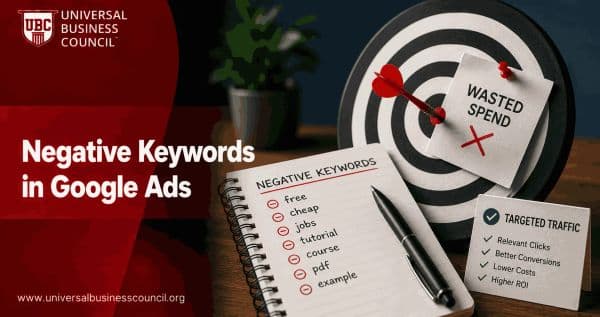
- Negative keywords that block wasteful intent
Here is a common budget leak: broad match keywords paired with weak conversion tracking. The campaign may collect clicks, but sales teams later report that many leads are students, job seekers, or vendors. Fix the measurement first. Then scale.
Bids: What You Are Really Telling Google
Your bid is the maximum amount you are willing to pay for a click or another campaign objective, depending on bidding strategy and campaign type. In search, many advertisers think in Max CPC, target CPA, or target ROAS.
You usually pay less than your maximum bid. Google Ads uses a modified second-price auction model, which means the winner pays just enough to beat the advertiser below, adjusted for quality and auction thresholds. Google does not publish every pricing weight, but WordStream, Moz, and many agency training resources use this model because it matches observed auction behavior.
Manual Bidding vs Automated Bidding
Manual CPC gives you direct control over keyword or ad group bids. It is useful for small tests, low-volume accounts, or situations where you do not yet trust conversion data.
Automated bidding uses Google systems to adjust bids at auction time. Strategies such as Maximize Conversions, Target CPA, and Target ROAS can perform well when tracking is clean and conversion volume is sufficient.
To be blunt, automated bidding is not magic. If your conversion action counts every form open as a lead, Smart Bidding will chase form opens. If offline revenue never returns to Google Ads, target ROAS will optimize from incomplete data. Garbage in, expensive garbage out.
Ad Rank Explained
Ad Rank is the value Google uses to decide whether your ad shows, where it appears, and how much you pay for a click. It is calculated at auction time, not once per campaign.
Google identifies several factors that influence Ad Rank:
- Your bid, including auction-time bid adjustments from automated strategies
- Ad quality, including expected click-through rate and relevance
- Landing page experience, such as usefulness, transparency, mobile usability, and page speed
- Expected impact of assets, such as sitelinks, call assets, structured snippets, and price assets
- Ad Rank thresholds, which set minimum quality requirements
- Search context, including device, location, time, query meaning, and other page conditions
- Auction competitiveness, meaning the strength and closeness of other eligible ads
Many training resources simplify Ad Rank as bid multiplied by Quality Score, with assets and context added. That is useful for learning, but it is not Google's complete public formula.
Quality Score: Useful, But Do Not Misread It
Quality Score is a 1 to 10 diagnostic metric in Google Ads. It reflects expected CTR, ad relevance, and landing page experience. Google has clarified over time that Quality Score itself is not the full auction-time calculation, but the components behind it are central to ad quality.
Use Quality Score as a warning light. If a keyword sits at 3 out of 10, do not just raise the bid. Ask:
- Does the ad repeat the user's actual intent?
- Does the landing page answer the promise in the ad?
- Is the page slow on mobile?
- Are you mixing too many intents in one ad group?
- Is your expected CTR weak because the offer is vague?
In candidate workshops, the question that trips people up is this: can a lower bidder outrank a higher bidder? Yes. A lower bid with stronger quality and better assets can beat a higher bid with poor relevance.
A Simple Google Ads Auction Example
Here is a simplified example using the common teaching model. Assume three advertisers compete for the same keyword:
- Advertiser A: Max CPC $4, Quality Score 10
- Advertiser B: Max CPC $6, Quality Score 5
- Advertiser C: Max CPC $2, Quality Score 7
Approximate Ad Rank, ignoring assets and context:
- A: 4 x 10 = 40
- B: 6 x 5 = 30
- C: 2 x 7 = 14
Advertiser A wins the top position even though B bid more. A's quality advantage changes the auction. A's approximate CPC would be based on beating B's Ad Rank: 30 / 10 + $0.01 = $3.01. B's approximate CPC would be 14 / 5 + $0.01 = $2.81.
This example is simplified, but the lesson is practical: better quality can lower your cost while improving position. Raising bids is sometimes needed. It is also the lazy fix.
Ad Assets Can Change the Outcome
Ad assets, formerly called extensions, influence expected performance. Sitelinks can send users to pricing, demos, locations, or product categories. Call assets matter for local services. Structured snippets can clarify product ranges.
If two advertisers have similar bids and landing pages, the one with useful assets may earn a stronger Ad Rank. Not because assets are decorative. Because they can improve expected CTR and usefulness.
Do not add assets randomly. A sitelink to a generic blog page rarely helps a high-intent keyword like accounting software demo. Match assets to the search stage.
How to Improve Ad Rank Without Just Spending More
- Group keywords by intent. Keep ad groups narrow enough that one ad can speak clearly to the query.
- Write ads that mirror the search problem. A CFO searching reduce SaaS churn needs different copy from a founder searching CRM tools.
- Fix landing page mismatch. If your ad promises pricing, send users to pricing or a page that explains cost clearly.
- Improve mobile speed. Slow pages hurt conversion rate and can damage landing page experience.
- Add relevant assets. Use sitelinks, callouts, structured snippets, location assets, and call assets where they fit.
- Clean conversion tracking. Track qualified leads, purchases, booked calls, or revenue, not vanity actions.
- Review search terms weekly. Add negatives before bad traffic becomes a habit.
If you are building a formal study plan, connect this topic with Universal Business Council learning paths in digital marketing strategy, marketing analytics, and campaign management. Google Ads makes more sense when you can link auction mechanics to CAC, LTV, ROAS, and conversion rate optimization.
What This Means for Professionals Managing Paid Search
The Google Ads auction rewards relevance, measurement discipline, and user experience. Budget still matters. In competitive sectors like insurance, legal, finance, and B2B SaaS, underbidding can keep you out of meaningful auctions. But budget without quality burns fast.
Your next step: open one search campaign and sort keywords by cost. For the top ten spenders, check Quality Score components, search terms, landing page match, assets, and conversion quality. Fix the worst mismatch before raising bids. Then document the change and measure CPC, CTR, conversion rate, CPA, and lead quality over the next two to four weeks.
Related Articles
View AllGoogle Ads
Ad Rank Explained: How Google Decides Which Ads Appear First
Learn how Ad Rank works in Google Ads, why quality can beat higher bids, and how to improve ad position through relevance, landing pages, and assets.

Google Ads
Google Ads Billing: Payment Methods, Invoices, Budgets, and Common Issues Explained
A practical guide to Google Ads billing, covering payment methods, invoices, budgets, thresholds, setup mistakes, and common fixes.
Google Ads
Negative Keywords in Google Ads: How to Reduce Wasted Spend
Learn how negative keywords in Google Ads reduce wasted spend, improve traffic quality, and support Search and Performance Max campaign control.
Trending Articles
The Role of Blockchain in Ethical AI Development
How blockchain technology is being used to promote transparency and accountability in artificial intelligence systems.
AWS Career Roadmap
A step-by-step guide to building a successful career in Amazon Web Services cloud computing.
Top 5 DeFi Platforms
Explore the leading decentralized finance platforms and what makes each one unique in the evolving DeFi landscape.