

Nursing Assistant vs Registered Nurse

Nursing assistant vs registered nurse is the first comparison most people make when they look at healthcare careers, and it usually gets framed as a lower rung against a higher one. That framing leaves out what matters. The two roles carry different duties, different legal limits and different training, and a care team needs both to work properly. Anyone planning to start as a certified nursing assistant will see that bedside experience teaches things a classroom cannot fully cover. This guide compares CNA vs RN across education, scope of practice, daily work, compliance duties and career growth, so the decision rests on facts instead of job titles.
What is the difference between a nursing assistant and a registered nurse?
A nursing assistant, often called a CNA, gives hands-on daily care to patients under the direction of a licensed nurse. The work includes helping patients bathe, dress, eat and move, taking vital signs, and reporting changes to the nursing team. A registered nurse (RN) holds a nursing license, assesses patients, builds and updates care plans, gives medicines, and decides which care tasks can be handed to others.

The nursing assistant spends the most time with the patient and notices the small changes. The registered nurse interprets those changes and makes the clinical decisions. Neither role works well without the other, and both are bound by facility policy and by the rules of the state where they practice.
Education and licensing requirements
The path into each role looks very different, and so does the paperwork that keeps a person in the role. Requirements change from state to state, so candidates should check with their own state board or health department before choosing a program.
How to become a nursing assistant
Nursing assistants complete a short, state-approved training program that combines classroom learning with supervised clinical practice. A competency exam follows, and successful candidates are added to a state registry. Because the program is brief, many people use it as a quick way to start working in care.
How to become a registered nurse
Registered nurses complete a nursing degree or diploma, pass a national licensing exam and then receive a license from the state board of nursing. The training goes much deeper into patient assessment, pharmacology and clinical judgment.
Renewals and continuing education
Licenses and certifications do not last forever. Both roles must renew on a set cycle, and RNs usually complete continuing education along the way. A lapsed credential can mean the person is not allowed to work in the role until it is reinstated.
Scope of practice: who can do what
Scope of practice is the legal boundary around what a person may do at work. It is the biggest difference between the two roles and the one with the most compliance weight. Typical nursing assistant tasks include:
Bathing, grooming and toileting support
Feeding and hydration assistance
Repositioning patients and helping them walk
Measuring and recording vital signs
Reporting changes in a patient's condition to the nurse
Registered nurses take on tasks that call for clinical judgment:
Assessing patients and writing care plans
Giving medicines and monitoring how patients respond
Starting and managing treatments
Teaching patients and families about care at home
Supervising nursing assistants and delegating work to them
Delegation runs in one direction. A nurse can hand a task to an assistant when it sits within the assistant's training and permitted scope. An assistant who takes on a task outside that scope, even with good intentions, puts the patient at risk and the facility in breach of its own rules.
What a typical shift looks like
On a normal shift a nursing assistant moves from room to room, helping with the routines that keep patients comfortable and safe. Every task is followed by a note in the patient record, since care that is not documented is treated as care that did not happen. Registered nurses split their shift between the bedside and the computer, reviewing orders, updating charts and coordinating with doctors.
Both roles now spend a good deal of time inside electronic health record systems. Staff who understand how digital tools work make fewer entry errors and spot problems sooner, which is one reason some healthcare workers pick up tech certifications to build confidence with software and data basics.
Compliance duties shared by both roles
Whatever the job title, anyone who touches patient care works under a set of compliance duties. They protect patients first and the employer second.
Keeping patient information private and sharing it only with people who need it
Following infection control and hygiene procedures every time
Documenting care accurately and on time
Reporting suspected abuse, neglect or unsafe conditions through the proper channel
Staying within scope of practice and facility policy
Employers also have to confirm that staff are who they say they are. Credential checks, license verification and background screening are routine at hiring, and platforms such as HireValid exist to support that verification work. For candidates, this means certificates, license numbers and work history need to be accurate and easy to prove.
Where careers can go from here
Many registered nurses began as nursing assistants. The bedside years give a clear picture of patient needs and of how a care team really runs, which makes nursing school easier to approach.
Bridging from CNA to RN
Some schools offer bridge programs or give credit for prior care experience, though the details depend on the school and the state. A nursing assistant who wants to move up should ask early which courses transfer and whether the employer offers tuition support.
Registered nurses have their own routes forward, such as specialty units, leadership, education and health informatics. Healthcare is also adopting newer technology like artificial intelligence and secure data systems, and nurses who understand them are well placed for those roles. Learning paths such as deep tech certifications offer a starting point for that kind of knowledge.
Telling the career story well
Healthcare employers compete for good staff, and candidates compete for good employers. Clear, honest communication helps both sides. Staffing teams and training providers that write accurate job descriptions and publish useful career content tend to attract better matches. A digital marketing course can help recruiters and training organizations learn to do that without making claims they cannot support, which matters in a field where accuracy is a legal and ethical requirement.
How to choose between the two roles
The choice depends on time, money and appetite for responsibility. It helps to ask how soon income needs to start, whether a longer degree is realistic right now, and whether clinical decision-making or hands-on comfort care is the bigger draw. It also helps to ask whether the long-term plan includes moving up, and whether the employer supports it.
Starting as a nursing assistant is a reasonable way to test the field before committing years to a degree. Going straight into RN training makes sense for someone who already knows they want clinical authority and can handle the study load.
Conclusion
Nursing assistant vs registered nurse comes down to training, scope and responsibility. Nursing assistants provide daily hands-on care under supervision, complete a short state-approved program and pass a competency check. Registered nurses complete a longer education, hold a state license and make the clinical decisions that shape care plans. Both must protect privacy, document accurately, follow infection control and stay inside their scope of practice, and both need credentials that can be verified. For many people the two roles are stages on one path rather than competing options. Whichever comes first, the CNA vs RN decision should follow honest answers about time, goals and readiness, plus a close look at local state requirements.
Frequently asked questions
These are the questions people ask most often when comparing the two roles.
1. What is the main difference between a nursing assistant and a registered nurse?
Nursing assistants give basic daily care under supervision. Registered nurses hold a license, assess patients, give medicines and direct the care plan.
2. Is a CNA the same as a nursing assistant?
In most cases, yes. CNA stands for certified nursing assistant, and employers often use the two terms interchangeably.
3. Can a nursing assistant become a registered nurse?
Yes. Many do it by completing nursing school and passing the licensing exam, sometimes through a bridge program.
4. Who earns more, a CNA or an RN?
RNs generally earn more because of longer training and wider responsibility. Exact pay depends on location, employer and experience.
5. Do nursing assistants need a license?
Rules vary by state. Most require state-approved training, an exam and a registry listing rather than a nursing license.
6. How long does it take to become a nursing assistant?
Training is short compared with a nursing degree, but the exact length depends on state rules and the school.
7. How long does it take to become a registered nurse?
It takes years of study, depending on the degree route, followed by the national licensing exam and state licensing.
8. Can a CNA give medication?
Generally not as a regular duty. Some states allow limited medication tasks with extra training, so local rules should be checked.
9. Can a CNA take vital signs?
Yes. Measuring and recording vital signs is a standard task, and abnormal readings go to the nurse straight away.
10. Who supervises nursing assistants?
A licensed nurse supervises them, usually a registered nurse, though the exact setup depends on the facility.
11. What can an RN do that a CNA cannot?
An RN can assess patients, create care plans, give most medicines and delegate tasks to other staff.
12. Do both roles need to keep records?
Yes. Accurate and timely documentation is a core duty for nursing assistants and registered nurses alike.
13. Why does scope of practice matter?
It sets the legal limits of each role. Working outside those limits can harm patients and lead to disciplinary action.
14. Do CNAs and RNs have to renew their credentials?
Yes, on a cycle set by the state. RNs commonly need continuing education as part of renewal.
15. Is CNA experience useful before nursing school?
Yes. It builds patient care skills and gives a realistic view of daily work in a care team.
16. What happens if a credential lapses?
The person may not be allowed to work in that role until the credential is renewed or reinstated.
17. How do employers verify nursing credentials?
They use license lookups, registry checks and background screening, often through verification providers.
18. Which role suits someone who wants to start working quickly?
The nursing assistant path usually fits better because the training takes less time.
19. Where do nursing assistants and registered nurses work?
Both work in hospitals, nursing homes, home care, clinics and other care settings, though duties differ by site.
20. How should someone decide between CNA vs RN?
Compare time, cost, career goals and state requirements. Starting as a CNA is a practical way to test the field first.
Related Articles
View All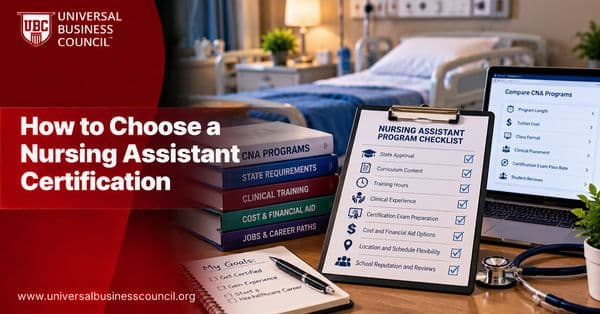
Health
How to Choose a Nursing Assistant Certification
Wondering whether earning a nursing assistant certification is worth the investment? Explore the benefits, costs, career opportunities, and challenges of becoming a certified nursing assistant to decide if this healthcare career path is right for you.
Health
Is a Nursing Assistant Certification Worth It?
Wondering whether earning a nursing assistant certification is worth the investment? Explore the benefits, costs, career opportunities, and challenges of becoming a certified nursing assistant to decide if this healthcare career path is right for you.
Health
How to Become a Nursing Assistant
Discover how to become a nursing assistant and start a career in healthcare. Explore the education and training requirements, certification process, essential skills, and steps to qualify for nursing assistant roles.
Trending Articles
The Role of Blockchain in Ethical AI Development
How blockchain technology is being used to promote transparency and accountability in artificial intelligence systems.
AWS Career Roadmap
A step-by-step guide to building a successful career in Amazon Web Services cloud computing.
Top 5 DeFi Platforms
Explore the leading decentralized finance platforms and what makes each one unique in the evolving DeFi landscape.