

A Beginner's Guide to Building an HR Analytics Strategy from Scratch
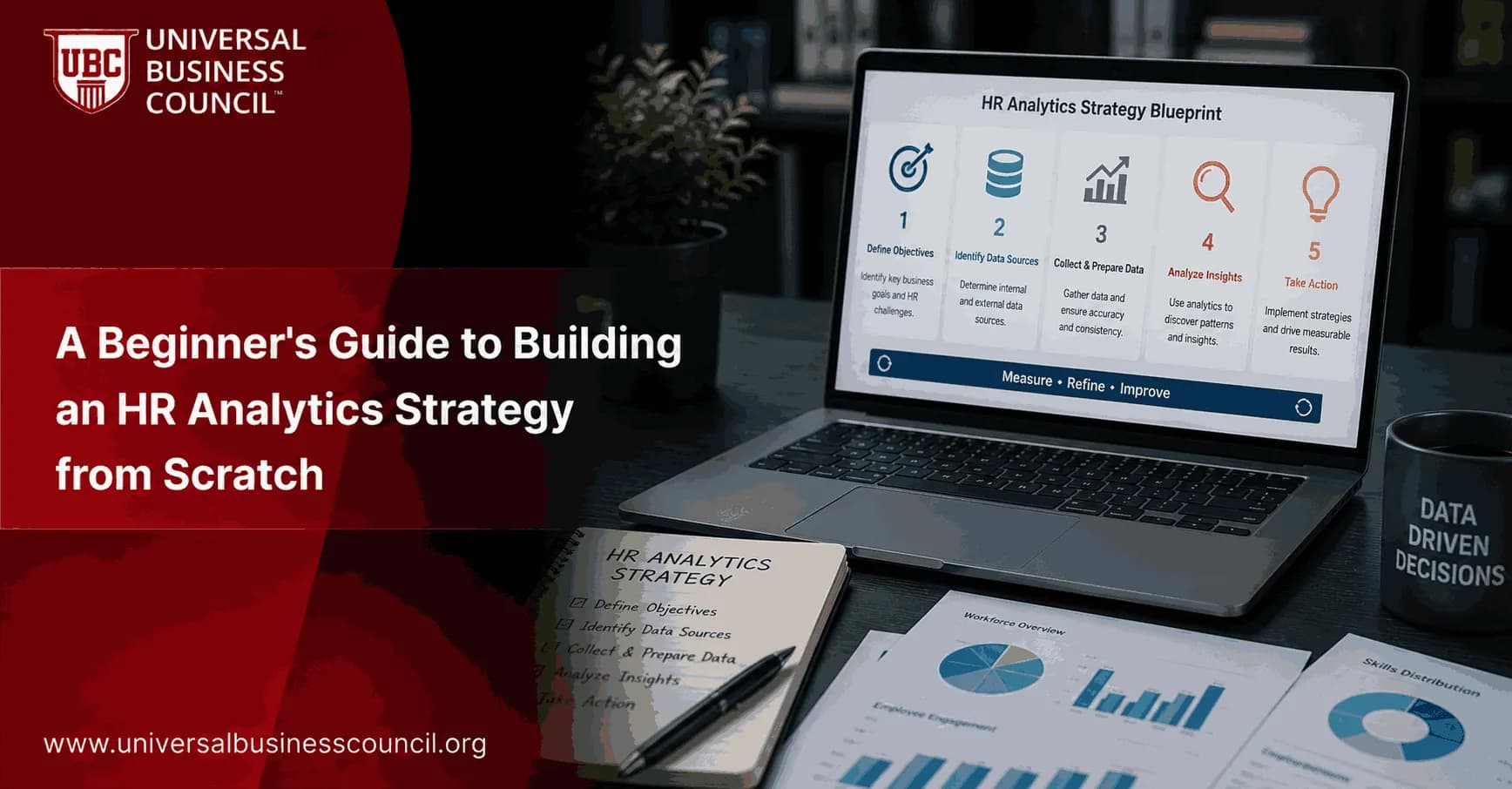
An HR analytics strategy is not a dashboard project. It is a decision system. You use people data to answer business questions, test what works, and improve outcomes such as retention, hiring quality, productivity, engagement, and workforce planning.
If you are starting from scratch, resist the urge to buy a platform first. Start with the questions your leaders already care about. Why are senior engineers leaving after 18 months? Which hiring sources produce employees who stay and perform? Are manager capability gaps showing up in engagement scores? Those questions will shape the data, tools, and skills you actually need.

As organizations increasingly rely on workforce data for strategic planning, the role of an HR Professional has expanded beyond administrative responsibilities to include evidence-based decision-making and business partnership.
What HR Analytics Means in Practice
HR analytics, often called people analytics or workforce analytics, is the use of workforce data to improve decisions about people and organizational performance. The CIPD describes people analytics as using people data and evidence to improve work and business outcomes. That is the right framing. The point is not prettier reports. The point is better choices.
Most HR analytics work falls into four levels:
Descriptive analytics: What happened? Examples include headcount, turnover, absenteeism, time-to-fill, and training completion.
Diagnostic analytics: Why did it happen? Here you compare attrition by tenure, role, manager, location, pay band, or hiring source.
Predictive analytics: What is likely to happen? Attrition risk models and workforce demand forecasts sit here.
Prescriptive analytics: What should we do next? This may include targeted manager coaching, revised sourcing spend, or retention actions for critical roles.
Beginners should spend more time on descriptive and diagnostic work than they expect. Predictive models are attractive. But a model built on messy job titles, missing termination reasons, and inconsistent employee status fields will only make bad data look scientific.
Start With Business Questions, Not Data
Your first HR analytics strategy should focus on two or three high-value questions. Not ten. Not a company-wide analytics transformation. Pick problems that leadership already feels.
Good starter questions include:
What are the main drivers of voluntary turnover in critical roles?
Which recruitment channels produce the strongest new hires after six or twelve months?
Where do engagement scores predict retention, performance, or absence risk?
Which teams have high performance but rising burnout signals?
Where are internal mobility and promotion rates uneven across groups?
To be blunt, a question like How can HR be more data-driven? is too vague. A stronger version is this: Which factors explain the 12-month attrition rate among customer support team leads, and what intervention should we test next quarter?
Build a Minimum Viable Data Foundation
You do not need a perfect data warehouse to begin. You do need clean enough data for the first use case. For most organizations, the first HR analytics dataset pulls from a few core systems:
HRIS: employee ID, department, manager, tenure, role, level, location, employment status.
Payroll or compensation system: pay band, bonus eligibility, working hours, allowances where relevant.
ATS: source, application stage, offer status, time-to-accept, recruiter, hiring manager.
Performance system: rating, goal completion, calibration result, performance cycle.
Engagement platform: survey score, participation, driver scores such as recognition or career growth.
Learning platform: course completion, certification status, skills tags, learning hours.
Here is the boring part that saves weeks later: define your terms. What counts as an active employee? Is a transfer counted as a vacancy? Does turnover include fixed-term contract endings? What is a regretted loss? Who owns job family data?
One detail catches first-time teams every time: job titles are usually a mess. Sales Rep II, Sales Representative 2, and Sr. Account Executive may be coded as separate groups even when leaders see them as one talent pool. Clean the taxonomy before you present conclusions by role. Otherwise your charts will start arguments about labels instead of decisions.
Select Metrics That Match the Question
Do not build a giant HR scorecard on day one. Choose metrics that connect to the business issue.
Talent acquisition metrics
Time-to-fill and time-to-accept
Cost-per-hire
Candidate conversion rate by stage
Source effectiveness
Quality of hire, often measured through new-hire performance, retention, and hiring manager feedback
Retention metrics
Voluntary and involuntary turnover
Critical-role turnover
High-performer retention
New-hire retention at 90, 180, and 365 days
Exit reasons, coded consistently
Engagement and experience metrics
Survey participation rate
Engagement index
Driver scores for leadership, recognition, workload, and career growth
Absence trends
Internal mobility and promotion patterns
Performance and productivity metrics
Performance rating distribution
Goal attainment
Revenue per full-time equivalent, where suitable
Output measures such as tickets resolved, quality scores, project delivery, or customer satisfaction
Be careful with productivity metrics. Revenue per employee can be useful at company level, but it is often too blunt for team-level HR decisions. A finance analyst may love it. A service operations manager may need first-contact resolution, average handling time, quality audit score, and schedule adherence instead.
Choose Tools Only After You Know the Use Case
For a beginner HR analytics strategy, start with the tools already on hand. A spreadsheet, Google Sheets or Microsoft Excel, can handle early data checks. Power BI, Tableau, Looker Studio, or built-in HRIS dashboards can visualize trends. Many HR suites and applicant tracking systems already export enough data for the first round of analysis.
Specialized people analytics platforms help when you have repeatable use cases, multiple data sources, and clear governance. They are not a cure for weak definitions. If your termination reason field is optional and managers tag half the exits as other, no software will infer the truth reliably.
Create a Simple Operating Model
Even a small HR analytics program needs roles. Keep it practical:
Executive sponsor: removes blockers and keeps analytics tied to business priorities.
HR owner: defines the people question and confirms policy context.
Data owner: manages source data quality and access.
Analyst: prepares data, runs analysis, and builds visuals.
Business partner or line manager: validates whether findings make operational sense.
IT or security partner: supports privacy, access control, and integrations.
In small organizations, one person may wear three of these hats. That is fine. Just write down who is accountable for each part.
Run Your First HR Analytics Project
Use this seven-step sequence for your first project.
Define the question: for example, reduce voluntary turnover among field sales managers.
Agree the outcome metric: use voluntary turnover rate, segmented by tenure, region, manager, and performance level.
Map data sources: pull HRIS, performance, compensation, engagement, and exit interview data if available.
Clean definitions: confirm active employee status, termination type, job family, region, and manager hierarchy.
Analyze patterns: compare turnover by cohort. Look for tenure cliffs, manager clusters, pay compression, engagement drops, or promotion delays.
Validate with managers: ask what changed. A new territory model, quota reset, or weak onboarding process may explain the pattern.
Test an action: try a focused intervention, then measure the same metric over the next quarter or two.
A common mistake is stopping at the finding. Turnover is higher under Manager A is not yet insight. Ask whether Manager A has the hardest territory, the newest hires, the lowest pay position, or a real leadership issue. Analytics should sharpen judgment, not replace it.
Build Governance, Ethics, and Privacy From Day One
HR data is sensitive. Treat governance as part of the design, not paperwork after the fact. The European Union's General Data Protection Regulation sets principles such as data minimization, purpose limitation, accuracy, and security. Even outside the EU, those principles are useful guardrails.
Your governance checklist should include:
Documented purpose for each analysis
Role-based access to identifiable employee data
Clear rules for anonymized and aggregated reporting
Bias checks for models that affect hiring, promotion, pay, or retention decisions
Employee communication about what data is used and why
Retention rules for old survey, candidate, and employee records
If you use algorithms in selection or promotion, involve legal and compliance early. In the United States, the Equal Employment Opportunity Commission has issued guidance on algorithmic decision tools and discrimination risk. You do not want to discover adverse impact after a tool has shaped hiring decisions for six months.
As HR increasingly adopts AI, analytics platforms, and digital workforce technologies, a Tech Certification can help professionals develop a stronger understanding of the systems and governance practices behind modern HR analytics.
Develop HR Analytics Capability
An HR analytics strategy depends on skills, not only systems. HR professionals need enough data literacy to question a chart, spot a bad average, and explain a confidence problem without hiding behind jargon.
Build capability in layers:
Foundation: metrics, data definitions, spreadsheet skills, basic visualization.
Intermediate: segmentation, correlation, cohort analysis, dashboard design, storytelling.
Advanced: predictive modeling, workforce forecasting, text analysis, experiment design.
This is where structured study earns its keep. Universal Business Council HR certification courses, business analytics programs, and management education pathways can build these layers in order. If you are an HR generalist moving into analytics, pair HR domain learning with practical data interpretation. If you are already technical, study workforce planning, employment law basics, and organizational behavior. The best people analytics practitioners can speak to both the CHRO and the data engineer.
Building these capabilities is an important step toward becoming an HR Analytics Expert, combining HR expertise with analytical thinking to deliver workforce insights that support organizational performance.
Measure Impact and Scale Carefully
Your first projects should prove that HR analytics changes decisions. Track whether the action worked. If you adjusted sourcing spend, measure quality of hire and early attrition by source. If you trained managers, measure engagement drivers, absence, turnover, and performance changes in the target group.
Then scale. Add more use cases only when the basics are stable: definitions, access, repeatable reports, stakeholder trust, and a habit of acting on findings.
ISO 30414:2018, the international guideline for human capital reporting, is useful here because it encourages consistent reporting across workforce cost, productivity, leadership, culture, succession, skills, and workforce availability. You do not need to adopt every measure at once. But the standard is a good reference when building a mature scorecard.
Your Next Step
Pick one business question this week. Write the metric definition, list the data sources, identify the data owner, and build a simple baseline. Do not wait for perfect data. Start small, document your assumptions, and improve the system with each cycle. If you want a structured learning path, explore Universal Business Council's HR, business analytics, and management certification options as the next step in building practical HR analytics capability.
Professionals preparing for the future of workforce analytics may also benefit from a Deeptech Certification to build a broader understanding of AI, automation, and emerging technologies that are reshaping HR strategy and organizational decision-making.
FAQs
1. What Is an HR Analytics Strategy?
An HR analytics strategy is a structured approach to collecting, analyzing, and using workforce data to improve HR decisions. It helps organizations optimize recruitment, employee engagement, retention, workforce planning, and overall business performance.
2. Why Is an HR Analytics Strategy Important?
An HR analytics strategy enables organizations to make evidence-based HR decisions instead of relying on assumptions. It improves workforce planning, talent management, productivity, and supports long-term business growth.
3. How Can Beginners Start Building an HR Analytics Strategy?
Start by defining clear HR objectives, identifying key workforce metrics, collecting accurate employee data, selecting analytics tools, and regularly reviewing insights to improve HR decision-making.
4. What Are the First Steps in Creating an HR Analytics Strategy?
Begin by understanding business goals, identifying HR challenges, defining measurable KPIs, assessing available workforce data, and establishing a plan for ongoing analysis and reporting.
5. What HR Goals Should an Analytics Strategy Support?
An HR analytics strategy should support goals such as improving recruitment, reducing employee turnover, increasing engagement, enhancing workforce productivity, strengthening succession planning, and optimizing learning and development.
6. What Data Should Be Collected for HR Analytics?
Organizations should collect data on employee demographics, recruitment, performance, attendance, engagement, compensation, learning and development, retention, promotions, and workforce productivity.
7. Which HR Metrics Should Beginners Track First?
Key beginner-friendly metrics include employee turnover rate, retention rate, time-to-hire, cost-per-hire, absenteeism, employee engagement, training completion, and performance ratings.
8. How Does Data Quality Affect HR Analytics?
Accurate, complete, and consistent data is essential for reliable analytics. Poor-quality data can lead to incorrect conclusions, ineffective HR strategies, and poor business decisions.
9. What Tools Can Be Used for HR Analytics?
Popular HR analytics tools include Microsoft Excel, Power BI, Tableau, Google Looker Studio, BambooHR, Workday, SAP SuccessFactors, Oracle HCM, and other Human Resource Information Systems (HRIS).
10. How Can HR Dashboards Support an Analytics Strategy?
HR dashboards display key workforce metrics in real time, making it easier to monitor performance, identify trends, and communicate insights to managers and business leaders.
11. What Role Does Artificial Intelligence Play in HR Analytics?
AI helps automate data analysis, identify workforce patterns, forecast employee trends, generate reports, and provide predictive insights that improve HR planning and decision-making.
12. How Can Predictive Analytics Improve HR Strategies?
Predictive analytics forecasts future workforce trends such as employee turnover, hiring demand, skills shortages, and performance risks, allowing HR teams to take proactive action.
13. How Often Should HR Analytics Be Reviewed?
Most organizations review HR metrics monthly or quarterly, while critical indicators such as recruitment pipelines, absenteeism, and workforce capacity may require more frequent monitoring.
14. How Can HR Analytics Improve Executive Decision-Making?
HR analytics provides leaders with reliable workforce insights that support strategic decisions related to hiring, budgeting, organizational growth, employee development, and business planning.
15. What Skills Are Needed to Build an HR Analytics Strategy?
Key skills include data analysis, Excel, HR reporting, data visualization, business communication, analytical thinking, workforce planning, and familiarity with HR technology platforms.
16. What Challenges Do Beginners Face When Implementing HR Analytics?
Common challenges include poor data quality, disconnected HR systems, limited analytics experience, employee privacy concerns, resistance to change, and difficulty selecting meaningful KPIs.
17. How Can Organizations Create a Data-Driven HR Culture?
Encourage leaders to use workforce data in decision-making, invest in analytics training, improve data quality, promote transparency, and regularly measure HR outcomes against business goals.
18. How Can Businesses Measure the Success of Their HR Analytics Strategy?
Success can be measured through improved hiring efficiency, lower employee turnover, higher engagement, better workforce planning, increased productivity, and stronger alignment between HR initiatives and business objectives.
19. What Common Mistakes Should Beginners Avoid When Building an HR Analytics Strategy?
Avoid tracking too many metrics, relying on poor-quality data, ignoring business objectives, failing to communicate insights, and treating analytics as a one-time project. A successful strategy evolves as business needs and workforce priorities change.
20. What Is the Best Way to Build a Successful HR Analytics Strategy?
The best approach is to start with clear business goals, focus on meaningful HR metrics, invest in reliable data and analytics tools, build easy-to-understand dashboards, and continuously refine your strategy using workforce insights. A well-planned HR analytics strategy helps organizations make smarter decisions, improve employee experiences, and create a more agile and data-driven HR function.
Related Articles
View All
Hr
HR Analytics in Recruitment: Building Data-Driven Talent Acquisition
Learn how HR analytics improves recruitment decisions, sourcing, candidate experience, quality of hire, workforce planning, and responsible AI use.

Hr
From HR Generalist to HR Analytics Expert: Career Path, Skills, and Certifications
A practical guide for moving from HR generalist to HR analytics expert, including skills, tools, career stages, use cases, and certification planning.

Hr
How HR Analytics Supports Strategic Talent Management and Succession Planning
Learn how HR analytics strengthens strategic talent management, improves succession planning, reduces leadership risk, and supports fairer workforce decisions.
Trending Articles
The Role of Blockchain in Ethical AI Development
How blockchain technology is being used to promote transparency and accountability in artificial intelligence systems.
AWS Career Roadmap
A step-by-step guide to building a successful career in Amazon Web Services cloud computing.
Top 5 DeFi Platforms
Explore the leading decentralized finance platforms and what makes each one unique in the evolving DeFi landscape.