

HR Analytics in Recruitment: Building Data-Driven Talent Acquisition
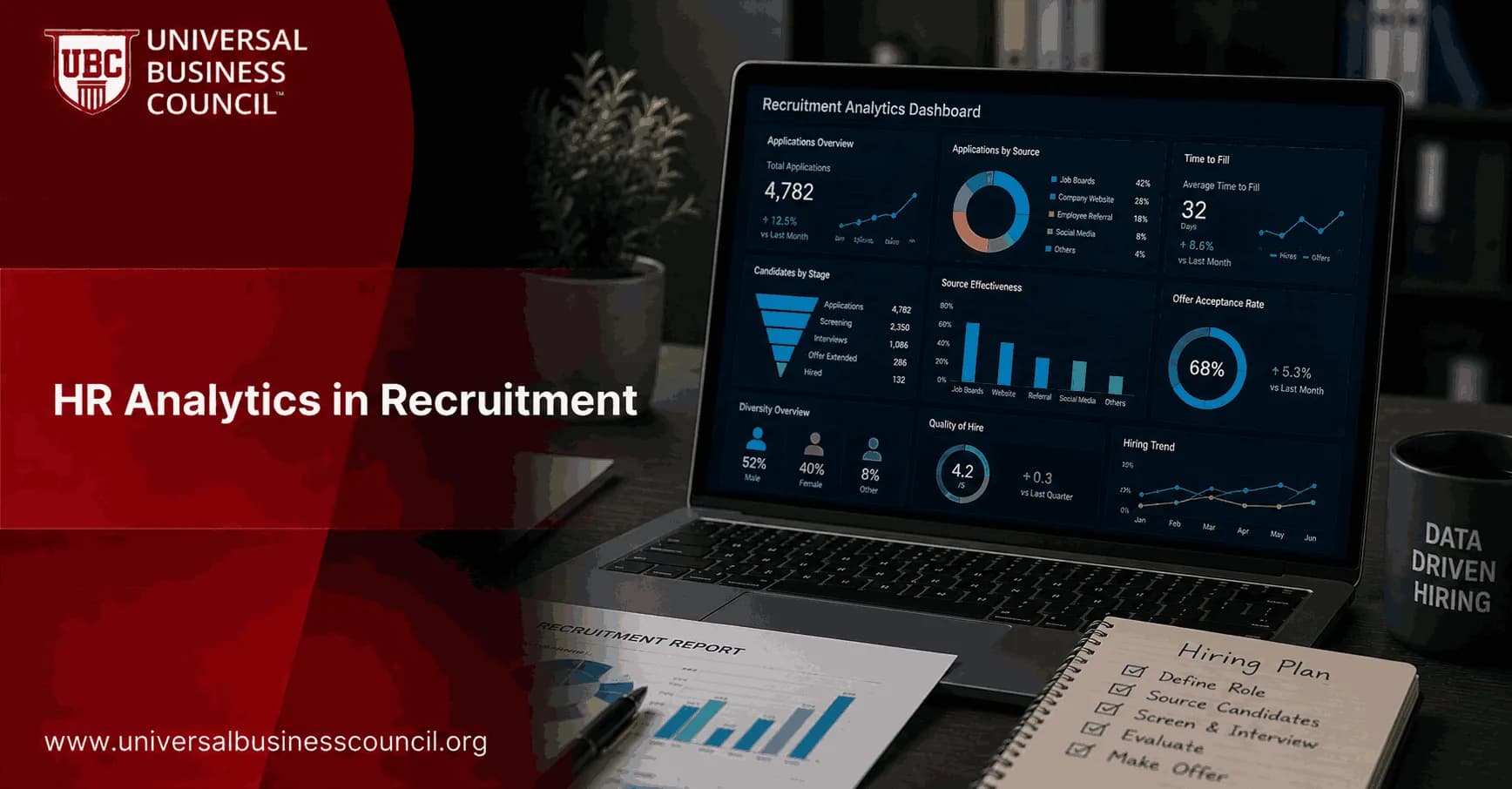
HR analytics in recruitment turns hiring from a string of opinions into a measurable business process. You still need human judgment. You also need clean data on sourcing, screening, interviews, offers, onboarding, and early performance, because gut feel alone does not tell you why good candidates drop out or which channel actually produces strong hires.
The shift is not theoretical. Deloitte describes talent acquisition analytics as the systematic discovery of patterns in recruitment and onboarding data to support better hiring decisions. Josh Bersin has pointed to skills-based hiring, AI-supported sourcing, and integrated talent platforms as major forces reshaping how companies hire. Put simply: the teams that can read the hiring funnel will outwork the teams that only count applicants.

As recruitment becomes increasingly data-driven, the role of an HR Professional extends beyond filling vacancies to making strategic hiring decisions that align talent acquisition with long-term business goals.
What HR Analytics Means in Recruitment
HR analytics, also called people analytics, is the structured collection, analysis, and reporting of workforce data. In recruitment, it focuses on the evidence behind talent decisions: where candidates come from, how they move through the process, why they accept or reject offers, and how they perform after joining.
Talent acquisition analytics usually covers four levels:
Descriptive analytics: What happened? For example, time to fill rose from 41 to 58 days for engineering roles.
Diagnostic analytics: Why did it happen? Interview scheduling sat in the hiring manager review stage for nine extra days.
Predictive analytics: What is likely to happen? Historical data suggests senior data roles will take 70 days in a specific market.
Prescriptive analytics: What should you do next? Add interview blocks, change sourcing spend, or remove a low-value assessment step.
Start with the first two. To be blunt, predictive hiring models built on messy ATS data are expensive decoration. Fix definitions, timestamps, and funnel stages before you ask AI to recommend candidates.
Why Data-Driven Recruitment Has Become a Board-Level Topic
Recruitment has direct impact on growth, project delivery, customer service capacity, and operating cost. Market interest reflects that reality. Industry forecasts project global HR analytics revenue to grow from roughly 4.9 billion USD in 2025 to 11.5 billion USD by 2032, with an estimated compound annual growth rate near 13 percent.
The labor market is professionalizing around this skill set too. Recent job market snapshots have shown thousands of HR analytics related postings across roles such as HR analyst, people analytics specialist, and staffing data coordinator. This is not a niche anymore.
For HR leaders, the appeal is practical:
You can show hiring managers where delays occur instead of arguing from anecdotes.
You can compare source quality, not just applicant volume.
You can track whether new hires stay and perform.
You can link recruitment plans to workforce planning, internal mobility, and skills gaps.
If you are building this capability, connect it with broader Universal Business Council learning paths in HR management, business analytics, and management leadership. Recruitment analytics sits where all three meet.
The Recruitment Metrics That Actually Matter
A dashboard with 40 metrics usually means nobody is making a decision. Keep the first version tight. Measure the funnel, the cost, the experience, and the outcome.
Time to Hire and Time to Fill
Time to hire measures the period from candidate application or first contact to accepted offer. Time to fill measures the period from requisition approval to role closure. Do not mix them.
The useful analysis is stage-level. Break down recruiter screen, hiring manager review, interview scheduling, assessment, final interview, offer approval, and candidate notice period. In real ATS exports, a common trap is timestamp inconsistency. I have seen interview scheduled and interview completed captured in different time zones, which creates negative stage durations unless the data is normalized. Small data hygiene issue. Big reporting problem.
Source of Hire and Source Quality
Application volume can mislead you. A job board may produce 600 applicants and only three serious finalists. Employee referrals may produce 30 applicants and eight hires. Track conversion by source, but carry it through to offer acceptance, first-year retention, and manager feedback.
A simple source quality view might compare:
Applicants by channel
Screen pass rate
Interview pass rate
Offer rate
Acceptance rate
Six-month retention
That last line matters. Without it, you are optimizing for recruiter activity rather than business value.
Cost per Hire
Cost per hire includes advertising spend, agency fees, recruiter time, assessment tools, employer branding campaigns, and recruitment technology costs. Use it by role family and level. Comparing graduate hiring with executive search in one blended number tells you almost nothing.
Quality of Hire
Quality of hire is powerful and dangerous. It should not be a single black-box score. Use a balanced view that may include early performance ratings, ramp time, retention, hiring manager feedback, productivity measures, and training completion.
Do not punish recruiters for weak onboarding or poor management. If a new hire leaves after 90 days because the role was misrepresented, that is a talent acquisition issue. If they leave because the manager never set goals, that is an organizational issue. The data should help you separate the two.
Developing this level of workforce insight is a defining capability of an HR Analytics Expert, who uses hiring data to evaluate recruitment quality, identify trends, and support continuous improvement across the talent acquisition process.
Offer Acceptance and Candidate Dropout
Offer acceptance rate shows whether compensation, role clarity, and employer reputation match candidate expectations. Candidate dropout shows where the process loses people. Watch assessment abandonment, interview no-shows, and post-offer silence.
Candidate experience data matters here. Application completion rates, response times, and candidate satisfaction surveys can expose problems that hiring teams miss. Long forms on mobile are still a common offender.
Practical Use Cases for HR Analytics in Talent Acquisition
1. Finding Bottlenecks in the Hiring Funnel
When every requisition feels urgent, process discipline slips. Analytics gives you a neutral record. If 62 percent of cycle time sits between recruiter screen and first interview, the issue is not sourcing. It is manager availability or scheduling design.
A practical fix is to ask hiring managers for fixed interview blocks before the requisition opens. It sounds basic. It works. Self-scheduling tools can help, but only if calendars are actually protected.
2. Improving Recruitment Marketing Spend
Talent acquisition analytics can show which channels produce high-quality candidates by role type. For software roles, a specialist community may beat broad job advertising. For high-volume operations roles, local campaigns and referral programs may perform better.
Do not cut a channel only because it has a high cost per applicant. Cut it if it has poor downstream conversion or weak quality of hire.
3. Supporting Skills-Based Hiring
Skills-based hiring depends on evidence. Instead of filtering by school name or years of experience, you analyze which skills, assessment results, work samples, and interview signals predict success.
This is where HR analytics and fairness meet. If a requirement does not predict performance, challenge it. Degree filters, inflated years of experience, and vague cultural fit scores often screen out capable people while adding little predictive value.
4. Forecasting Hiring Timelines and Capacity
Workforce analytics platforms can model expected hiring timelines by role, region, and seniority. That helps business leaders plan product launches, client delivery, and expansion timelines with fewer surprises.
If historical data says senior cybersecurity roles take 75 days to fill in a given location, a 30-day staffing promise is not ambitious. It is poor planning.
5. Connecting External Hiring with Internal Mobility
Strong talent acquisition teams do not treat every vacancy as an external search. HR analytics can compare external supply with internal skills, learning data, succession plans, and attrition risk. Sometimes the best hire is already in the company.
AI and Automation: Useful, but Not a Substitute for Governance
AI is now common in sourcing, resume parsing, candidate matching, interview scheduling, chatbot communication, and predictive dashboards. Used well, automation helps HR teams process large volumes of data and improve decision quality, and predictive workforce analytics is one of the fastest growing areas in the field.
Use AI carefully. Candidate scoring models can replicate past bias if historical hiring data favored certain backgrounds. Resume parsers can misread non-standard career paths. Automated rejection rules can quietly remove strong candidates before a person sees them.
Set clear controls:
Audit selection rates by protected and relevant demographic groups where legally permitted.
Document which data fields the models use.
Explain automated decisions in plain language.
Review models after process changes, not once a year.
Keep humans accountable for final hiring decisions.
Privacy is not paperwork. Candidates should know what data is collected, why it is used, how long it is stored, and who can access it. People analytics loses trust fast when it feels hidden.
How to Build a Recruitment Analytics Capability
You do not need a huge team to start. You need definitions, discipline, and a few decisions worth improving.
Define the hiring funnel. Use consistent stages across the ATS, recruiter reports, and hiring manager updates.
Clean the data. Standardize role names, locations, sources, timestamps, rejection reasons, and offer outcomes.
Choose five core metrics. Start with time to fill, stage conversion, source quality, cost per hire, and offer acceptance.
Link to outcomes. Add retention, ramp time, performance feedback, and onboarding completion where appropriate.
Review with hiring managers monthly. Show the evidence. Agree on one process change at a time.
Document ethical rules. Cover privacy, consent, bias monitoring, AI use, and decision rights.
If you are a professional developing this skill set, build fluency in Google Analytics 4 for campaign traffic, LinkedIn Talent Solutions reporting, ATS exports, Excel or Google Sheets, Power BI or Tableau, and basic statistical thinking. You do not need to become a data scientist first. You do need to ask better questions.
As recruitment increasingly depends on analytics platforms, AI tools, and digital HR systems, a Tech Certification can help professionals strengthen their understanding of the technologies driving modern talent acquisition and workforce analytics.
The Future of HR Analytics in Recruitment
HR analytics in recruitment will keep moving toward integrated talent intelligence. Recruiting data, learning records, skills taxonomies, internal mobility platforms, engagement signals, and workforce plans will sit closer together. That is useful. It is also risky if governance lags behind adoption.
The winning teams will not be the ones with the most dashboards. They will be the ones that make better hiring decisions, improve candidate trust, reduce waste, and build skills the business actually needs.
Your next step: audit one live hiring funnel this week. Pull stage timestamps, source data, offer outcomes, and candidate dropout points. Find the slowest handoff. Fix that before buying another tool. Then use Universal Business Council resources in HR, analytics, and management education to build the deeper capability behind the dashboard.
Professionals preparing for the future of talent acquisition may also benefit from a Deeptech Certification to build a broader understanding of AI, automation, and other advanced technologies that are reshaping recruitment, workforce planning, and organizational decision-making.
FAQs
1. What Is HR Analytics in Recruitment?
HR analytics in recruitment is the use of workforce data, metrics, and analytics to improve hiring decisions, optimize recruitment processes, and identify the most effective talent acquisition strategies for an organization.
2. Why Is HR Analytics Important for Talent Acquisition?
HR analytics helps recruiters make data-driven hiring decisions by measuring recruitment performance, reducing hiring costs, improving candidate quality, and increasing the efficiency of the hiring process.
3. How Does HR Analytics Improve Recruitment?
HR analytics identifies recruitment trends, evaluates sourcing channels, measures hiring performance, predicts talent needs, and helps HR teams make better hiring decisions based on real data rather than assumptions.
4. What Data Is Used in Recruitment Analytics?
Recruitment analytics uses data such as candidate applications, interview scores, sourcing channels, time-to-hire, cost-per-hire, offer acceptance rates, quality of hire, and employee retention after hiring.
5. What Is Data-Driven Talent Acquisition?
Data-driven talent acquisition uses analytics and measurable insights to attract, evaluate, hire, and retain the right candidates while improving recruitment efficiency and business outcomes.
6. How Can HR Analytics Reduce Time-to-Hire?
By identifying recruitment bottlenecks, improving interview scheduling, optimizing sourcing strategies, and streamlining candidate screening, HR analytics helps shorten the hiring process.
7. What Is Quality of Hire and Why Does It Matter?
Quality of hire measures how well new employees perform and contribute after joining the organization. It helps HR evaluate whether recruitment strategies are attracting the right talent.
8. How Does HR Analytics Improve Candidate Sourcing?
Analytics helps identify which job boards, social media platforms, employee referrals, and recruitment channels consistently deliver the highest-quality candidates.
9. How Can Recruitment Analytics Reduce Hiring Costs?
By tracking recruitment spending, identifying cost-effective sourcing channels, reducing hiring delays, and improving recruitment efficiency, organizations can lower overall hiring expenses.
10. What HR Metrics Should Recruiters Track?
Important recruitment metrics include time-to-hire, cost-per-hire, source of hire, offer acceptance rate, quality of hire, candidate satisfaction, application conversion rate, and employee retention.
11. How Does Artificial Intelligence Support Recruitment Analytics?
AI analyzes candidate data, matches resumes to job requirements, predicts hiring success, automates resume screening, and provides insights that help recruiters make faster and more informed decisions.
12. Can HR Analytics Improve Candidate Experience?
Yes. Analytics helps HR identify delays, communication gaps, and process inefficiencies, enabling recruiters to create a smoother, faster, and more engaging candidate journey.
13. How Does Recruitment Analytics Support Workforce Planning?
Recruitment analytics forecasts future hiring needs, identifies talent shortages, monitors labor market trends, and helps organizations prepare for workforce growth.
14. What Tools Are Used for Recruitment Analytics?
Common tools include Applicant Tracking Systems (ATS), Human Resource Information Systems (HRIS), Microsoft Power BI, Tableau, Workday, SAP SuccessFactors, Greenhouse, Lever, and LinkedIn Talent Insights.
15. How Can HR Analytics Support Diversity Hiring?
Analytics measures diversity across recruitment stages, identifies potential biases, monitors hiring outcomes, and helps organizations improve fairness and inclusion in talent acquisition.
16. What Challenges Do Organizations Face with Recruitment Analytics?
Challenges include inconsistent data, fragmented recruitment systems, privacy concerns, limited analytics expertise, integration issues, and selecting meaningful recruitment metrics.
17. How Can Organizations Build a Data-Driven Recruitment Strategy?
Organizations should define hiring goals, collect accurate recruitment data, monitor KPIs, leverage AI and analytics tools, evaluate sourcing performance, and continuously optimize hiring processes.
18. How Can HR Measure Recruitment Success?
Success can be measured through improved quality of hire, faster hiring times, reduced recruitment costs, higher offer acceptance rates, stronger employee retention, and increased hiring manager satisfaction.
19. What Common Mistakes Should Recruiters Avoid When Using HR Analytics?
Avoid relying only on historical data, tracking too many KPIs, ignoring candidate feedback, overlooking data quality, and making hiring decisions based solely on analytics. Data should support recruiter expertise, not replace it.
20. How Will HR Analytics Transform the Future of Talent Acquisition?
HR analytics will continue to reshape recruitment by enabling predictive hiring, AI-assisted candidate matching, personalized recruitment experiences, and smarter workforce planning. Organizations that embrace data-driven talent acquisition will be better positioned to attract top talent, improve hiring quality, reduce recruitment costs, and build a stronger workforce in an increasingly competitive job market.
Related Articles
View All
Hr
How HR Analytics Supports Strategic Talent Management and Succession Planning
Learn how HR analytics strengthens strategic talent management, improves succession planning, reduces leadership risk, and supports fairer workforce decisions.

Hr
A Beginner's Guide to Building an HR Analytics Strategy from Scratch
Learn how to build an HR analytics strategy from scratch with practical steps for data, metrics, tools, governance, ethics, and workforce insights.

Hr
From HR Generalist to HR Analytics Expert: Career Path, Skills, and Certifications
A practical guide for moving from HR generalist to HR analytics expert, including skills, tools, career stages, use cases, and certification planning.
Trending Articles
The Role of Blockchain in Ethical AI Development
How blockchain technology is being used to promote transparency and accountability in artificial intelligence systems.
AWS Career Roadmap
A step-by-step guide to building a successful career in Amazon Web Services cloud computing.
Top 5 DeFi Platforms
Explore the leading decentralized finance platforms and what makes each one unique in the evolving DeFi landscape.