

From HR Generalist to HR Analytics Expert: Career Path, Skills, and Certifications
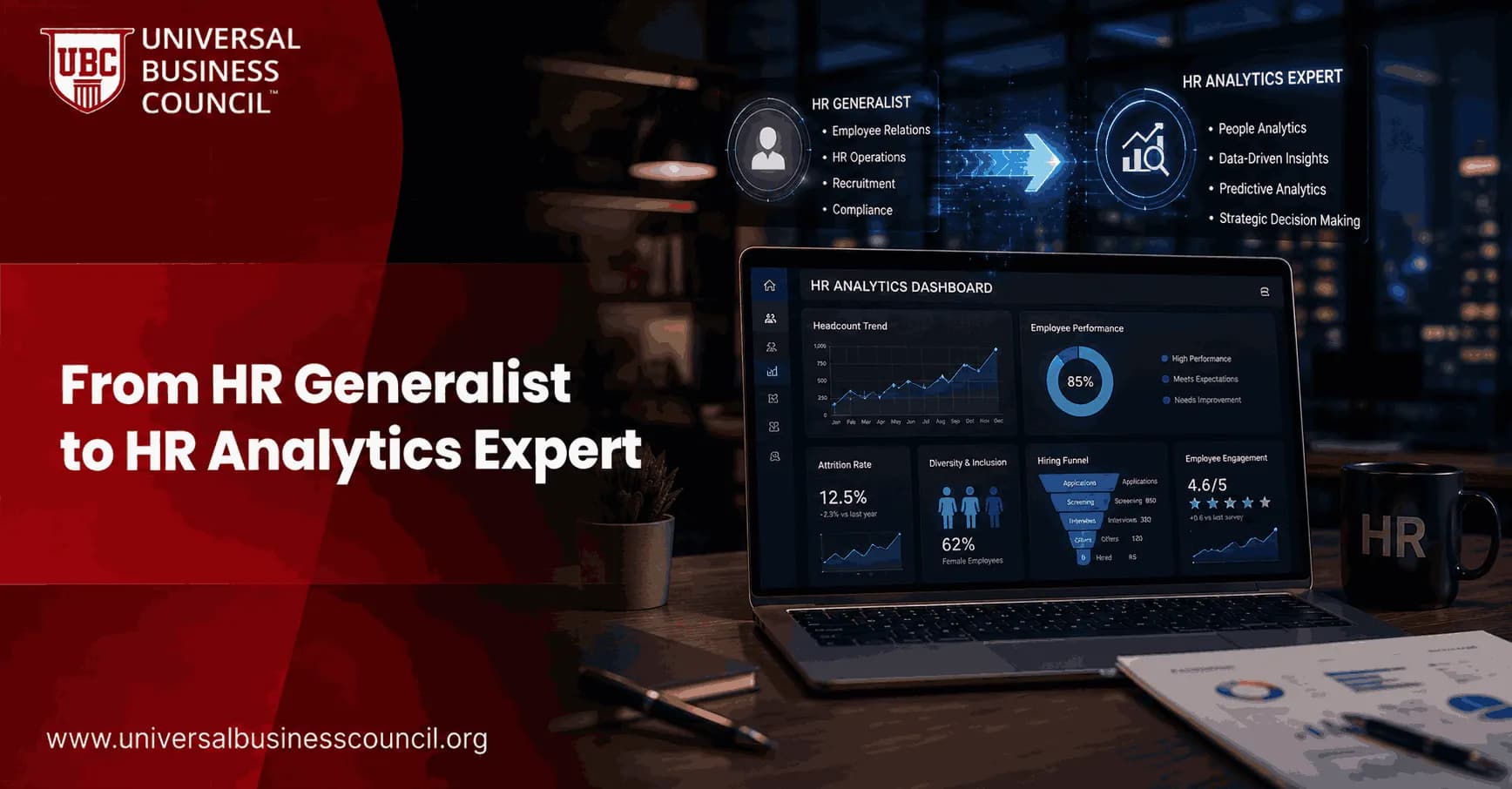
Moving from HR generalist to HR analytics expert is one of the most practical specialist paths in HR right now. You already understand hiring cycles, employee relations, manager behaviour, policy constraints, and the messy reality behind HRIS records. The next step is learning how to turn that operational knowledge into credible workforce insight.
This shift is not just a passing trend. Deloitte's human capital trends research, HR Acuity's employee relations reporting, and people analytics capability models all point the same way: HR is expected to advise the business with evidence, not only process requests. Combine HR judgment with analytics and you move closer to the decisions that shape workforce planning, retention, skills strategy, and employee experience.

How the HR Generalist Role Is Changing
An HR generalist has traditionally covered a wide brief: recruitment support, onboarding, employee relations, performance processes, policy interpretation, compliance, and basic reporting. In many organisations, the generalist is still the person managers call first when something feels unclear.
That broad exposure is useful. Very useful. A pure data analyst may see a spike in resignations after 18 months of tenure. A generalist is more likely to ask whether those employees had the same manager, joined under an inflated salary band, missed onboarding during a hiring surge, or got stuck without clear promotion criteria. Context changes the analysis.
Career paths in HR now commonly split after the generalist stage. Some professionals move into HR business partnering. Others specialise in total rewards, talent acquisition, employee relations, learning, or people analytics. The HR analytics expert path is especially strong if you enjoy asking better questions, testing assumptions, and presenting evidence to leaders who need to make workforce decisions.
What an HR Analytics Expert Actually Does
An HR analytics expert uses workforce data to answer business questions. Not just to produce dashboards. That distinction matters.
Typical work includes:
Analysing turnover, regretted attrition, retention risk, and internal mobility.
Reviewing recruitment funnels by source, stage, time to hire, quality of hire, and offer acceptance.
Supporting workforce planning with headcount forecasts, skills gaps, and scenario models.
Studying engagement, wellbeing, absence, and performance patterns.
Monitoring pay equity, promotion rates, representation, and inclusion survey data.
Building dashboards in tools such as Power BI, Tableau, Workday reporting, SAP SuccessFactors, or spreadsheets.
Partnering with HR, finance, operations, legal, and senior leadership.
The work is partly technical and partly consultative. You may write SQL one hour, then spend the next hour explaining why a turnover model should not be used to label individual employees as flight risks. Good people analytics requires restraint.
Why HR Generalists Have an Advantage
Do not underestimate your generalist background. It gives you pattern recognition that technical teams often lack.
You know when a manager is coding performance issues as conduct issues. You know that job titles are often inconsistent across departments. You know that a termination reason logged as "better opportunity" may hide pay compression, workload problems, or a poor manager relationship. These details are not small. They decide whether analysis is useful or misleading.
That practical experience is one of the biggest strengths of an HR Professional, providing the business context needed to interpret workforce data accurately and turn analytics into meaningful people decisions.
A practical example: source-of-hire reporting often breaks when the applicant tracking system and HRIS do not carry the same requisition ID through to hire. The dashboard may still look polished, but the data behind it is already compromised. An HR generalist who has lived through requisition changes, backfills, and late approvals will catch that faster than someone working only from a clean export.
Core Skills You Need to Build
HR and Business Acumen
You need to understand the HR process and the business model. A turnover rate means different things in a seasonal retail team, a software engineering group, a manufacturing plant, or a regulated financial services unit.
Learn the language leaders use: cost per hire, time to productivity, vacancy cost, span of control, revenue per employee, absence rate, engagement score, churn, and workforce capacity. If your company uses OKRs, connect people metrics to those outcomes.
Data Literacy and Statistics
You do not need to become a data scientist on day one. Start with the basics:
Mean, median, distribution, variance, and correlation.
Headcount movement, turnover rate, retention rate, and promotion rate.
Sampling bias and survey response bias.
Confidence intervals and practical significance.
Simple regression and driver analysis.
To be blunt, many HR reports fail before the statistics begin. Employee IDs are duplicated. Termination dates are missing. Departments change names mid-year. Fixing data quality is not glamorous, but it is where real analytics starts.
Tools: Spreadsheets, SQL, Python, and Visualisation
Start with advanced spreadsheet skills. You should be comfortable with pivot tables, XLOOKUP, Power Query, and basic formulas for rates and cohorts. Then add a visualisation tool such as Power BI or Tableau.
SQL is worth learning if you want to move into a dedicated HR analyst or people analytics specialist role. It lets you pull and join data from HRIS, ATS, LMS, payroll, and engagement platforms. Python can help with repeatable analysis, text processing, and predictive modelling, but it is not the first tool every HR generalist needs.
Consulting and Storytelling
People analytics capability models highlight consulting, data science and research, employee listening, analytics at scale, and ecosystem thinking. The consulting piece is often the difference between a report that gets ignored and a decision that changes.
Do not present 30 charts. Present the business question, the answer, your level of confidence, the trade-offs, and the action required. Leaders usually track a small number of workforce signals closely: regretted attrition, critical role vacancies, bench strength, engagement movement, and payroll cost against plan. Build your story around what they already care about.
Career Path: HR Generalist to HR Analytics Expert
Stage 1: HR Coordinator or Junior Generalist
At this stage, focus on process accuracy. Learn how data enters the system. Recruitment, onboarding, job changes, leave, performance cycles, and terminations all create data points. If you understand the source, you will later understand the limits of the analysis.
Stage 2: HR Generalist With Reporting Responsibilities
Volunteer for reporting work. Own a monthly headcount pack, turnover report, recruitment funnel, or engagement follow-up tracker. Ask managers what decisions they make from the report. If the answer is none, redesign it.
A simple but strong project is voluntary turnover by tenure band, manager, location, and job family. Add exit reason quality checks. You will quickly see whether the issue is broad retention, poor onboarding, pay, manager capability, or role design.
Stage 3: HR Analyst or People Analytics Specialist
This is the first dedicated analytics role. You will design analyses, maintain dashboards, improve data definitions, and work with HR leaders on questions about hiring, retention, DEIB, engagement, performance, and workforce planning.
This is also where you need more discipline. Document metric definitions. Agree whether turnover uses average headcount or opening headcount. Separate voluntary from involuntary exits. Define regretted attrition before the CHRO asks for it in a board pack.
Stage 4: People Analytics Manager or Lead
At this level, your job is less about producing every analysis yourself and more about setting the analytics roadmap. You define governance, prioritise business questions, manage stakeholders, and build repeatable methods. You also work across HR, finance, technology, legal, and operations.
Progressing into an HR Analytics Expert role means combining HR expertise with analytical thinking, data governance, and business communication to support strategic workforce planning and organizational performance.
Certifications That Support the Transition
HR analytics certifications can help, especially if your CV is heavy on generalist work and light on technical evidence. The best programmes combine HR metrics, statistics, data management, workforce planning, visualisation, and applied projects.
Look for training that covers:
HR data sources such as HRIS, ATS, LMS, payroll, and engagement tools.
Data quality, privacy, governance, and ethical use of employee data.
Descriptive, diagnostic, and predictive analytics.
Workforce planning and skills-based talent strategy.
Dashboard design and executive communication.
Professional credentials in people analytics can signal credibility when moving into HR analyst, people analytics specialist, or workforce planning roles. They are most valuable when paired with a real project, not used as a substitute for practice.
For Universal Business Council readers, this is a natural point to connect your learning plan with relevant UBC HR certification pathways and business analytics programmes. If your goal is HR analytics leadership, pair HR knowledge with formal analytics training. If your goal is HR business partnering with stronger data skills, prioritise workforce metrics, consulting, and dashboard interpretation.
Real Use Cases You Should Practice
Attrition and Retention Analytics
Start with turnover. It is visible, costly, and politically important. Analyse voluntary exits by tenure, manager, performance rating, compensation band, location, and role type. Be careful with small groups. A team of eight losing two people produces a scary percentage, but the story may be very different from a 300-person function with the same rate.
Recruitment Funnel Optimisation
Track applicants from source to screen, interview, offer, acceptance, and start date. Watch for quiet budget leaks. Paid sourcing channels can look successful on applicant volume while producing weak interview-to-offer conversion. The metric that matters is not applicants. It is qualified hires at an acceptable cost and speed.
Skills-Based Workforce Planning
Skills-based planning is growing because organisations need clearer views of current capability and future demand, especially in digital, AI, cybersecurity, and data roles. Your job is to help map skills, identify gaps, and decide whether to hire, reskill, redeploy, or automate.
Employee Relations and Risk Analytics
HR Acuity's research points to AI and analytics becoming part of employee relations case management. This area needs caution. Case data can reveal hotspots, repeat issues, policy gaps, and manager training needs. It can also be sensitive, incomplete, and legally risky if handled poorly.
DEIB and Pay Equity Analytics
DEIB analytics covers representation, hiring flow, promotion rates, pay equity, performance outcomes, and inclusion survey results. Do not stop at representation charts. Look at movement through the system. Where do people enter, stall, advance, or leave?
Future Outlook for HR Analytics Careers
People analytics is moving closer to workforce strategy. Deloitte and other human capital trend reports describe AI, skills-based organisations, wellbeing analytics, and cross-functional workforce planning as major themes. HR analytics experts will need stronger data ethics, better stakeholder management, and a clearer understanding of how technology affects work design.
The wrong move is to treat analytics as dashboard production. Dashboards are useful, but they are not the job. The job is better workforce decisions.
As AI, automation, and digital HR platforms continue to reshape workforce management, a Tech Certification can help professionals strengthen their understanding of the technologies driving modern people analytics and business decision-making.
Your Practical 90-Day Roadmap
Days 1 to 30: Audit the HR reports you already use. Identify metric definitions, missing fields, duplicate records, and reports nobody acts on.
Days 31 to 60: Build one focused analysis, such as turnover by tenure or recruitment funnel conversion. Use a spreadsheet or Power BI. Keep it simple.
Days 61 to 90: Present findings to an HR leader or business manager. Include one recommendation, one risk, and one follow-up question.
Then choose a certification path that fills your biggest gap. If you lack analytics confidence, start with HR analytics and data fundamentals. If you already work with data, deepen your HR strategy, workforce planning, and consulting skills through relevant Universal Business Council learning pathways. Your next step is not another generic report. Pick one workforce problem, clean the data, answer the question, and use the result to influence a real decision.
Professionals preparing for the future of HR and workforce strategy may also benefit from a Deeptech Certification to build a broader understanding of AI, automation, and other emerging technologies that are transforming people analytics, workforce planning, and organizational leadership.
FAQs
1. What Is an HR Analytics Expert?
An HR analytics expert is an HR professional who uses workforce data, analytics, and business intelligence tools to improve hiring, employee engagement, retention, performance, workforce planning, and strategic decision-making.
2. Why Are HR Professionals Transitioning into HR Analytics?
As organizations become more data-driven, HR professionals with analytics skills are increasingly in demand. HR analytics enables professionals to contribute strategically by turning workforce data into business insights.
3. Can an HR Generalist Become an HR Analytics Expert?
Yes. HR generalists already understand core HR functions and can transition into HR analytics by learning data analysis, HR metrics, reporting, visualization tools, and workforce analytics techniques.
4. What Skills Are Required to Become an HR Analytics Expert?
Essential skills include data analysis, Excel, HR metrics, Power BI, Tableau, HRIS platforms, workforce planning, data visualization, predictive analytics, business communication, and analytical thinking.
5. What Is the Career Path from HR Generalist to HR Analytics Expert?
A common path is HR Assistant → HR Generalist → HR Analyst → Senior HR Analyst → HR Analytics Specialist → People Analytics Manager → HR Analytics Consultant or HR Director.
6. Why Is Excel Important for HR Analytics?
Microsoft Excel remains one of the most widely used tools for organizing workforce data, performing calculations, creating reports, analyzing HR metrics, and preparing dashboards.
7. Which Data Visualization Tools Should HR Professionals Learn?
Popular visualization tools include Microsoft Power BI, Tableau, Google Looker Studio, and Excel dashboards. These tools help transform workforce data into easy-to-understand reports and executive dashboards.
8. What HR Metrics Should Every HR Analytics Professional Understand?
Key metrics include employee turnover, retention rate, time-to-hire, cost-per-hire, absenteeism, employee engagement, productivity, internal mobility, diversity, and training effectiveness.
9. How Does Artificial Intelligence Support HR Analytics?
AI automates workforce data analysis, identifies trends, predicts employee turnover, recommends hiring strategies, generates reports, and helps HR professionals make faster, evidence-based decisions.
10. What Is People Analytics and How Does It Differ from HR Analytics?
People analytics is a specialized area of HR analytics that focuses on understanding employee behavior, engagement, productivity, and workforce trends to improve organizational performance.
11. Which HR Analytics Certifications Are Worth Pursuing?
Popular certifications include AIHR People Analytics Certificate, SHRM certifications, HRCI certifications, Google Data Analytics Professional Certificate, Microsoft Power BI certifications, and Tableau certifications.
12. Should HR Professionals Learn SQL for HR Analytics?
Basic SQL knowledge is valuable because it allows HR professionals to retrieve, filter, and analyze workforce data stored in databases, especially in larger organizations.
13. Is Python Required for HR Analytics?
Python is not mandatory for most HR analytics roles, but learning it can help professionals automate reporting, analyze large datasets, build predictive models, and enhance advanced analytics capabilities.
14. What HR Technologies Should Analytics Professionals Know?
Professionals should understand HRIS platforms like Workday, SAP SuccessFactors, Oracle HCM, BambooHR, UKG Pro, ADP Workforce Now, and analytics tools such as Power BI and Tableau.
15. How Can HR Professionals Gain Practical HR Analytics Experience?
They can analyze HR datasets, build dashboards, track workforce KPIs, complete real-world projects, earn certifications, and apply analytics techniques within their current HR responsibilities.
16. What Challenges Do HR Professionals Face When Transitioning to HR Analytics?
Common challenges include learning technical tools, understanding statistics, improving data literacy, interpreting workforce data, and connecting analytics insights to business strategy.
17. What Salary Benefits Can HR Analytics Skills Offer?
Professionals with HR analytics expertise often qualify for higher-paying roles because they combine HR knowledge with analytical and technical skills that support strategic business decisions.
18. How Long Does It Take to Become an HR Analytics Expert?
The timeline varies, but many HR professionals can build foundational HR analytics skills within six to twelve months through structured learning, hands-on projects, and practical experience.
19. What Common Mistakes Should Beginners Avoid When Learning HR Analytics?
Avoid focusing only on software tools, ignoring business context, skipping HR fundamentals, relying on poor-quality data, and learning without practical projects. Strong HR analytics combines technical skills with real business problem-solving.
20. What Is the Best Career Strategy for Becoming an HR Analytics Expert?
The most effective approach is to build a strong HR foundation, master workforce metrics, learn Excel and visualization tools, understand AI and predictive analytics, gain experience with HRIS platforms, and earn relevant certifications. HR professionals who combine people expertise with data-driven decision-making will be well positioned for leadership roles in the future of human resources.
Related Articles
View All
Hr
HR Analytics Dashboards: Key Metrics Every HR Expert Should Track
Learn the HR analytics dashboard metrics that matter most, from hiring and retention to engagement, learning, productivity, and employee relations risk.

Hr
Essential HR Analytics Skills Every Modern HR Professional Needs to Master
Learn the essential HR analytics skills modern HR professionals need, from data literacy and statistics to AI, ethics, storytelling, and workforce planning.

Hr
How HR Analytics Supports Strategic Talent Management and Succession Planning
Learn how HR analytics strengthens strategic talent management, improves succession planning, reduces leadership risk, and supports fairer workforce decisions.
Trending Articles
The Role of Blockchain in Ethical AI Development
How blockchain technology is being used to promote transparency and accountability in artificial intelligence systems.
AWS Career Roadmap
A step-by-step guide to building a successful career in Amazon Web Services cloud computing.
Top 5 DeFi Platforms
Explore the leading decentralized finance platforms and what makes each one unique in the evolving DeFi landscape.