

Essential HR Analytics Skills Every Modern HR Professional Needs to Master
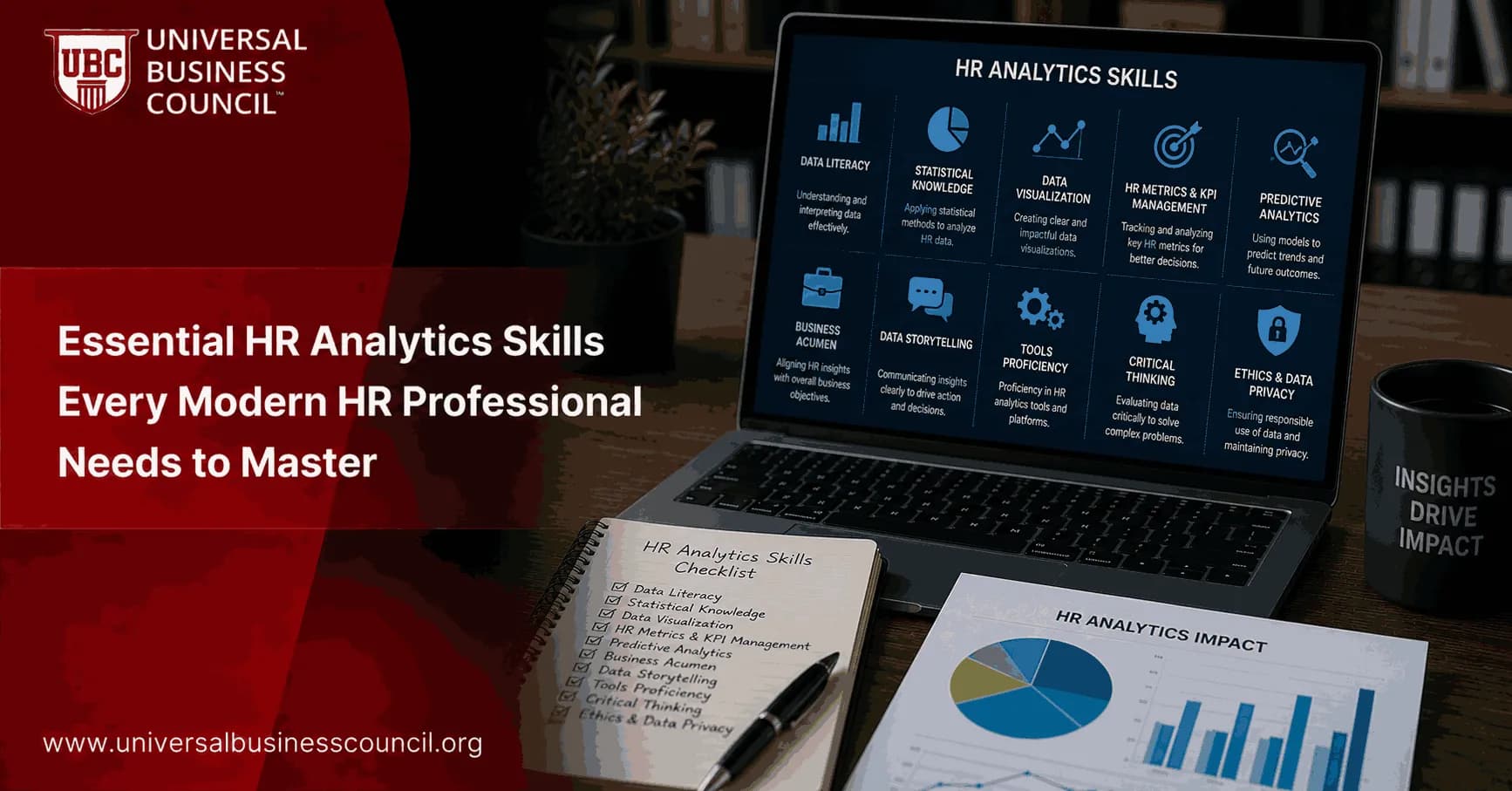
HR analytics skills are now baseline requirements for modern HR work, not a specialist extra. If you advise leaders on hiring, retention, engagement, workforce planning, pay equity, or performance, you need to read the data, question it, and turn it into a decision someone can act on.
The shift is visible across the profession. Research cited by HR commentators suggests a majority of HR leaders still struggle to use analytics effectively. Many HR professionals can open a dashboard, but fewer feel confident interpreting patterns, challenging assumptions, or making a recommendation from the numbers. That gap matters. Leaders no longer ask HR only for policies. They ask: what is happening, why is it happening, and what should we do next?

Why HR Analytics Skills Matter Now
People analytics has moved into daily HR practice because workforce decisions have become more expensive, more visible, and more data-rich. Recruitment costs are under scrutiny. Voluntary turnover can damage customer service and productivity. Skills shortages stall transformation plans. AI tools are entering hiring, internal mobility, learning, and performance management.
To be blunt, a monthly headcount report is not enough anymore. You need to connect HR metrics to business questions. Which roles are hardest to replace? Which teams are losing high performers? Where is manager capability driving engagement scores down? Which skills will be missing six months from now?
That is where HR data analytics earns its place. The best HR teams do not drown leaders in charts. They clarify choices.
As the role becomes increasingly strategic, the expectations of an HR Professional now extend well beyond policy administration to include workforce planning, data interpretation, and business decision support.
1. Data Literacy and Analytical Thinking
Data literacy is the foundation of every other HR analytics skill. It means you can read, understand, question, and explain workforce data in context.
At a practical level, you should be able to:
Interpret common HR metrics such as turnover, retention, absenteeism, time to hire, offer acceptance rate, engagement, and internal mobility.
Spot data quality problems, including missing fields, duplicate employee records, inconsistent job titles, and outdated manager assignments.
Ask whether a metric actually answers the business question.
Separate correlation from causation.
Explain what the data can and cannot prove.
Here is the detail that often changes the meeting. Annual turnover is usually too broad. Look at resignation rates by tenure band, role family, manager, and location. A spike among employees with 6 to 18 months of service tells a very different story from retirements in a long-tenured group.
Good HR analytics starts with better questions. Do not ask, what does the dashboard show? Ask, which decision are we trying to improve?
2. Core Analytical and Statistical Skills
You do not need to become a data scientist to be credible in HR analytics. You do need enough statistical judgment to avoid bad conclusions.
Build comfort with three levels of analysis:
Descriptive analysis: What happened? Example: voluntary turnover increased from one quarter to the next.
Diagnostic analysis: Why might it have happened? Example: exit data shows higher resignations in one role family after a compensation change.
Predictive analysis: What is likely to happen next? Example: workforce planning models forecast hiring needs based on growth, productivity, and historical attrition.
Useful statistical concepts include averages, medians, distributions, sample size, significance, outliers, and bias. These are not academic details. They stop you from overreacting to tiny samples or presenting a team of eight people as if it represents the whole company.
Simple techniques go a long way:
Trend analysis for engagement, absence, and turnover.
Segment comparisons by department, tenure, gender, location, or manager group.
Correlation checks between engagement scores and retention.
Basic regression analysis where data quality and sample size support it.
Analytics should support HR judgment, not replace it. That is the right position. Employee data rarely gives a clean answer on its own. Pair the numbers with manager interviews, employee listening, case notes, and business context.
3. Tool Proficiency and Digital Fluency
Modern HR professionals need practical tool skills. You should be comfortable working with HRIS reports, applicant tracking systems, learning platforms, survey tools, and business intelligence dashboards.
Common platforms include Workday, SAP SuccessFactors, Oracle HCM, BambooHR, Greenhouse, Lever, Microsoft Excel, Power BI, Tableau, Google Looker Studio, Qualtrics, Culture Amp, and Visier. You do not need mastery of all of them. You do need to understand how data flows from systems into reports.
At minimum, learn to:
Export and clean basic workforce data.
Use pivot tables and lookup functions in Excel or Google Sheets.
Create simple charts that show trends clearly.
Read dashboard filters and understand how they change the result.
Check whether employee counts are based on headcount, FTE, active employees, or payroll records.
AI is now embedded in many HR platforms, especially in candidate matching, skills inference, internal mobility, and workforce planning. You do not need to build machine learning models, but you must know enough to challenge their outputs. Ask what data trained the model, whether protected characteristics could be indirectly influencing recommendations, and how decisions are reviewed by humans.
4. Business Acumen and Strategic Alignment
HR analytics becomes powerful when it links workforce patterns to business outcomes. A dashboard full of HR activity metrics may look impressive, but leaders care about revenue, cost, risk, productivity, customer experience, and growth capacity.
Translate HR data into business language:
Turnover in critical sales roles can affect pipeline coverage and customer relationships.
Long time to fill in engineering roles can delay product roadmaps.
High absence in frontline teams can increase overtime cost and service risk.
Poor internal mobility can increase hiring spend and slow skills development.
Pay equity gaps can create legal, reputational, and retention risk.
This is where HR business partners stand out. Do not present attrition as an HR issue only. Show which business objective is at risk. If a customer support team has rising churn among trained agents, connect that to onboarding cost, service levels, and manager capacity.
If you are building this capability, the Universal Business Council programmes in human resources, business management, leadership, and analytics offer structured pathways for deeper study.
These capabilities closely reflect the work of an HR Analytics Expert, who combines workforce data, business context, and analytical thinking to help organizations make better people decisions.
5. Data Storytelling and Stakeholder Communication
Data storytelling is not decoration. It is the skill that turns analysis into action.
Most executives do not want twenty slides of charts. They want a clear answer:
What changed?
Why does it matter?
What are the options?
What do you recommend?
What risk remains?
A useful HR analytics story has four parts: context, evidence, interpretation, and action. Instead of saying, engagement is down 7 points, say this: Engagement fell most sharply among first-line supervisors in the logistics group. The lowest-scoring items were workload, recognition, and confidence in senior leadership. This group also has rising absence and higher regrettable turnover. I recommend a manager workload review, targeted listening sessions, and a 60-day follow-up pulse survey.
Keep visuals simple. Use line charts for trends, bar charts for comparisons, and tables only when the reader needs exact values. Avoid 3D charts. Please. They make serious data harder to read.
6. Data Governance, Ethics, and Privacy
HR data is sensitive. It can include pay, performance, demographics, health-related absence, disciplinary records, grievances, and employee relations cases. Mishandling it damages trust fast.
Strong HR analytics skills include knowing the rules and the ethics. You should understand:
Who is allowed to access different categories of employee data.
When data should be anonymized or aggregated.
How long records should be retained.
Which analyses could expose individuals in small groups.
How privacy laws such as GDPR affect employee data use.
How bias can enter hiring, promotion, pay, and performance analytics.
Employee relations analytics can help spot incident patterns, complaint hotspots, and systemic risks. That work has real value, but it must be handled carefully. Analytics should improve fairness, safety, and decision quality. It should not become surveillance dressed up as insight.
Be transparent where you can. Tell employees what data is collected, why it is used, and how it supports better workforce decisions.
7. Change Management and Adoption Skills
Many HR analytics projects fail for a simple reason: managers do not change their behavior. They receive dashboards, nod in the meeting, and go back to gut-feel decisions.
Your job is not just to produce analysis. You need to help people use it.
That requires change management skills:
Coach managers on how to read their team data.
Explain metrics without making managers feel attacked.
Agree on actions, owners, and timelines.
Follow up after interventions.
Work with IT, finance, legal, and operations to align definitions.
The bigger shift is from reporting-centered work to action-centered people analytics. That shift is critical. If your attrition dashboard does not change retention plans, manager coaching, workforce planning, or job design, it is just reporting.
As HR teams rely more on AI, analytics platforms, and digital HR systems, a Tech Certification can help professionals strengthen their understanding of emerging technologies and the digital tools shaping modern workforce management.
How to Build Your HR Analytics Skills
Start with a focused development plan. Do not try to learn every tool and model at once.
Master the core HR metrics. Know the formulas, data sources, and common interpretation mistakes.
Improve spreadsheet fluency. Pivot tables, filters, XLOOKUP, charts, and basic data cleaning are still everyday skills.
Study business basics. Learn how your organization measures margin, productivity, customer retention, risk, and growth.
Practice with one real problem. Pick turnover, hiring funnel leakage, absence, engagement, or internal mobility.
Build one clear story. Present the issue, evidence, recommendation, and next action.
Learn responsible AI use. Understand bias, explainability, validation, and human review in people decisions.
Pursue structured learning. Universal Business Council HR, management, and analytics courses support deeper study and credential planning.
The HR Analytics Skills That Will Define Career Growth
The next stage of HR will be shaped by AI-assisted analysis, skills-based workforce planning, internal talent marketplaces, pay transparency, and stronger expectations for evidence-based decisions. HR professionals who can combine data literacy, business acumen, ethical judgment, and clear communication will be better prepared for those demands.
Start with one workforce question your leaders already care about. Pull the data. Check the definitions. Segment the results. Find the pattern. Then recommend one action that can be tested in the next 30 to 60 days. That is how HR analytics skills become real capability, not just a line on a development plan.
Professionals preparing for the future of HR may also benefit from a Deeptech Certification to build a broader understanding of AI, automation, and other advanced technologies that are transforming workforce planning and people analytics.
FAQs
1. What Are HR Analytics Skills?
HR analytics skills are the abilities needed to collect, analyze, interpret, and communicate workforce data to support better hiring, employee engagement, retention, performance management, and strategic business decisions.
2. Why Are HR Analytics Skills Important for HR Professionals?
HR analytics helps professionals make data-driven decisions instead of relying solely on intuition. It improves workforce planning, talent management, employee retention, and overall organizational performance.
3. What Are the Most Important HR Analytics Skills to Learn?
Modern HR professionals should master data analysis, reporting, Excel, HR metrics, workforce planning, statistical thinking, data visualization, communication, and business strategy.
4. How Does Data Analysis Help HR Professionals?
Data analysis enables HR teams to identify workforce trends, evaluate employee performance, measure recruitment effectiveness, and make informed decisions that align with business objectives.
5. Why Is Excel Still an Essential HR Analytics Skill?
Excel remains one of the most widely used HR tools for organizing employee data, creating reports, performing calculations, building dashboards, and analyzing workforce metrics efficiently.
6. What HR Metrics Should Every HR Professional Understand?
Key HR metrics include employee turnover rate, retention rate, time-to-hire, cost-per-hire, absenteeism, employee engagement, productivity, internal mobility, and training effectiveness.
7. How Important Is Data Visualization in HR Analytics?
Data visualization helps HR professionals present complex workforce information through charts, dashboards, and reports, making insights easier for managers and executives to understand.
8. What Role Does Business Intelligence Play in HR Analytics?
Business intelligence tools help HR teams combine workforce data from multiple sources, create interactive dashboards, monitor KPIs, and support strategic workforce planning.
9. How Can HR Professionals Improve Workforce Planning with Analytics?
HR analytics helps forecast hiring needs, identify skill gaps, monitor workforce trends, and align staffing strategies with future business requirements.
10. Why Is Predictive Analytics Becoming Important in HR?
Predictive analytics enables HR teams to anticipate employee turnover, hiring demand, performance trends, and future workforce challenges before they affect business operations.
11. What Statistical Skills Should HR Professionals Learn?
Basic knowledge of averages, percentages, correlations, trend analysis, forecasting, and data interpretation helps HR professionals analyze workforce data more effectively.
12. How Does Artificial Intelligence Support HR Analytics?
AI automates data analysis, identifies workforce patterns, predicts employee behavior, generates reports, and provides insights that help HR teams make faster and smarter decisions.
13. What Software Tools Should HR Analytics Professionals Learn?
Popular tools include Microsoft Excel, Power BI, Tableau, Google Looker Studio, SAP SuccessFactors, Workday, Oracle HCM, BambooHR, and other HRIS platforms.
14. Why Is Data Storytelling Important in HR Analytics?
Data storytelling helps HR professionals explain workforce insights clearly by combining data, visuals, and business context to support better decision-making by leadership teams.
15. How Can HR Professionals Develop Strong Analytical Thinking?
Analytical thinking improves by asking the right questions, interpreting workforce trends, validating findings with data, and connecting HR insights to measurable business outcomes.
16. How Does HR Analytics Improve Employee Retention?
By analyzing engagement surveys, performance data, compensation trends, and turnover patterns, HR can identify retention risks and implement proactive employee retention strategies.
17. What Challenges Do HR Professionals Face When Using Analytics?
Common challenges include poor data quality, disconnected HR systems, privacy concerns, limited analytical expertise, resistance to change, and difficulty translating data into actionable insights.
18. How Can HR Professionals Start Learning HR Analytics?
Begin by mastering Excel and HR metrics, learning data visualization tools, studying workforce analytics, practicing with HR datasets, and gaining hands-on experience through real-world projects.
19. What Common Mistakes Should HR Professionals Avoid in HR Analytics?
Avoid relying on incomplete or outdated data, focusing only on reports without business context, ignoring employee privacy, and presenting data without actionable recommendations. Effective HR analytics combines accurate data with strategic decision-making.
20. How Will HR Analytics Skills Shape the Future of Human Resources?
HR analytics is becoming a core competency for modern HR professionals. As organizations increasingly rely on AI, workforce data, and predictive insights, professionals with strong analytical skills will be better equipped to improve hiring, workforce planning, employee experience, and business performance while contributing more strategically to organizational success.
Related Articles
View All
Hr
From HR Generalist to HR Analytics Expert: Career Path, Skills, and Certifications
A practical guide for moving from HR generalist to HR analytics expert, including skills, tools, career stages, use cases, and certification planning.

Hr
HR Analytics Dashboards: Key Metrics Every HR Expert Should Track
Learn the HR analytics dashboard metrics that matter most, from hiring and retention to engagement, learning, productivity, and employee relations risk.

Hr
How HR Analytics Supports Strategic Talent Management and Succession Planning
Learn how HR analytics strengthens strategic talent management, improves succession planning, reduces leadership risk, and supports fairer workforce decisions.
Trending Articles
The Role of Blockchain in Ethical AI Development
How blockchain technology is being used to promote transparency and accountability in artificial intelligence systems.
AWS Career Roadmap
A step-by-step guide to building a successful career in Amazon Web Services cloud computing.
Top 5 DeFi Platforms
Explore the leading decentralized finance platforms and what makes each one unique in the evolving DeFi landscape.