

How to Measure Employee Engagement with HR Analytics Tools
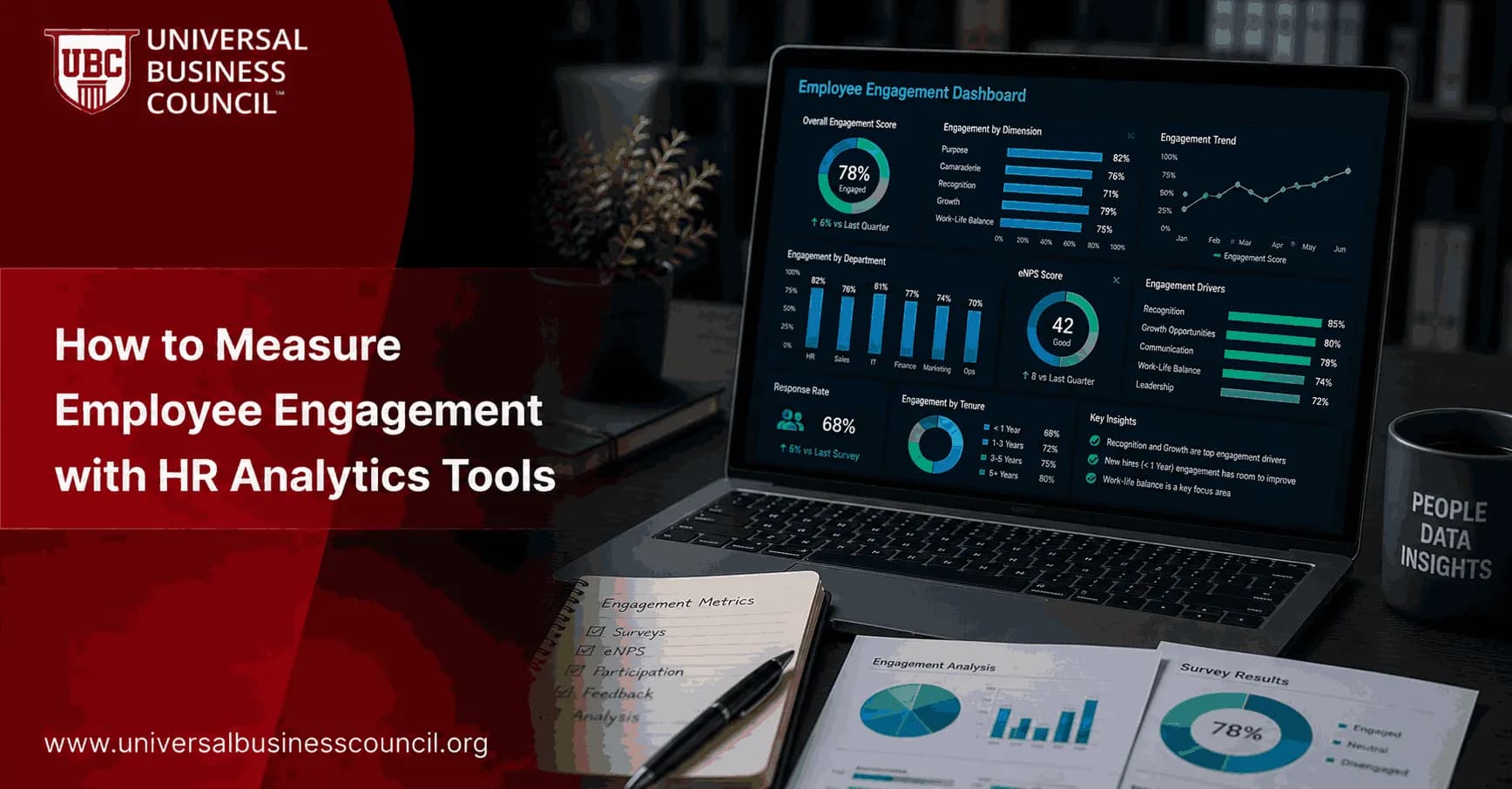
Measuring employee engagement with HR analytics tools means combining survey feedback, HRIS data, performance indicators, and predictive analytics to understand how employees feel, where risk is building, and which actions are likely to improve retention and productivity. The work is not just running a survey. It is building a measurement system managers can actually use.
As organizations place greater emphasis on workforce experience, the role of an HR Professional increasingly involves turning employee feedback into practical actions that support engagement, retention, and business performance.

Done well, HR analytics turns scattered signals - pulse survey answers, eNPS, absenteeism, internal mobility, turnover, recognition data, and open-text comments - into evidence for decisions. Done badly, it produces a dashboard no one opens after the board meeting.
What Employee Engagement Analytics Measures
Employee engagement analytics is the structured analysis of how employees experience their work, team, manager, and organization. It connects attitude data with behavior and outcomes.
You are not only asking, Are people satisfied? You are asking sharper questions:
Do employees understand the company's direction?
Do they trust their manager?
Are workloads sustainable?
Do people see a future here?
Which engagement drivers predict turnover, performance, or customer outcomes?
This is where HR analytics tools earn their keep. They combine traditional employee listening with segmentation, trend analysis, sentiment analysis, and, in more mature teams, predictive models. The principle worth holding onto is criterion-related validity: a good pulse question should help predict future behavior and business results, not just describe how someone felt on a Tuesday afternoon.
Start with the Right Engagement Metrics
There is no single perfect engagement metric. To be blunt, eNPS alone is too thin. It works as a headline number, but it can hide the real issue. A team might recommend the company while still struggling with workload, burnout, or a weak manager relationship.
Use a balanced set of sentiment, behavior, and outcome measures.
Survey-Based Metrics
Employee Net Promoter Score (eNPS): Calculated as the percentage of promoters minus the percentage of detractors who answer whether they would recommend the company as a place to work.
Engagement score: Usually built from Likert-scale questions on commitment, energy, purpose, recognition, growth, and manager support.
Pulse survey scores: Short monthly or quarterly checks on targeted topics such as workload, psychological safety, change communication, or role clarity.
Open-text sentiment: Themes and tone from written feedback, analyzed manually or with sentiment analysis tools.
HR Outcome Metrics
These are not engagement scores by themselves, but they tell you whether engagement is turning into behavior.
Turnover rate: The percentage of employees who leave during a defined period.
Retention rate: The percentage who stay, especially in critical roles or high-performing groups.
Absenteeism and punctuality: Repeated absence can signal workload strain, disengagement, or health issues.
Internal mobility: Movement into new roles often shows whether employees see career paths inside the organization.
Learning participation: Course completion and post-training feedback can show appetite for growth.
Recognition activity: Peer recognition frequency and reach can reveal how visible appreciation is across teams.
Performance and productivity indicators: Quality, output, sales results, customer satisfaction, or service metrics, depending on the role.
A practical warning: never compare a team of six employees with a division of 600 as if the numbers carry the same weight. Small groups swing wildly. In real engagement reviews, first-time managers tend to overreact to one low comment or a single 1 on a 5-point scale. Always check sample size, response rate, and trend before you act.
Build a Survey Strategy That People Will Answer
Most organizations need more than one survey type. Annual surveys give breadth. Pulse surveys give speed. Lifecycle surveys give context.
Annual Engagement Survey
Use the annual survey to establish a baseline and assess core themes across the organization. Keep it focused. A 30 to 50 question survey is usually enough if the questions are well written. Include open-text questions, but do not ask for essays on every page.
Strong annual survey themes include:
Leadership trust
Manager effectiveness
Communication quality
Recognition
Growth and development
Workload and wellbeing
Inclusion and belonging
Intent to stay
Pulse Surveys
Pulse surveys should be short, often under 10 questions. Run them monthly or quarterly, not whenever leadership gets anxious. That mistake burns trust quickly.
Good pulse questions are specific. Ask I have the information I need to do my job well rather than Communication is good here. The first version gives a manager something to fix.
Lifecycle and Trigger-Based Surveys
Send surveys at moments that shape engagement:
30, 60, and 90 days after hire
After promotion or internal transfer
After a manager change
After a major reorganization
After training programs
During exit or, better, through stay interviews before someone resigns
These surveys help you avoid one of the classic HR analytics errors: treating every employee as if they are in the same experience stage.
Connect HR Analytics Tools to Your HRIS
An engagement platform becomes far more valuable when it connects to your HRIS and other systems. Survey results alone tell you what people report. Integrated HR analytics shows what happens next.
Useful integrations include:
HRIS data: Department, location, tenure, job family, manager, employment type, and demographic fields where legally and ethically appropriate.
Performance systems: Ratings, goal achievement, quality measures, sales output, or customer feedback.
Learning platforms: Course participation, completion, and post-training survey results.
Recognition platforms: Recognition frequency, distribution, and participation.
Internal communication tools: Open rates, click rates, town hall attendance, and response patterns.
The point of joining these sources is to support proactive decisions on culture, retention, and workplace quality. The key word is proactive. If HR only reviews engagement data after resignations rise, the tool is being used too late.
Use Segmentation to Find the Real Engagement Problem
The organization-wide engagement score is a starting point, not the answer. Segment your data.
Useful cuts include:
Department or business unit
Location or region
Manager
Tenure band
Role type, such as frontline, technical, sales, or corporate
New hires versus long-tenured employees
High performers or critical roles, where policy permits
Segmentation often exposes problems that averages hide. A company may show a steady engagement score overall while employees with less than one year of tenure report poor role clarity. That points to onboarding and manager communication, not a broad culture campaign.
Be careful with privacy. Do not report results for tiny groups where people can be identified. A common approach is to suppress reporting below a minimum response count, though the exact number should be set with legal, privacy, and employee relations guidance.
Apply Sentiment Analysis, but Read the Comments Yourself Too
AI and machine learning can help analyze open-text feedback at scale. These tools identify recurring themes, tone, and emotional patterns across thousands of comments. That is genuinely useful.
But do not outsource judgment. Sentiment tools can miss sarcasm, local context, and coded language. A comment like Another exciting reorg, lucky us may not score correctly unless the model understands the context.
Use sentiment analysis to sort and prioritize. Then have HR business partners and managers read representative comments. The best insight often comes from the sentence that does not fit the chart.
Link Engagement to Business Outcomes
Once you have clean data, test relationships between engagement and outcomes. Do teams with higher role clarity have lower turnover? Does manager trust track with customer satisfaction? Are employees who join learning programs more likely to move internally instead of leaving?
Start simple:
Select one engagement driver, such as manager support.
Select one outcome, such as voluntary turnover.
Compare trends by team or tenure group.
Control for obvious factors, such as location or role type, where possible.
Turn the finding into one manager action and measure again.
Do not chase complicated predictive models before your data is clean. I would rather trust a clear trend with a 78 percent response rate than an impressive model built on stale HRIS fields and vague survey questions.
Developing this level of analytical judgment is a hallmark of an HR Analytics Expert, who combines workforce data, business context, and evidence-based decision-making to improve employee engagement and organizational outcomes.
Turn Dashboards into Manager Action
Dashboards do not improve engagement. Managers do.
Your HR analytics tool should give managers clear, practical views:
Top three strengths
Top three risks
Trend versus last survey
Comparison to a relevant internal benchmark
Comment themes
Suggested discussion questions
Action tracking
Require managers to discuss results with their teams. Not defend them. Discuss them. A simple format works well:
Share two findings.
Ask the team what is behind the numbers.
Choose one action for the next 30 days.
Assign an owner.
Report back before the next pulse survey.
This follow-through matters. Employees stop responding when surveys feel like a ritual with no consequence.
Keep the Data Ethical and Useful
Engagement analytics touches sensitive employee data. Set rules before you scale.
Explain what data is collected and why.
Protect anonymity in survey reporting.
Limit access by role.
Use demographic analysis responsibly.
Do not use engagement scores to punish individual managers without context.
Review questions for bias and clarity.
Retire questions that do not predict or explain anything useful.
Good governance protects trust and improves data quality. Employees answer honestly when they believe the process is fair.
A Practical Framework to Measure Employee Engagement with HR Analytics Tools
Use this sequence if you are building or improving your measurement approach:
Define engagement: Decide whether you mean commitment, discretionary effort, belonging, satisfaction, or a combination.
Select core metrics: Include eNPS, engagement score, retention, turnover, absenteeism, learning participation, internal mobility, recognition, and performance indicators.
Design the listening system: Combine annual surveys, pulse surveys, and lifecycle surveys.
Integrate data sources: Connect engagement tools with HRIS, performance, learning, recognition, and communication platforms.
Segment results: Review patterns by team, tenure, location, manager, and role type.
Analyze drivers: Use trend analysis, correlation, sentiment analysis, and predictive modeling where data quality supports it.
Act through managers: Convert insight into team-level actions with deadlines.
Measure again: Track whether the action changed the score, behavior, or outcome.
As HR teams increasingly rely on AI, analytics platforms, and digital workplace technologies, a Tech Certification can help professionals strengthen their understanding of the tools and systems that support modern people analytics.
Skills HR Teams Need Next
HR professionals who want to use engagement analytics well need more than survey administration skills. You need data literacy, privacy judgment, consulting skills, and the confidence to challenge weak interpretations.
For internal development, link this work to relevant Universal Business Council certifications and courses in HR analytics, leadership, management, and organizational performance. These are natural starting points for professionals building capability in people analytics and evidence-based HR decision making.
Next Step
Pick one engagement question this week and test whether it connects to a real outcome, such as regretted turnover, absenteeism, or internal mobility. If it does not help explain or predict anything, rewrite it. Then build your HR analytics dashboard around the questions that actually guide action.
Professionals preparing for the future of HR may also benefit from a Deeptech Certification to build a broader understanding of AI, automation, and other advanced technologies that are reshaping employee engagement, workforce analytics, and organizational decision-making.
FAQs
1. What Is Employee Engagement in Human Resources?
Employee engagement measures how committed, motivated, and emotionally connected employees are to their work and the organization. Engaged employees are typically more productive, collaborative, and likely to remain with the company.
2. Why Is Employee Engagement Important for Businesses?
High employee engagement improves productivity, employee retention, customer satisfaction, innovation, and overall business performance while reducing absenteeism and turnover costs.
3. How Do HR Analytics Tools Measure Employee Engagement?
HR analytics tools collect and analyze data from employee surveys, performance reviews, attendance records, feedback platforms, recognition programs, and workplace interactions to measure engagement levels.
4. What HR Metrics Are Used to Measure Employee Engagement?
Common engagement metrics include employee satisfaction scores, engagement survey results, absenteeism rate, turnover rate, retention rate, productivity, participation rates, and employee Net Promoter Score (eNPS).
5. What Is an Employee Engagement Survey?
An employee engagement survey gathers feedback about job satisfaction, leadership, communication, workplace culture, career development, and employee well-being to help organizations identify improvement opportunities.
6. What Is Employee Net Promoter Score (eNPS)?
Employee Net Promoter Score (eNPS) measures how likely employees are to recommend their organization as a place to work. It is a widely used indicator of employee loyalty and workplace satisfaction.
7. How Can HR Analytics Improve Employee Retention?
HR analytics identifies trends that contribute to employee turnover, helping organizations address workplace issues, improve engagement strategies, and retain top talent before problems escalate.
8. How Does AI Help Measure Employee Engagement?
AI analyzes workforce data, identifies engagement patterns, detects early signs of disengagement, and provides predictive insights that help HR teams make proactive decisions.
9. Can HR Analytics Predict Employee Disengagement?
Yes. Predictive HR analytics can identify warning signs such as declining performance, increased absenteeism, low survey scores, and reduced participation, allowing HR to intervene early.
10. How Does Employee Feedback Improve HR Analytics?
Continuous employee feedback provides valuable insights into workplace experiences, helping HR teams understand employee needs, improve engagement strategies, and make data-driven improvements.
11. What Role Does Workforce Analytics Play in Employee Engagement?
Workforce analytics combines data from multiple HR systems to identify trends, monitor employee behavior, evaluate engagement initiatives, and support better workforce planning.
12. Which HR Analytics Tools Are Commonly Used to Measure Engagement?
Popular tools include Microsoft Viva Insights, Qualtrics, Culture Amp, Workday, SAP SuccessFactors, BambooHR, Microsoft Power BI, Tableau, and Google Looker Studio.
13. How Often Should Employee Engagement Be Measured?
Many organizations conduct comprehensive engagement surveys annually or quarterly, while pulse surveys and HR analytics dashboards provide ongoing insights throughout the year.
14. What Factors Influence Employee Engagement Scores?
Leadership quality, communication, recognition, career development, work-life balance, compensation, workplace culture, management support, and learning opportunities all affect engagement.
15. How Can Managers Use HR Analytics to Improve Engagement?
Managers can use analytics to identify team challenges, monitor employee sentiment, recognize achievements, provide timely feedback, and create personalized development plans.
16. What Challenges Do Organizations Face When Measuring Employee Engagement?
Common challenges include low survey participation, inconsistent data, employee privacy concerns, survey bias, poor follow-up actions, and difficulty interpreting engagement metrics.
17. How Can Businesses Build an Employee Engagement Strategy Using HR Analytics?
Organizations should define engagement goals, collect reliable employee data, monitor key metrics, act on feedback, communicate improvements, and continuously evaluate engagement initiatives.
18. How Can HR Measure the Success of Employee Engagement Programs?
Success can be measured through higher engagement scores, improved employee retention, lower absenteeism, increased productivity, stronger internal mobility, and better employee satisfaction over time.
19. What Common Mistakes Should HR Teams Avoid When Measuring Engagement?
Avoid surveying employees without acting on feedback, focusing only on one metric, collecting inconsistent data, ignoring manager involvement, and overlooking employee privacy. Analytics is most valuable when insights lead to meaningful workplace improvements.
20. How Will HR Analytics Shape the Future of Employee Engagement?
HR analytics will continue to transform employee engagement through AI-powered insights, predictive analytics, real-time feedback, and personalized employee experiences. Organizations that use workforce data effectively will be better equipped to improve engagement, strengthen workplace culture, retain top talent, and build a more productive and resilient workforce.
Related Articles
View All
Hr
Top HR Analytics Tools and Technologies for Workforce Decision-Making
Compare leading HR analytics tools, core technologies, metrics, governance needs, and selection steps for better workforce decision-making.

Hr
Using Predictive Analytics to Reduce Employee Turnover and Improve Retention
Learn how predictive analytics helps HR identify attrition risk, target retention actions, reduce turnover costs, and improve workforce planning.

Hr
From HR Generalist to HR Analytics Expert: Career Path, Skills, and Certifications
A practical guide for moving from HR generalist to HR analytics expert, including skills, tools, career stages, use cases, and certification planning.
Trending Articles
The Role of Blockchain in Ethical AI Development
How blockchain technology is being used to promote transparency and accountability in artificial intelligence systems.
AWS Career Roadmap
A step-by-step guide to building a successful career in Amazon Web Services cloud computing.
Top 5 DeFi Platforms
Explore the leading decentralized finance platforms and what makes each one unique in the evolving DeFi landscape.