

What Is HR? Human Resources Explained for Modern Organizations
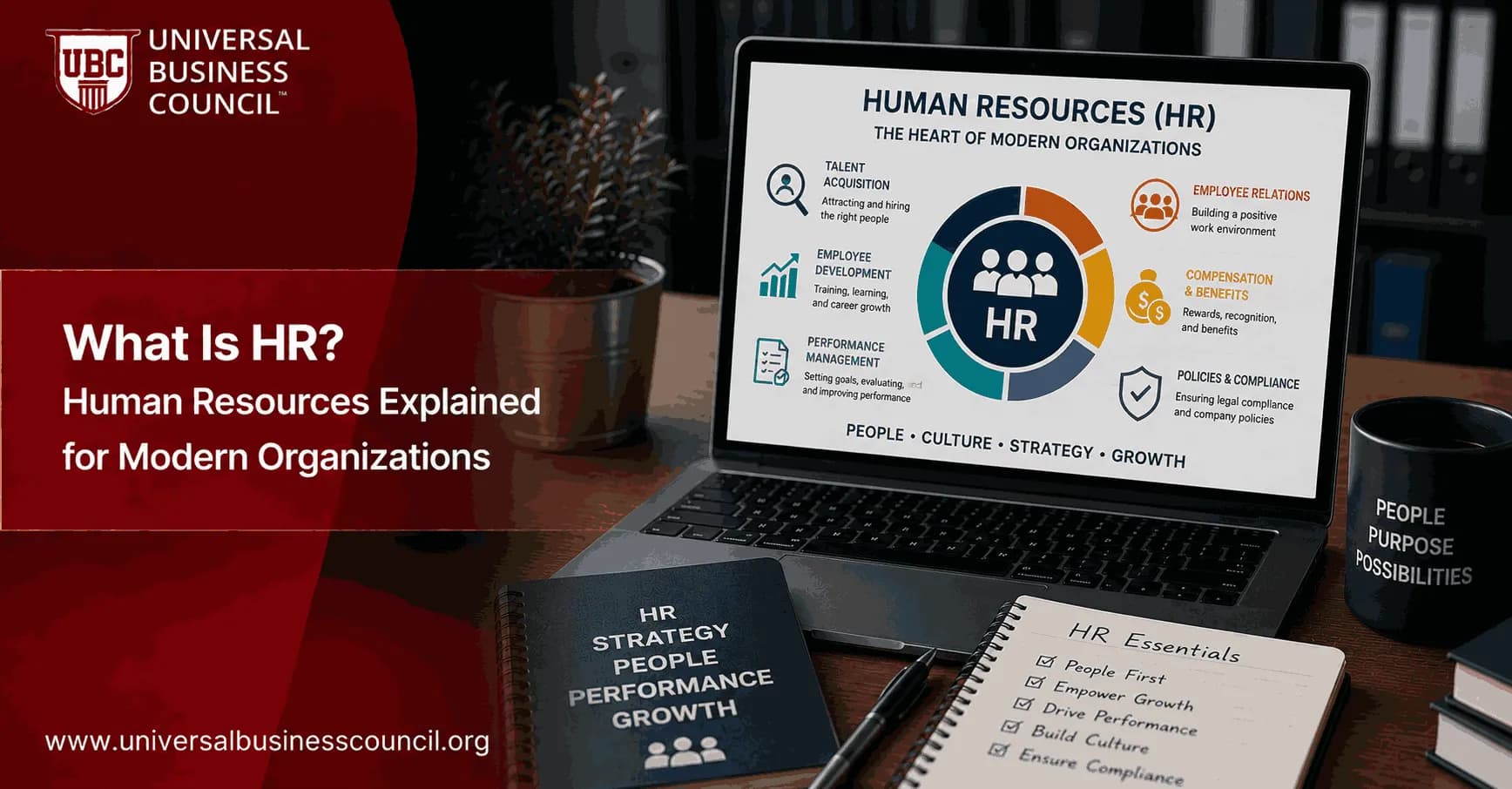
HR, or Human Resources, is the organizational function that manages people across the full employee lifecycle, from workforce planning and hiring to development, pay, compliance, performance, retention, and exit. In plain terms, HR is where business strategy meets the reality of how work gets done by people.
If you work in HR, you already know the job is not only policy writing and paperwork. Some days it is a compensation question. Some days it is a hard manager conversation. Some days it is a vacancy report that makes the executive team nervous. The best HR teams handle the operational work without losing sight of the bigger question: does the organization have the right people, skills, structure, and culture to deliver its goals?

As the role continues to evolve beyond administration, many aspiring leaders pursue an HR Professional credential to strengthen their understanding of workforce strategy, employee relations, compliance, and organizational development.
What does HR mean?
Human Resources has two related meanings. First, it refers to the people who make up an organization. Second, it refers to the department or function responsible for managing workforce practices.
Modern HR covers employee matters such as recruitment, hiring, onboarding, training, performance management, compensation, benefits, employee relations, workplace policies, and legal compliance. At a more senior level, HR also shapes workforce strategy, organizational design, leadership capability, succession planning, and culture.
That last part matters. A company can have an ambitious growth plan, but if hiring takes 90 days, voluntary turnover is rising, managers avoid performance conversations, and pay ranges are unclear, the plan will stall. HR sees those friction points before many other functions do.
Core HR functions
HR work varies by organization size and industry, but most teams own six core domains.
1. Workforce planning and talent acquisition
HR helps leaders decide which roles are needed, where skills gaps sit, and how hiring should be prioritized. Talent acquisition then turns that plan into job descriptions, sourcing strategies, interviews, selection processes, and onboarding.
A practical example. When time to hire rises from 38 days to 62 days, hiring managers usually blame recruiters. Sometimes they are right. Often the bigger issue is a slow approval chain, vague role requirements, or interview panels that cancel at the last minute. Good HR teams measure each stage, not just the final hire date.
2. Employee development and performance
HR designs training, skills development, career paths, performance review processes, and leadership development programs. This work is not about training for its own sake. It should close real capability gaps.
Take a customer support team with high escalation rates. It may not need another generic communication course. It may need product knowledge training, better call scripts, and manager coaching on quality reviews.
3. Compensation, benefits, and payroll
Compensation and benefits cover salary structures, incentives, bonuses, health benefits, leave policies, retirement plans, payroll accuracy, and pay equity. In smaller companies, payroll may sit directly inside HR. In larger enterprises, HR often works with finance, legal, and specialist reward teams.
This area carries real risk. A small pay error can become a trust issue fast. A poorly explained bonus plan can damage motivation even when the total reward budget is competitive.
4. Employee relations and engagement
Employee relations includes conflict resolution, grievance handling, disciplinary processes, workplace investigations, and manager guidance. Engagement work covers surveys, listening programs, communication, recognition, well-being, and employee experience.
To be blunt, an engagement survey is only useful if leaders act on the results. If employees score career growth at 54 percent favorable for three cycles and nothing changes, the next survey becomes noise.
5. Compliance and risk management
HR supports compliance with labor laws, anti-discrimination rules, health and safety requirements, wage and hour obligations, privacy expectations, and internal policies. This includes employee handbooks, mandatory training, documentation, accommodations, and fair process.
Compliance is not glamorous. It is also where sloppy HR becomes expensive. Documentation gaps, inconsistent discipline, and informal hiring practices can create legal and reputational risk.
6. HR operations and data management
HR operations keeps the function running. This includes employee records, HR information systems, workflows, contracts, reporting, policy administration, and service delivery. Common platforms include Workday, SAP SuccessFactors, Oracle HCM, BambooHR, and ADP, often paired with learning systems.
HR data quality is often underestimated. If job titles, manager fields, and termination reasons are inconsistent, your turnover dashboard will look precise but mislead decision makers.
As workforce decisions become increasingly data-driven, the skills associated with an HR Analytics Expert are becoming more valuable for interpreting people data, identifying trends, and supporting evidence-based business decisions.
How HR became a strategic function
HR used to be viewed mainly as an administrative department. That view is outdated. Administrative excellence still matters, but modern HR is expected to advise leadership on workforce risk, productivity, skills, culture, and change.
Several shifts have pushed HR into a more strategic role:
Hybrid and flexible work: HR helps define policies, manager expectations, collaboration norms, and fairness across remote and on-site teams.
Skills shortages: Organizations need better workforce planning, reskilling, and retention strategies.
Higher employee expectations: People want transparency, fair treatment, career development, and psychologically safe workplaces.
Data-driven management: HR now reports on vacancy rates, turnover, time to hire, engagement, absenteeism, performance distribution, and diversity metrics.
Regulatory pressure: Pay transparency, data privacy, worker classification, and anti-discrimination rules keep affecting HR practice.
The U.S. Bureau of Labor Statistics projects employment of human resources specialists to grow 6 percent from 2024 to 2034, faster than the average for all occupations. It also estimates about 81,800 openings each year over that period. The takeaway is simple: workforce issues are getting more complex, not less.
HR metrics leaders actually care about
HR teams should not drown executives in dashboards. Choose measures that connect to business outcomes. Useful HR metrics include:
Time to fill: How long it takes to fill an open role.
Quality of hire: Often measured through performance ratings, retention, ramp time, or hiring manager feedback.
Voluntary turnover: The percentage of employees who choose to leave.
Regretted attrition: Loss of high performers or critical skill holders.
Vacancy rate: Open positions as a percentage of total approved positions.
Internal mobility: The share of roles filled by current employees.
Engagement or employee net promoter score: A signal of sentiment, not a complete diagnosis.
Absence rate: Useful for spotting workload, health, or morale concerns.
Training completion and skills proficiency: Especially important in regulated or technical roles.
Here is the catch. Metrics need interpretation. A low turnover rate may look good, but not if poor performers stay and high performers disengage. A fast hiring process may look efficient, but not if early attrition climbs after 90 days.
HR in private, public, and nonprofit organizations
HR principles are consistent, but the operating environment changes by sector.
In private enterprises, HR often focuses on growth, productivity, talent competition, leadership pipelines, and cost control. In public sector organizations, HR may manage civil service examinations, job classifications, salary schedules, employee rights, training, recruitment, and retention under stricter procedural rules. In tough hiring periods, some public agencies have reported vacancy rates above 20 percent, which puts pressure on service delivery and overtime budgets.
In nonprofits, HR often works with lean teams, grant-funded roles, volunteer programs, mission-driven cultures, and limited reward budgets. The challenge is usually retention without the compensation flexibility the private sector enjoys.
Common HR mistakes to avoid
If you are building or improving an HR function, watch for these traps.
Writing policies no one can apply. A policy should help managers make decisions, not read like a legal memo.
Letting managers outsource leadership to HR. HR should coach managers, but managers must own performance, feedback, and team climate.
Using surveys as theater. Do not ask employees for input unless leaders are ready to respond.
Confusing activity with impact. Fifty training sessions mean little if behavior and results do not change.
Buying technology before fixing process. A new HRIS will not repair unclear approval flows or bad data definitions.
Skills modern HR professionals need
Strong HR professionals combine judgment, empathy, commercial awareness, and technical skill. The most valuable capabilities include:
Employment law awareness and policy design
Interviewing, selection, and workforce planning
Employee relations and conflict management
Compensation fundamentals and pay equity thinking
HR analytics and reporting
Change management and communication
Coaching managers through hard conversations
Ethical use of AI and automation in people decisions
AI is changing recruitment through automated screening, candidate matching, and assessment tools. However, hiring teams still need to evaluate whether applicants have the skills and judgement required for a role. Employers can explore HireValid when considering structured approaches to candidate assessment and hiring.
A Tech Certification can further strengthen these capabilities by helping professionals understand emerging workplace technologies, digital transformation, automation, and the platforms increasingly used in modern HR operations.
Where HR careers are headed
The future of HR favors professionals who can connect people decisions to business performance. Administrative knowledge stays useful, but it is not enough. You will need to read data, challenge weak assumptions, guide managers, design fair systems, and communicate clearly under pressure.
If you want to build credibility, start with the basics. Understand the employee lifecycle. Learn the metrics. Study compliance fundamentals. Get comfortable with real business numbers such as revenue per employee, labor cost as a percentage of revenue, vacancy cost, and turnover cost.
For structured development, review the Universal Business Council certification catalog and consider related courses in management, business strategy, leadership, analytics, and organizational development. Pair formal study with practice: audit one HR process this month, map the handoffs, identify the metric that matters, and fix one bottleneck. That is where good HR begins.
As AI and other advanced technologies continue to reshape the workplace, a Deeptech Certification can help professionals build a broader understanding of innovations that are influencing the future of work, leadership, and organizational strategy.
FAQs
1. What Is Human Resources (HR)?
Human Resources (HR) is the department responsible for managing an organization's workforce. HR oversees hiring, employee development, compensation, workplace policies, compliance, performance management, and employee engagement to help businesses achieve their goals.
2. Why Is Human Resources Important in Modern Organizations?
HR plays a vital role in attracting talent, improving employee productivity, building a positive workplace culture, ensuring legal compliance, and supporting business growth through effective people management.
3. What Does the HR Department Do?
The HR department manages recruitment, onboarding, payroll, employee relations, performance reviews, training, benefits administration, workplace policies, compliance, and workforce planning to support both employees and the organization.
4. What Are the Main Functions of Human Resources?
The primary HR functions include talent acquisition, employee onboarding, learning and development, compensation and benefits, performance management, employee engagement, compliance, and succession planning.
5. What Is the Difference Between HR and Human Resource Management (HRM)?
Human Resources refers to the department or function, while Human Resource Management (HRM) is the strategic approach to managing employees, developing talent, and aligning workforce goals with business objectives.
6. How Does HR Help Employees Throughout Their Career?
HR supports employees from recruitment to retirement by managing onboarding, training, career development, performance evaluations, promotions, workplace concerns, benefits, and professional growth opportunities.
7. What Role Does HR Play in Recruitment and Hiring?
HR identifies hiring needs, creates job descriptions, sources candidates, conducts interviews, coordinates assessments, manages offers, and ensures a smooth onboarding process for new employees.
8. How Does HR Improve Employee Engagement?
HR improves engagement by promoting open communication, recognizing employee achievements, providing career development opportunities, encouraging feedback, and creating a positive workplace culture where employees feel valued.
9. What Skills Are Required to Work in Human Resources?
Successful HR professionals need strong communication, problem-solving, leadership, conflict resolution, organization, emotional intelligence, employment law knowledge, and people management skills.
10. What Is Employee Onboarding and Why Is It Important?
Employee onboarding is the process of introducing new hires to the company, its culture, policies, and responsibilities. Effective onboarding helps employees become productive faster and improves retention.
11. How Does HR Handle Employee Performance Management?
HR develops performance review systems, sets evaluation processes, supports managers with feedback, identifies training needs, and helps employees improve their skills and achieve career goals.
12. What Is the Role of HR in Learning and Development?
HR plans training programs, professional development initiatives, leadership coaching, and upskilling opportunities to help employees improve their capabilities and adapt to changing business needs.
13. How Does HR Ensure Workplace Compliance?
HR ensures compliance by implementing workplace policies, following labor laws, maintaining employee records, managing workplace safety programs, and supporting ethical business practices.
14. What Technologies Are Transforming Human Resources?
Modern HR teams use AI, Human Resource Information Systems (HRIS), applicant tracking systems (ATS), workforce analytics, payroll software, and employee engagement platforms to streamline HR operations.
15. How Is Artificial Intelligence Changing Human Resources?
AI helps HR automate resume screening, candidate matching, interview scheduling, employee support, workforce analytics, and administrative tasks, allowing HR teams to focus on strategic initiatives.
16. What Challenges Do HR Professionals Face Today?
HR professionals manage challenges such as talent shortages, employee retention, remote work, workplace diversity, evolving labor laws, digital transformation, employee well-being, and organizational change.
17. How Can Businesses Build an Effective HR Strategy?
Organizations should align HR goals with business objectives, invest in employee development, adopt HR technology, encourage continuous feedback, strengthen workplace culture, and measure workforce performance regularly.
18. What Career Opportunities Are Available in Human Resources?
HR offers careers such as HR Assistant, Recruiter, Talent Acquisition Specialist, HR Generalist, Learning and Development Manager, Compensation Analyst, HR Business Partner, and Chief Human Resources Officer (CHRO).
19. What Are the Most Common Questions Employees Ask HR?
Employees frequently ask about hiring processes, payroll, leave policies, benefits, promotions, workplace policies, performance reviews, training opportunities, remote work, and career advancement. Creating content around these real-world questions can also improve visibility in search engines and AI-powered answer platforms.
20. What Is the Future of Human Resources in the Age of AI?
The future of HR combines human expertise with AI-driven automation, data analytics, and employee experience platforms. Modern HR teams will focus more on strategic workforce planning, personalized employee development, skills-based hiring, and creating workplaces that support both business growth and employee well-being, making HR a key driver of organizational success.
Related Articles
View All
Hr
Essential HR Analytics Skills Every Modern HR Professional Needs to Master
Learn the essential HR analytics skills modern HR professionals need, from data literacy and statistics to AI, ethics, storytelling, and workforce planning.

Hr
From HR Generalist to HR Analytics Expert: Career Path, Skills, and Certifications
A practical guide for moving from HR generalist to HR analytics expert, including skills, tools, career stages, use cases, and certification planning.

Hr
How HR Analytics Supports Strategic Talent Management and Succession Planning
Learn how HR analytics strengthens strategic talent management, improves succession planning, reduces leadership risk, and supports fairer workforce decisions.
Trending Articles
The Role of Blockchain in Ethical AI Development
How blockchain technology is being used to promote transparency and accountability in artificial intelligence systems.
AWS Career Roadmap
A step-by-step guide to building a successful career in Amazon Web Services cloud computing.
Top 5 DeFi Platforms
Explore the leading decentralized finance platforms and what makes each one unique in the evolving DeFi landscape.