

SXO (Search Experience Optimization) Explained
Introduction: When Rankings Are No Longer Enough
For more than two decades, search engine optimisation focused on a single objective: rank higher. Get the click. Drive the traffic. The metrics were impressions, positions, and click-through rates. Everything that happened after the user arrived on the website was someone else's problem.
In 2026, that model is obsolete. AI Overviews handle 47 percent of informational queries, zero-click searches represent 65 percent of all results, and pages without the right structural architecture are losing ground daily. Getting a high ranking no longer guarantees meaningful traffic. And even for the clicks that do arrive, if your site ranks first but users bounce in five seconds due to poor user experience, you will not rank first for long.

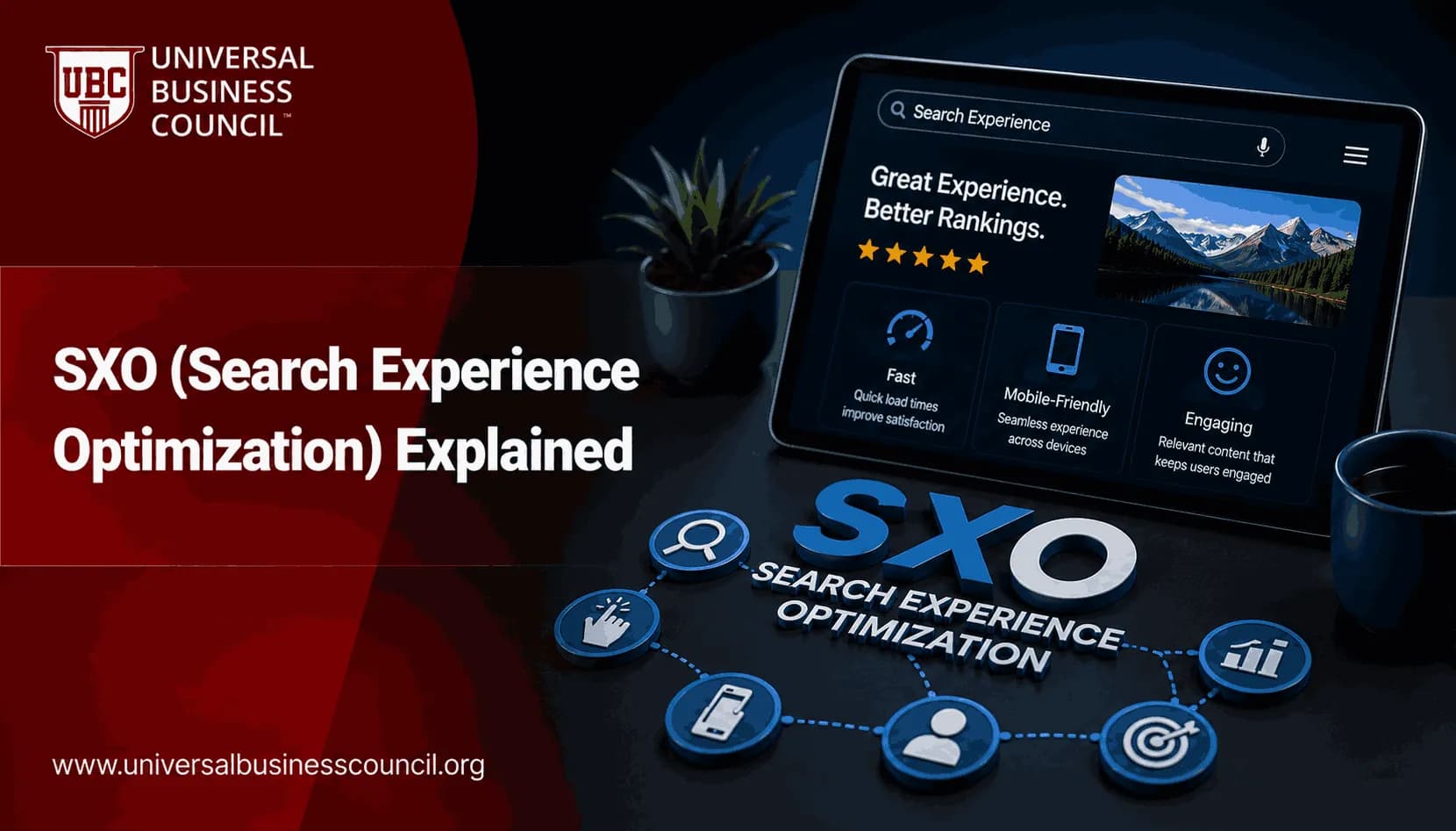
SXO Search Experience Optimisation is the framework that addresses this new reality. SXO is a digital marketing approach that combines Search Engine Optimisation (SEO), user experience (UX), content quality, website performance, and Conversion Rate Optimisation (CRO). It aims to improve the complete journey of a user from entering a search query and clicking a result to exploring the website and completing a desired action.
For digital marketers, SEO specialists, and business owners navigating this shift, structured expertise in SXO is one of the most commercially relevant skills available in 2026. A Certified SEO Expert credential from the Universal Business Council provides the strategic SEO foundation that SXO builds upon verifiable expertise in rankings, on-page optimisation, and search strategy that underpins every successful SXO implementation.
This article covers everything you need to know about SXO: its definition, how it differs from traditional SEO, its four core pillars, the metrics that matter, how to implement it, the tools that support it, and what the AI era has permanently changed about how search success is defined.
What Is SXO? A Direct Definition
Search Experience Optimisation is the convergence of SEO, UX design, and Conversion Rate Optimisation. It shifts success metrics from keyword rankings to post-click behaviour: dwell time, interaction rates, and task completion. Traditional SEO asks "Am I visible?" SXO asks "Am I useful, fast, and engaging?"
Put more simply: SEO gets users to your website. SXO determines what they do when they arrive, and whether they complete the action your business needs them to complete.
SXO is considered an evolution of SEO. While SEO focuses on visibility and ranking, SXO goes a step further and makes optimisations that improve the search experience.
The practical formula is: SXO = SEO + UX + CRO = Revenue. It bridges rankings and revenue by optimising for traffic, experience, and conversion simultaneously.
SXO vs SEO: Understanding the Distinction
Before exploring how to implement SXO, it is important to understand precisely how it differs from traditional SEO and why that difference matters in 2026.
What Traditional SEO Focuses On
Traditional SEO operates primarily at the search engine layer. It optimises title tags, meta descriptions, backlinks, keyword density, and page authority all signals that determine how search engine algorithms rank a page. The success metric is position: ranking in the top three results for target keywords.
What SXO Adds
SXO extends the optimisation surface from the search engine result page to everything that happens after the click. It optimises page load speed, content clarity, visual hierarchy, navigation ease, call-to-action placement, form completion rates, and user satisfaction signals. The success metrics are dwell time, scroll depth, conversion rate, and task completion the signals that indicate a user found what they needed and took meaningful action.
What good is ranking first if visitors bounce in three seconds? What good is a beautiful website nobody finds through search? SXO argues these cannot be separate disciplines.
The relationship is complementary, not competitive. SXO does not replace SEO. It contains SEO as its foundation and extends it into user behaviour, conversion architecture, and content quality.
The Four Pillars of SXO
Every effective SXO strategy is built on four interconnected pillars. Understanding each one and how they interact is the foundation of successful implementation.
Pillar 1 Search Engine Optimisation (SEO)
SEO remains the entry point of any SXO strategy. Without ranking visibility, there is no traffic to optimise the experience for.
In the SXO framework, SEO focuses specifically on intent alignment ensuring that the content of a page matches not just the keyword a user typed but the underlying intent behind that query. If users stay longer and engage more, it signals that your page is valuable. Over time, this helps improve your rankings naturally.
Intent-aligned SEO means understanding whether a query is informational (the user wants to learn), navigational (the user wants to reach a specific destination), commercial (the user is comparing options), or transactional (the user is ready to act). Each intent type requires different content architecture, different depth, and different calls to action.
Pillar 2 User Experience (UX)
SXO seamlessly blends SEO and UX to convert visitors into leads, customers, and loyal advocates. It tracks user behaviours like button clicks and time on site, prioritising quality interactions over raw traffic.
UX in the SXO framework encompasses mobile responsiveness, page speed (measured through Core Web Vitals), navigation clarity, visual hierarchy, content scannability, and the elimination of friction at every stage of the user journey. SXO ensures your website works well on mobile, tablet, and desktop, which is essential today.
Core Web Vitals, specifically Largest Contentful Paint (LCP), Interaction to Next Paint (INP), and Cumulative Layout Shift (CLS) are the primary technical measurements of UX quality in an SXO context. They measure how fast the page loads its main content, how responsive it is to user interaction, and how stable the visual layout is as the page loads.
Pillar 3 Content Quality and Relevance
Content in the SXO framework is not measured by word count or keyword frequency. It is measured by how completely and accurately it satisfies the user's intent at the moment they arrive. This means content that is structured for fast comprehension using headers, bullet points, and clear section structure and that answers the user's question before asking them to take an action.
In the AI search era, your website must be a clear, structured repository of value that an AI agent can navigate and trust on behalf of the user. This means content architecture that supports both human readability and machine interpretation semantic markup, clear factual statements, and structured data where applicable.
Pillar 4 Conversion Rate Optimisation (CRO)
An optimised search experience naturally concludes with a conversion. If users consume your content but do not take action, your SXO strategy is incomplete.
CRO within SXO focuses on three primary levers: the clarity and placement of calls to action, the elimination of friction in conversion flows (particularly forms, checkout processes, and sign-up sequences), and the alignment between the user's intent arriving from search and the action they are being asked to complete.
Vague calls to action like "Click Here" or "Learn More" fail to set expectations. The SXO fix: implement context-aware CTAs. If a user is reading a technical guide on server speed, the CTA should say "Get a Free Site Speed Audit," not just "Contact Us."
Why SXO Became Essential in the AI Era
The shift toward SXO is not a marketing trend. It reflects a structural change in how search works in 2026.
The Zero-Click Search Problem
Over 60 percent of searches now end with no clicks, thanks to AI-driven answers. Google's AI Overviews, featured snippets, People Also Ask boxes, and knowledge panels answer users' questions directly on the results page, eliminating the click entirely for a large proportion of informational queries.
This fundamentally changes the economics of traffic-first SEO. Volume-optimised strategies that relied on ranking for high-impression informational keywords lose their traffic base as AI absorbs those queries. SXO responds by prioritising the quality and conversion value of the clicks that do arrive over the total volume of clicks optimising bottom-of-funnel content where clicks represent high commercial intent.
Agentic Search: The Next Frontier
In 2026 and beyond, we are seeing the rise of agentic search. Users ask their AI assistant to find the best option and complete a purchase on their behalf. In this world, SXO becomes about machine-to-machine trust. Your website must be a clear, structured repository of value that an AI agent can navigate and trust on behalf of the user.
For SXO practitioners, this means structured data implementation, fast server response times, clear product and service schema, and content architecture that an AI agent can parse as efficiently as a human can read.
Google's Algorithm Alignment With SXO
In 2026, Google's algorithm has evolved beyond keywords to measure the entire user journey. Behavioural signals how long users spend on a page, whether they click back to the results immediately, whether they interact with multiple elements now influence ranking in ways they did not a decade ago. This means that strong UX and high engagement are no longer soft marketing goals. They are ranking factors.
How to Implement SXO: A Practical Framework
Step 1 Audit Intent Alignment
Begin with a content audit that maps each existing page to the specific search intent it targets. For each page, confirm that the content format, depth, and call to action match the intent of the keywords driving traffic to it. Informational pages should answer questions comprehensively. Transactional pages should reach the CTA within the visible screen area on mobile.
Step 2 Fix Core Web Vitals
Run your website through Google's PageSpeed Insights and Core Web Vitals report in Google Search Console. Address LCP scores above 2.5 seconds, INP scores above 200 milliseconds, and CLS scores above 0.1. These are the technical baseline for any SXO implementation. No amount of content quality or CRO work overcomes a page that loads slowly or shifts visually as it renders.
Step 3 Eliminate Friction in Conversion Flows
Map the journey from search click to conversion completion. Identify every step where a user could exit without completing the desired action. Common friction points include forms with too many required fields, checkout flows that require account creation, pages that load slowly on mobile, and navigation structures that require more than three clicks to reach the conversion point.
Step 4 Implement Structured Data
Add schema markup to key page types FAQ, HowTo, Product, Organisation, and Review schemas to give search engines and AI systems structured, machine-readable signals about the content of each page. Structured data improves eligibility for rich results and increases the probability that an AI Overview or AI agent will draw on your content accurately.
Step 5 Measure and Iterate
Replace traffic-centric reporting with behaviour and conversion metrics. The primary SXO metrics are: dwell time (how long users stay), scroll depth (how much of the content they read), conversion rate (the proportion who complete the target action), and task completion rate (assessed through exit surveys or session recordings). Focus on immediate, mobile-friendly design and fix "dead clicks" elements users click that do not respond or link anywhere.
SXO Tools: What Practitioners Use in 2026
SXO implementation requires a set of tools that span technical SEO, user behaviour analysis, and conversion optimisation.
For technical performance, Google PageSpeed Insights, Google Search Console, and Screaming Frog provide the audit data needed to identify Core Web Vitals issues, crawling errors, and structural SEO gaps.
For user behaviour analysis, Microsoft Clarity and Hotjar provide session recordings and heatmaps that reveal where users click, how far they scroll, where they exit, and what elements cause friction. These tools surface the SXO implementation priorities that technical audits alone cannot identify.
For conversion optimisation, A/B testing platforms including Google Optimize alternatives and VWO allow structured testing of CTA placement, copy, and page layout without the risk of implementing untested changes to live traffic.
For structured data validation, Google's Rich Results Test and Schema.org validators confirm that structured markup is correctly implemented and eligible for enhanced search result features.
SXO for Different Business Types
SXO implementation priorities vary by business model. Understanding which elements of the framework deliver the highest return for your specific context is more efficient than attempting to optimise everything simultaneously.
For e-commerce businesses, the highest SXO leverage is in product page experience, fast image loading, clear pricing display, mobile-optimised add-to-cart flows, and review content that addresses purchase objections before they become exits. Build pages around specific, intent-matched queries. This aligns with the commercial investigation intent that AI search engines prioritise.
For service businesses and SaaS, the highest SXO leverage is in landing page content quality and lead generation form optimisation. Intent alignment is critical: users arriving from "how to" content and "best software for" queries have fundamentally different conversion readiness and need different page architectures.
For content publishers and media sites, SXO focuses on content depth, internal linking, content freshness signals, and engagement metrics that indicate genuine reading rather than accidental visits.
The Future of SXO: Where It Goes From Here
In the AI search era, you are no longer just optimising for a search engine; you are optimising for a human being assisted by an AI. This distinction defines the trajectory of SXO for the remainder of the decade.
As AI systems become the primary interface between users and web content interpreting queries, assembling answers, and in some cases completing actions on the user's behalf the website that is structured for machine trust and human satisfaction simultaneously will be the website that wins.
Voice search, visual search, and multimodal queries will extend the range of entry points through which users can arrive at web content. Each requires the same underlying SXO principles intent alignment, fast performance, clear content structure applied to a new input format.
The practitioners and organisations that invest in SXO capability now, rather than waiting for the traffic impacts of the AI era to become undeniable, will hold a durable advantage as these changes compound through 2027 and beyond.
For those ready to build verified expertise across the technical systems and platforms powering modern search, a Tech Certification from the Global Tech Council provides structured credentials in the web infrastructure, API ecosystems, and developer tools that underpin SXO implementation complementing strategic SEO and UX expertise with technical depth.
Building Your SXO Career in 2026
SXO represents one of the most commercially valuable skill combinations available to digital marketing professionals in 2026. The convergence of SEO, UX, and CRO into a single discipline means that practitioners who understand all three and how they interact are significantly more valuable than those who specialise in only one.
For professionals who want to formalise expertise across the emerging technology and deeptech landscape that shapes search and AI in 2026, a Deep Tech Certification from the Blockchain Council provides the foundations of AI, blockchain, and emerging technology knowledge that is increasingly relevant to understanding how AI Overviews, agentic search, and structured data influence the search landscape that SXO operates within.
Frequently Asked Questions (FAQs)
What Does SXO Stand For?
SXO stands for Search Experience Optimisation. It is the discipline of optimising both search engine visibility and the on-site user experience that follows the click combining SEO, UX, and CRO into a unified strategy.
What Is the Difference Between SEO and SXO?
SEO focuses on achieving high rankings in search results. SXO extends the optimisation surface to everything that happens after the click page performance, content quality, navigation, conversion flow, and user satisfaction. SXO contains SEO as its foundation and builds upon it.
Is SXO Replacing SEO?
No. SXO is the evolution of SEO, not its replacement. Traditional SEO practices keyword research, on-page optimisation, link building, technical audits remain foundational. SXO adds user experience and conversion optimisation on top of that foundation.
Why Is SXO More Important in 2026?
Because AI Overviews, zero-click searches, and agentic AI now handle a large proportion of informational queries, reducing the clicks that reach websites from search. The clicks that do arrive are increasingly high-intent, making conversion optimisation and user experience more commercially important than ever.
Who Should Implement SXO?
Every organisation with a website that depends on organic search traffic should implement SXO e-commerce businesses, SaaS products, service businesses, media publishers, local businesses, and global enterprises. The principles are universal; the implementation priorities vary by business model.
What Are Core Web Vitals and How Do They Relate to SXO?
Core Web Vitals are Google's user experience metrics that influence search rankings. They measure Largest Contentful Paint (how fast main content loads), Interaction to Next Paint (how quickly the page responds to user input), and Cumulative Layout Shift (visual stability during loading). Strong Core Web Vitals are a technical requirement for effective SXO.
What Is a Zero-Click Search?
A zero-click search is a search query that ends on the results page without the user clicking through to any website. AI Overviews, featured snippets, and knowledge panels provide the answer directly. Zero-click searches now represent approximately 65 percent of all search results in 2026.
How Does Structured Data Support SXO?
Structured data provides machine-readable signals about page content that help search engines and AI systems understand, interpret, and accurately surface your content. It improves eligibility for rich results stars, FAQs, prices, events that increase click-through rates from the search results page.
What Is Dwell Time and Why Does It Matter for SXO?
Dwell time is the amount of time a user spends on a page after clicking from search results before returning to the results page. Longer dwell time is a positive signal that the content satisfied the user's intent. Short dwell time (also called pogo-sticking) is a negative signal that can influence rankings.
What Is a Living DOM Architecture in the SXO Context?
Living DOM architecture refers to a web page structure that dynamically renders relevant content based on user signals and context, allowing the page to adapt as the user interacts. In the SXO context, it refers to pages built to be readable and navigable by both human users and AI crawlers, with content that loads quickly and is structurally accessible to machine interpretation.
How Do I Start Implementing SXO?
Begin with a content audit that maps each page to its search intent, then run Core Web Vitals tests through Google Search Console. Fix critical performance issues first, then address content-intent alignment, then add structured data, and finally optimise conversion flows. Measure impact through dwell time and conversion rate rather than traffic volume alone.
What Tools Do I Need for SXO?
The core toolkit includes Google Search Console for technical SEO and Core Web Vitals data, Google PageSpeed Insights for performance audits, Microsoft Clarity or Hotjar for session recordings and heatmaps, a structured data testing tool like Google's Rich Results Test, and an A/B testing platform for conversion optimisation experimentation.
How Long Does SXO Take to Show Results?
Technical improvements to page speed and Core Web Vitals can show ranking impact within four to eight weeks. Content and UX improvements affect conversion rates immediately but influence organic rankings on a three-to-six-month timeline. Structured data implementation can improve click-through rates from the results page within two to four weeks of successful crawling.
What Is an Intent Audit in SXO?
An intent audit maps each page on your website to the specific user intent (informational, navigational, commercial, or transactional) of the search queries driving traffic to it. It identifies mismatches pages targeting high-volume informational keywords with transactional content, or transactional pages that lack the purchase intent signals users need to convert.
How Do I Measure SXO Success?
The primary SXO metrics are dwell time, scroll depth, conversion rate, task completion rate, and Core Web Vitals scores. Secondary metrics include bounce rate, pages per session, form completion rates, and organic ranking trends. Replace impressions and click-through rates as primary success metrics with conversion and engagement data.
What Is Agentic Search and How Does It Affect SXO?
Agentic search is a search behaviour in which an AI assistant independently researches, evaluates, and takes action on behalf of a user for example, finding and booking a product without the user visiting a website directly. SXO for agentic search means structuring content so AI agents can accurately interpret, trust, and act on your website's information on behalf of users.
How Does SXO Relate to GEO (Generative Engine Optimisation)?
GEO Generative Engine Optimisation is the practice of optimising content to be cited and surfaced by AI-generated answers in tools like ChatGPT, Google AI Overviews, and Perplexity. SXO and GEO share the same content quality foundations, factual accuracy, clear structure, semantic clarity but serve different channels. GEO targets AI-generated results; SXO targets the post-click experience on the website. A complete 2026 search strategy incorporates both.
Is SXO Relevant for Small Businesses?
Yes. Small businesses benefit disproportionately from SXO implementation because they typically have smaller traffic volumes, making each visit's conversion probability more commercially significant. Core Web Vitals improvements, mobile optimisation, and intent-aligned content are all achievable without large marketing budgets.
How Will Voice Search Change SXO?
Voice search queries are typically longer, more conversational, and more locally oriented than typed queries. SXO for voice means optimising content to directly answer question-format queries "what is," "how to," "where can I" with concise, direct answers placed near the top of the page, supported by FAQ schema markup that increases eligibility for voice result inclusion.
What Role Does AI Play in SXO Strategy?
AI plays three roles in SXO in 2026. First, AI tools accelerate content creation and intent analysis enabling faster production of intent-aligned content at scale. Second, AI-powered analytics platforms surface user behaviour patterns faster than manual analysis. Third, AI search systems are now the primary evaluators of content quality and relevance making the machine-readability of your content as important as its human readability.
Related Articles
View All
Seo
SEO 101: The Fundamentals of Search Engine Optimization
Learn the fundamentals of search engine optimization, including keywords, on-page SEO, technical SEO, backlinks, content quality, and how search engines rank websites.

Seo
New Google Search Console Features: Everything You Need to Know
Google Search Console has introduced new features to help website owners monitor performance, improve indexing, and gain deeper SEO insights. Discover what's new, how these updates work, and how they can improve your search visibility.

Seo
SEO After ChatGPT, Gemini & AI Search
ChatGPT, Gemini, and AI search are changing how users find answers, forcing SEO teams to rethink rankings, citations, authority, and content structure.
Trending Articles
The Role of Blockchain in Ethical AI Development
How blockchain technology is being used to promote transparency and accountability in artificial intelligence systems.
AWS Career Roadmap
A step-by-step guide to building a successful career in Amazon Web Services cloud computing.
Top 5 DeFi Platforms
Explore the leading decentralized finance platforms and what makes each one unique in the evolving DeFi landscape.