

DMAIC vs DMADV: When to Improve and When to Design
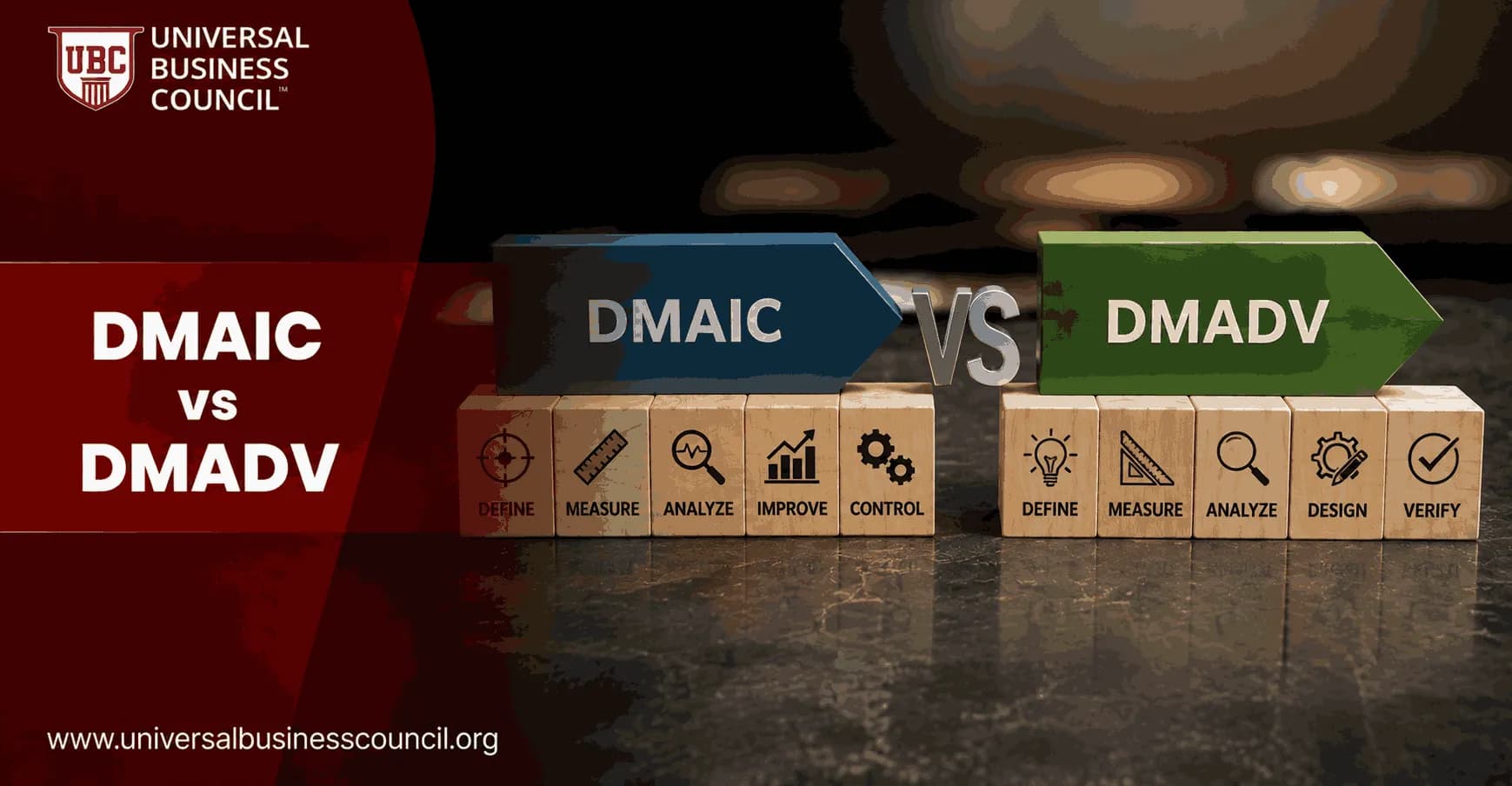
DMAIC vs DMADV is a practical decision, not a terminology debate. Use DMAIC when an existing process is underperforming and can be improved with data. Use DMADV when you need to design a new product, service, or process, or when the current design cannot meet customer or regulatory requirements even after improvement work. For professionals building structured Six Sigma expertise, a Certified Six Sigma Expert pathway can help develop a stronger foundation for selecting and applying the right improvement methodology.
That choice matters. Pick DMAIC for a design problem and you may spend months tuning a broken model. Pick DMADV for a simple defect problem and you may overbuild the solution, burn budget, and frustrate operations teams who just needed a cleaner control plan.

What DMAIC Means in Six Sigma
DMAIC stands for Define, Measure, Analyze, Improve, and Control. ASQ and other quality bodies describe it as the core Six Sigma roadmap for improving existing processes using data and root cause analysis.
For professionals who want to connect process improvement with broader organizational and leadership capabilities, Management Certifications can complement Six Sigma learning by developing skills useful for managing projects, teams, and operational performance.
DMAIC starts with a known problem: high defect rates, long cycle times, customer complaints, excess rework, or unstable output. You define the problem, measure current performance, analyze causes, improve the process, then control it so the gains do not disappear after the project team leaves.
Use DMAIC when the process already exists
Choose DMAIC when three conditions are true:
You have a current process. It may be messy, but it is running.
You have measurable history. Defects, cycle time, scrap, complaints, cost, or service levels can be tracked.
The design is probably capable. The gap can be closed by removing variation, waste, or root causes.
A finance team with invoice error rates above 3 percent is a classic DMAIC case. You can map the process, check where errors enter, validate the measurement system, run a Pareto analysis, and fix the few inputs causing most defects. In practice, the ugly detail is often not the approval workflow. It is the supplier master data field nobody owns.
DMAIC projects commonly run 3 to 6 months. The financial case is usually cost reduction, fewer defects, shorter cycle time, lower rework, or better productivity.
What DMADV Means in Six Sigma
DMADV stands for Define, Measure, Analyze, Design, and Verify. It is part of Design for Six Sigma, often called DFSS. Instead of improving the current state, DMADV creates a future state that is built to meet critical customer requirements from the start.
The key difference sits in the final two phases. DMAIC has Improve and Control. DMADV has Design and Verify. That small wording change signals a very different project.
Use DMADV when improvement is not enough
Choose DMADV when one of these conditions applies:
No process exists. You are building a new service, platform, product, or operating model.
Historical data is limited. You need customer research, requirements analysis, modeling, and prototypes.
The current design is constrained. Prior DMAIC work has helped, but the process still cannot meet CTQs.
Risk is high. Regulatory, safety, technology, or adoption risk makes quality by design essential.
DMADV relies heavily on Voice of the Customer, CTQ trees, quality function deployment, Pugh matrices, simulation, prototype testing, and verification planning. It is slower because the scope is larger. Many DMADV efforts take 6 to 12 months, and complex redesigns can run longer.
Take a bank that replaces a legacy onboarding system because the old architecture cannot support new identity checks. DMAIC is the wrong default here. You are not fixing a queue time problem. You are designing a new process with compliance, customer experience, data capture, and exception handling built in.
DMAIC vs DMADV: The Decision Table
Question | Choose DMAIC | Choose DMADV |
|---|---|---|
Does a process exist? | Yes | No, or it needs a full rebuild |
Is performance data available? | Yes, enough to baseline defects and variation | Limited data, with more need for customer research |
Can the current design meet requirements? | Probably, after root causes are fixed | No, the design itself is the constraint |
Main tools | Process capability, hypothesis testing, Pareto charts, SPC, control plans | Voice of the Customer, CTQ trees, concept selection, simulation, verification testing |
Financial case | Cost reduction and efficiency | Revenue enablement, risk avoidance, new capability |
Typical duration | 3 to 6 months | 6 to 12 months or more |
A Simple Rule You Can Use in Project Selection
Ask this first: Are we improving a working process, or are we designing a new capability?
If you are improving a working process, start with DMAIC. If you are designing a new capability, start with DMADV. If you are unsure, run a short diagnostic:
Define the customer requirement or CTQ in plain language.
Baseline current performance, if data exists.
Check whether the gap is caused by variation, waste, or a design limit.
Review whether prior fixes have failed for structural reasons.
Select DMAIC for controllable process causes. Select DMADV for design constraints.
To be blunt, many teams choose DMAIC because it feels safer. That is fine when the process is fixable. It gets expensive when the real issue is a platform, product, or policy design that cannot meet the requirement under normal operating conditions.
Common Mistakes When Comparing DMAIC and DMADV
Mistake 1: Treating DMADV as advanced DMAIC
DMADV is not a more sophisticated version of DMAIC. It answers a different question. DMAIC asks, what is causing current performance to fail? DMADV asks, what must we design so future performance meets requirements?
Mistake 2: Skipping measurement in DMADV
Some teams think DMADV needs less measurement because there is no historical process. Wrong. Measurement shifts toward customer segments, CTQs, design tolerances, verification criteria, and risk thresholds.
Mistake 3: Ignoring control after DMADV handoff
DMADV ends with Verify, but operations still need process ownership, monitoring, training, and escalation paths. A verified design can still fail if nobody owns the daily management system.
Technology can also influence the DMAIC versus DMADV decision. A process built around complex software, automation, data infrastructure, or emerging technologies may require a deeper understanding of the underlying technical design before choosing an improvement roadmap. A Deep Tech Certification can provide complementary technology-focused learning for professionals working across process and technical teams.
How Professionals Should Build Capability
If your work touches operations, technology delivery, product management, customer experience, or compliance, you should know both roadmaps. DMAIC helps you reduce variation in existing systems. DMADV helps you design better systems before defects become expensive.
This topic sits close to Universal Business Council learning pages on Six Sigma, quality management, operations management, project management, and business analytics. If you are preparing for certification, pay special attention to scenario questions. Candidates often lose marks when they see defect data and automatically choose DMAIC, even though the question says the existing process cannot meet CTQs.
Next Step: Choose the Roadmap Before You Choose the Tools
Before your next quality project begins, write one sentence: We are using DMAIC because... or We are using DMADV because... If you cannot defend that sentence with process data, customer requirements, and design constraints, pause the project charter. Then study the Six Sigma roadmap that matches your real problem, not the one that feels familiar.
As improvement and design projects increasingly involve digital platforms, analytics, automation, and interconnected systems, broader technology knowledge can also help professionals evaluate technical constraints and opportunities. A Tech Certification pathway can complement Six Sigma expertise with additional technology-focused learning.
FAQs
1. What is the difference between DMAIC and DMADV in Six Sigma?
DMAIC and DMADV are Six Sigma methodologies used for different types of problems.
DMAIC stands for:
Define → Measure → Analyze → Improve → Control
It is primarily used to improve an existing process, product, or service.
DMADV stands for:
Define → Measure → Analyze → Design → Verify
It is primarily used to design a new process, product, or service, or substantially redesign one when incremental improvement is insufficient.
The simplest distinction is:
Existing process needs improvement → DMAIC
New or fundamentally redesigned process needed → DMADV
Choosing between them matters. Applying DMAIC to a process that fundamentally cannot meet requirements can become an expensive exercise in polishing machinery that needs replacing.
2. What does DMAIC stand for?
DMAIC represents five phases:
Define: Clarify the problem, customers, CTQs, scope, and business case.
Measure: Establish reliable measurements and baseline performance.
Analyze: Identify and validate root causes.
Improve: Develop, test, and implement solutions.
Control: Sustain the improved performance.
DMAIC is built around the idea that an existing process has a measurable performance gap that can be reduced through systematic improvement.
3. What does DMADV stand for?
DMADV also contains five phases:
Define: Establish project goals, customer needs, and scope.
Measure: Translate customer needs into measurable requirements and CTQs.
Analyze: Evaluate design alternatives and determine critical design characteristics.
Design: Develop and optimize the selected solution.
Verify: Test whether the final design meets customer and business requirements.
DMADV is commonly associated with Design for Six Sigma (DFSS).
4. When should you use DMAIC?
Use DMAIC when an existing process or product:
Already exists and operates
Has measurable performance problems
Produces excessive defects or variation
Has high cycle time or cost
Generates customer complaints
Contains waste or bottlenecks
Has root causes that are not fully understood
Can reasonably be improved without fundamental redesign
For example:
Current invoice accuracy = 94%
Requirement = ≥ 99.5%
If the existing process can potentially achieve the requirement after root causes are addressed, DMAIC is a sensible approach.
5. When should you use DMADV?
DMADV is appropriate when:
A completely new process is required
A new product or service is being developed
Customer requirements have changed substantially
Existing technology cannot meet requirements
The current process requires fundamental redesign
DMAIC improvements cannot close the performance gap
A new operating model or architecture is needed
For example, if a bank wants to create an entirely new digital onboarding process, DMADV may be more appropriate than improving a legacy paper workflow one form at a time.
6. What is the main goal of DMAIC?
The goal of DMAIC is to improve the performance of an existing process by reducing:
Defects
Variation
Waste
Cost
Rework
Cycle time
Customer dissatisfaction
DMAIC starts with current performance and seeks measurable improvement.
A typical progression is:
Current State → Measure Gap → Find Root Causes → Improve Process → Sustain Results
The existing process is treated as something worth fixing rather than something that must be replaced entirely.
7. What is the main goal of DMADV?
The goal of DMADV is to create a design capable of meeting customer and business requirements from the beginning.
The progression is:
Customer Needs → CTQs → Design Requirements → Alternatives → Optimized Design → Verification
Rather than repairing an existing process, DMADV asks:
“What should the process or product look like to meet requirements reliably?”
This makes DMADV particularly valuable when design decisions will strongly determine future quality, cost, reliability, and customer experience.
8. How do you decide between DMAIC and DMADV?
A practical decision sequence is:
Does a process already exist?
If No → Consider DMADV
If Yes ↓
Can the existing process realistically meet customer requirements?
If Yes → DMAIC
If No → Consider DMADV
Then ask:
Are root causes unknown and improvement possible? → DMAIC
Is fundamental redesign required? → DMADV
The methodology should follow the nature of the problem, not whichever acronym the project leader happens to have printed on the training binder.
9. Can DMAIC be used to design a new process?
Generally, DMAIC is not the preferred methodology for designing a completely new process because its Measure and Analyze phases assume meaningful current-state performance exists.
A new process has no mature baseline to improve.
DMADV is better suited because it begins with:
Customer Needs → Requirements → Design Alternatives → New Design → Verification
However, DMAIC may still be used later after the new process is operating and enough performance data exists to identify improvement opportunities.
10. Can DMADV be used to redesign an existing process?
Yes.
DMADV can be appropriate when an existing process is so structurally limited that incremental improvements cannot achieve required performance.
For example:
Customer Requirement: Application decision within 10 minutes.
Existing Process: Requires several manual reviews across multiple departments.
If reducing waste and variation cannot realistically close the gap, a new automated workflow may need to be designed.
The fact that a process exists does not automatically mean DMAIC must be used.
11. What is the difference between the Improve phase and the Design phase?
The Improve phase of DMAIC modifies an existing process.
Typical activities include:
Eliminating root causes
Reducing variation
Removing waste
Optimizing settings
Piloting improvements
Implementing error-proofing
The Design phase of DMADV creates or fundamentally configures a new solution.
Activities may include:
Developing detailed designs
Creating prototypes
Modeling performance
Optimizing design parameters
Conducting risk analysis
Preparing implementation plans
Improve asks “How can we make this process better?”
Design asks “What process should we build?”
12. What is the difference between Control in DMAIC and Verify in DMADV?
DMAIC ends with Control.
Control ensures the improved existing process maintains its gains through tools such as:
Control plans
SPC
Standard work
Dashboards
Reaction plans
Training
Process ownership
DMADV ends with Verify.
Verify confirms that the newly designed solution performs according to requirements through activities such as:
Pilot testing
Prototype testing
Capability studies
Validation
Customer acceptance
Performance monitoring
Both phases protect results, but they begin from different project contexts.
13. How is Voice of the Customer used differently in DMAIC and DMADV?
Voice of the Customer (VOC) is important in both methodologies.
In DMAIC, VOC helps determine where the existing process is failing customer expectations.
For example:
Requirement = 98% on-time delivery
Current Performance = 87%
DMAIC addresses the gap.
In DMADV, VOC plays an even more foundational role because customer needs are translated into requirements that shape the new design itself.
VOC → Needs → CTQs → Design Requirements → New Solution
DMADV attempts to build customer requirements into the architecture rather than repair them later.
14. How are CTQs used in DMAIC and DMADV?
Critical-to-Quality (CTQ) characteristics are measurable requirements important to customers.
In DMAIC:
CTQ → Measure Current Performance → Identify Gap → Improve
In DMADV:
CTQ → Translate into Design Requirement → Design Solution → Verify
For example:
CTQ: Response time ≤ 30 seconds.
DMAIC might reduce an existing system's response time from 55 seconds to 25 seconds.
DMADV might design an entirely new architecture capable of consistently operating below 30 seconds.
15. What tools are commonly used in DMAIC?
Common DMAIC tools include:
Define
Project Charter
SIPOC
VOC
CTQ Tree
Measure
Process Mapping
MSA
Gauge R&R
Capability Analysis
Analyze
Pareto Charts
Fishbone Diagrams
5 Whys
Hypothesis Testing
Regression
ANOVA
Improve
DOE
Poka Yoke
Kaizen
Pilot Testing
Control
Control Charts
Control Plans
Standard Work
The exact toolkit should depend on the problem. Using every tool because it appeared in certification training is not statistical rigor. It is collecting badges.
16. What tools are commonly used in DMADV?
DMADV often uses tools focused on requirements, design selection, optimization, and risk prevention.
Examples include:
Voice of the Customer
CTQ Trees
Kano Analysis
Quality Function Deployment
Benchmarking
Concept Selection
FMEA
Simulation
Design of Experiments
Robust Design
Prototyping
Capability Analysis
Verification Testing
The emphasis is on designing quality into the product or process before full-scale implementation.
17. What is the relationship between DMADV and Design for Six Sigma?
DMADV is one of the best-known methodologies used within Design for Six Sigma (DFSS).
DFSS focuses on designing products, services, and processes capable of meeting customer requirements at high quality levels.
DMADV provides a structured path:
Define
↓
Measure Customer Requirements
↓
Analyze Design Alternatives
↓
Design the Solution
↓
Verify Performance
Other DFSS frameworks exist, so DFSS and DMADV are not strictly interchangeable terms. DMADV is better understood as a major DFSS roadmap.
18. What is an example of choosing DMAIC versus DMADV?
Consider a company experiencing slow order fulfillment.
Scenario A
Current process:
Average lead time = 5 days
Customer requirement:
≤ 3 days
Analysis suggests excessive waiting, rework, and poor scheduling can be eliminated.
Choose DMAIC.
The existing process appears capable of being improved.
Scenario B
Customer requirement:
Same-day automated fulfillment
Current process:
Paper forms + manual approvals + legacy systems
Incremental improvements cannot realistically achieve the requirement.
Choose DMADV.
A fundamentally different process architecture is required.
19. What are common mistakes when choosing between DMAIC and DMADV?
Common mistakes include:
Using DMAIC for every Six Sigma project.
Redesigning a process before proving redesign is necessary.
Using DMADV when a straightforward improvement would suffice.
Ignoring customer requirements when selecting the methodology.
Assuming an existing process must always use DMAIC.
Starting with a predetermined technology solution.
Failing to evaluate whether the current process can meet future CTQs.
The correct methodology depends on the size and nature of the performance gap, not on organizational affection for one particular acronym.
20. How should organizations choose between DMAIC and DMADV?
A practical selection framework is:
Define Customer and Business Requirements
↓
Identify CTQs
↓
Determine Whether a Process Already Exists
↓
Measure or Estimate Current Capability
↓
Compare Capability with Required Performance
↓
Assess Whether Root-Cause Improvements Can Close the Gap
Then choose:
Existing Process + Improvement Can Meet Requirements
↓
DMAIC
Define → Measure → Analyze → Improve → Control
Or:
New Process Needed / Existing Process Fundamentally Cannot Meet Requirements
↓
DMADV
Define → Measure → Analyze → Design → Verify
A useful comparison is:
Question | DMAIC | DMADV |
|---|---|---|
Primary purpose | Improve | Design/redesign |
Existing process required? | Usually yes | Not necessarily |
Current baseline important? | Yes | Less central |
Root cause analysis | Major focus | Used to inform design |
Customer requirements | Define improvement target | Drive the design |
Main solution phase | Improve | Design |
Final phase | Control | Verify |
Typical outcome | Better existing process | New or fundamentally redesigned process |
The decision ultimately comes down to one question:
Can the existing process realistically be improved enough to meet the required CTQs?
If yes, DMAIC usually makes sense.
If no, DMADV deserves serious consideration.
Trying to force DMAIC onto a fundamentally incapable process can produce endless optimization of something whose basic design is the problem. Conversely, redesigning everything when a modest process improvement would work is an excellent way to transform a quality project into a capital-budget emergency.
The sensible principle is:
Improve what is worth improving. Design what needs designing.
Related Articles
View All
Six Sigma
Design for Six Sigma Explained: When to Use DFSS Instead of DMAIC
Design for Six Sigma helps teams design new products, services, and processes to meet quality targets from launch instead of fixing defects later.

Six Sigma
Six Sigma DMADV Explained: Define, Measure, Analyze, Design, Verify
Six Sigma DMADV explained through its five phases, practical use cases, DMAIC comparison, and how professionals apply it to design for quality.

Six Sigma
Six Sigma Minitab Explained: Statistical Software for DMAIC Projects
Learn how Six Sigma Minitab supports DMAIC projects with capability analysis, control charts, DOE, regression, Minitab Engage, and real project results.
Trending Articles
The Role of Blockchain in Ethical AI Development
How blockchain technology is being used to promote transparency and accountability in artificial intelligence systems.
AWS Career Roadmap
A step-by-step guide to building a successful career in Amazon Web Services cloud computing.
Top 5 DeFi Platforms
Explore the leading decentralized finance platforms and what makes each one unique in the evolving DeFi landscape.