

Six Sigma FMEA Explained: Preventing Failures Before They Happen
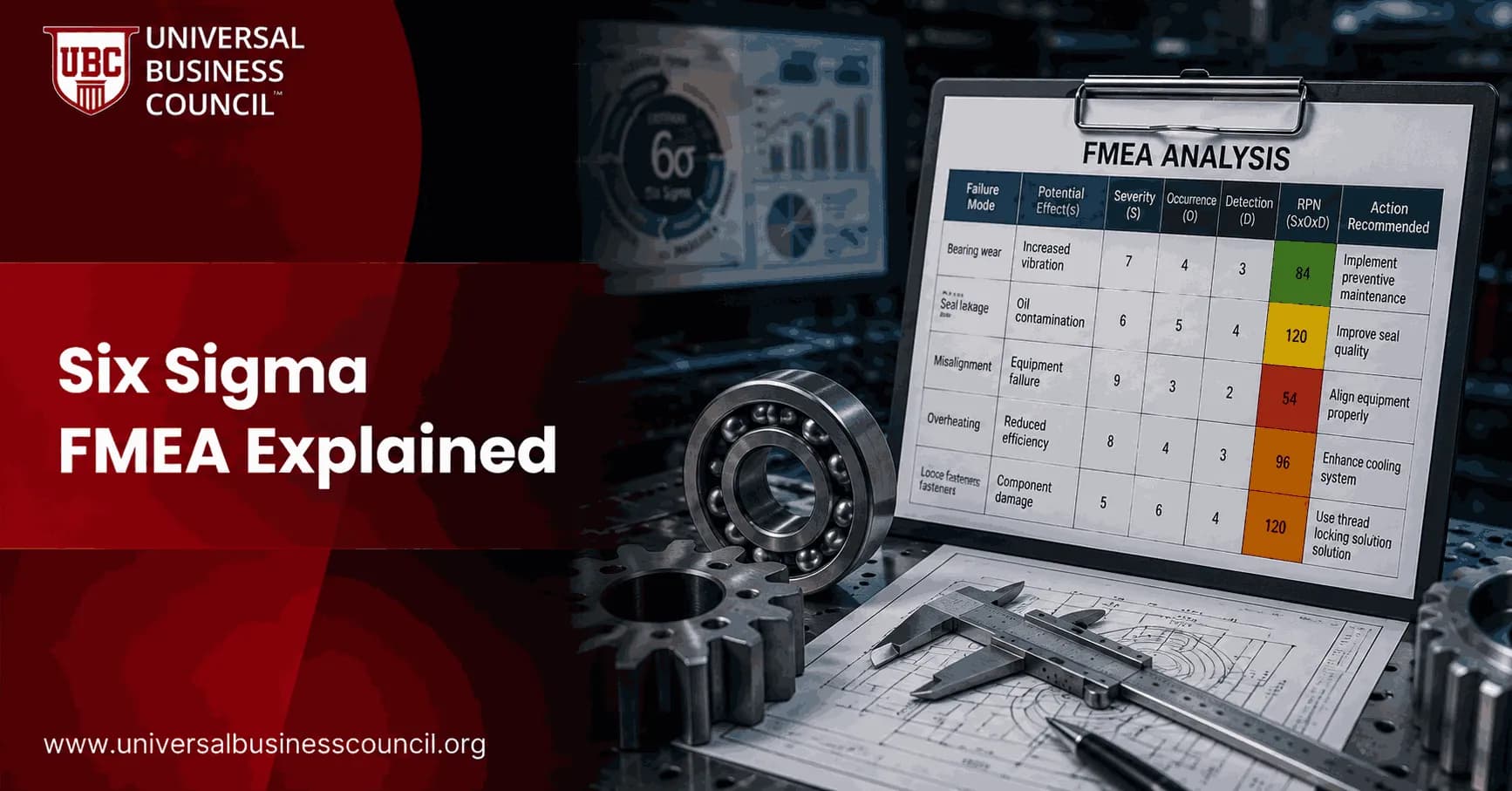
Six Sigma FMEA is the practical discipline of finding possible failures before customers, regulators, or production teams discover them the hard way. It combines Six Sigma's data-driven improvement method with Failure Mode and Effects Analysis, a structured way to identify how a product, process, or system can fail, what the impact would be, and what you should do first. Professionals building this discipline often start with a focused credential like the Certified Six Sigma Expert program, since FMEA only becomes useful once you understand how it fits inside the broader DMAIC cycle around it.
If you have ever watched a launch meeting stall because nobody can agree which risk matters most, you already know why FMEA exists. It forces the team to be specific. Not vague risk talk. Actual failure modes, causes, controls, owners, and dates.

What Is Six Sigma FMEA?
Failure Mode and Effects Analysis examines three core questions:
Failure mode: What could go wrong?
Effect: What happens if it goes wrong?
Cause and control: Why would it happen, and how will we prevent or detect it?
Six Sigma brings the operating system around it. In DMAIC, FMEA usually appears in the Analyze and Improve phases, then feeds the Control phase. In Design for Six Sigma, Design FMEA is used earlier, before tooling, software freeze, supplier contracts, or clinical validation become expensive to change.
There are two common types you will see in projects:
Design FMEA: Used for products, components, software features, and system architecture.
Process FMEA: Used for manufacturing steps, service workflows, maintenance routines, and handoffs.
Running a Design FMEA that actually changes decisions before tooling or software freeze requires real cross-functional authority, which is why FMEA leads often pair Six Sigma training with broader Management Certifications, covering the stakeholder influence and governance skills needed to get design, quality, and supplier teams to act on a risk before it becomes expensive to fix.
How Six Sigma FMEA Works in DMAIC
Define and Measure: Set the boundaries
Start with a process map, SIPOC, customer requirements, complaint history, defect data, warranty claims, or incident reports. Do not run an FMEA on everything. Pick the process step or design function where failure would hurt quality, safety, cost, delivery, or compliance.
Analyze: Score the risks
Traditional FMEA scores each failure mode across three dimensions:
Severity: How serious is the effect?
Occurrence: How likely is the cause?
Detection: How likely are current controls to catch it before impact?
Older FMEAs often multiplied these into a Risk Priority Number, or RPN. Be careful. RPN can mislead teams because very different risk profiles can produce the same number. A failure with high severity should not be buried just because occurrence looks low. Current practice, including the AIAG and VDA FMEA approach used in automotive, favors Action Priority, which pushes teams toward risk-based decisions instead of blind ranking.
Improve and Control: Act, then keep it alive
The value is not the spreadsheet. It is the action list. Strong actions include design changes, poka-yoke error proofing, tighter process controls, alarm limits, supplier specification changes, test coverage, preventive maintenance, and training where behavior is the true failure point.
A common practitioner mistake is writing weak controls such as operator to be careful. That is not a control. A barcode scan that blocks the wrong component from moving forward is a control. A torque tool that records actual torque and locks out when calibration expires is a control. See the difference?
Where Six Sigma FMEA Is Used
Six Sigma FMEA is common in automotive, aerospace, healthcare, medical devices, electronics, industrial automation, and regulated manufacturing. It is also showing up more in software-enabled services, especially where outages, incorrect data, or workflow failures affect safety or customer trust.
Automotive: Brake systems, airbag deployment, battery systems, supplier processes, and warranty reduction.
Aerospace: Landing gear, avionics, propulsion components, and maintenance procedures.
Healthcare: Medication administration, surgical pathways, infusion pumps, and patient handoffs.
Manufacturing: Downtime reduction, scrap prevention, quality control plans, and maintenance planning.
Healthcare FMEA has gained attention because patient safety failures often occur at handoffs. Wrong dose. Similar packaging. Missed allergy warning. A well-run FMEA identifies those failure points before they become incident reports.
What the Data Says
FMEA is not fading. Published research and bibliometric reviews point to rising activity through the early 2020s, with healthcare and surgical safety applications growing especially fast. The drivers are not mysterious: tighter regulation, complex supply chains, more software inside physical products, and the need to cut failures before they become warranty claims or recalls.
The business case shows up in the numbers teams actually track. Reliability engineering reports describe automotive FMEA projects cutting warranty claims meaningfully in braking system applications, and medical device teams reducing complaints after applying FMEA to infusion pump risks. Treat any single percentage figure as directional rather than a benchmark, because results depend heavily on the maturity of your baseline controls.
Digital and AI-Enabled FMEA
The old conference-room FMEA is changing. Digital quality systems now connect FMEA records with control plans, inspection data, corrective actions, PLM systems, and maintenance logs. That matters because a static FMEA becomes stale quickly.
AI and machine learning are also being tested for failure mode discovery, occurrence estimation, and pattern detection in sensor data. Useful? Yes, when the data is clean. Overhyped? Also yes, if the team expects AI to replace engineering judgment. A model can flag recurring temperature drift. It cannot always understand why a technician bypassed a fixture on the night shift. Connecting FMEA records cleanly with PLM, maintenance, and inspection systems is real integration engineering, and a Deep Tech Certification from Blockchain Council can help teams understand how reliable, traceable data pipelines are actually built, since an AI-assisted FMEA is only as trustworthy as the systems feeding it clean data.
FMEA vs FMEDA: Do Not Mix Them Up
FMEA focuses on failure modes, effects, causes, and controls for quality and reliability. FMEDA, Failure Modes, Effects, and Diagnostic Analysis, goes deeper into diagnostic coverage and is used in functional safety work tied to standards such as ISO 26262, IEC 61508, IEC 60601, and DO-254.
If you work on safety-critical electronics, industrial controls, medical devices, or aerospace systems, you may need both. FMEA helps prevent defects and process failures. FMEDA supports formal safety integrity analysis.
How to Build a Better FMEA
Use real data first. Pull defects, complaints, downtime, service tickets, scrap, and near misses before the workshop.
Keep the team small but complete. Include design, process, quality, operations, supplier, service, and someone who actually does the work.
Write failure modes clearly. Use specific wording such as seal leaks at 2 bar pressure, not poor quality.
Do not hide high severity risks. Treat safety and compliance risks with discipline, even when occurrence is low.
Assign owners and dates. An FMEA without action ownership is documentation theater.
Update it after changes. New supplier, new software release, new fixture, new material, new risk.
Building Six Sigma FMEA Capability
If you manage quality, operations, engineering, product development, or compliance, Six Sigma FMEA is a skill worth formalizing. It gives you a shared language for risk and helps teams make better trade-offs under pressure.
Connect this topic to Universal Business Council's Six Sigma certification pathways, quality management courses, and process improvement training in the certification catalog. If you are preparing for a Six Sigma assessment, practice interpreting FMEA tables. Candidates often miss questions where a high severity rating requires action even when the total RPN is not the highest.
Your next step: take one active process, choose its five most painful failure modes, and build a short FMEA this week. Keep it practical. Then use the results to strengthen your control plan and decide which Six Sigma training or certification will close your knowledge gaps. If your FMEA keeps going stale because it cannot connect cleanly to your PLM, maintenance, or inspection systems, a Tech Certification from Global Tech Council is worth adding to your plan, since some FMEA problems need better systems integration, not another workshop.
FAQs
1. What is FMEA in Six Sigma?
Failure Mode and Effects Analysis (FMEA) is a structured risk-analysis method used in Six Sigma to identify how a product, process, service, or system could fail, understand the consequences of those failures, and prioritize actions to reduce risk before problems occur.
In simple terms:
What could fail? → What would happen? → Why could it happen? → What controls exist? → What should we improve?
FMEA shifts quality management from reacting to defects toward preventing them, which is generally cheaper than discovering the problem after several thousand units have reached customers.
2. What does FMEA stand for?
FMEA stands for Failure Mode and Effects Analysis.
Each part has a specific meaning:
Failure Mode: The way something could fail.
Effect: What happens if the failure occurs.
Cause: Why the failure could happen.
Analysis: Evaluation of the risk and existing controls.
For example:
Failure Mode: Incorrect component installed
Effect: Product does not function
Cause: Similar-looking components
Control: Final inspection
The team then determines whether stronger preventive or detection controls are needed.
3. Why is FMEA important in Six Sigma?
FMEA helps Six Sigma teams identify risks before they become defects, customer complaints, safety incidents, delays, or expensive rework.
It provides a systematic method for evaluating potential problems instead of waiting for historical defect data to reveal them.
FMEA can help teams:
Prevent failures
Reduce defects
Prioritize improvement work
Improve process controls
Strengthen product reliability
Reduce quality costs
Protect customers
Document risk decisions
It is essentially organized pessimism, which turns out to be quite useful in quality engineering.
4. What are the main types of FMEA?
Two widely used forms are Design FMEA (DFMEA) and Process FMEA (PFMEA).
Design FMEA examines risks associated with product or system design.
Examples include material failure, inadequate strength, overheating, software malfunction, or incorrect tolerances.
Process FMEA examines risks associated with manufacturing, assembly, transactional, or service processes.
Examples include incorrect setup, missing components, data-entry errors, contamination, or improper processing.
The appropriate FMEA depends on what the team is trying to protect.
5. What is a Process FMEA in Six Sigma?
A Process FMEA (PFMEA) evaluates how individual process steps could fail and how those failures could affect customers or downstream operations.
For example:
Process Step: Install seal
Failure Mode: Seal installed incorrectly
Effect: Product leaks
Cause: Incorrect orientation
Current Control: Visual inspection
Potential Action: Add Poka Yoke fixture
PFMEA is particularly useful for identifying opportunities to prevent errors rather than relying exclusively on inspection.
6. What is a Design FMEA?
A Design FMEA (DFMEA) evaluates potential failures created by product, component, software, or system design.
Suppose an electronic product contains a cooling system.
A DFMEA might identify:
Function: Maintain safe temperature
Failure Mode: Insufficient cooling
Effect: Component overheating
Cause: Undersized heat sink
Potential Action: Redesign thermal management
DFMEA is particularly valuable during product development because design problems become increasingly expensive to correct after production begins.
7. When should FMEA be used in a Six Sigma project?
FMEA can be used throughout DMAIC, although its role varies by phase.
Define: Identify major customer and business risks.
Measure: Understand current failure modes and controls.
Analyze: Prioritize potential causes and failure mechanisms.
Improve: Evaluate proposed solutions and reduce risks.
Control: Connect important risks to monitoring and reaction plans.
FMEA should also be revisited when processes, designs, suppliers, equipment, materials, software, or customer requirements change.
8. How do you perform an FMEA step by step?
A practical FMEA process is:
Step 1: Define the scope.
Step 2: Understand functions and process steps.
Step 3: Identify potential failure modes.
Step 4: Identify the effects of each failure.
Step 5: Evaluate Severity.
Step 6: Identify potential causes.
Step 7: Evaluate Occurrence.
Step 8: Identify current prevention and detection controls.
Step 9: Evaluate Detection.
Step 10: Prioritize risks.
Step 11: Define recommended actions.
Step 12: Assign owners and deadlines.
Step 13: Implement actions.
Step 14: Reassess residual risk.
FMEA is therefore an action process, not merely an unusually wide spreadsheet.
9. What are failure modes in FMEA?
A failure mode describes how a function, requirement, or process step could fail.
Examples include:
Component missing
Dimension too large
Dimension too small
Incorrect material
Late delivery
Wrong customer information
Excessive temperature
Software fails to respond
Incorrect assembly
Insufficient torque
Failure modes should be specific enough that causes, effects, and controls can be meaningfully evaluated.
“Quality problem” is not a particularly useful failure mode.
10. What are failure effects in FMEA?
A failure effect describes the consequence of the failure mode.
Effects should be considered from the perspective of the relevant customer or downstream user.
Examples include:
Failure Mode: Missing bolt
Effect: Assembly becomes unstable
Failure Mode: Incorrect invoice
Effect: Customer is overcharged
Failure Mode: Late processing
Effect: Customer delivery is delayed
Severity is typically assigned based on the seriousness of the effect rather than how frequently the cause occurs.
11. What are failure causes in FMEA?
A failure cause explains why the failure mode could occur.
For example:
Failure Mode: Incorrect fill quantity
Possible causes:
Incorrect machine setting
Sensor drift
Worn filling valve
Wrong recipe
Operator setup error
Good FMEA causes should be specific and actionable.
If the cause is written merely as “operator error,” the team should usually investigate further. Humans are wonderfully convenient root causes because they cannot be tightened with a wrench, but the process conditions enabling the error are often more useful.
12. What are Severity, Occurrence, and Detection in FMEA?
Traditional FMEA commonly evaluates three risk dimensions:
Severity (S): How serious is the effect?
Occurrence (O): How likely is the cause or failure to occur?
Detection (D): How likely are existing controls to detect the problem before the effect escapes, according to the chosen methodology?
Many systems use rating scales from 1 to 10.
Higher values generally represent greater risk, although organizations should use clearly defined rating tables rather than assigning numbers by intuition.
13. What is RPN in FMEA?
Risk Priority Number (RPN) is a traditional FMEA metric calculated as:
RPN = Severity × Occurrence × Detection
Suppose:
Severity = 8
Occurrence = 5
Detection = 4
Then:
RPN = 8 × 5 × 4 = 160
Higher RPN values can help identify risks requiring attention, but teams should also examine the individual ratings, especially Severity.
RPN should support judgment, not replace it.
14. Why should FMEA teams not rely only on RPN?
Different risk combinations can produce the same RPN.
For example:
10 × 2 × 3 = 60
and:
3 × 5 × 4 = 60
The first scenario has maximum Severity, while the second does not.
Treating both risks as identical simply because multiplication produced the same number can be dangerous.
High-severity safety, regulatory, or critical-function risks may require action even when their RPN is comparatively low.
15. What is Action Priority in modern FMEA?
The AIAG-VDA FMEA methodology uses Action Priority (AP) as a structured approach for prioritizing actions rather than relying primarily on RPN.
Action Priority considers combinations of:
Severity + Occurrence + Detection
and assigns categories such as:
High (H)
Medium (M)
Low (L)
This approach gives appropriate attention to high-severity risks and addresses some limitations of traditional RPN ranking.
Organizations should follow the FMEA methodology required by their industry, customers, and quality-management system.
16. How does FMEA help prevent defects?
FMEA encourages teams to strengthen prevention controls rather than depending only on downstream detection.
Consider:
Risk: Component can be installed backward.
A weak approach might be:
Install component → Inspect orientation → Rework mistakes
A stronger approach could be:
Redesign fixture → Component physically cannot be installed backward
This is Poka Yoke, or mistake-proofing.
The hierarchy is generally:
Prevent failure > Detect failure early > Inspect defect later
Preventing a defect usually creates a more robust process than becoming exceptionally talented at finding defects after creating them.
17. What is the relationship between FMEA and a Six Sigma Control Plan?
FMEA and the Control Plan should be closely connected.
FMEA identifies important risks:
Failure Mode → Cause → Effect → Risk → Controls
The Control Plan defines how critical characteristics and controls will be maintained operationally:
Characteristic → Measurement → Frequency → Owner → Control Method → Reaction Plan
A useful flow is:
FMEA identifies risk → Improvement reduces risk → Control Plan sustains control
If a high-risk failure receives an important control in the FMEA, that control should usually appear somewhere meaningful in operational documentation.
18. What is the relationship between FMEA and root cause analysis?
FMEA and root cause analysis serve related but different purposes.
FMEA is primarily proactive:
What could go wrong?
Root Cause Analysis is commonly reactive or investigative:
Why did this problem happen?
Tools such as:
5 Whys
Fishbone diagrams
Pareto analysis
Regression
Hypothesis testing
Fault tree analysis
can help investigate suspected causes identified during FMEA or actual failures discovered in operations.
Lessons from root cause investigations should also be fed back into the FMEA.
19. What are common mistakes when performing FMEA?
Common FMEA mistakes include:
Using one person instead of a cross-functional team: Important perspectives are missed.
Writing vague failure modes: Risks become difficult to analyze.
Using “operator error” as the final cause: System weaknesses remain hidden.
Focusing only on RPN: High-severity risks can be underestimated.
Confusing prevention and detection controls: The actual risk-reduction mechanism becomes unclear.
Assigning ratings without evidence: Scores become opinion disguised as mathematics.
Failing to assign action owners: Recommended improvements quietly die.
Never updating the FMEA: The document stops representing the real process.
An FMEA that exists solely because an auditor expects one is technically documentation, but only in the same sense that an unused treadmill is technically exercise equipment.
20. How does FMEA prevent failures before they happen?
FMEA creates a structured path from risk identification to preventive action:
Understand Process or Design
↓
Identify Functions and Requirements
↓
Identify Potential Failure Modes
↓
Evaluate Failure Effects
↓
Identify Causes
↓
Assess Severity, Occurrence and Detection
↓
Prioritize Risk
↓
Strengthen Prevention Controls
↓
Improve Detection Where Necessary
↓
Assign Actions and Owners
↓
Implement Changes
↓
Reassess Residual Risk
↓
Link Critical Controls to the Control Plan
The real value of FMEA is not the completed worksheet or the RPN column. It is the discussion and action that occur because the team systematically asks how the process or design could fail before customers discover the answer for them.
Used properly, FMEA helps Six Sigma teams move from:
Detect defects → Correct defects
toward:
Predict failures → Prevent causes → Control remaining risk
That makes FMEA one of the most useful preventive tools in Six Sigma, quality engineering, product development, and operational risk management.
The spreadsheet is merely where the thinking gets documented. The prevention is the part that actually saves money.
Related Articles
View All
Six Sigma
Six Sigma Minitab Explained: Statistical Software for DMAIC Projects
Learn how Six Sigma Minitab supports DMAIC projects with capability analysis, control charts, DOE, regression, Minitab Engage, and real project results.

Six Sigma
Six Sigma and Machine Learning: Predicting Defects Before They Occur
Learn how Six Sigma and machine learning combine DMAIC, IoT data, SPC, and predictive models to reduce defects before they occur.

Six Sigma
Design for Six Sigma Explained: When to Use DFSS Instead of DMAIC
Design for Six Sigma helps teams design new products, services, and processes to meet quality targets from launch instead of fixing defects later.
Trending Articles
The Role of Blockchain in Ethical AI Development
How blockchain technology is being used to promote transparency and accountability in artificial intelligence systems.
AWS Career Roadmap
A step-by-step guide to building a successful career in Amazon Web Services cloud computing.
Top 5 DeFi Platforms
Explore the leading decentralized finance platforms and what makes each one unique in the evolving DeFi landscape.