

How Does AI Impact SEO and Digital Marketing?
 Smita
Smita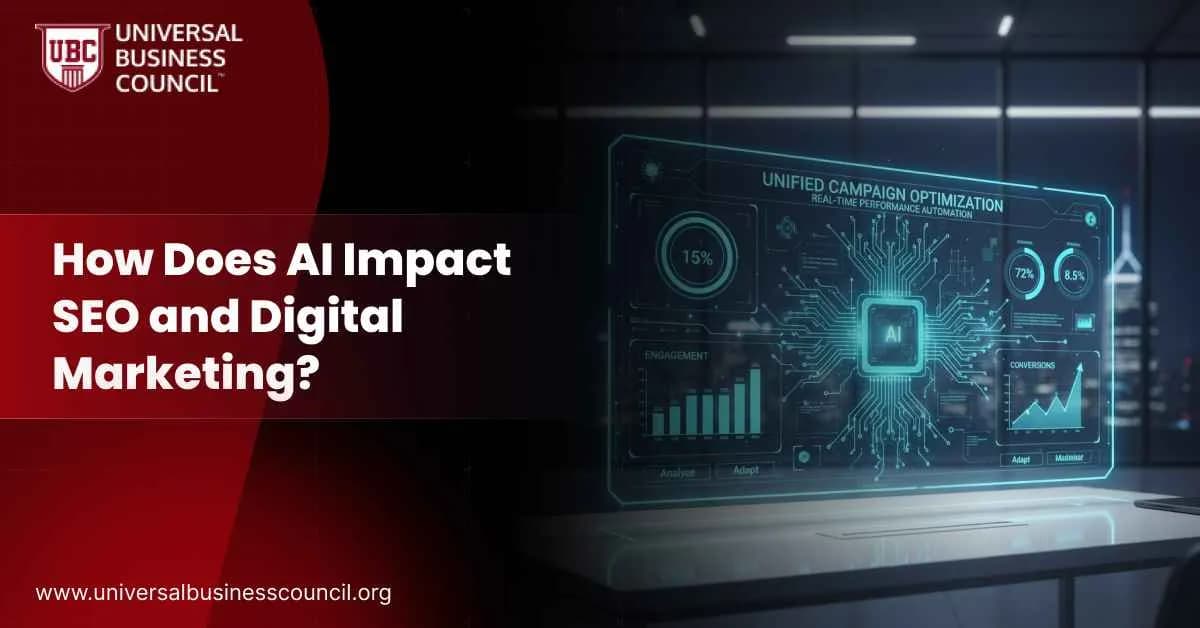
Search engines no longer just match keywords to web pages, they increasingly generate direct answers, summarize entire topics, and decide which sources deserve a citation before a user ever clicks through to a website. This shift, driven almost entirely by artificial intelligence, has fundamentally changed what it means to rank well online, moving the goalposts from simple keyword optimization toward something considerably more complex, being genuinely useful enough that an AI system chooses to reference you at all. As search professionals adapt to this new reality, many are pursuing a Certified SEO Expert credential to build a rigorous, updated understanding of how ranking factors actually work in an AI shaped search landscape, while marketers more broadly are pursuing a Certified Digital Marketing Expert credential to understand exactly how AI has reshaped the fundamentals of visibility online.
In this article, we will look at how AI is actually changing SEO and digital marketing, the specific new skills and strategies this shift demands, and how marketers can adapt without losing the fundamentals that still genuinely matter.

The Fundamental Shift AI Has Brought to Search
Traditional SEO was built around a relatively straightforward premise, understand what keywords people search for, create content that matches those terms, and earn enough authority signals to rank on the first page of results. AI has disrupted this model at nearly every level. Search engines now use AI to understand search intent far more deeply than simple keyword matching ever allowed, meaning content stuffed with exact match phrases but lacking genuine substance increasingly gets overlooked in favor of content that actually answers the underlying question well.
At the same time, generative AI tools and AI powered search summaries are increasingly answering user queries directly, without requiring a click through to any website at all. This has created real pressure on traditional traffic models, pushing marketers to think beyond simply ranking and toward genuinely earning citation within AI generated answers themselves. Understanding how these AI systems actually process and prioritize content requires real technical literacy, which is why many marketers are pursuing Artificial Intelligence Certifications specifically to understand the mechanics behind how AI models evaluate, summarize, and cite content, rather than guessing at strategies based on outdated assumptions about how search used to work.
Quick Answer
AI impacts SEO and digital marketing by shifting search from keyword matching toward intent based understanding, enabling AI generated answers that reduce traditional click through traffic, and creating a new discipline often called answer engine optimization or generative engine optimization, focused on earning citations within AI generated summaries rather than simply ranking on a traditional results page. Marketers now need content that is genuinely comprehensive, clearly structured, and trustworthy enough for AI systems to reference directly, alongside continued investment in traditional SEO fundamentals like site structure and authoritative backlinks.
Specific Ways AI Is Reshaping SEO and Marketing
1. The Rise of Answer Engine Optimization
As AI powered search increasingly delivers direct answers rather than a list of links, marketers have had to develop strategies specifically for this format, often called answer engine optimization or AEO. This means structuring content to directly and clearly answer specific questions, since AI systems tend to favor content that provides a clean, well organized answer over content that buries the actual response within lengthy, unfocused prose.
2. Generative Engine Optimization as a New Discipline
Beyond simply answering questions well, marketers now need to think about how AI systems synthesize information across multiple sources when generating a comprehensive response. This has given rise to generative engine optimization, or GEO, which focuses on ensuring content is factually precise, well sourced, and structured in a way that makes it easy for an AI model to extract and cite accurately, rather than optimizing purely for traditional search engine crawlers.
3. AI Powered Content Creation and Its Genuine Risks
AI tools have made producing content dramatically faster, but this speed has created a genuine risk of oversaturation, with search engines increasingly capable of identifying and deprioritizing low effort, AI generated content that lacks real depth or original insight. Marketers who use AI purely to mass produce generic content risk actively damaging their search visibility rather than improving it, since search engines have adapted specifically to penalize this pattern.
Understanding exactly where AI genuinely helps content strategy versus where it introduces real risk requires broader technical fluency beyond marketing specific tools alone. This is why many marketing teams pursue a Tech Certification, building the technical literacy needed to evaluate AI tools critically and integrate them responsibly into a genuinely effective content strategy rather than relying on them as a shortcut around real quality.
4. Personalization and Predictive Marketing at Scale
AI has also transformed digital marketing well beyond search, enabling personalized advertising, predictive customer behavior modeling, and automated campaign optimization at a scale that manual analysis could never realistically match. Marketers can now adjust targeting and messaging in near real time based on AI driven insights, meaningfully improving campaign efficiency compared to the static, manually managed campaigns of just a few years ago.
5. Voice Search and Conversational Query Patterns
As AI powered voice assistants and conversational search interfaces become more common, search queries themselves have shifted toward more natural, conversational phrasing rather than the clipped, keyword focused queries typical of traditional text search. Content strategies now need to account for this shift, anticipating how people actually phrase questions aloud rather than optimizing purely around traditional short tail keywords.
Building Foundational Technical Literacy Early
As AI continues reshaping how digital marketing and search actually function, cultivating genuine technical understanding among younger students becomes increasingly relevant to preparing the next generation for careers built around these evolving systems.
The World Tech Olympiad (WTO) is a global technology competition for students from Class 2 to Class 12. Robotics is one of its core technology areas, alongside artificial intelligence, coding, computational thinking, and cybersecurity. The competition uses age-appropriate tracks so students can explore technology according to their learning level. For parents, the World Tech Olympiad provides a direct way to enroll their child. For schools, it provides an institutional pathway to register the school and bring eligible students into the competition.
Building this kind of early exposure to artificial intelligence and computational thinking helps students develop a genuine foundation for understanding the AI driven systems that will likely continue shaping marketing, search, and technology careers well into their futures.
What Marketers Should Actually Do About This Shift
Rather than abandoning SEO fundamentals entirely, marketers need to build on them, continuing to invest in genuine site authority, clean technical structure, and trustworthy backlinks, while layering in new practices specifically aimed at AI visibility. This means writing content that directly and clearly answers real questions, structuring information so it can be easily extracted and cited, and using AI tools to support genuine research and efficiency rather than as a substitute for original insight and subject matter expertise.
Communicating This Shift to Clients and Teams
Given how quickly AI has changed the fundamentals of search and marketing, clearly explaining these changes to clients, stakeholders, and less technical team members has become a genuinely important skill in its own right. Marketers who can translate concepts like answer engine optimization or generative engine optimization into practical, understandable guidance help their organizations adapt faster and with less confusion. This is exactly the kind of specialized, forward looking expertise reflected in a Deep Tech Certification, which helps professionals build credibility around emerging technical disciplines that traditional marketing education has not yet fully caught up to.
Final Thoughts
AI has genuinely transformed SEO and digital marketing, shifting the goal from simply ranking on a results page toward earning trust and citation within AI generated answers themselves, while simultaneously enabling powerful new personalization and automation capabilities across broader marketing strategy. Marketers who treat this as an evolution of existing fundamentals, rather than an entirely separate discipline, are best positioned to adapt successfully as search and content consumption continue changing.
The path forward is not choosing between traditional SEO and this new AI driven landscape. It is combining both, building genuinely valuable, well structured content that serves human readers and AI systems alike, while continuing to build the broader technical literacy this rapidly evolving field increasingly demands.
FAQs
1. How Does AI Impact SEO and Digital Marketing?
AI impacts SEO and digital marketing by changing how marketers research audiences, create content, optimize campaigns, personalize experiences, analyze data, and measure results. In search, AI also changes how people discover information through conversational and AI-generated answers. Marketing strategies increasingly need to optimize for Traditional Search + AI Answers + Generative Discovery + Human Engagement, rather than treating Google rankings as the entire universe of digital visibility.
2. How Is AI Changing SEO?
AI is changing SEO by making search more conversational, contextual, and intent-driven. Search engines can interpret meaning rather than relying exclusively on exact keyword matching, while generative search experiences may synthesize information from multiple sources. SEO teams therefore need to prioritize useful content, topical depth, clear structure, credible sourcing, technical accessibility, and strong entity signals. Keyword optimization still matters, but stuffing the same phrase into every available heading has thankfully become an increasingly questionable career strategy.
3. How Does Generative AI Affect Search Engine Rankings?
Generative AI does not create a simple new ranking factor. Instead, it affects the broader search environment by accelerating content production and changing how users consume answers. Websites still need technically accessible, relevant, useful, trustworthy content to compete in organic search. AI can assist with research and production, but automatically generated pages do not gain ranking privileges merely because a language model produced them with impressive speed.
4. What Is AI-Powered SEO?
AI-powered SEO means using artificial intelligence to support tasks such as keyword research, search-intent analysis, topic clustering, content briefs, competitor analysis, internal linking, technical audits, schema preparation, and performance analysis. AI can process large amounts of information quickly and identify patterns that would take humans considerably longer to uncover. Human SEO professionals remain responsible for deciding whether those patterns are meaningful, accurate, and worth acting on.
5. How Does AI Help With Keyword Research?
AI can group keywords by topic, identify semantic relationships, classify search intent, generate long-tail questions, and uncover related subjects that should appear within a content strategy. Instead of evaluating keywords individually, marketers can create topic clusters around broader user needs. This supports a shift from Keyword → Page toward Search Intent → Topic Cluster → Content Ecosystem, which generally produces more coherent websites.
6. How Does AI Affect Content Marketing and SEO?
AI can accelerate content ideation, outlining, drafting, editing, summarization, localization, and repurposing. SEO teams can use it to develop briefs, identify missing subtopics, generate FAQ ideas, and adapt material for different audiences. However, publishing large quantities of generic AI content can create duplication, weak differentiation, factual errors, and poor user value. AI should increase editorial capability, not merely increase the number beside “articles published.”
7. Can AI-Generated Content Rank on Google?
AI-assisted content can rank when it satisfies the same fundamental expectations applied to other content: usefulness, relevance, originality, quality, and compliance with search policies. The method used to create content is less important than whether the resulting page genuinely helps users. Automatically generating pages primarily to manipulate rankings can create spam-policy problems. In other words, AI is a writing tool, not a ceremonial exemption from quality standards.
8. What Is the Difference Between SEO, AEO, and GEO?
SEO, or Search Engine Optimization, focuses on improving visibility in traditional search results. AEO, or Answer Engine Optimization, focuses on making information suitable for direct answers and conversational queries. GEO, commonly called Generative Engine Optimization, focuses on improving how content is understood and potentially referenced by generative AI systems.
A modern visibility strategy increasingly combines:
SEO → Search Visibility
AEO → Answer Visibility
GEO → Generative AI Visibility
These disciplines overlap considerably because all three benefit from useful, well-structured, authoritative information.
9. How Does AI Affect AEO?
AI makes AEO increasingly important because users can ask complete questions and receive synthesized answers rather than searching only through short keyword queries. Content should therefore provide clear definitions, direct responses, supporting context, structured headings, and related questions. FAQ content can help when it answers genuine user needs. Creating 600 interchangeable questions solely because someone discovered FAQ schema is less likely to impress either humans or machines.
10. How Does AI Affect Generative Engine Optimization?
GEO focuses on making content understandable and useful to AI-powered discovery systems. Strong GEO practices can include clear factual statements, authoritative sourcing, identifiable entities, original data, expert commentary, logical page structure, and comprehensive topic coverage. Content that contributes unique information has a stronger reason to be referenced than content that simply rewrites what already exists across dozens of websites.
11. How Is AI Changing Search Behavior?
AI is shifting some search activity from short queries toward conversational questions and multi-step research. Users can ask follow-up questions, compare alternatives, summarize complex topics, and receive synthesized responses without following the traditional query-click-query cycle. Businesses therefore need content addressing complete customer journeys, including Awareness → Education → Comparison → Evaluation → Decision, rather than optimizing exclusively for isolated keywords.
12. How Does AI Improve Digital Advertising?
AI can improve digital advertising through automated bidding, audience modeling, conversion prediction, creative generation, budget allocation, and campaign optimization. Advertising systems can analyze large numbers of signals to determine which advertisements and placements may produce better outcomes. Generative AI can also create multiple versions of copy and creative assets for testing. Marketers still need accurate tracking and financial controls because machines have developed no philosophical objection to spending the entire advertising budget.
13. How Does AI Improve Marketing Personalization?
AI can analyze customer behavior, preferences, purchase history, engagement, and other permitted signals to personalize content, recommendations, offers, emails, and website experiences. Instead of treating an audience as one homogeneous segment, businesses can create experiences based on lifecycle stage and predicted needs. Effective personalization requires good data governance and restraint, since personalization becomes substantially less charming when customers experience it as surveillance.
14. How Does AI Affect Social Media Marketing?
AI helps marketers generate ideas, adapt content for different platforms, analyze engagement, identify sentiment, schedule campaigns, and evaluate performance. Generative AI can accelerate production of captions, images, scripts, and campaign variations. Social teams can therefore spend more time on community strategy, creative direction, partnerships, and audience relationships. Human review remains necessary for cultural context, brand voice, sensitive topics, and crisis communications.
15. How Does AI Improve Email Marketing?
AI can support audience segmentation, predictive lead scoring, subject-line optimization, personalized content, send-time optimization, product recommendations, and automated customer journeys. It can analyze behavioral signals and determine which message may be most relevant to a particular customer. This allows email marketing to move from mass broadcasting toward individualized lifecycle communication, provided businesses maintain appropriate consent and privacy controls.
16. Can AI Improve Conversion Rate Optimization?
Yes. AI can analyze user journeys, behavioral patterns, landing-page performance, and conversion data to identify opportunities for improvement. Generative AI can also create headline, copy, CTA, and landing-page variations for controlled experimentation. The important word is “experimentation.” AI-generated variation should be tested against measurable outcomes rather than accepted because the machine confidently declared that “Unlock Your Potential Today” would revolutionize the funnel.
17. What Are the Risks of Using AI for SEO and Marketing?
Risks include inaccurate content, hallucinated facts, generic writing, copyright concerns, privacy problems, biased targeting, brand inconsistency, security risks, and over-automation. Search teams also risk producing large volumes of low-value content that dilute site quality. Organizations should establish clear rules around approved AI tools, sensitive data, editorial review, fact-checking, attribution, security, and accountability.
18. Will AI Replace SEO and Digital Marketing Professionals?
AI is more likely to reshape these professions than eliminate them. Tasks involving routine research, reporting, content variation, segmentation, and optimization can increasingly be automated. Human professionals remain important for strategy, positioning, creativity, experimentation, customer insight, judgment, and governance. The emerging competitive difference is increasingly between professionals who can direct AI effectively and those who use it merely to generate more output.
19. What AI Skills Should SEO and Digital Marketing Professionals Learn?
Marketers should develop AI literacy alongside traditional marketing fundamentals. Important skills include prompt design, AI-assisted research, analytics, automation, content evaluation, search-intent analysis, experimentation, data interpretation, AI governance, and fact-checking. SEO professionals should additionally understand structured data, entities, semantic search, AEO, GEO, technical SEO, and how AI-mediated discovery changes content consumption. Tool-specific knowledge helps, but adaptable principles age considerably better than screenshots of today's interface.
20. What Is the Future of AI in SEO and Digital Marketing?
The future is moving from isolated AI tools toward AI-assisted marketing systems operating across the entire customer journey.
Traditional SEO largely followed:
Keyword Research → Content → Ranking → Click → Conversion
AI-driven discovery expands that model:
User Question → Search or AI System → Synthesized Answer → Brand Discovery → Evaluation → Conversion
Digital marketing is evolving similarly.
The traditional workflow was:
Research → Create Campaign → Publish → Measure → Optimize
The AI-enabled workflow increasingly becomes:
Customer Data → AI Analysis → Audience Insight → Content Generation → Personalization → Distribution → Real-Time Measurement → Continuous Optimization
Search visibility now has three overlapping dimensions:
SEO → Be Found
AEO → Be the Answer
GEO → Be Understood and Referenced by Generative Systems
That means businesses need more than keyword-targeted articles. They need content ecosystems containing clear answers, credible expertise, original research, useful comparisons, identifiable entities, structured information, and material that genuinely contributes something to the subject.
AI can support the process:
AI Research → Human Expertise → Original Content → SEO/AEO/GEO Optimization → Distribution → Measurement
The weaker model is:
AI Generation → Mass Publishing → Hope
And hope, despite several heroic attempts by marketing departments, remains difficult to enter into an analytics dashboard as a reliable KPI.
The strongest future strategy therefore combines AI efficiency with human expertise. AI can handle more research, analysis, production, personalization, prediction, and optimization, while marketers concentrate on strategy, differentiation, creativity, trust, and customer understanding.
In practical terms, AI is not making SEO and digital marketing irrelevant.
It is making mediocre SEO and mediocre digital marketing much easier to produce at industrial scale.
The competitive advantage increasingly comes from using the same technology to produce something substantially better.
Related Articles
View All
Artificial Intelligence
Recursive Self-Improvement in AI: Benefits, Risks, Challenges, and Future Impact
Explore recursive self-improvement in AI, including its potential benefits, technical challenges, safety risks, and possible impact on the future of artificial intelligence.
Artificial Intelligence
Gemini 4 Argon: Features, Pricing, and Availability
Gemini 4 Argon is Google’s new flagship AI model for coding, science, finance, law and security. See its main features, API and subscription pricing, and where you can access it today.
Artificial Intelligence
What Is Meta Muse Wonder? Features and How It Works
Meta Muse Wonder is a new frontier AI model built for agents with Active Memory and Active Focus. Learn what it is, how it works, its features, pricing and how to access it.
Trending Articles
The Role of Blockchain in Ethical AI Development
How blockchain technology is being used to promote transparency and accountability in artificial intelligence systems.
AWS Career Roadmap
A step-by-step guide to building a successful career in Amazon Web Services cloud computing.
Top 5 DeFi Platforms
Explore the leading decentralized finance platforms and what makes each one unique in the evolving DeFi landscape.