

Can AI Rewrite and Improve Its Own Code for Recursive Self-Improvement?
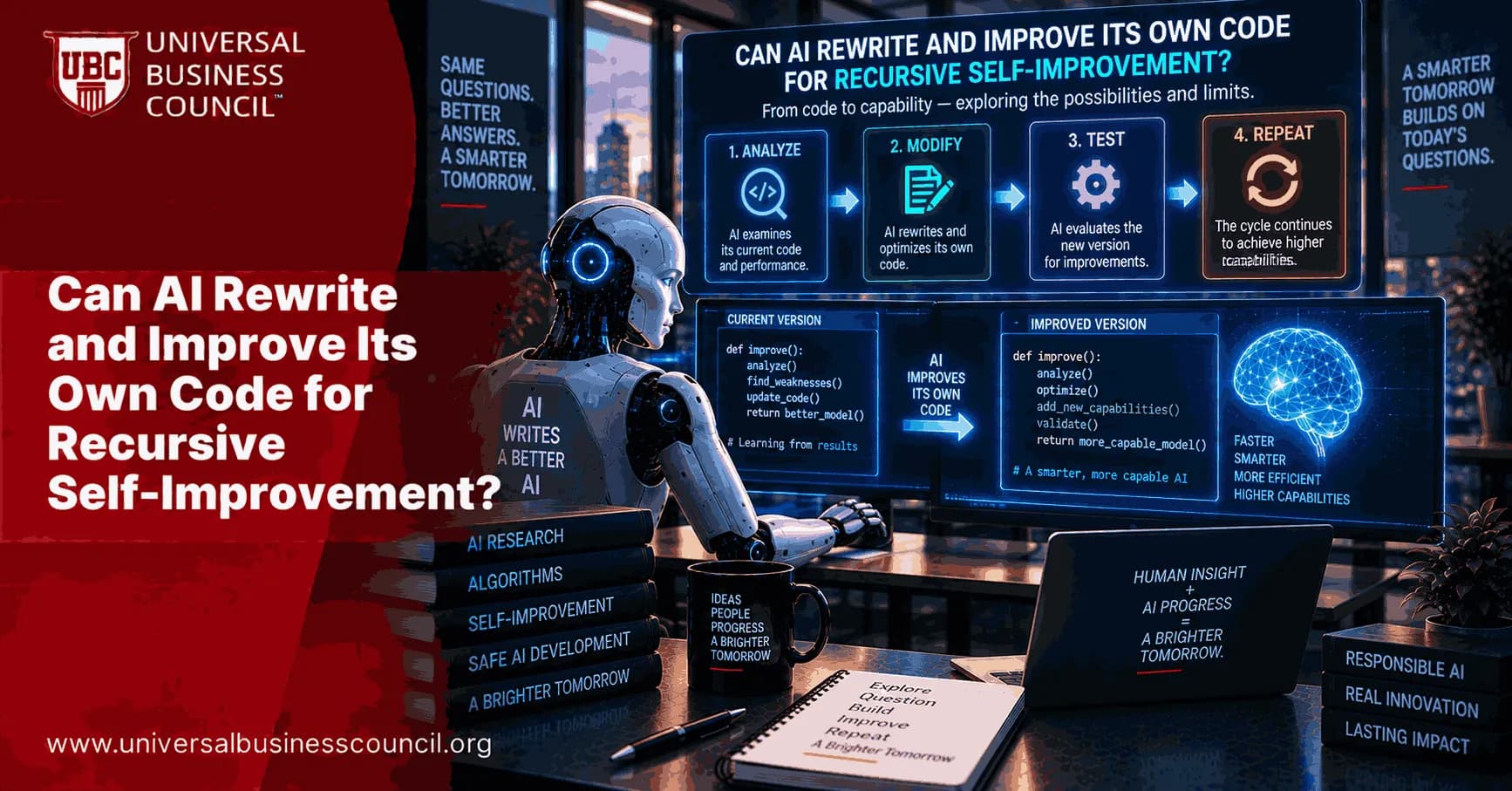
Among all the different approaches to recursive self-improvement, code rewriting stands out as the most concrete and verifiable. Unlike adjusting internal model weights or generating synthetic training data, a system that literally edits its own source code produces changes that can be inspected, tested, and measured directly against real-world benchmarks. This makes it one of the clearest windows into how much progress AI has genuinely made toward self-improvement. As interest in this specific capability grows across industries, professionals in fields like marketing are also paying attention to what it might mean for AI-powered tools, and many build their understanding through a Marketing Certification to better anticipate how self-improving development tools could eventually change product timelines.
This article looks specifically at how AI systems rewrite their own code, what results this approach has actually produced, and where the real technical boundaries of this capability sit.

How Code Self-Rewriting Actually Works
Unlike training a model on new data, code self-rewriting involves an AI system directly editing its own source files, testing the modified version, and deciding whether to keep or discard the change.
Understanding the engineering details behind this process requires genuine technical background, and professionals who want that depth often pursue Artificial Intelligence Certifications, which typically cover the software architectures and evaluation pipelines needed to judge whether a given code-rewriting result reflects real progress.
The General Process Behind Self-Modifying Code Systems
The system analyzes its current codebase and identifies a specific area to modify, such as an editing tool, a validation step, or a decision-making function
It generates a proposed code change, often using a large language model to write the actual modification
The modified version is tested against a defined benchmark, such as its ability to resolve real coding problems
If the new version performs better, it's kept and becomes the base for the next round of modifications; if it performs worse, it's discarded or archived for potential later use
The Darwin Gödel Machine as a Concrete Example
The clearest publicly documented example of this approach is the Darwin Gödel Machine, built by Sakana AI in collaboration with the University of British Columbia, which rewrites its own codebase to improve its performance on programming tasks.
The system builds a growing archive of different code versions rather than discarding every unsuccessful attempt, allowing it to branch off from earlier promising versions later
On SWE-bench, a benchmark built from real GitHub issues, the system improved its own performance from twenty percent to fifty percent through repeated self-modification
Specific improvements included better code editing tools, a patch validation step, and a memory system tracking which past approaches had failed and why
The open-ended, archive-based structure allows multiple evolutionary paths to be explored in parallel rather than following a single linear improvement track
What Makes Code Rewriting Different From Other Self-Improvement Approaches
Code self-modification carries distinct advantages and risks compared to approaches that adjust model weights or generate synthetic training data.
Advantages of the Code-Rewriting Approach
Changes are directly inspectable, meaning researchers can read exactly what was modified and why, rather than interpreting opaque changes in model weights
Results can be tested immediately against concrete benchmarks like passing specific software tests
Version history creates a clear audit trail, since every code change can be tracked, compared, and reverted if needed
This transparency makes code rewriting one of the more trustworthy self-improvement approaches from a safety and oversight standpoint
Unique Risks of Self-Modifying Code
A system capable of editing its own code could theoretically modify safety checks or validation logic if not carefully constrained
Bugs introduced through self-modification can be harder to catch than bugs written by human engineers, since the reasoning behind a given change may not be fully transparent
Without strict sandboxing, a self-modifying system risks breaking its own functionality in ways that are difficult to recover from
Researchers building these systems explicitly restrict what parts of the codebase can be modified, keeping core safety and evaluation logic outside the system's own editing reach
Where This Capability Currently Falls Short
Despite genuinely impressive results, code self-rewriting systems remain bounded in specific, important ways.
The improvement target, such as a specific benchmark score, is still defined by human researchers rather than chosen by the system itself
Modifications happen within a fixed, human-designed framework of allowed changes rather than a completely open-ended rewrite of the entire system
Gains have been substantial within tested domains but haven't been shown to generalize into entirely new, previously unseen types of problems
Human oversight remains active throughout, reviewing which benchmarks apply and validating that safety constraints stay intact
A Creative Parallel in Iterative Refinement
The underlying logic behind code self-rewriting, propose a change, test it, keep what works, also shows up in very different, lower-stakes creative applications. One emerging application is AI microdrama, where generative AI helps bring serialized stories, characters, and fictional worlds to life. These systems often refine character consistency and plot pacing across episodes using audience feedback, a narrative-focused example of the same generate-test-keep cycle, though scoped to storytelling rather than the technical, code-level self-modification seen in systems like the Darwin Gödel Machine.
Why This Approach Is Considered a Meaningful Step Forward
Even with its current limitations, code self-rewriting represents genuine progress toward more autonomous AI development for a few clear reasons.
It demonstrates that AI systems can meaningfully improve specific, measurable capabilities without a human manually rewriting each update
The transparency of code changes makes this approach easier to study and validate than less interpretable forms of self-improvement
Results have been reproducible and benchmarked publicly, rather than relying on unverified claims
It provides a practical, real-world foundation for researchers studying how far self-modification can safely extend
Staying current with how this specific capability develops requires ongoing attention, and professionals who broaden their expertise through a well-rounded Tech Certification tend to track these nuanced, benchmark-driven developments more accurately than those relying on general news coverage alone.
The Bigger Picture for Recursive Self-Improvement Research
Code self-rewriting is often described by researchers as one of the more promising and safety-manageable paths toward broader recursive self-improvement, precisely because its results are so directly verifiable. That said, the leap from rewriting supporting code and tooling to redesigning a system's fundamental architecture or training objectives remains substantial and unresolved.
Professionals who want to follow this specific research thread with real technical rigor often pursue a Deep Tech Certification, which provides the depth needed to distinguish genuine code-rewriting breakthroughs from incremental engineering improvements framed with more dramatic language.
Final Thoughts
AI can genuinely rewrite and improve its own code today, and the results are among the most concrete, verifiable evidence available for any form of recursive self-improvement. Systems like the Darwin Gödel Machine have demonstrated real, benchmarked gains through repeated self-modification cycles, while still operating within human-defined evaluation criteria and restricted editing boundaries. This represents meaningful, measurable progress rather than either the runaway breakthrough sometimes suggested in headlines or a dismissible engineering trick, and understanding that distinction is key to following this research accurately.
FAQs
1. Can AI Rewrite and Improve Its Own Code?
Yes, AI systems can already generate, review, debug, and modify code. This can support recursive self-improvement, but writing better code alone does not mean an AI has achieved full RSI.
2. What Does Self-Code Improvement Mean in AI?
Self-code improvement means an AI system contributes to modifying software that affects its performance or the processes used to develop it. The changes can involve algorithms, tools, training code, or other components.
3. How Would AI Rewrite Its Code Recursively?
A simplified process could be:
Identify weakness → generate code changes → execute and test → evaluate performance → keep successful changes → repeat
If the improved system then uses its new capabilities to find additional improvements, the process becomes recursive.
4. Can Large Language Models Rewrite Their Own Programs?
LLMs are capable of generating and modifying software when connected to appropriate coding tools and execution environments. However, the model's underlying weights and architecture are typically controlled by external training and deployment infrastructure.
5. Can AI Debug Its Own Code?
Yes. AI coding systems can inspect code, identify potential bugs, propose fixes, and test those fixes. Automated testing is important because an AI-generated correction can itself introduce new errors.
6. Can AI Automatically Test Code It Has Written?
Yes. An AI agent can execute generated code against unit tests, benchmarks, simulations, or other evaluation systems. This creates a useful feedback loop in which failed implementations can be revised.
7. Can AI Decide Which Code Improvement Is Better?
AI can compare candidate implementations using predefined metrics such as correctness, speed, memory usage, or benchmark performance. However, independent evaluation is important because an AI may optimize for a narrow metric without producing a broader improvement.
8. Does Improving Code Automatically Improve the AI Model?
No. Better supporting software does not necessarily make the underlying model more capable. Genuine model improvement may require changes to training, architecture, data, inference methods, or other components.
9. Can AI Modify Its Own Training Code?
Potentially. AI systems can generate and optimize training code, experiment with hyperparameters, and suggest changes to optimization procedures. OpenAI's AI self-improvement evaluations include tasks involving modification of training code and optimization of LLM training processes.
10. Can AI Rewrite Its Own Model Architecture?
AI can propose architectural changes and help implement them in a controlled development environment. However, independently redesigning an architecture, training the new model, and reliably demonstrating that it is broadly better is considerably more difficult.
11. What Role Does Automated Evaluation Play in Self-Code Improvement?
Automated evaluation provides the feedback needed to determine whether generated changes work. It can measure correctness, performance, safety, and other predefined properties before a change is accepted.
12. Are There Real Examples of AI Improving Algorithms?
Yes. Google DeepMind's AlphaEvolve combines Gemini models with automated evaluators and evolutionary search to generate and test algorithmic improvements. Google reports that AlphaEvolve has been used to optimize computing infrastructure and aspects of AI training.
13. Is AlphaEvolve an Example of AI Rewriting Its Own Code?
AlphaEvolve demonstrates an automated process for generating and improving algorithms, but it should not be described as an unrestricted AI rewriting and upgrading its entire underlying model. Its improvement process operates within defined objectives and evaluation systems.
14. Can AI Use Improved Code to Make Further Improvements?
Yes, in principle. If a system's improved code makes it better at experimentation, optimization, or AI engineering, those capabilities could help it discover additional improvements. This feedback loop is an important part of the RSI concept.
15. What Is the Difference Between Code Optimization and RSI?
Code optimization improves a particular program or algorithm. Recursive self-improvement involves repeated improvements to the AI system or its development process, where successful improvements help enable subsequent improvement cycles.
16. What Prevents AI From Fully Rewriting Itself?
Important limitations include access restrictions, computing requirements, unreliable self-evaluation, software complexity, model-training costs, security controls, and difficulty verifying that changes genuinely improve the system.
17. Could AI Rewrite Its Code and Make Itself Worse?
Yes. A code change can introduce bugs, reduce performance, create security vulnerabilities, or optimize the wrong objective. Robust testing and independent validation are therefore essential.
18. Could AI Rewrite Its Code Without Human Intervention?
An AI agent can autonomously modify and test code within a sufficiently controlled environment. However, this does not mean it can independently modify every component of itself, retrain a successor, and deploy that successor without external controls.
19. Is AI Self-Code Improvement Already Recursive Self-Improvement?
Not necessarily. Current systems demonstrate bounded and task-specific improvement loops, while fully autonomous RSI would require a much broader process in which AI independently drives repeated improvements to increasingly capable versions of itself. OpenAI currently states that fully autonomous recursive self-improvement is not happening today.
20. Could AI Eventually Rewrite and Improve Its Own Code Recursively?
It is possible in principle. A more advanced RSI system would need to identify its limitations, modify relevant code or training processes, test the changes, independently verify the results, and repeatedly use successful improvements to drive the next cycle. Whether AI can eventually perform this process reliably and safely at broad scale remains an open research question.
Related Articles
View All
Artificial Intelligence
Can ChatGPT Improve Its Own Capabilities Through Recursive Self-Improvement?
Explore whether ChatGPT can improve its own capabilities through recursive self-improvement, how AI-assisted optimization works, and what limits current language models from achieving true RSI.

Artificial Intelligence
Can LLMs Improve Their Own Capabilities Through Recursive Self-Improvement?
Explore whether large language models can improve their own capabilities through recursive self-improvement, how iterative self-optimization might work, and the technical and safety limits involved.

Artificial Intelligence
Can Google Gemini Improve Itself Through Recursive Self-Improvement?
Explore whether Google Gemini can improve itself through recursive self-improvement, how Gemini-powered systems already support iterative learning and optimization, and what still separates them from true autonomous RSI.
Trending Articles
The Role of Blockchain in Ethical AI Development
How blockchain technology is being used to promote transparency and accountability in artificial intelligence systems.
AWS Career Roadmap
A step-by-step guide to building a successful career in Amazon Web Services cloud computing.
Top 5 DeFi Platforms
Explore the leading decentralized finance platforms and what makes each one unique in the evolving DeFi landscape.