

Can Artificial Intelligence Really Improve Itself Recursively?
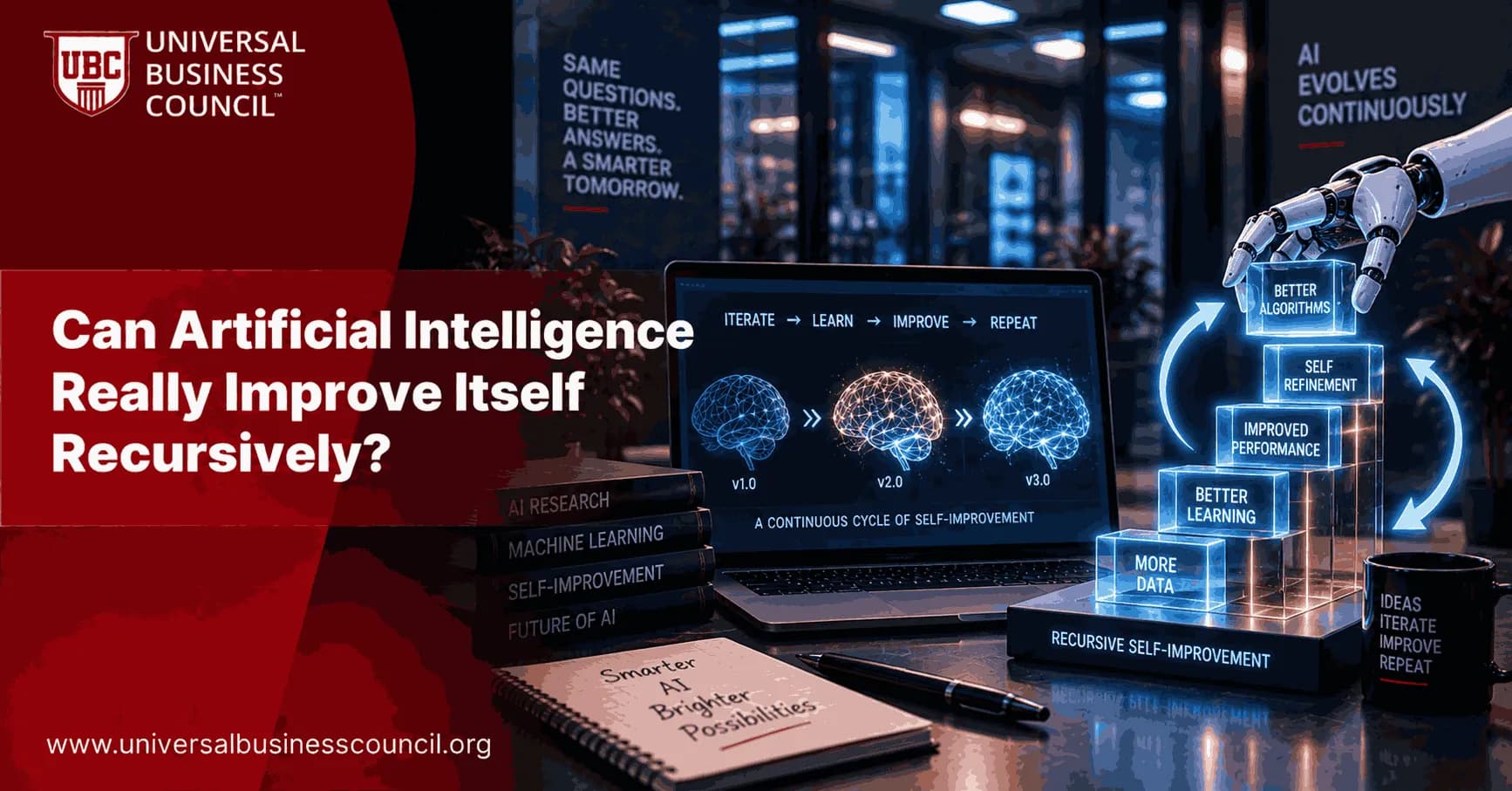
The idea of an AI system that keeps making itself smarter, without ongoing human intervention, sounds like something pulled straight from science fiction. Yet recursive self-improvement is a genuine topic of debate among AI researchers, some of whom see it as a plausible future milestone, while others argue current AI architectures are nowhere close to achieving it. As this conversation grows louder across tech circles, professionals in adjacent fields, including marketing teams relying more heavily on AI-driven tools, are taking notice too, and many are reinforcing their broader understanding of these shifts through a Marketing Certification to stay ahead of how increasingly capable AI systems might reshape their own industry.
This article examines the actual evidence behind recursive self-improvement claims, what current AI systems can and can't do in this regard, and why experts remain divided on how close, or far, this capability really is.

Breaking Down What "Recursive Self-Improvement" Actually Claims
Before evaluating whether it's real, it helps to be precise about what the term actually describes. Recursive self-improvement refers to a system that can enhance its own capabilities, then use that enhanced version of itself to make further enhancements, in a repeating cycle rather than a single upgrade.
This concept sits at the intersection of several deep technical fields, and people looking to genuinely evaluate these claims rather than rely on headlines often build their understanding through structured Artificial Intelligence Certifications, which typically cover the machine learning fundamentals needed to separate legitimate technical possibility from exaggerated speculation.
The Core Requirements for True Recursive Improvement
For a system to genuinely qualify as recursively self-improving, it would generally need to demonstrate:
Independent identification of its own performance gaps or weaknesses
The ability to generate meaningful modifications to its own architecture or training process
A reliable way to test whether those modifications actually help rather than harm performance
Implementation of successful changes without requiring a human engineer at every step
Repetition of this cycle using each newly improved version as the next starting point
What the Evidence Currently Shows
Most AI researchers agree that today's most advanced systems fall well short of this bar, even as some individual pieces of the puzzle already exist in limited forms.
Where Current AI Systems Show Partial Progress
Automated hyperparameter tuning: Systems can already adjust certain internal settings to optimize performance on specific tasks
AI-assisted code generation: Some models can suggest improvements to their own training pipelines or supporting code
Reinforcement learning loops: Certain systems iteratively improve through repeated trial and feedback, though typically within a narrow, predefined task
Neural architecture search: Automated processes can explore different model structures to find better-performing configurations
Why These Examples Fall Short of True Recursive Self-Improvement
Each of these capabilities operates within tightly controlled boundaries set by human researchers. A system tuning its own parameters within a fixed architecture is meaningfully different from a system redesigning its own fundamental architecture without guardrails. Most current examples still rely on human-defined objectives, human-selected training data, and human oversight at critical decision points, which limits how "recursive" or autonomous the improvement process genuinely is.
Arguments For and Against Its Feasibility
The debate around recursive self-improvement tends to split researchers into a few general camps.
The Case That It's Plausible
Supporters point to the rapid pace of AI progress over the past several years, arguing that capabilities once considered decades away arrived far sooner than expected. They suggest that as models become more capable at general reasoning and coding, the gap between "AI-assisted improvement" and "AI-driven improvement" could narrow faster than most people anticipate.
The Case for Skepticism
Skeptics argue that intelligence and capability don't scale in a simple, compounding way, and that each incremental improvement often becomes harder to achieve than the last, not easier. They also point out that current AI systems still lack genuine understanding of their own reasoning processes, which makes truly autonomous self-modification a much harder technical problem than headlines often suggest.
Where Similar Iterative Concepts Are Already Appearing Commercially
While full recursive self-improvement remains unresolved in research, related ideas around AI systems refining their own outputs are already showing up in commercial applications. One emerging application is AI microdrama, where generative AI helps bring serialized stories, characters, and fictional worlds to life. These systems often refine characters, pacing, and plot direction across episodes based on audience engagement data, which reflects a much smaller, tightly scoped version of iterative self-refinement, useful as a real-world example of AI adjusting its own outputs, even if it's far removed from the open-ended self-improvement researchers debate at a theoretical level.
Why This Debate Matters Beyond Academic Circles
The conversation around recursive self-improvement isn't purely theoretical. It shapes real decisions around AI safety research funding, regulatory attention, and how seriously businesses should plan for rapid future capability jumps.
For researchers, it defines a key benchmark for understanding long-term AI trajectory
For policymakers, it informs discussions around AI safety guardrails and oversight requirements
For businesses, it affects how much weight to place on AI systems potentially outpacing current expectations
For technical professionals, it highlights the value of staying current rather than assuming today's AI capabilities represent a stable baseline
Professionals who want to stay genuinely informed on both the practical and theoretical sides of this conversation often strengthen their foundation through a well-rounded Tech Certification, which helps separate credible technical developments from speculative claims circulating in broader tech discourse.
The Honest Answer: Not Yet, But the Question Remains Open
Based on current evidence, artificial intelligence cannot yet meaningfully improve itself in the fully autonomous, open-ended way the term recursive self-improvement implies. Existing systems show narrow, human-guided versions of iterative improvement, not the compounding, independent capability jump that theoretical discussions describe. Whether that changes in the coming years remains a genuinely open question among experts, which is exactly why continued, serious study of the topic matters. Those looking to engage with this question at a deeper technical level often pursue a Deep Tech Certification, gaining the grounding needed to evaluate future claims critically rather than taking speculative headlines at face value.
Final Thoughts
Recursive self-improvement remains one of AI's most compelling open questions, sitting somewhere between genuine technical possibility and speculative concern. Current systems show early, narrow signs of self-directed optimization, but nothing close to the fully autonomous improvement loop the concept ultimately describes. As research continues, staying informed with a critical, evidence-based perspective is far more valuable than assuming either extreme, dismissing the idea entirely or treating it as an inevitable near-term outcome.
FAQs
1. What Does Recursive Self-Improvement Mean in AI?
Recursive Self-Improvement (RSI) is the idea that an AI system can improve its own capabilities and then use those improvements to make further improvements. In a fully recursive process, each generation could potentially become better at developing the next generation.
2. Can Artificial Intelligence Really Improve Itself Recursively?
Partially, but not fully autonomously today. AI systems can already perform important parts of an RSI loop, including coding, algorithm optimization, experimentation, and AI research. However, OpenAI states that fully autonomous recursive self-improvement, where AI independently drives successive generations of increasingly capable AI, is not happening today.
3. How Would AI Improve Itself?
A potential RSI loop could work like this:
Identify weakness → propose improvement → implement it → test → evaluate → deploy → repeat
The critical requirement is that each successful cycle provides the basis for another improvement cycle.
4. Can AI Write Better Code for Itself?
Yes. Modern AI systems can generate, debug, optimize, and modify code. This can contribute to self-improvement, but writing better code is only one component of RSI and does not mean the AI controls its complete training and development process.
5. Can AI Train a Better Version of Itself?
AI can help with parts of model development, including generating training data, optimizing algorithms, debugging experiments, and designing improvements. Google DeepMind's AlphaEvolve, for example, uses Gemini models, automated evaluators, and evolutionary search to discover and optimize algorithms, including improvements related to AI training processes.
6. Is AI-Assisted Improvement the Same as RSI?
No. AI-assisted improvement means AI helps humans or an external system improve an AI model. Recursive self-improvement requires the improved system to contribute to subsequent improvement cycles, creating a continuing feedback loop.
7. Can Large Language Models Improve Their Own Capabilities?
LLMs can contribute to their improvement by analyzing problems, generating code, designing experiments, and finding potential solutions. Current systems still depend on external infrastructure, objectives, evaluation mechanisms, and human or system-level controls.
8. Can AI Evaluate Its Own Improvements?
AI can evaluate proposed changes using benchmarks, automated tests, reward systems, or other AI evaluators. However, self-evaluation is challenging because an AI can fail to recognize its own errors or optimize for a flawed measurement.
9. Can AI Generate Its Own Training Data?
Yes. AI-generated or synthetic data can be used for training and evaluation. The challenge is maintaining data quality and preventing errors from being repeatedly reinforced through successive training cycles.
10. What Role Does Automated AI Research Play in RSI?
Automated AI research is important because it can connect several stages of the improvement process. AI agents can increasingly help with research, coding, experimentation, and analysis. OpenAI says it has reached its stated goal of an "automated research intern" working under human supervision, describing this as progress toward more automated AI research rather than full autonomous RSI.
11. What Are Real Examples of AI Self-Improvement?
Examples include AI systems that optimize algorithms, generate and test code, perform automated red-teaming, and assist with AI research. For instance, OpenAI's GPT-Red is used to find vulnerabilities and adversarially train GPT-5.6, creating a feedback loop in which one AI system helps make later models more robust.
12. Does AI Self-Improvement Mean AI Becomes Smarter Automatically?
No. Improvement requires a reliable mechanism for identifying what should change, implementing the change, and verifying that performance actually increased. Without effective evaluation, an AI could simply change without becoming better.
13. What Are the Biggest Barriers to Recursive Self-Improvement?
Major barriers include reliable self-evaluation, computing requirements, data quality, long-term planning, safe deployment, and verification of improvements. An AI may also optimize a narrow benchmark without producing broader improvements.
14. Why Is Self-Evaluation So Important for RSI?
An RSI system needs to distinguish genuine improvements from changes that only appear beneficial. Independent tests and robust evaluation help prevent an AI from reinforcing mistakes or optimizing the wrong objective.
15. Could AI Improve Its Own AI Architecture?
AI can propose architectural changes and help researchers test different designs. Automated systems can explore these possibilities, but independently redesigning an entire AI architecture and reliably validating the result remains considerably harder than optimizing an individual algorithm.
16. Could Recursive Self-Improvement Lead to an Intelligence Explosion?
In theory, yes. If an AI became better at developing AI, and those improvements made it substantially better at further AI research, the process could potentially accelerate. OpenAI's safety framework describes a hypothetical intelligence explosion as a cycle in which AI improvement increases its ability to make further improvements.
17. Is Recursive Self-Improvement Related to AGI?
Yes. Google DeepMind's 2026 report on the transition from AGI to ASI identifies recursive improvement as one potential pathway among several ways AI capabilities could progress beyond human-level general intelligence.
18. Could AI Achieve RSI Without Human Intervention?
A theoretical RSI system could operate with very limited human involvement, but current systems have not demonstrated that level of independence. Today's AI development still involves humans and external systems controlling objectives, resources, evaluations, safety measures, and deployment.
19. Is Recursive Self-Improvement Happening Right Now?
Bounded forms of AI-driven improvement are happening, but fully autonomous RSI is not established. AI is already contributing to algorithm discovery, coding, model research, evaluation, and safety improvement. OpenAI explicitly distinguishes these developments from fully autonomous recursive self-improvement.
20. Could AI Eventually Improve Itself Recursively?
It is technically possible in principle, but whether and when fully autonomous RSI becomes practical remains uncertain. The major milestones would include reliable autonomous research, robust self-evaluation, the ability to implement validated improvements, access to sufficient resources, and mechanisms that preserve meaningful human control.
Related Articles
View All
Artificial Intelligence
What Happens If AI Gains the Ability to Improve Itself Recursively?
Explore what could happen if AI gains the ability to improve itself recursively, including rapid capability growth, accelerated innovation, alignment challenges, and major safety concerns.

Artificial Intelligence
Can Google Gemini Improve Itself Through Recursive Self-Improvement?
Explore whether Google Gemini can improve itself through recursive self-improvement, how Gemini-powered systems already support iterative learning and optimization, and what still separates them from true autonomous RSI.

Artificial Intelligence
Can Artificial Intelligence Train the Next Generation of AI Models?
Explore whether artificial intelligence can train the next generation of AI models through synthetic data, automated evaluation, model optimization, and AI-assisted research.
Trending Articles
The Role of Blockchain in Ethical AI Development
How blockchain technology is being used to promote transparency and accountability in artificial intelligence systems.
AWS Career Roadmap
A step-by-step guide to building a successful career in Amazon Web Services cloud computing.
Top 5 DeFi Platforms
Explore the leading decentralized finance platforms and what makes each one unique in the evolving DeFi landscape.