

Can Artificial Intelligence Train the Next Generation of AI Models?
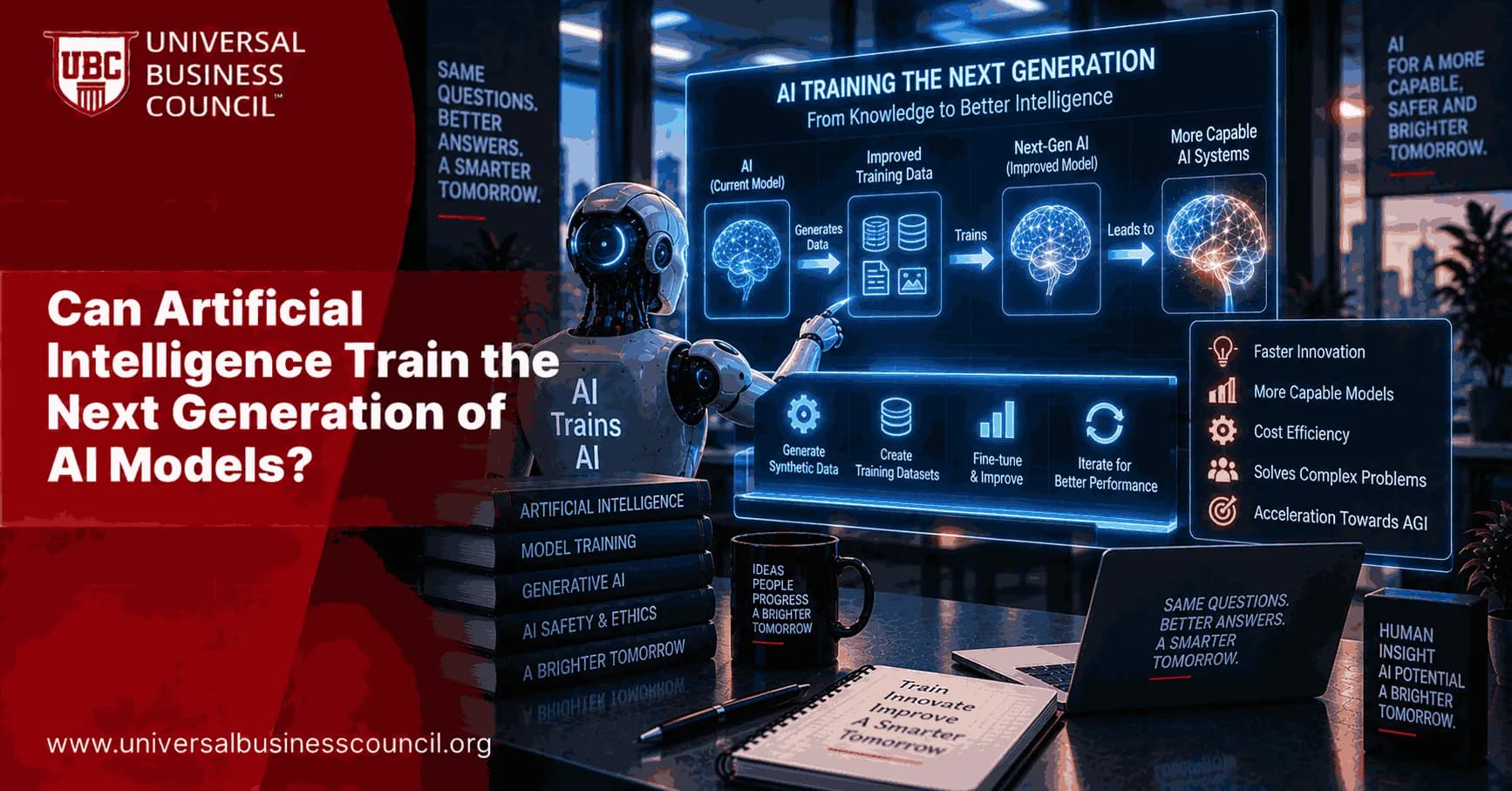
The idea of AI training AI sounds abstract until you look at how modern AI development actually works behind the scenes. Today's leading models are already trained using synthetic data generated by earlier AI systems, evaluated by AI-based grading systems, and refined through feedback loops where one model critiques another. This isn't a future possibility, it's the current standard practice across much of the industry, and it's reshaping how quickly new models can be built. As this shift accelerates, professionals in adjacent fields including marketing are paying closer attention to how AI-trained AI might affect the tools they rely on, and many deepen their understanding through a Marketing Certification to stay ahead of how these faster development cycles could reshape available marketing technology.
This article breaks down the specific ways AI already trains other AI systems today, where human involvement remains essential, and what this trend means for the pace of future AI development.

The Core Ways AI Already Trains Other AI Models
Rather than a single technique, "AI training AI" spans several distinct, well-established methods already used across the industry.
Understanding these methods in technical depth requires more than surface familiarity, and professionals who want that grounding often pursue Artificial Intelligence Certifications, which typically cover the data pipelines, evaluation systems, and training architectures involved in these processes in real technical detail.
Synthetic Data Generation
Large models generate text, code, or reasoning examples used as training data for other models
This approach helps address data scarcity in specialized domains where high-quality human-written examples are limited
Synthetic data is typically filtered and mixed with human-generated data to avoid quality degradation
Companies increasingly rely on this method as high-quality public training data becomes harder to source at scale
Knowledge Distillation
A large, highly capable "teacher" model generates outputs or guidance
A smaller "student" model is trained to replicate the teacher's behavior and reasoning patterns
This allows smaller, more efficient models to inherit much of a larger model's capability without requiring the same computational resources
Distilled models are widely used in production because they run faster and cheaper while retaining strong performance
Reinforcement Learning from AI Feedback
Instead of relying solely on human raters to judge model outputs, an AI system is used to evaluate and score responses
This scoring guides the training process, similar to traditional reinforcement learning from human feedback, but at a fraction of the cost and time
Human oversight typically remains in place to periodically check that the AI evaluator's judgments align with actual quality standards
This method has become increasingly common as training datasets and feedback volumes have grown too large for human review alone
Where Human Oversight Remains Essential
Despite how much of this process AI now handles, human involvement hasn't disappeared. It has shifted to different, often more strategic points in the pipeline.
Humans still define the objectives and success criteria that guide what "better" means for a new model
Humans set safety guardrails and review edge cases where AI-generated training data or evaluations might introduce bias or errors
Humans decide which architectures, datasets, and training approaches to pursue at a strategic level
Humans validate final model performance before deployment, rather than trusting AI-driven evaluation alone
The Real Risk: Compounding Errors Across Generations
Using AI to train AI introduces a specific technical risk that researchers take seriously. If errors, biases, or blind spots in one generation of models get passed into the synthetic data or evaluations used to train the next generation, those issues can compound rather than disappear. This phenomenon, sometimes called model collapse, shows why most serious AI labs blend synthetic data with fresh human-generated data and maintain human validation checkpoints, rather than relying entirely on an AI-only training loop.
A Creative Parallel: AI Refining Its Own Output Over Time
The same underlying principle behind AI training AI, using one system's output to improve another, shows up in creative and commercial applications as well. One emerging application is AI microdrama, where generative AI helps bring serialized stories, characters, and fictional worlds to life. In these productions, AI systems often use audience engagement data and their own prior episode outputs to refine future storylines and character development, a smaller-scale, narrative-focused example of the same generate-evaluate-refine cycle at work in large-scale model training.
Why This Trend Is Accelerating AI Development Timelines
The ability for AI to assist in training other AI systems is one of the main reasons new models continue arriving faster than many expected just a few years ago.
Synthetic data generation reduces dependency on scarce, expensive human-labeled datasets
AI-based evaluation allows companies to test and refine models at a scale human reviewers alone couldn't match
Distillation lets companies deploy smaller, faster models without starting each one from scratch
These combined efficiencies shorten the overall cycle time between one model generation and the next
Staying current with how these accelerating development cycles affect broader technology adoption is valuable across industries, and professionals who build a well-rounded Tech Certification tend to track these shifts more accurately than those relying on general headlines alone, since the underlying pipeline changes often matter more than any single flagship model release.
Is This the Same as Recursive Self-Improvement?
It's worth being precise here. AI training AI, as described above, is a genuinely powerful and increasingly standard practice, but it differs from the more theoretical concept of recursive self-improvement, where a single system autonomously redesigns its own architecture without human-defined objectives or oversight. What's happening today involves multiple systems, clear human-set goals, and validation checkpoints throughout, which is a meaningfully different, more contained process than fully autonomous self-improvement.
Professionals who want to evaluate this distinction rigorously, separating genuine industry practice from more speculative claims, often pursue a Deep Tech Certification, which provides the technical depth needed to understand exactly where current AI-assisted training practices end and more theoretical self-improvement concepts begin.
Final Thoughts
Artificial intelligence is already deeply involved in training the next generation of AI models, through synthetic data generation, distillation, and AI-driven evaluation systems that have become standard practice across the industry. This has genuinely accelerated how quickly new models get built and deployed. What it hasn't done, at least not yet, is remove humans from the process entirely, since strategic direction, safety oversight, and final validation remain firmly human-driven, even as more of the technical heavy lifting shifts to AI itself.
FAQs
1. Can Artificial Intelligence Train the Next Generation of AI Models?
Yes, AI can already assist with several parts of training and developing newer AI models. However, fully autonomous training in which an AI independently designs, trains, evaluates, and deploys increasingly capable successors is not yet established.
2. How Can AI Help Train New AI Models?
AI can contribute by generating training data, writing and optimizing code, tuning hyperparameters, designing experiments, evaluating model outputs, and identifying problems in training pipelines. These capabilities can reduce the amount of manual work required from AI researchers.
3. Can an AI Model Create Training Data for Another AI?
Yes. AI-generated synthetic data can be used to train or fine-tune other models. This approach is already used in areas such as reasoning, coding, instruction following, and specialized model development.
4. Can AI Generate Synthetic Data for Its Successor?
Potentially. A model can generate examples, solutions, explanations, code, or other material that may become training data for a subsequent model. The quality of that data needs to be carefully evaluated because generated errors can otherwise be passed to the next model.
5. Can AI Write the Training Code for a New Model?
Yes. Modern AI systems can generate, debug, and optimize machine-learning code. This can help automate portions of the model-development process, although humans or external systems generally remain responsible for defining objectives and validating the resulting system.
6. Can AI Optimize a Model's Training Process?
Yes. AI can search for better hyperparameters, algorithms, architectures, and computational strategies. Google DeepMind's AlphaEvolve, for example, combines Gemini models with automated evaluators and evolutionary search to discover improved algorithms and optimize aspects of AI infrastructure and training.
7. Can an AI Model Train a Better Version of Itself?
An AI can contribute to training a successor that performs better on particular capabilities. However, producing a consistently superior successor across broad capabilities requires reliable evaluation, substantial computing resources, high-quality data, and a carefully controlled training pipeline.
8. What Is the Difference Between AI-Assisted Training and Recursive Self-Improvement?
AI-assisted training means AI helps develop another model. Recursive Self-Improvement (RSI) involves a repeated cycle where an improved AI contributes to creating further improvements, potentially across successive generations.
9. Can Large Language Models Help Train Future LLMs?
Yes. LLMs can generate synthetic data, write training utilities, analyze experiments, identify errors, and assist with evaluation. These capabilities can make them useful tools in the development of future language models.
10. Can AI Evaluate the Next Generation of AI Models?
Yes. AI evaluators can assess model responses, code, reasoning, safety behavior, and other characteristics. Independent evaluation remains important because an AI evaluator may share some of the limitations or biases of the models being tested.
11. Can AI Improve the Algorithms Used to Train AI?
Yes. AI systems can propose algorithmic changes and automatically test candidate solutions when reliable evaluators are available. AlphaEvolve demonstrates this type of automated algorithm discovery using Gemini-powered generation and evolutionary search.
12. Can AI Discover Better Model Architectures?
AI can search or propose alternative architectures and configurations. Automated architecture search can evaluate many candidates, but discovering an architecture that provides broad, reliable improvements remains a complex research problem.
13. Can AI Train Future Models Without Human-Generated Data?
In some controlled settings, AI-generated experience can provide additional training information. Google DeepMind's SIMA 2, for example, can learn through self-directed play and generate experience that contributes to training later versions, without requiring additional human-generated demonstrations in the described setup.
14. Does AI Training Without Human Data Mean Full Autonomy?
No. A system can generate its own training data while still operating within a human-designed environment, objective, evaluation system, and infrastructure. Removing human-generated examples is therefore not the same as removing human involvement from the entire development process.
15. What Are the Main Challenges of AI Training AI?
Important challenges include data quality, model evaluation, computing costs, error propagation, objective design, reproducibility, and safety. AI-generated training material can also contain subtle errors that become harder to detect when reused across generations.
16. Can AI Training AI Cause Model Degradation?
Yes. If models repeatedly train on low-quality or insufficiently diverse AI-generated data, errors can accumulate and performance can deteriorate. Independent data sources and robust quality controls can help reduce this risk.
17. Can AI Fully Replace Human AI Researchers?
AI can automate an increasing number of research and engineering tasks, but fully replacing human researchers requires much broader capabilities. AI would need to reliably identify important research problems, develop solutions, conduct experiments, interpret results, and validate discoveries.
18. Is AI Already Helping Build the Next Generation of AI?
Yes. AI is increasingly used in coding, algorithm discovery, automated experimentation, model evaluation, and research. OpenAI has also described efforts to build automated AI researchers that perform defined research tasks under human direction.
19. Does AI Training AI Lead to Recursive Self-Improvement?
It can form one component of an RSI system. Training a new model becomes recursive self-improvement only when the resulting model contributes to further improvements and the cycle can reliably repeat across generations.
20. Could AI Eventually Train and Improve Future AI Models Autonomously?
Potentially, but this would require much more than automated training. A highly autonomous system would need to research improvements, generate or obtain appropriate data, develop training methods, run experiments, verify results, allocate resources, and safely deploy better successors. OpenAI currently states that fully autonomous recursive self-improvement is not happening today.
Related Articles
View All
Artificial Intelligence
Can AI Models Train and Improve Themselves Without Human Intervention?
Explore whether AI models can train and improve themselves without human intervention, how self-training and automated optimization work, and where human oversight is still required.
Artificial Intelligence
Can Artificial Intelligence Really Improve Itself Recursively?
Explore whether artificial intelligence can truly improve itself recursively, how recursive self-improvement could work, and the technical, practical, and safety limits involved.
Artificial Intelligence
AI in Digital Marketing: How Artificial Intelligence Is Transforming Modern Marketing
Learn how AI in digital marketing improves personalization, content, analytics, ads, SEO, and automation, plus the skills marketers need next.
Trending Articles
The Role of Blockchain in Ethical AI Development
How blockchain technology is being used to promote transparency and accountability in artificial intelligence systems.
AWS Career Roadmap
A step-by-step guide to building a successful career in Amazon Web Services cloud computing.
Top 5 DeFi Platforms
Explore the leading decentralized finance platforms and what makes each one unique in the evolving DeFi landscape.