

Can LLMs Improve Their Own Capabilities Through Recursive Self-Improvement?
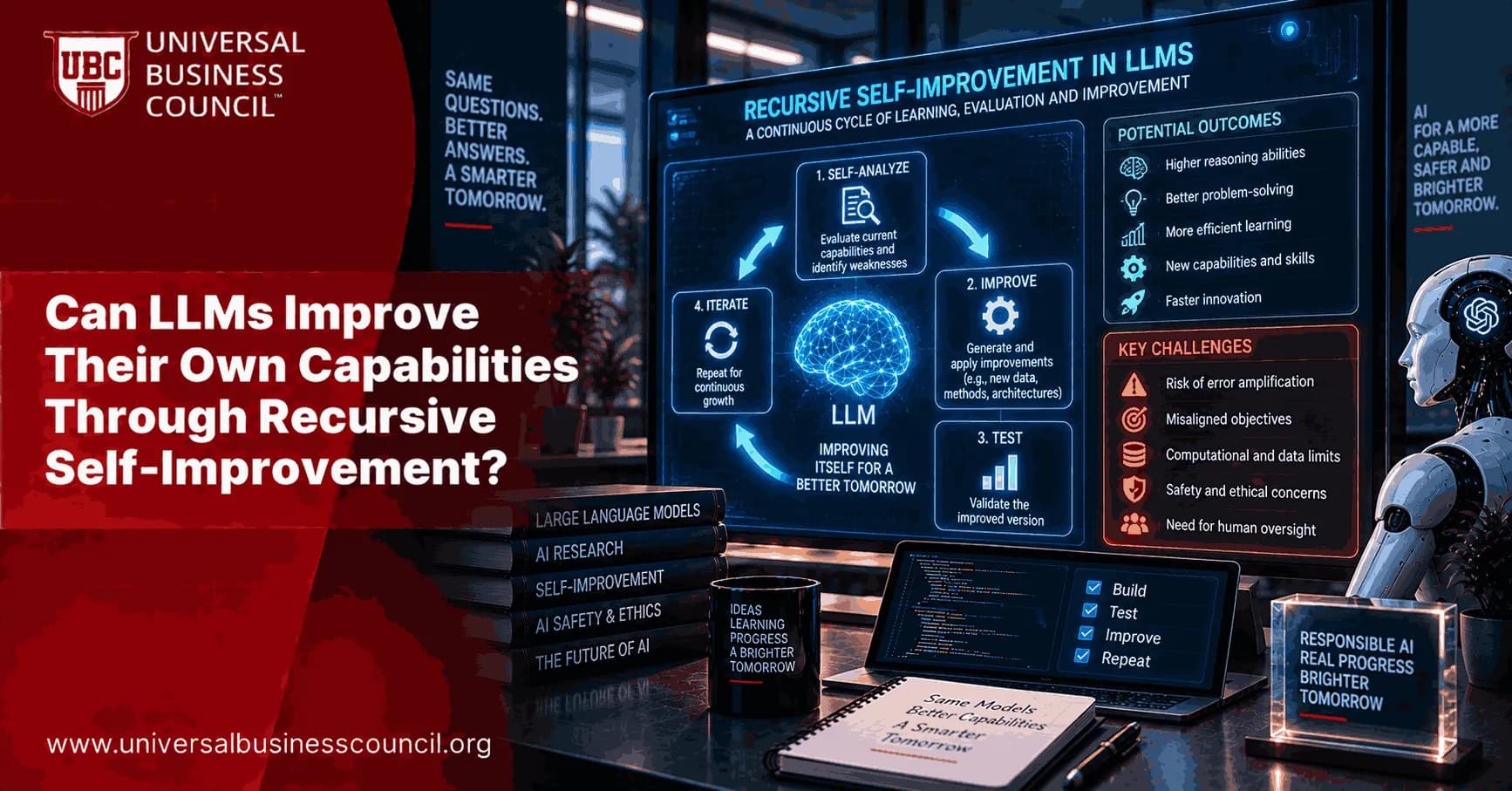
Large language models are increasingly being asked to do more than generate text. They're being used to critique their own answers, plan multi-step tasks, and even guide their own training in limited ways. This raises a specific and practical question worth separating from broader AI hype: can an LLM actually get better at reasoning, coding, or problem-solving by working on itself, cycle after cycle, without a human redesigning it each time? As businesses build more of their operations around these tools, professionals in areas like marketing are also trying to understand these capability shifts, and many strengthen their grounding through a Marketing Certification to better anticipate how self-improving language tools might change content workflows in the near future.
This article walks through the specific techniques researchers use to push LLMs toward self-improvement, what results those techniques have actually produced, and where the real limits still sit.

The Techniques Researchers Actually Use
Rather than one single method, LLM self-improvement research spans several distinct approaches, each targeting a different part of the improvement loop.
Evaluating which of these techniques genuinely move the needle requires technical grounding beyond surface-level familiarity with AI tools, and professionals who want that depth often pursue Artificial Intelligence Certifications, which typically cover the training and evaluation methods needed to judge these results critically rather than taking research paper abstracts at face value.
Self-Refine and Iterative Critique
The model generates an initial response to a task
The same model, or a separate instance, critiques that response for errors or weaknesses
A revised response is generated based on the critique
This cycle repeats a fixed number of times or until the critique reports no further issues
Research on this approach has shown measurable quality improvements on specific tasks like writing and coding, though gains typically plateau after a few iterations rather than continuing indefinitely.
Self-Taught Reasoner Style Bootstrapping
The model attempts to solve reasoning problems and generates explanations for its answers
Correct answers, along with their reasoning chains, are kept as new training examples
The model is fine-tuned on this self-generated data, ideally improving its reasoning on similar future problems
The cycle repeats using the newly fine-tuned model to generate the next round of training data
This bootstrapping approach has produced genuine capability gains on structured reasoning tasks, particularly in mathematics and logic problems where correctness can be verified automatically.
Reflexion and Agentic Self-Improvement
An LLM-based agent attempts a task, such as writing code that needs to pass specific tests
The agent receives feedback on failures, either from test results or another model
The agent stores this feedback as a kind of working memory and adjusts its next attempt accordingly
Performance improves across attempts within a single task session, though this memory typically doesn't persist into future, unrelated tasks
What the Evidence Shows About Real Capability Gains
These techniques have produced measurable, verifiable improvements, but the pattern of those improvements matters just as much as the fact that they occurred.
Gains are strongest on tasks with clear, automatically verifiable correctness, like math problems or code that either passes tests or doesn't
Improvements tend to plateau after a limited number of iterations rather than compounding indefinitely
Techniques that rely on the model critiquing itself show weaker gains than those verified against an external, objective standard
None of these methods have demonstrated the model improving its own underlying architecture or training methodology, only its outputs within a fixed architecture
Why Verification Is the Real Bottleneck
The common thread across every successful self-improvement technique is reliable verification. When a model can check whether an answer is actually correct, whether through code execution, mathematical proof checking, or another objective standard, self-improvement loops work reasonably well. When verification depends on the model's own subjective judgment of quality, results become noisier and less reliable, since the model can end up confidently reinforcing its own mistakes rather than correcting them.
Where Similar Iterative Refinement Appears in Commercial Applications
This same principle, generate, evaluate, and refine, shows up well beyond research papers in commercial AI applications already reaching audiences today. One emerging application is AI microdrama, where generative AI helps bring serialized stories, characters, and fictional worlds to life. These platforms often refine character voice, plot pacing, and episode structure iteratively based on audience engagement signals, a creative, real-world instance of the same refine-and-repeat logic researchers study more formally, though scoped to a single narrative domain rather than general capability improvement.
The Honest Boundaries of Current LLM Self-Improvement
Based on published research, a fair summary looks like this:
LLMs can meaningfully improve specific outputs within a session through critique and revision
LLMs can bootstrap better performance on verifiable reasoning tasks through self-generated training data
LLMs cannot currently redesign their own architecture, training objectives, or fundamental capabilities independently
Gains remain narrow and task-specific rather than reflecting general, compounding intelligence growth
Human-defined verification systems remain essential to preventing these loops from reinforcing errors
Staying current with which of these boundaries shift over time requires ongoing attention, and professionals who broaden their technical foundation through a well-rounded Tech Certification tend to track this kind of nuanced progress more accurately than those relying on general news coverage alone.
Where This Research Is Likely Headed
Researchers continue exploring ways to expand verifiable domains beyond math and code, since broader verification would extend these self-improvement techniques into more subjective areas like writing quality or strategic reasoning. Progress here remains incremental, and claims of breakthrough, general-purpose self-improvement should be evaluated carefully rather than accepted at face value.
Professionals who want to evaluate future research developments in this area with real technical rigor often pursue a Deep Tech Certification, which builds the depth needed to distinguish genuine methodological advances from incremental results dressed up in more dramatic language.
Final Thoughts
LLMs can improve specific capabilities through structured techniques like self-critique, bootstrapped reasoning, and agentic feedback loops, and the evidence for these narrow gains is genuinely solid. What they cannot yet do is redesign themselves at a fundamental level or sustain open-ended, compounding improvement without human-defined verification systems keeping the process grounded. The realistic picture is incremental progress within clear boundaries, not the autonomous, self-directed intelligence explosion the broader term recursive self-improvement often implies in public discussion.
FAQs
1. Can LLMs Improve Their Own Capabilities Through Recursive Self-Improvement?
LLMs can participate in processes that improve their capabilities, such as generating code, analyzing weaknesses, creating training data, and optimizing algorithms. However, fully autonomous recursive self-improvement, where an LLM independently develops increasingly capable versions of itself, has not been reliably demonstrated.
2. What Is Recursive Self-Improvement in LLMs?
Recursive Self-Improvement (RSI) is the concept of an LLM improving its own capabilities and then using those improvements to help create further improvements. A complete RSI process would involve repeated cycles of improvement, evaluation, and further improvement.
3. How Could an LLM Improve Its Own Capabilities?
A potential process could involve:
Identify weaknesses → propose improvements → implement changes → test → evaluate → retain successful changes → repeat.
The improved system would then become the starting point for the next cycle.
4. Can LLMs Improve Their Own Reasoning?
LLMs can improve performance through techniques such as reinforcement learning, feedback, self-refinement, and additional training. These methods can produce better results on specific tasks, but they do not necessarily constitute recursive self-improvement of the underlying model.
5. Can LLMs Rewrite Their Own Code?
LLMs can generate, debug, and modify code when provided with appropriate tools and permissions. This can contribute to an RSI workflow, but changing software code is different from independently redesigning the model, training pipeline, and infrastructure that produce the LLM.
6. Can an LLM Create a Better Version of Itself?
An LLM can potentially help researchers create a better successor by generating training code, proposing algorithms, analyzing experiments, or producing synthetic data. The difficult part is making this process autonomous, repeatable, and reliably capable of producing genuine improvements.
7. Can LLMs Train Their Own Successors?
LLMs can contribute to successor training by generating data, code, evaluations, or optimization strategies. However, training a better successor still requires substantial computing resources, carefully designed objectives, and reliable evaluation.
8. Can LLMs Generate Their Own Training Data?
Yes. LLMs can generate synthetic text, code, solutions, and other examples for training or fine-tuning. However, repeated training on AI-generated data without sufficient external quality controls can reinforce errors or reduce data diversity.
9. Can LLMs Evaluate Their Own Improvements?
They can evaluate outputs using predefined criteria, automated tests, reward models, or other AI evaluators. The challenge is ensuring that the evaluation accurately measures genuine capability improvements rather than simply rewarding outputs that satisfy a narrow metric.
10. What Role Does Code Generation Play in LLM Self-Improvement?
Code generation can allow an LLM to propose and implement changes to algorithms and software. When combined with execution-based testing and automated evaluation, it can form an important part of an iterative improvement loop.
11. Is Self-Improvement the Same as Recursive Self-Improvement?
No. Self-improvement can refer to a single improvement or limited optimization. Recursive self-improvement involves repeated cycles where the improved system contributes to finding and implementing subsequent improvements.
12. Can Reinforcement Learning Enable Recursive Self-Improvement?
Reinforcement learning can provide feedback that helps an LLM learn better strategies or behaviors. When combined with automated experimentation and evaluation, it can support parts of an RSI process, but reinforcement learning alone does not create autonomous RSI.
13. Can LLMs Use Their Own Outputs to Improve?
Yes. LLM-generated outputs can be used as training examples, feedback, or evaluation material. However, relying too heavily on self-generated information can propagate mistakes, making independent data and verification important.
14. Are There Real Examples of LLM-Assisted Self-Improvement?
Yes. Google DeepMind's AlphaEvolve combines Gemini models with automated evaluators and evolutionary search to discover improved algorithms. Google reports that it has been used to optimize computing infrastructure and aspects of AI training.
15. Is OpenAI Working on LLM-Based Self-Improvement?
OpenAI is developing increasingly automated AI research systems that can assist with research, coding, experimentation, and evaluation. OpenAI describes these efforts as progress toward automated AI research and RSI, while distinguishing them from fully autonomous recursive self-improvement.
16. What Prevents LLMs From Fully Improving Themselves?
Major barriers include unreliable self-evaluation, limited long-term autonomy, computing requirements, difficulty validating improvements, imperfect objectives, and security constraints. An LLM may also optimize a narrow benchmark without becoming broadly more capable.
17. Why Is Verification Important for LLM Recursive Self-Improvement?
An LLM needs to establish that a proposed change actually improves performance. Without robust verification, a recursive system could preserve bugs, amplify errors, or select changes that appear successful only because the evaluation process is flawed.
18. Could Recursive Self-Improvement Make LLMs More Capable?
Potentially. If an LLM could reliably improve its algorithms, training methods, reasoning processes, and research capabilities, repeated improvement could increase its overall performance. The speed and scale of such gains remain uncertain.
19. Is Recursive Self-Improvement Happening in LLMs Today?
Bounded forms of AI-driven improvement are already being explored and used, but fully autonomous RSI has not been established. OpenAI currently states that fully autonomous recursive self-improvement, in which AI independently drives successive generations of increasingly capable AI, is not happening today.
20. Could LLMs Eventually Improve Themselves Recursively?
It is possible in principle, but significant technical and safety challenges remain. A genuinely RSI-capable LLM would need to independently identify weaknesses, conduct useful research, implement changes, verify improvements, and repeatedly use successful improvements to drive the next generation.
Related Articles
View All
Artificial Intelligence
Can ChatGPT Improve Its Own Capabilities Through Recursive Self-Improvement?
Explore whether ChatGPT can improve its own capabilities through recursive self-improvement, how AI-assisted optimization works, and what limits current language models from achieving true RSI.

Artificial Intelligence
Can Google Gemini Improve Itself Through Recursive Self-Improvement?
Explore whether Google Gemini can improve itself through recursive self-improvement, how Gemini-powered systems already support iterative learning and optimization, and what still separates them from true autonomous RSI.

Artificial Intelligence
Can AI Rewrite and Improve Its Own Code for Recursive Self-Improvement?
Explore whether AI can rewrite and improve its own code, how code-generating systems support self-optimization, and what role this could play in recursive self-improvement.
Trending Articles
The Role of Blockchain in Ethical AI Development
How blockchain technology is being used to promote transparency and accountability in artificial intelligence systems.
AWS Career Roadmap
A step-by-step guide to building a successful career in Amazon Web Services cloud computing.
Top 5 DeFi Platforms
Explore the leading decentralized finance platforms and what makes each one unique in the evolving DeFi landscape.