

How GPT-6 Astra Could Transform Marketing Strategy, Customer Experience, and Workforce Skills
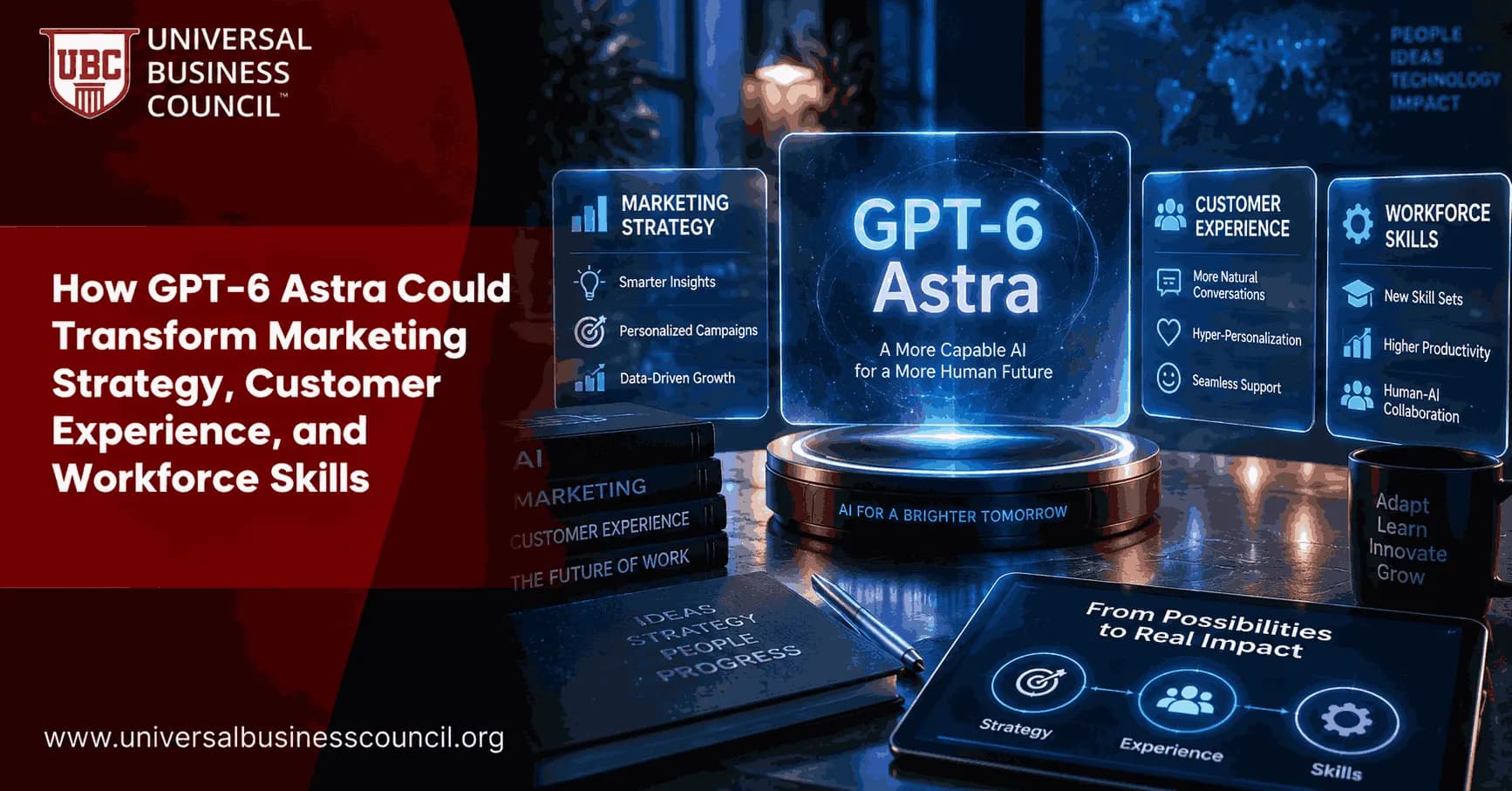
GPT-6 Astra could mark the point where generative AI in marketing shifts from helpful tools to an autonomous operating layer. Not a better copy assistant. Something bigger. A system that reads market signals, coordinates campaigns, tests customer journeys, and flags risk while your team is still arguing over the quarterly plan. Marketers preparing for this kind of shift often start with a structured credential like the Certified ChatGPT Expert program, since understanding how these models actually reason is what separates a real strategy from chasing a headline.
That shift is not theoretical. AI is already stitched into daily marketing work. A 2025 global survey found that 88 percent of organisations use AI in at least one business function, with marketing and sales among the strongest adopters. Separate reporting puts the share of organisations using AI to prepare or execute marketing activities at around 94 percent. And survey data suggests roughly 88 percent of marketers use AI in daily workflows, with most saying it speeds up content creation.

Why GPT-6 Astra matters for marketing strategy
OpenAI has publicly described its Preparedness Framework, which classifies models by capability thresholds in areas such as cybersecurity. If a frontier model in the GPT-6 range brings that kind of autonomous planning ability into business contexts, marketing strategy changes fast. The exact naming and specifications of any "Astra" release are not confirmed, so treat this as a scenario worth preparing for, not a shipped product.
Today, most teams use AI inside isolated tasks. Draft an email. Summarise a call. Build a segment. Write ad variations. Useful, but fragmented. The real change comes when a model can connect those tasks into a chain of decisions. Since preparing for that shift means marketers need depth in both AI literacy and core marketing craft, many professionals pair general AI training with a Certified Digital Marketing Expert certification, which grounds the strategic and channel skills that will still matter once a model is doing the heavy lifting on execution.
From quarterly plans to live strategy
Recent CMO Survey data suggests AI currently handles roughly a quarter of marketing optimisation and automation work, and marketers expect that figure to climb past half within three years. That is a major operating shift, not a tweak.
A model at that level could make media mix planning less like a quarterly spreadsheet ritual and more like continuous control. It could watch CAC, LTV, ROAS, churn risk, conversion rate, paid search CPCs, email engagement, inventory limits, and competitor moves. Then recommend budget changes daily, or hourly in high-volume environments.
To be blunt, this will expose weak measurement. If your Google Analytics 4 events treat a trial start as revenue-quality, the AI will optimise toward noisy growth. I have watched teams celebrate cheaper leads while sales quietly rejected half of them. The fix is not a smarter model. It is better event design, clean CRM stages in Salesforce or HubSpot, and agreement on what leadership actually tracks.
Customer experience will become more adaptive
Customer experience is where a model like this could feel most visible. Current AI already moves the numbers. Organisations applying AI across marketing report meaningful revenue lift and lower acquisition costs, and the majority of AI-using marketers apply it to content creation. Speed helps. But speed is not the ceiling.
A frontier model could coordinate an end-to-end journey across ads, website, email, in-app messages, support tickets, and renewal workflows, rather than treating each channel as a separate island.
What hyperpersonalization would actually mean
Real personalisation is not dropping a first name into an email. It is deciding that one customer needs a pricing calculator, another needs a technical proof point, and a third should not get another discount because the margin is already thin.
A GPT-6 Astra style system could combine behaviour, purchase history, service interactions, product usage, and consent status to choose the next best action. For a B2B software company, that might mean:
Sending onboarding content when product usage drops after day 7.
Routing a high-value account to a human success manager after repeated support friction.
Suppressing paid remarketing for users already in an active sales opportunity.
Testing different proof points for CFO, developer, and operations personas.
That last point matters. Bad personalisation feels creepy or lazy. Good personalisation just makes the customer's life easier.
AI as a customer operating system
A model of this class could also become a conversational layer across support, sales, onboarding, and feedback. Instead of separate chatbots reading shallow scripts, the system could hold context, explain policies, escalate sensitive cases, and update CRM records after the interaction.
The trade-off is clear. Routine questions can be automated. High-empathy cases should not be dumped on an agent without human review. Refund disputes, medical or financial concerns, enterprise contract tension, and angry long-term customers need judgment. Use AI to prepare the human, not to hide the human.
Workforce skills will shift from tool use to model supervision
A model this capable would not remove the need for marketers, strategists, analysts, product managers, and developers. It would change what good work looks like.
Research on AI and workforce transformation points to a recurring gap: a large share of organisations, by some estimates around three-quarters, lack structured AI training. That is the uncomfortable part. Teams use AI every day, yet many have no shared standards for prompting, reviewing outputs, protecting data, or escalating risk.
Industry reporting on the state of marketing AI shows rising recognition of its importance, and routine AI use is now normal among marketers. The skills agenda has to catch up.
The skills you will need
AI literacy: Understand what large language models can and cannot do. They predict, reason, summarise, and generate, but they can still invent facts.
Model steering: Give objectives, constraints, examples, evaluation rules, and context. A vague prompt creates vague work.
Experimentation discipline: Know A/B testing, incrementality, holdout groups, and statistical confidence. Otherwise the model may optimise noise.
Data governance: Track consent, retention rules, source quality, and access permissions.
Critical review: Check claims, brand tone, legal risk, bias, and commercial logic before work ships.
Workflow design: Decide which tasks AI can handle, which need approval, and which stay human-led.
If you are building a learning path, tie these skills to Universal Business Council certifications in marketing, business, management, and artificial intelligence. The strongest professionals will not be prompt hobbyists. They will be operators who connect AI outputs to strategy, governance, and measurable business results.
Likely GPT-6 Astra use cases in marketing teams
The most useful applications will not be flashy. They will remove friction from high-frequency decisions.
Autonomous growth labs: The model generates hypotheses, creates test variants, allocates small budgets, reads results, and updates the playbook.
Real-time journey orchestration: Email, paid media, on-site content, and support workflows adjust from a shared view of the customer.
Strategic customer listening: The system summarises reviews, call transcripts, social comments, and support tickets into themes leaders can act on.
Product and marketing feedback loops: Campaign data informs onboarding changes, feature education, pricing tests, and retention plays.
Brand and compliance review: AI checks claims, disclaimers, audience exclusions, privacy rules, and tone before launch.
A common first mistake is handing an autonomous system too much budget too soon. Start with low-risk recommendations, human approvals, and limited spend. Expand only when your measurement is clean and your approval logs are boring. Boring is good here.
Governance is not optional
Classifying any model as high-capability is a warning for every enterprise leader. More autonomous AI needs more serious governance. Marketing teams handle personal data, persuasion, pricing signals, and brand trust. That is not a sandbox.
Your governance plan should define:
Which data the model can access.
Which decisions require human approval.
How outputs are logged and audited.
How bias, privacy, and compliance are tested.
Who owns model performance when something goes wrong.
Do not bury this in a policy PDF nobody reads. Put the controls inside the workflow. Require legal review before regulated claims go live. Block sensitive attributes in targeting. Keep campaign change logs that show who approved what.
What you should do next
The market is moving quickly. Forecasts put AI in marketing well into the tens of billions of dollars within the next few years, with the wider generative AI market projected to reach hundreds of billions by 2030. Treat these as directional signals rather than precise promises, since estimates vary by source.
Do not wait for a GPT-6 Astra release to prepare. Audit your data quality. Rebuild weak measurement. Train your team on AI governance. Document where human approval is required. If you are serious about career growth, map your next credential through Universal Business Council's certification pathways in marketing, management, business strategy, and AI. Start with the skills that make autonomous systems useful: measurement, strategy, ethics, and operational judgment. If your team's biggest blocker is connecting AI outputs cleanly to CRM, analytics, and ad platforms rather than strategy itself, a Tech Certification from Global Tech Council is worth adding to the plan, since some marketing AI problems need better systems integration, not another prompt.
AI & Technology
As artificial intelligence continues to transform education, students are getting more opportunities to explore technology beyond traditional classroom learning. A World Tech Olympiad can help students develop their understanding of AI, logical reasoning, problem-solving, and other technology skills through structured competition.
FAQs
1. How could GPT-6 Astra transform marketing strategy?
GPT-6 Astra could move marketing AI beyond content generation toward end-to-end workflow execution. Its ability to research, reason, use computers, analyze information, and work across professional applications could help marketers connect research, planning, execution, and reporting more efficiently.
2. What does GPT-6 Astra mean for digital marketers?
For digital marketers, Astra could automate more repetitive research and execution tasks while supporting more complex analysis. Marketers could use it for research, reporting, website work, data analysis, content workflows, and other multistep activities, while retaining human oversight for strategic decisions.
3. Can GPT-6 Astra automate marketing workflows?
Yes. Astra is designed to perform multistep computer-based workflows, including interacting with websites, software, documents, and other digital environments. This could allow marketing teams to automate connected processes instead of using AI only for individual tasks.
4. How could GPT-6 Astra improve customer experience?
Astra could help businesses respond to customer needs faster by supporting research, record updates, document preparation, and other digital workflows. Its ability to interact with customer records and software could make some service processes more efficient, although organizations still need appropriate permissions and human oversight.
5. Can GPT-6 Astra personalize customer experiences?
It could support personalization by analyzing relevant customer information and helping teams create more context-aware communications and experiences. However, businesses need strong data governance and privacy controls when using customer information with AI systems.
6. How could GPT-6 Astra change customer service?
Astra could help automate routine digital customer-service processes, such as gathering information, updating records, preparing responses, and navigating business applications. This could allow customer-service employees to spend more time on complex cases that require judgment, empathy, or negotiation.
7. Will GPT-6 Astra replace marketing jobs?
GPT-6 Astra is more likely to change the composition of marketing jobs than eliminate the entire profession. Routine execution and reporting may become increasingly automated, while strategic thinking, creativity, brand judgment, experimentation, customer understanding, and AI supervision could become more valuable.
8. What workforce skills will become important because of GPT-6 Astra?
Workers will increasingly need AI literacy, critical thinking, data analysis, workflow design, communication, and domain expertise. The ability to give AI systems clear instructions, evaluate their outputs, manage AI-driven workflows, and recognize errors will also become important.
9. Will marketers still need SEO skills in the GPT-6 Astra era?
Yes. SEO remains valuable because businesses still need to understand search behavior, websites, content quality, technical performance, and discoverability. However, SEO professionals may increasingly combine traditional search optimization with AI-search optimization, data analysis, content strategy, and automated workflows.
10. How could GPT-6 Astra change content marketing?
Astra could help marketers move from producing individual pieces of content to managing larger content workflows. It can create professional documents and other polished outputs while following templates, instructions, and stylistic requirements.
11. Can GPT-6 Astra help marketers analyze campaign performance?
Yes. Astra is designed for complex analysis and professional work, including spreadsheets and data-science tasks. Marketers could use it to examine campaign data, identify patterns, prepare reports, and turn findings into recommendations, with human review still important for business-critical decisions.
12. How could GPT-6 Astra affect marketing automation?
Astra could make automation more flexible because it can reason about changing requirements rather than simply follow fixed rules. OpenAI reports a 41.4% score on AutomationBench, compared with 18.1% for GPT-5.6 Sol, highlighting its stronger performance on professional automation tasks.
13. Could GPT-6 Astra change how businesses build customer journeys?
Potentially. AI agents could help analyze different stages of a customer journey, identify friction points, test digital experiences, and assist with improvements across websites and applications. Astra's computer-use capabilities make this more practical because it can interact with digital interfaces rather than only describe recommended changes.
14. How could GPT-6 Astra affect marketing managers?
Marketing managers may spend less time coordinating repetitive execution and more time defining goals, reviewing AI-generated work, interpreting business results, and making strategic decisions. Their role could increasingly involve managing human-AI teams and designing reliable marketing workflows.
15. What new AI skills should marketers learn?
Marketers should consider developing skills in AI-assisted research, prompt and instruction design, data analysis, automation, AI agents, SEO, experimentation, and output evaluation. Understanding how AI systems interact with websites, applications, and business data can also become increasingly useful.
16. Will creativity still matter when GPT-6 Astra can create content?
Yes. AI can accelerate ideation and production, but effective marketing still requires understanding audiences, positioning, emotions, cultural context, brand identity, and business objectives. Human creativity can become more valuable when AI makes content production faster and easier.
17. How could GPT-6 Astra affect the role of a marketing analyst?
Marketing analysts could use Astra to automate parts of data preparation, analysis, reporting, and presentation creation. This could shift the analyst's focus toward asking better business questions, validating findings, identifying meaningful insights, and translating data into decisions.
18. What are the risks of using GPT-6 Astra in marketing?
Businesses need to consider inaccurate outputs, privacy issues, unauthorized actions, prompt injection, excessive automation, and insufficient human oversight. These risks become more important as AI systems gain the ability to interact directly with websites, software, and business data. OpenAI has highlighted the need for additional safeguards and monitoring for Astra's increased capabilities.
19. How should businesses prepare employees for GPT-6 Astra?
Businesses should provide practical AI training rather than treating AI as only a software purchase. Employees should learn how to delegate tasks, verify outputs, protect sensitive information, monitor automated workflows, and recognize situations where human approval is necessary.
20. What is the future of marketing and work with GPT-6 Astra?
GPT-6 Astra points toward a workplace where AI can participate in complete workflows instead of simply generating answers. For marketing, this could mean more automated research, analysis, execution, customer-experience optimization, and reporting, while human professionals increasingly focus on strategy, judgment, creativity, governance, and relationship building.
Related Articles
View All
Artificial Intelligence
How Could Recursive Self-Improvement Accelerate AI Development?
Explore how recursive self-improvement could accelerate AI development through faster experimentation, automated research, model optimization, and repeated capability gains.

Artificial Intelligence
Could Recursive Self-Improvement Lead to Artificial Superintelligence?
Explore whether recursive self-improvement could lead to artificial superintelligence, how repeated capability gains might accelerate AI development, and what technical and safety challenges could emerge.
Artificial Intelligence
Why Could Recursive Self-Improvement Be Important for AGI?
Explore why recursive self-improvement could matter for AGI, how it might accelerate capability growth, and why it raises important questions about alignment, control, and AI safety.
Trending Articles
The Role of Blockchain in Ethical AI Development
How blockchain technology is being used to promote transparency and accountability in artificial intelligence systems.
AWS Career Roadmap
A step-by-step guide to building a successful career in Amazon Web Services cloud computing.
Top 5 DeFi Platforms
Explore the leading decentralized finance platforms and what makes each one unique in the evolving DeFi landscape.