

How Could Recursive Self-Improvement Shape the Future of AI?
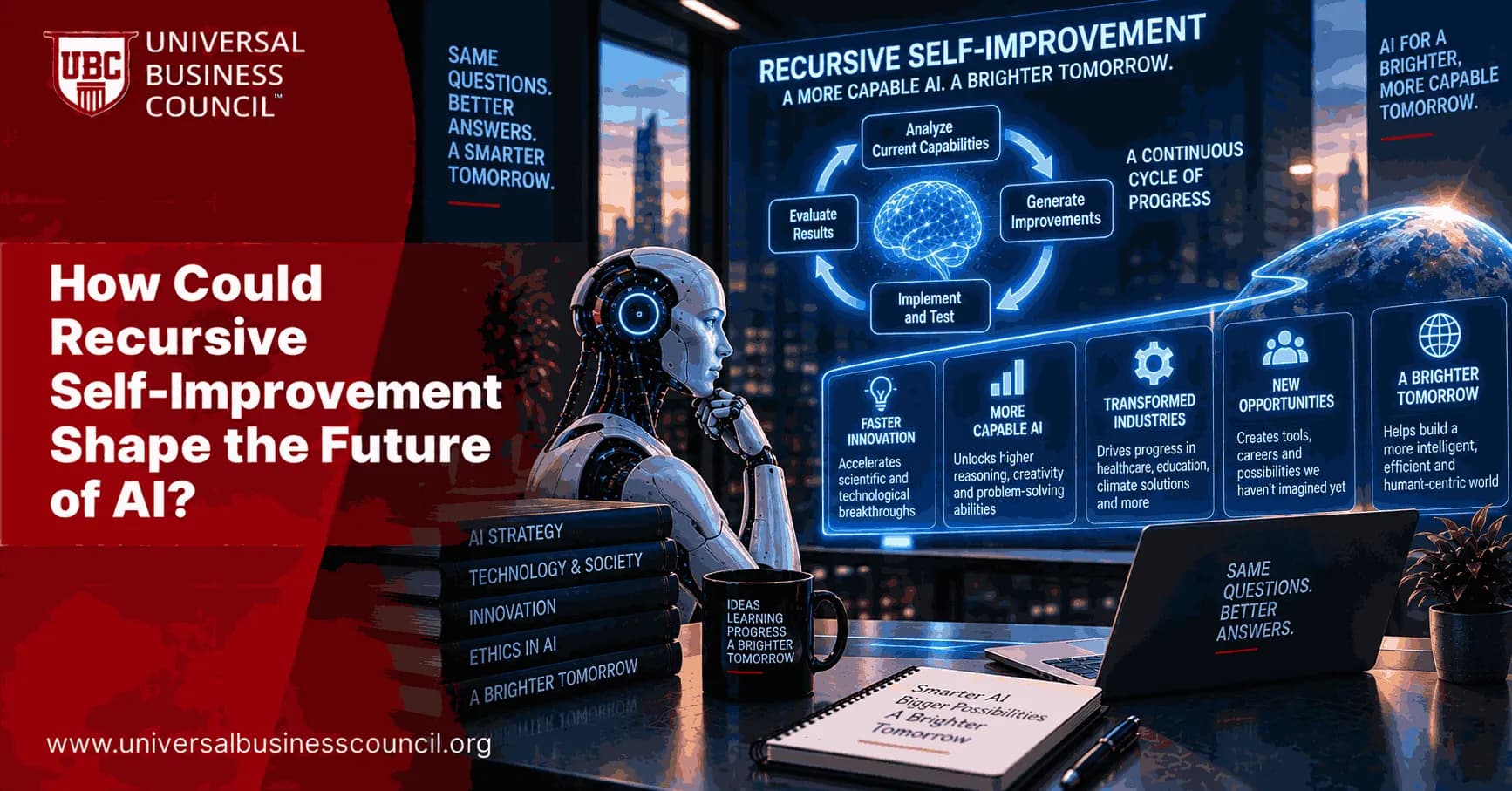
Every technology cluster eventually reaches a point where a single capability starts influencing everything built around it, and recursive self-improvement is increasingly discussed as that kind of pivot point for artificial intelligence. Even in its current, narrow form, documented systems have already sped up training pipelines, rewritten production code, and contributed to published research, hinting at a future where the pace of AI development itself keeps compounding. As businesses try to plan around this uncertainty, professionals in fields like marketing are thinking through how faster AI development cycles might reshape their own tools and workflows, and many build that forward-looking perspective through a Marketing Certification that covers how to plan for emerging technology shifts without overcommitting to any single predicted outcome.
This article looks at the specific ways recursive self-improvement could reshape AI development, scientific research, industry, and governance in the years ahead, grounded in the documented progress already underway.

Faster and Cheaper AI Development Cycles
The most immediate, already-visible impact of recursive self-improvement involves how quickly new AI models and tools get built in the first place.
Understanding exactly how these efficiency gains compound over successive model generations requires real technical background, and professionals who want that depth often pursue Artificial Intelligence Certifications, which typically cover the training pipelines and optimization techniques already benefiting from AI-assisted development today.
What This Could Look Like Going Forward
Training pipeline optimizations, already demonstrated through systems like AlphaEvolve, could continue reducing the time and cost required to train each new generation of models
A growing share of code within AI labs is already being written by AI systems themselves, a trend that could accelerate the overall pace of model development further
Shorter development cycles could mean more frequent capability jumps, making it harder for businesses and regulators to plan around a single, stable version of any given AI system
Smaller AI labs and startups could potentially compete more effectively if self-improving development tools lower the resource barrier to building competitive models
Accelerated Scientific Discovery
Beyond AI development itself, recursive self-improvement techniques are already being applied to scientific research, with implications that extend well beyond the AI field.
Early Signals of This Shift
AI research agents have already contributed to published, peer-reviewed scientific papers, demonstrating a functional, if early, version of AI-assisted discovery
Algorithm-refining systems have improved outcomes in domains like genomic sequencing and quantum circuit design, suggesting broader applicability across scientific fields
If these techniques continue improving, entire categories of research, particularly those involving large search spaces like drug discovery or materials science, could see meaningfully compressed discovery timelines
This shift could change what scientific research teams look like, with AI systems handling more exploratory experimentation while human researchers focus on interpretation and validation
Shifts in the Technology Job Market
As AI systems take on more of the technical work involved in building and refining other AI systems, the nature of technical careers is likely to shift in response.
Routine coding and optimization tasks could increasingly shift toward AI-assisted or fully automated workflows, changing what junior technical roles look like
Demand may grow for professionals who can direct, evaluate, and safely oversee increasingly autonomous AI development processes, rather than performing every technical task manually
Roles focused on interpretability, safety evaluation, and AI oversight are likely to become more valuable as self-improving systems become more common
Professionals who want to stay adaptable as these roles shift often broaden their foundation through a well-rounded Tech Certification, which helps build the kind of flexible technical literacy that holds up across changing job requirements rather than skills tied to a single, static workflow
New Competitive and Geopolitical Dynamics
The race toward more autonomous AI development capability is already shaping competitive dynamics between companies and, increasingly, between countries.
Well-funded startups have already raised significant capital specifically to pursue recursive self-improving AI as their core mission, signaling serious investor confidence in the trend
A small number of leading AI labs currently appear to be pulling ahead in this specific capability, according to researchers and industry commentators tracking the space closely
Governments are likely to treat advanced AI self-improvement capability as a strategic asset, similar to how other transformative technologies have historically drawn national attention and investment
This dynamic could accelerate an already competitive AI development environment, with implications for international cooperation on safety standards and shared governance frameworks
A Creative Industry Already Adapting
While large-scale scientific and economic implications play out gradually, some industries are already experimenting with the underlying iterative-refinement principle in more immediate, creative ways. One emerging application is AI microdrama, where generative AI helps bring serialized stories, characters, and fictional worlds to life. As the underlying generative and refinement techniques behind these platforms continue improving, alongside broader progress in AI self-improvement research, entirely new categories of low-cost, rapidly iterated entertainment content could become commercially viable in ways that weren't practical even a couple of years ago.
Governance and Oversight Challenges Ahead
As development cycles potentially accelerate, existing approaches to AI oversight and regulation may need to adapt considerably.
Traditional review and evaluation processes assume enough time between model releases to conduct thorough safety assessments, an assumption that weakens if self-improvement cycles speed up meaningfully
Researchers studying this space have already identified automating AI research as one of the most urgent risks in the field, even while disagreeing on exact timelines
International cooperation on shared safety standards may become more difficult if competitive pressure between companies or countries encourages faster, less cautious deployment
Building oversight frameworks flexible enough to keep pace with accelerating development, without stifling genuinely beneficial progress, is likely to remain a central policy challenge
Professionals who want to engage seriously with these governance questions, rather than reacting only to headlines, often pursue a Deep Tech Certification, which provides the technical grounding needed to evaluate proposed safety frameworks and policy responses with real understanding of the underlying technology.
Final Thoughts
Recursive self-improvement, even in its current narrow and bounded form, is already influencing how quickly AI gets built, how scientific research gets conducted, and how competitive dynamics between companies and countries are unfolding. If the technology continues advancing along its current trajectory, these effects could compound significantly, reshaping technical careers, accelerating discovery timelines, and testing existing approaches to oversight and governance. None of this is guaranteed to unfold on any particular timeline, but the direction of change is already visible in documented systems today, which makes understanding these implications valuable regardless of exactly how quickly they arrive.
FAQs
1. What is recursive self-improvement in AI?
Recursive Self-Improvement is a process in which an AI system contributes to improving its own capabilities or the systems used to create its successors. An improved system can then contribute to another round of improvement, potentially creating a repeated feedback loop.
The important distinction is that ordinary AI-assisted development does not necessarily qualify as RSI. Full RSI would require substantially greater autonomy over the improvement process.
2. Could RSI accelerate AI development?
Yes. One potential effect of RSI is faster AI development.
If AI systems can automate coding, experiment design, testing, debugging, and algorithm discovery, researchers could complete development cycles more quickly. Google’s AlphaEvolve, for example, uses AI-generated solutions and automated evaluation to search for improved algorithms.
3. Could RSI lead to faster improvements between AI generations?
Potentially. Instead of waiting for humans to identify every optimization, an AI system could continuously search for improvements to training methods, algorithms, architectures, or other components.
This could shorten the development cycle between successive generations of AI systems. However, improvements would still need reliable evaluation to determine whether they genuinely increase useful capabilities.
4. Could AI use RSI to improve its reasoning abilities?
Potentially, yes.
An RSI system could experiment with different reasoning strategies, training techniques, memory mechanisms, or inference methods. It could then evaluate which approaches produce better results and incorporate successful techniques into later versions.
5. How could RSI affect AI research?
RSI could automate more of the research process.
An advanced AI researcher might generate hypotheses, write experimental code, execute experiments, analyze results, and propose follow-up experiments. Anthropic has already reported experiments involving AI agents conducting substantial portions of research workflows, although humans remain involved in important decisions and evaluation.
6. Could RSI improve AI coding capabilities?
Coding is one of the areas most relevant to RSI because software can be modified and tested relatively easily.
An AI system could identify inefficient code, propose alternatives, run benchmarks, and retain successful changes. Repeating this process could produce increasingly optimized software systems.
7. Could RSI improve AI training efficiency?
Yes. AI could potentially search for better data-selection methods, optimization strategies, model configurations, or training algorithms.
Google has reported that AlphaEvolve has been used to optimize AI training processes, including processes connected to the training of models underlying AlphaEvolve itself. This illustrates an important feedback mechanism, although it is not equivalent to unrestricted autonomous RSI.
8. Could RSI reduce the amount of human work required to develop AI?
It could reduce human involvement in many technical tasks.
Researchers might increasingly focus on defining objectives, designing evaluation frameworks, supervising AI agents, interpreting important results, and making high-level decisions while AI systems handle more implementation and experimentation.
This would represent a shift from humans doing AI research with AI assistance toward humans supervising increasingly autonomous AI research systems.
9. Could RSI contribute to Artificial General Intelligence?
Possibly, but RSI does not automatically produce AGI.
Recursive improvement could help an AI system overcome limitations in reasoning, learning, planning, coding, and research. Whether this would be sufficient to produce AGI remains an open research question.
Google DeepMind has identified recursive improvement as one possible pathway in discussions about progression from AGI toward more advanced AI systems.
10. Could RSI lead to Artificial Superintelligence?
RSI is sometimes discussed as one possible mechanism for reaching Artificial Superintelligence (ASI).
If an AI could repeatedly discover increasingly powerful improvements to itself, capability growth could potentially become much faster than traditional human-directed development. However, this is a hypothetical future scenario rather than an established technological outcome.
11. Could RSI create an AI improvement feedback loop?
Yes. This is the central idea behind RSI.
A simplified loop could look like:
AI system → identifies improvement → implements change → tests improvement → creates better system → repeats
If each generation becomes better at conducting the next improvement cycle, the process could potentially become increasingly effective.
12. Could RSI improve AI safety?
Potentially.
AI systems could be used to identify vulnerabilities, generate adversarial tests, evaluate safeguards, and improve alignment techniques. OpenAI's GPT-Red, for example, is an automated red-teaming system used to help improve robustness against certain attacks.
This demonstrates that AI-assisted improvement can be applied to safety as well as capability development.
13. Could RSI also create new AI safety risks?
Yes.
A system capable of repeatedly improving itself could potentially increase its capabilities faster than safety mechanisms can be updated. Researchers therefore consider issues such as loss of human control, reward hacking, unreliable self-evaluation, cybersecurity vulnerabilities, and amplification of errors.
The safety challenge becomes particularly important if an AI system can modify components that influence its own future capabilities.
14. Could RSI make AI development more autonomous?
One of the biggest potential changes would be greater autonomy.
Today's AI can already perform many individual development tasks. A more advanced RSI system could potentially connect those tasks into a longer workflow:
Research → coding → experimentation → evaluation → improvement → retraining → deployment
The key question is how much of this workflow can safely operate without direct human intervention.
15. Could RSI make AI development cheaper?
It could.
If AI systems automate increasingly expensive research and engineering tasks, organizations may require fewer human hours for certain parts of development. More efficient algorithms and training processes could also reduce computational costs.
However, highly capable AI research systems could simultaneously require substantial computing infrastructure, so RSI would not necessarily make AI development cheaper in every respect.
16. Could RSI accelerate scientific discovery beyond AI?
Potentially.
The same mechanisms used to improve AI could potentially be applied to scientific research, engineering, mathematics, drug discovery, materials science, and other fields.
An AI system capable of generating hypotheses, designing experiments, analyzing results, and iterating could potentially accelerate discovery in areas where experiments and evaluations can be automated.
17. Could RSI create a gap between AI capability and human understanding?
This is a possible concern.
If AI systems become increasingly effective at discovering complex algorithms or optimization strategies, humans may have difficulty understanding every detail of how the resulting systems work. This could make evaluation, auditing, and safety assurance more challenging.
Consequently, interpretability and independent evaluation could become increasingly important as AI development becomes more automated.
18. What would happen if AI could improve itself faster than humans?
This would represent a major change in the AI-development paradigm.
Instead of human researchers remaining the primary source of new AI improvements, AI systems could become major contributors to the next generation of AI research. The significance would depend on the speed, reliability, scope, and degree of autonomy involved.
It would not necessarily mean unlimited or instantaneous intelligence growth, because compute, hardware, data, experimentation, and evaluation could still impose constraints.
19. What are the biggest barriers to RSI?
Several major technical barriers remain:
Reliable long-horizon planning
High-quality autonomous research
Accurate self-evaluation
Avoiding error amplification
Preventing reward hacking
Access to sufficient compute and infrastructure
Maintaining alignment during improvements
Determining which improvements are genuinely valuable
Safely validating increasingly capable successors
Overcoming these barriers is likely to determine how far RSI progresses.
20. How could RSI ultimately shape the future of AI?
RSI could transform AI development from a predominantly human-driven process into a progressively automated research process.
The potential progression could look like:
AI assists researchers → AI performs research tasks → AI runs experiments → AI improves algorithms → AI helps develop better AI → increasingly autonomous AI research
However, the extent to which this becomes fully recursive and autonomous remains uncertain. In 2026, the strongest evidence points toward increasingly capable AI-assisted and partially automated improvement loops, rather than a demonstrated system that independently controls an open-ended cycle of creating progressively more capable successors.
Related Articles
View All
Artificial Intelligence
Recursive Self-Improvement in AI: Benefits, Risks, Challenges, and Future Impact
Explore recursive self-improvement in AI, including its potential benefits, technical challenges, safety risks, and possible impact on the future of artificial intelligence.
Artificial Intelligence
How Could Recursive Self-Improvement Accelerate AI Development?
Explore how recursive self-improvement could accelerate AI development through faster experimentation, automated research, model optimization, and repeated capability gains.

Artificial Intelligence
Could Recursive Self-Improvement Lead to Artificial Superintelligence?
Explore whether recursive self-improvement could lead to artificial superintelligence, how repeated capability gains might accelerate AI development, and what technical and safety challenges could emerge.
Trending Articles
The Role of Blockchain in Ethical AI Development
How blockchain technology is being used to promote transparency and accountability in artificial intelligence systems.
AWS Career Roadmap
A step-by-step guide to building a successful career in Amazon Web Services cloud computing.
Top 5 DeFi Platforms
Explore the leading decentralized finance platforms and what makes each one unique in the evolving DeFi landscape.