

How Close Is AI to Achieving Recursive Self-Improvement?
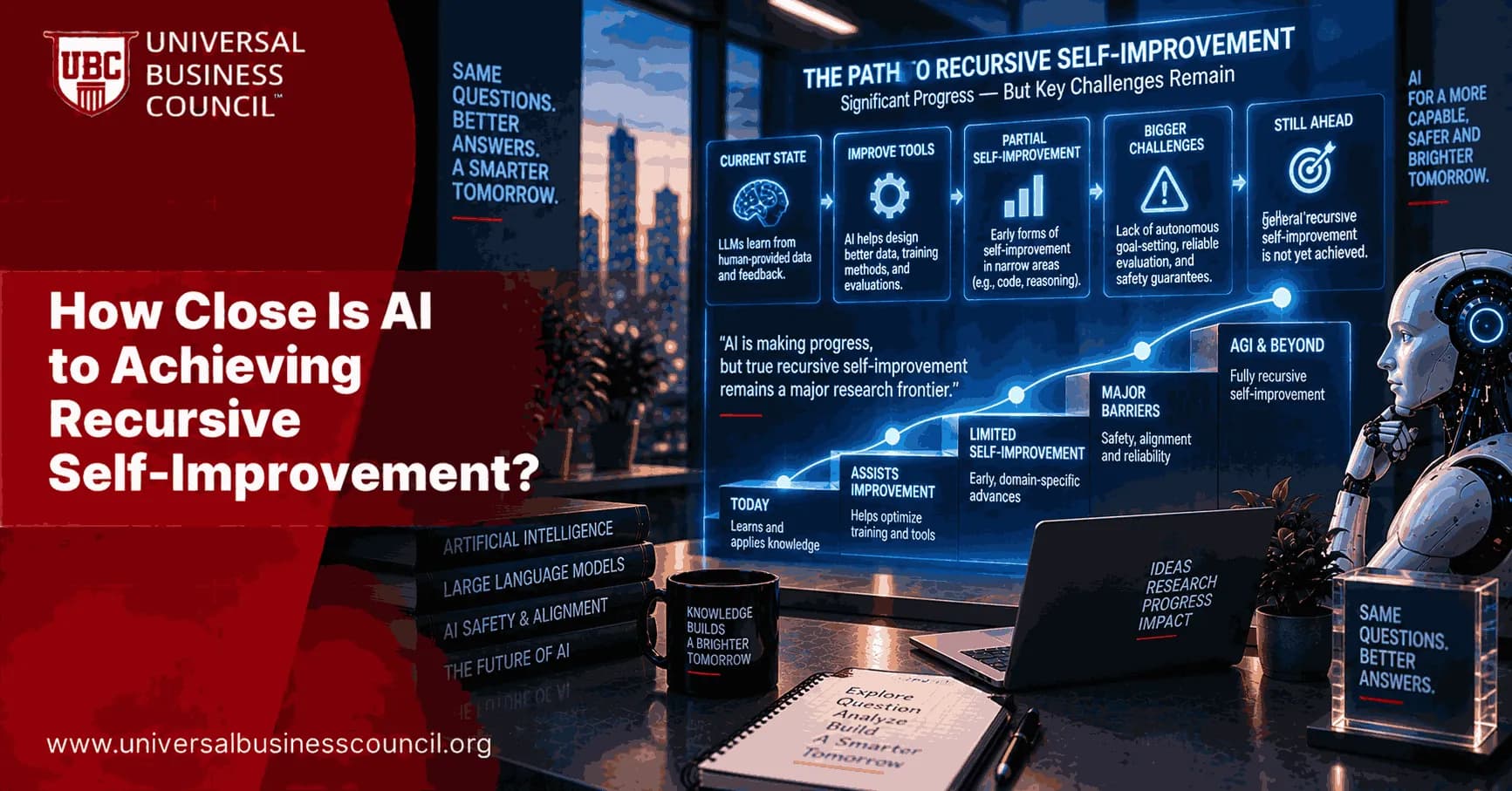
Ask ten AI researchers how close we are to genuine recursive self-improvement and you'll likely get answers ranging from a couple of years to several decades, and both groups will point to real evidence supporting their view. This isn't a case of some experts being informed and others being wrong. It reflects a genuine, unresolved disagreement about how to interpret current trends, one that has intensified as documented systems have started showing measurable, if narrow, progress. As this debate spills into business planning and public discourse, professionals in fields like marketing are trying to gauge how seriously to take these timelines, and many sharpen that judgment through a Marketing Certification that covers how to evaluate emerging technology claims without overreacting to either hype or dismissal.
This article lays out what the actual data shows, why expert predictions diverge so sharply, and what a realistic assessment of the distance remaining actually looks like.

What the Measurable Trends Currently Show
Before looking at predictions, it helps to start with data that can actually be tracked over time rather than speculation about the future.
Interpreting these trends accurately requires genuine technical background, and professionals who want that depth often pursue Artificial Intelligence Certifications, which typically cover the benchmarking methods researchers use to measure whether AI capability trends are actually accelerating, holding steady, or plateauing.
Documented Progress Worth Tracking
Research tracking AI task performance has found that the length of tasks AI systems can reliably complete has been doubling roughly every seven months in recent years
Systems like AlphaEvolve have already delivered measurable, double-digit percentage speedups to AI training pipelines through automated optimization
Major AI labs report that a meaningful share of their own internal code, reportedly between ten and twenty percent in some cases, is now generated by their own AI systems rather than written manually
The Darwin Gödel Machine has demonstrated a documented jump from twenty to fifty percent performance on a real coding benchmark through repeated self-modification
Why Expert Predictions Vary So Widely
Given the same underlying data, researchers reach dramatically different conclusions about timelines, largely because of a few specific points of disagreement.
The Core Points of Disagreement
The compute bottleneck question: Some researchers believe cognitive progress alone, without proportional increases in computing power, could be enough to trigger accelerating self-improvement, while others argue physical compute constraints will slow any runaway feedback loop regardless of algorithmic gains
The feedback multiplier debate: Researchers modeling this question estimate a wide range for how much a software improvement feedback loop could accelerate progress, with significant uncertainty in either direction
Frontier lab optimism versus academic caution: Interviews with researchers directly building these systems show more confidence in near-term recursive improvement, while academic researchers studying the same trends more often express skepticism about explosive growth scenarios
Definitional disagreement: Some predictions describe automating AI research tasks as recursive self-improvement, while others reserve that term specifically for open-ended, architecture-level self-modification, a much higher bar
The Range of Expert Timeline Estimates
Putting actual numbers to this disagreement shows just how wide the range genuinely is.
Some industry leaders and well-funded startups have publicly projected recursive self-improving AI within roughly two to three years, backed by significant venture investment betting on that timeline
More conservative technical estimates from researchers modeling software feedback loops suggest a broader window of five to fifteen years before meaningful recursive self-improvement becomes plausible
Broader surveys on related milestones like advanced general AI show median expert estimates spanning anywhere from the late 2020s to the 2040s or later, depending heavily on how the question is framed
Nearly all serious estimates agree on one point: a clear, gradual transition from AI functioning as an assistant to functioning as a more autonomous developer is already underway, even if the endpoint of that transition remains disputed
Staying grounded in this range, rather than anchoring to whichever single prediction gets the most media attention, benefits from ongoing technical literacy, and a well-rounded Tech Certification helps professionals track these evolving estimates with the nuance they actually require.
Signals That the Conversation Is Intensifying
Beyond predictions alone, concrete institutional signals suggest this question is being taken increasingly seriously across the industry.
A dedicated startup focused specifically on building recursive self-improving AI raised several hundred million dollars in funding within its first month of operation, backed by major technology investors
Sakana AI has formalized an entire research lab built around this specific goal, publishing multiple documented systems along the way
Academic conferences have begun hosting dedicated workshops specifically on AI systems capable of recursive self-improvement
Structured interviews with leading researchers found that a large majority identified automating AI research as one of the most urgent risks in the field today, even while disagreeing on exact timelines
A Smaller-Scale Example of Iterative Progress
While the broader debate plays out at a research and policy level, similar iterative refinement principles are already producing results in far more contained, commercial applications. One emerging application is AI microdrama, where generative AI helps bring serialized stories, characters, and fictional worlds to life. These systems refine character development and plot pacing across episodes based on audience response, a useful reminder that AI systems are already iterating meaningfully on their own outputs today, just within far narrower, lower-stakes domains than the open-ended self-improvement researchers debate.
A Realistic Assessment of the Distance Remaining
Weighing the documented progress against the genuine uncertainty in expert predictions points toward a measured conclusion rather than a confident date.
Meaningful, narrow forms of self-improvement already exist and are improving steadily, based on trackable, published benchmarks
The gap between these narrow, bounded systems and full, open-ended recursive self-improvement remains substantial, involving unresolved problems like independent verification and genuine self-modeling
Compute and safety constraints currently limit how far existing systems are allowed to run, separate from the question of whether they're technically capable of running further
The most defensible position sits between the most aggressive near-term predictions and the most skeptical long-range estimates, acknowledging real acceleration without assuming it continues indefinitely
Professionals who want to evaluate this fast-moving debate with genuine rigor, rather than anchoring to whichever prediction feels most compelling, often pursue a Deep Tech Certification, which builds the technical grounding needed to weigh conflicting expert claims critically as new evidence continues to emerge.
Final Thoughts
AI is measurably closer to recursive self-improvement than it was even a year or two ago, with documented systems showing real, benchmarked progress on narrow tasks like code rewriting and training pipeline optimization. Whether that trajectory leads to open-ended, autonomous self-improvement within a few years or remains a decade or more away is a question experts themselves haven't resolved, and treating any single confident prediction as settled fact overstates the current state of consensus. The honest answer is that the distance is shrinking, but exactly how much distance remains is still genuinely, seriously disputed among the people closest to the research.
FAQs
1. How close is AI to recursive self-improvement?
AI is closer to RSI than it was a few years ago, particularly in coding, experimentation, evaluation, and research automation. However, today's systems still depend heavily on humans for setting objectives, providing resources, validating results, and making major development decisions.
The remaining gap is not simply "better reasoning." AI needs to reliably identify useful improvements, implement them, test them, recognize failures, and independently decide what to improve next.
2. Can AI already improve its own code?
Yes, within constrained environments. Modern AI agents can write, modify, debug, test, and optimize software with limited human intervention.
For example, Anthropic reports that its models can independently execute increasingly complex engineering tasks, while Google's AlphaEvolve uses Gemini models, automated evaluation, and evolutionary search to discover and improve algorithms.
3. Can AI improve AI-training processes?
Yes. This is one of the clearest areas of progress.
Google reports that AlphaEvolve has been used to optimize AI training processes, including processes involved in training the large language models underlying AlphaEvolve itself. However, this is still a bounded optimization system rather than an AI independently redesigning the entire next generation of itself.
4. Can AI conduct AI research autonomously?
AI can now perform substantial portions of research workflows. Anthropic reports experiments in which Claude-powered agents proposed hypotheses, ran experiments, shared findings between agents, and iterated on results. Humans still selected the research problem and created the evaluation framework.
This distinction is important: automating research tasks is not the same as autonomously controlling the entire AI-development process.
5. What is the biggest missing capability?
One major missing capability is high-level research direction.
Current AI systems can become very effective at answering questions such as:
"How can we optimize this training code?"
But full RSI requires something closer to:
"What should we improve about ourselves next, why would that improvement matter, and how should we test it?"
Anthropic identifies this ability to choose goals and decide which problems are worth pursuing as an important remaining gap.
6. Are current AI systems already part of an improvement loop?
Yes. AI systems are increasingly being used to build, test, evaluate, debug, and improve subsequent AI systems.
OpenAI describes AI-assisted research as already accelerating parts of the development and alignment process for next-generation models, while emphasizing that this should not be confused with fully autonomous RSI.
7. What does the path toward RSI look like?
A simplified progression looks like this:
AI assistance → AI coding → AI agents → automated experimentation → AI research automation → AI-directed AI development → recursive self-improvement
Current frontier systems have moved substantially into the middle stages. The final transition requires much greater autonomy and reliability.
8. Is AI already capable of creating a better AI model?
AI can contribute to creating better models, but this usually happens inside a human-designed pipeline.
For example, AI can help optimize algorithms, generate training code, evaluate experiments, discover improvements, and analyze failures. Google describes AlphaEvolve as an example of AI-driven algorithm discovery and optimization.
That is different from an AI independently deciding to create its own successor and then deploying that successor.
9. Could recursive self-improvement happen suddenly?
It is possible in principle, but there is no reliable timetable.
Progress could remain gradual if bottlenecks such as compute, energy, data, hardware, evaluation, or research judgment limit improvement. Conversely, breakthroughs in automated research could accelerate progress.
Anthropic specifically notes that current capability trends could continue, stall, or eventually lead to systems capable of building their own successors.
10. What role does compute play in RSI?
Compute is a major constraint.
An AI capable of designing better algorithms still needs computational resources to train, test, and evaluate those improvements. If an AI becomes increasingly effective at finding computational efficiencies, it could potentially make each subsequent improvement cheaper or faster.
This creates one possible positive feedback loop:
Better AI → better algorithms → more efficient training → better AI → better algorithms
11. Does AGI automatically lead to recursive self-improvement?
No.
Artificial General Intelligence and RSI describe different properties. AGI generally refers to broad, human-level or greater capability across many intellectual tasks, while RSI refers specifically to an AI's ability to repeatedly improve the systems responsible for its own capabilities.
Google DeepMind's 2026 report identifies recursive improvement as one potential pathway from AGI toward ASI, alongside other possibilities such as scaling, new AI paradigms, and multi-agent systems.
12. What prevents today's AI from achieving full RSI?
Several barriers remain:
Reliable long-horizon planning
High-level research judgment
Robust self-evaluation
Reliable identification of genuine improvements
Access to sufficient compute and infrastructure
Avoiding errors and reward hacking
Maintaining alignment during capability improvements
Independently determining useful research objectives
Validating that a new AI version is actually better
These barriers mean that AI can automate pieces of the improvement process without yet controlling the complete cycle.
13. Can AI improve itself without human-generated data?
In some constrained settings, yes.
AI systems can generate experience, run experiments, produce synthetic data, and learn from the results. But removing humans from the loop creates additional challenges because AI-generated training data can contain errors or reinforce existing weaknesses.
Therefore, autonomous data generation is an important component of RSI research, but it does not by itself establish full RSI.
14. What is the difference between AI-assisted improvement and RSI?
The key difference is who controls the overall improvement loop.
AI-assisted improvement:
Human chooses the goal → AI performs tasks → humans evaluate results → humans decide what happens next.
Recursive self-improvement:
AI identifies improvements → AI implements them → AI evaluates them → AI develops an improved version → improved AI repeats the process.
Today's systems increasingly resemble the first model, with some parts of the second model emerging in constrained environments.
15. Are companies actively working toward RSI?
Yes.
OpenAI says it is working toward automated AI researchers operating under human supervision and has publicly discussed preparing for recursive self-improvement. Anthropic has also published research on its progress toward AI systems that could eventually participate more independently in AI development. Google DeepMind is researching AI systems such as AlphaEvolve that automate algorithm discovery and optimization.
16. Does AlphaEvolve represent recursive self-improvement?
AlphaEvolve demonstrates an important RSI-like mechanism, but it should not be described as unrestricted RSI.
It generates candidate programs, evaluates them automatically, and uses an evolutionary process to select promising improvements. Google reports that it has been applied to infrastructure, algorithms, chip design, and AI training.
The system operates within objectives and evaluation structures established by humans.
17. How close are AI systems to closing the entire RSI loop?
The evidence suggests that many individual components are becoming increasingly automated, but the complete loop remains incomplete.
A useful way to think about the current situation is:
RSI capability | Current state |
|---|---|
Write AI-related code | Advanced |
Debug AI systems | Advanced |
Optimize algorithms | Advanced in bounded tasks |
Run experiments | Increasingly autonomous |
Evaluate experiments | Increasingly automated |
Generate research ideas | Emerging |
Choose research priorities | Limited |
Build a successor model independently | Not demonstrated as fully autonomous |
Repeatedly improve itself without human direction | Not achieved |
This is why it is more accurate to describe current AI as approaching important components of RSI rather than already possessing full RSI.
18. Could current AI models eventually become recursively self-improving?
Potentially, but this remains an open technical question.
Anthropic says the current trend could eventually lead to systems capable of building and training their own successors, while also emphasizing that recursive self-improvement is not inevitable.
The outcome depends on whether current capability trends continue and whether researchers can overcome limitations in autonomy, judgment, evaluation, compute, and safety.
19. How close is AI to RSI in simple terms?
A useful simplified picture is:
AI can increasingly help build AI.
The next major step is:
AI independently runs much of the AI-development process.
The defining RSI step would then be:
AI builds a better version of itself, which builds an even better version, repeatedly and with decreasing human involvement.
That final loop has not been demonstrated as a fully autonomous process.
20. When will AI achieve recursive self-improvement?
There is currently no scientifically established date for full RSI.
Current evidence shows rapid progress toward automated coding, experimentation, algorithm optimization, and AI research. OpenAI says fully autonomous RSI is not happening today, while Anthropic describes the technology as moving toward greater automation but says "we are not there yet."
The most defensible conclusion in 2026 is that AI is substantially closer to the technical ingredients of RSI than it was previously, but the complete autonomous recursive loop remains an unsolved problem.
Related Articles
View All
Artificial Intelligence
What Limits AI From Achieving Recursive Self-Improvement?
Explore the key limitations preventing AI from achieving recursive self-improvement, including unreliable evaluation, limited autonomy, compute constraints, alignment challenges, and diminishing returns.

Artificial Intelligence
Recursive Self-Improvement in AI: Benefits, Risks, Challenges, and Future Impact
Explore recursive self-improvement in AI, including its potential benefits, technical challenges, safety risks, and possible impact on the future of artificial intelligence.
Artificial Intelligence
How Could Recursive Self-Improvement Accelerate AI Development?
Explore how recursive self-improvement could accelerate AI development through faster experimentation, automated research, model optimization, and repeated capability gains.
Trending Articles
The Role of Blockchain in Ethical AI Development
How blockchain technology is being used to promote transparency and accountability in artificial intelligence systems.
AWS Career Roadmap
A step-by-step guide to building a successful career in Amazon Web Services cloud computing.
Top 5 DeFi Platforms
Explore the leading decentralized finance platforms and what makes each one unique in the evolving DeFi landscape.