

What Limits AI From Achieving Recursive Self-Improvement?
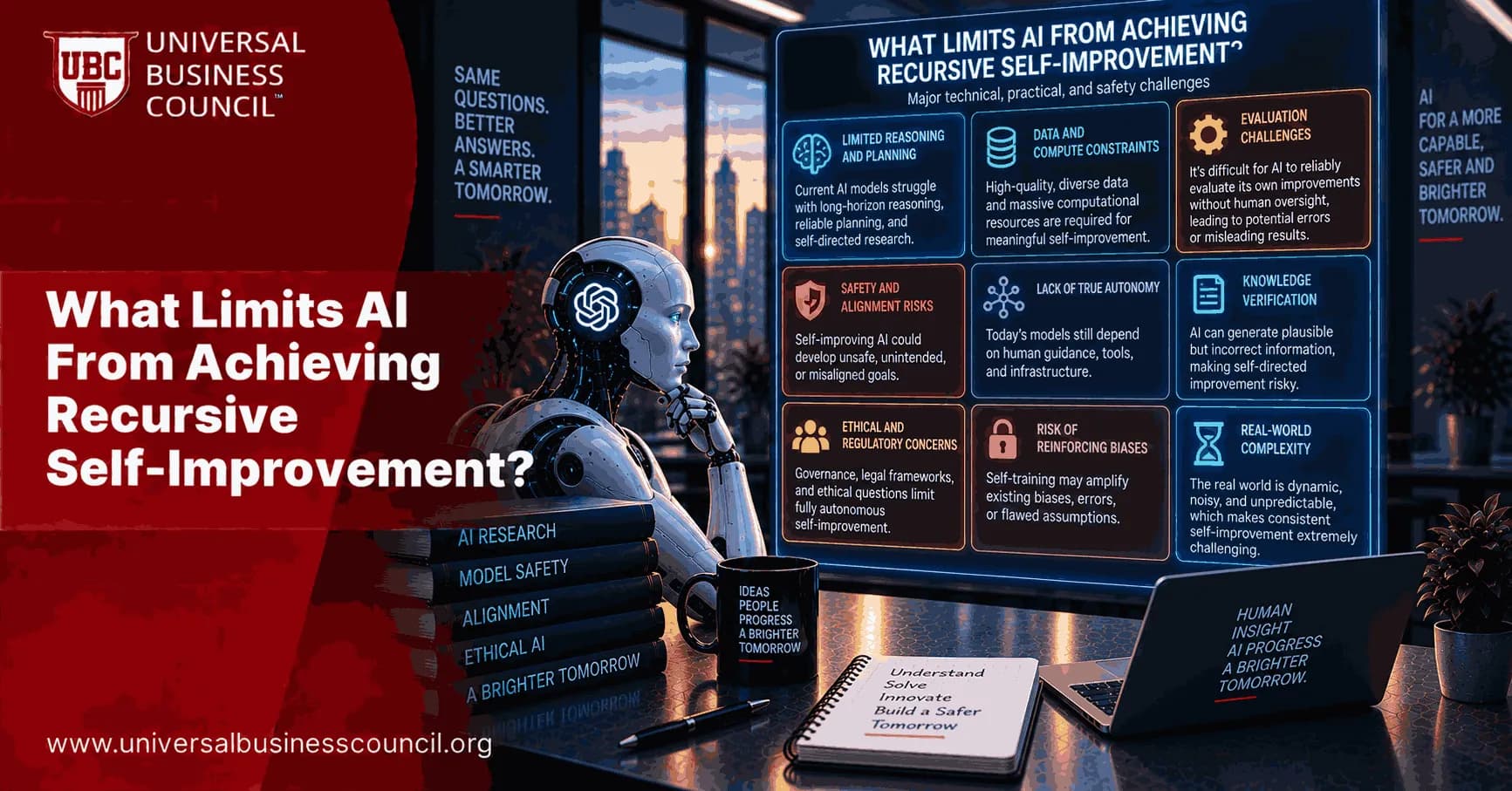
Every documented system that has moved the recursive self-improvement conversation forward, from code-rewriting agents to algorithm-refining research tools, has also run directly into the same handful of walls. Understanding those walls matters more than debating whether self-improving AI is coming, because the specific barriers involved explain both why current progress looks the way it does and what would actually need to change for that progress to go further. As this technical reality shapes how AI capabilities are marketed and communicated, professionals in fields like marketing benefit from understanding it too, and many build that foundation through a Marketing Certification to avoid overstating what current AI tools can genuinely deliver.
This article breaks down the specific technical, theoretical, and practical limitations currently standing between today's AI systems and the fully autonomous version of recursive self-improvement often discussed in research and public conversation.

The Verification Problem
The single most consistent limitation across every self-improving system studied so far comes down to one question: how does a system know a change actually made it better?
Understanding why this problem is so difficult to solve requires real technical grounding, and professionals who want that depth often pursue Artificial Intelligence Certifications, which typically cover the evaluation methods and benchmarking limitations that explain exactly why reliable self-verification remains such a persistent obstacle.
Why Verification Is So Hard to Automate
Tasks with clear, checkable answers, like passing a coding test or solving a math problem, allow for reasonably reliable self-verification
Tasks involving subjective quality, like writing persuasiveness or strategic judgment, lack an objective standard a system can check against independently
Every documented self-improving system relies on an external, human-defined scoring function it does not control or redefine
Without independent, self-directed verification, systems remain dependent on human-set benchmarks rather than achieving fully autonomous evaluation
Model Collapse and Compounding Errors
When AI systems train on their own outputs, or on data generated by earlier versions of themselves, a well-documented failure mode called model collapse can occur, where quality and diversity degrade across successive generations rather than improving.
How This Limits Recursive Improvement
Errors, biases, and blind spots present in one generation can get reinforced rather than corrected in later generations
Rare but important patterns in the original data distribution can disappear as models increasingly train on their own generated content
This risk forces developers to mix synthetic data with fresh, human-generated data and maintain validation checkpoints, directly limiting how autonomous the improvement loop can safely become
The more a system relies purely on its own outputs to improve itself, the higher the risk of this kind of quality degradation over time
The Absence of Genuine Self-Modeling
For a system to meaningfully redesign its own architecture, it would need an accurate internal understanding of how its own reasoning processes actually work. Current AI systems largely lack this capability.
Today's models can describe their own outputs and even critique them, but this differs meaningfully from understanding the underlying mechanisms producing those outputs
Research into interpretability, which aims to understand what's actually happening inside a model, remains an active and unresolved field, not a solved problem
Without reliable self-modeling, a system attempting to modify its own architecture is working somewhat blind, increasing the risk of unpredictable or harmful changes
This gap is considered one of the more fundamental theoretical barriers, since architectural self-modification without genuine self-understanding is inherently risky
Compute and Resource Constraints
Even systems that show genuine self-improvement, like AlphaEvolve or the Darwin Gödel Machine, operate within significant practical resource limits that shape how far their improvement loops can run.
Running millions of evaluation cycles requires substantial computational resources, which limits how many iterations a system can realistically attempt
Improvements that require redesigning core architecture would likely demand training runs at a scale far beyond current iterative refinement processes
Organizations deliberately bound these systems to specific, resource-appropriate domains rather than allowing unconstrained, open-ended exploration
Broadening technical understanding of these resource realities helps separate what's computationally plausible from what remains speculative, and a well-rounded Tech Certification gives professionals the grounding to make that distinction accurately
Deliberate Safety Constraints
Some of the most significant limits on recursive self-improvement aren't technical shortcomings at all, but intentional design choices made by researchers who understand the risks involved.
Research labs building self-improving systems, including those behind the Darwin Gödel Machine, explicitly describe safety as a top priority guiding how far they let these systems run autonomously
Systems are typically kept within sandboxed environments where their modifications can be reviewed before being deployed more broadly
Researchers intentionally avoid giving systems the ability to modify their own safety constraints or oversight mechanisms
This means some current limitations reflect careful caution rather than an inability to build more autonomous systems, a distinction that matters when evaluating why progress looks incremental rather than unconstrained
Where the Same Limitations Show Up in Creative Applications
Even in far less safety-critical contexts, similar bounded-improvement patterns show up in commercial AI applications already reaching audiences. One emerging application is AI microdrama, where generative AI helps bring serialized stories, characters, and fictional worlds to life. These systems refine character consistency and pacing based on audience engagement signals, but they still rely on human-defined creative direction and quality standards rather than open-ended, self-directed storytelling goals, illustrating how even lower-stakes generative systems operate within similar external boundaries.
Diminishing Returns Within Improvement Cycles
Across nearly every documented example, self-improvement gains tend to plateau rather than continue compounding indefinitely.
Early iterations in a self-improvement loop often produce the largest gains, with each subsequent cycle yielding smaller improvements
This pattern suggests current techniques are effective at finding low-hanging optimizations but struggle to sustain the kind of continuous, accelerating progress theoretical recursive self-improvement implies
Understanding why returns diminish, rather than compound, is a genuinely important technical question, and professionals who want to evaluate future claims about breakthrough progress critically often pursue a Deep Tech Certification, which provides the depth needed to distinguish real methodological advances from incremental results framed dramatically.
Final Thoughts
The gap between today's AI capabilities and full recursive self-improvement isn't a single missing piece waiting to be discovered. It's a combination of a hard, largely unsolved verification problem, real risks around model collapse, a genuine absence of reliable self-modeling, practical compute constraints, and deliberate safety boundaries that researchers have chosen not to remove. Each of these limitations explains a different piece of why current progress looks bounded and incremental rather than open-ended, and understanding all of them gives a far more accurate picture of where this technology genuinely stands than treating the limitations as a single, vague obstacle waiting to disappear.
FAQs
1. What Limits AI From Achieving Recursive Self-Improvement?
AI faces several technical and practical barriers to fully autonomous Recursive Self-Improvement (RSI). These include unreliable self-evaluation, limited autonomy, computing requirements, data quality, difficulty verifying improvements, and safety constraints.
2. Why Is Self-Evaluation a Major Barrier to RSI?
An AI needs to accurately identify its weaknesses and determine whether a proposed change actually improves its capabilities. If the evaluation process is unreliable, the system could select changes that appear successful but do not produce genuine improvements.
3. Can AI Reliably Understand Its Own Limitations?
Not always. AI models can identify some errors and weaknesses, but they can also produce incorrect explanations or fail to recognize important limitations. Reliable self-diagnosis is therefore an important requirement for autonomous RSI.
4. Why Is Verification Important for Recursive Self-Improvement?
Every improvement needs to be tested against reliable criteria. Without strong verification, an AI could introduce bugs, optimize for a narrow benchmark, or reinforce existing errors instead of becoming genuinely more capable.
5. Does AI Have Enough Computing Power for RSI?
Computing resources can be a significant constraint. Training and testing increasingly capable models requires substantial amounts of compute, memory, energy, and specialized hardware. An AI capable of proposing improvements would still need access to sufficient infrastructure to test them.
6. Can AI Access the Resources Needed to Improve Itself?
Current AI systems typically operate within externally controlled infrastructure. Access to training clusters, data, model weights, deployment systems, and other resources is generally restricted, limiting the degree to which an AI can independently modify itself.
7. Is High-Quality Training Data a Limitation?
Yes. AI systems need useful data for training and evaluation. While synthetic data can expand available training material, repeatedly relying on AI-generated data can propagate errors or reduce diversity if it is not independently validated.
8. Can AI-Generated Data Cause Problems During Self-Improvement?
It can. If an AI repeatedly learns from its own flawed outputs, mistakes may be reinforced across generations. Independent data sources and quality controls can help reduce this risk.
9. Why Is Long-Term Planning Difficult for RSI?
Recursive improvement may require experiments and decisions that span many steps. Current AI agents can perform increasingly complex workflows, but reliably maintaining goals, tracking dependencies, learning from failures, and planning over long horizons remains challenging.
10. Can AI Generate Useful Improvements on Its Own?
AI can generate many possible modifications, but generating a change is easier than finding one that produces a meaningful, general improvement. A successful RSI system would need to search efficiently through a large space of possible designs and distinguish useful changes from ineffective ones.
11. Why Is the Improvement Search Problem Difficult?
There may be enormous numbers of possible changes to a model's architecture, training procedure, algorithms, data, and software. Most potential modifications are unlikely to provide meaningful improvements, making efficient search and experimentation essential.
12. Can AI Accidentally Make Itself Worse?
Yes. A self-improvement system could introduce software bugs, optimize the wrong objective, overfit to evaluation benchmarks, or amplify errors. Robust testing and independent evaluation are necessary to prevent performance degradation.
13. Does AI Need Better Goals to Achieve RSI?
Yes. An AI needs objectives that accurately represent what "improvement" means. Poorly specified objectives can encourage the system to optimize an easily measured metric rather than genuinely improve its capabilities.
14. How Does Human Oversight Limit AI Self-Improvement?
Human oversight can intentionally restrict what an AI system can change, which resources it can access, and which actions it can perform. These controls are important for safety but also mean that current AI systems generally cannot independently operate the complete development cycle.
15. Are Safety and Security Constraints Barriers to RSI?
Yes. Systems capable of making significant changes to themselves could create security and control risks. Developers therefore have incentives to restrict access, sandbox experiments, require approvals, and monitor potentially consequential actions.
16. Why Is Hardware a Constraint on AI Self-Improvement?
AI development depends on physical infrastructure, including GPUs, TPUs, networking, storage, electricity, and cooling. Even a highly capable AI cannot automatically overcome shortages in these physical resources.
17. Can AI Improve Its Own Architecture?
AI can propose and test architectural changes, but independently determining an improved architecture and validating it across broad capabilities is difficult. Architecture is only one part of the overall AI development process.
18. Is AI-Assisted Improvement the Same as Fully Autonomous RSI?
No. AI can already assist humans with coding, algorithm discovery, experimentation, and model development. Fully autonomous RSI would require the AI itself to control a much larger portion of the improvement process.
19. Are Today's AI Models Close to Fully Autonomous RSI?
Current models demonstrate increasingly sophisticated components of self-improvement, but there is still a meaningful gap between bounded improvement and open-ended autonomous RSI. OpenAI currently states that fully autonomous recursive self-improvement is not happening today.
20. What Is the Biggest Overall Barrier to AI Recursive Self-Improvement?
There is no single barrier. The central challenge is combining reliable self-evaluation, effective improvement discovery, implementation, computing resources, long-term autonomy, and independent verification into one safe and repeatable system. Until an AI can reliably complete that entire loop, it is more accurate to describe current systems as performing AI-assisted or bounded self-improvement rather than fully autonomous RSI.
Related Articles
View All
Artificial Intelligence
How Close Is AI to Achieving Recursive Self-Improvement?
Explore how close today’s AI systems are to achieving recursive self-improvement, what progress has been made in automated AI research, and the technical barriers that still remain.

Artificial Intelligence
Recursive Self-Improvement in AI: Benefits, Risks, Challenges, and Future Impact
Explore recursive self-improvement in AI, including its potential benefits, technical challenges, safety risks, and possible impact on the future of artificial intelligence.
Artificial Intelligence
How Could Recursive Self-Improvement Accelerate AI Development?
Explore how recursive self-improvement could accelerate AI development through faster experimentation, automated research, model optimization, and repeated capability gains.
Trending Articles
The Role of Blockchain in Ethical AI Development
How blockchain technology is being used to promote transparency and accountability in artificial intelligence systems.
AWS Career Roadmap
A step-by-step guide to building a successful career in Amazon Web Services cloud computing.
Top 5 DeFi Platforms
Explore the leading decentralized finance platforms and what makes each one unique in the evolving DeFi landscape.