

How Does Recursive Self-Improvement Work in AI?
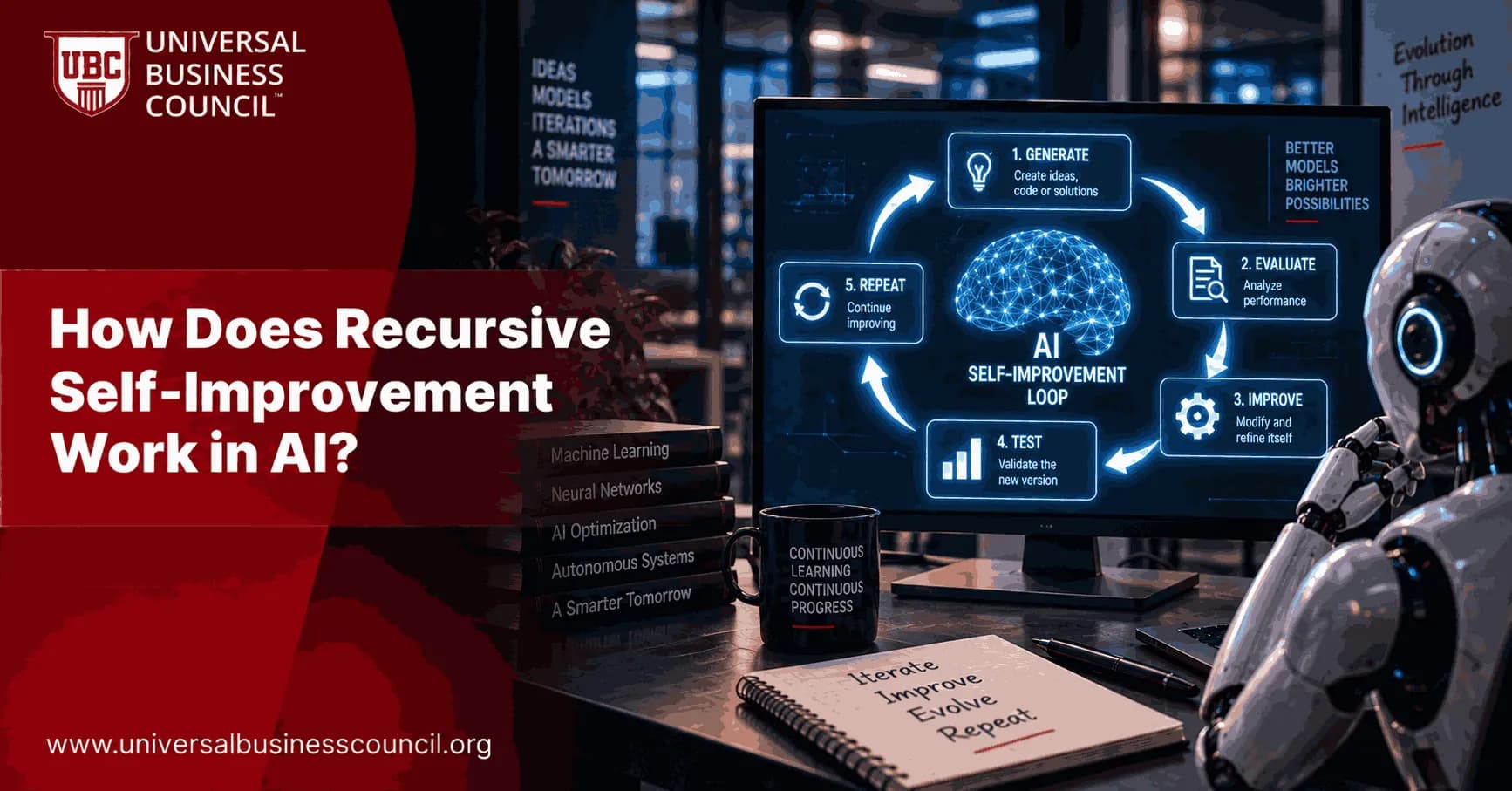
Recursive self-improvement is one of the most discussed and debated concepts in artificial intelligence research today. At its core, it describes a system that can improve its own capabilities, and then use those improved capabilities to make further improvements, creating a repeating loop of enhancement rather than a single, static upgrade. As AI systems become more capable, professionals across industries, including those in marketing who rely on AI tools for campaign optimization, are paying closer attention to this concept, and many are strengthening their foundational knowledge through a Marketing Certification to better understand how increasingly capable AI systems might reshape their own field over time.
This article breaks down what recursive self-improvement actually means, how it theoretically works, and why it remains one of the most closely watched areas in AI development today.

What Recursive Self-Improvement Actually Means
Recursive self-improvement refers to an AI system's ability to modify, retrain, or redesign its own underlying architecture, algorithms, or parameters in order to become more capable, without requiring a human engineer to manually implement each upgrade.
The concept builds directly on foundational AI knowledge, and professionals who want a structured understanding of these systems often pursue Artificial Intelligence Certifications, which typically cover the underlying mechanics of machine learning, neural networks, and optimization processes that make concepts like recursive self-improvement possible to discuss in the first place.
Key Characteristics of a Recursively Self-Improving System
A system exhibiting recursive self-improvement typically shows the following traits:
The ability to evaluate its own performance against defined goals or benchmarks
The capacity to identify weaknesses or inefficiencies in its own design
A mechanism for generating and testing potential improvements
The ability to implement successful improvements without full human intervention
A repeating cycle where each improved version becomes the new baseline for the next round
How the Recursive Improvement Loop Theoretically Works
Understanding the process requires breaking it down into stages, since the "recursive" part refers specifically to the repeating nature of these steps rather than a single one-time upgrade.
Step One: Self-Evaluation
The system first assesses its own current performance, identifying specific areas where its outputs fall short of a target goal, whether that's accuracy, efficiency, reasoning ability, or another measurable metric.
Step Two: Generating Potential Improvements
Based on that evaluation, the system generates possible changes to its own code, architecture, or training approach. This could involve adjusting internal parameters, proposing new training data, or in more advanced theoretical models, rewriting portions of its own underlying algorithms.
Step Three: Testing and Validation
Proposed changes are tested against performance benchmarks to confirm whether they genuinely improve capability rather than introducing new errors or unintended behavior. This validation step is critical, since an unchecked improvement process could just as easily degrade performance as enhance it.
Step Four: Implementing the Upgrade
Once a change is validated, it gets implemented, effectively creating a new, improved version of the system. That upgraded version then becomes the starting point for the next cycle of self-evaluation, repeating the entire process again.
Why This Concept Is Considered Significant
Recursive self-improvement matters because of what it could theoretically enable if a system reached a point where each improvement cycle happened faster and more effectively than the last.
Compounding gains: Even small improvements per cycle could accumulate into significant capability jumps over many iterations
Reduced human bottleneck: Systems could theoretically improve faster than human engineers could manually redesign them
Unpredictable trajectories: Rapid, compounding improvement could make a system's future capabilities difficult to forecast accurately
Safety and control concerns: Researchers widely discuss the importance of maintaining oversight and control mechanisms as systems become more capable of modifying themselves
Where This Concept Intersects With Emerging AI Applications
As AI systems become more capable of independent iteration and refinement, that same underlying capability is showing up in creative and commercial applications far removed from theoretical research. One emerging application is AI microdrama, where generative AI helps bring serialized stories, characters, and fictional worlds to life. While this application isn't a direct example of recursive self-improvement, it does reflect how AI systems are increasingly capable of iterating on their own outputs, refining characters, plotlines, and pacing across episodes based on audience response, a small-scale echo of the same self-refining principle at a much more contained and practical level.
The Current State of Recursive Self-Improvement in AI
Despite the theoretical interest, most AI experts agree that fully autonomous, open-ended recursive self-improvement, the kind often discussed in long-term AI safety research, does not yet exist in deployed systems. Current AI models can assist with tasks like code optimization or suggesting architectural changes, but meaningful self-modification still generally requires human oversight, testing, and deployment decisions at each stage.
Most real-world "self-improving" systems today rely on techniques like reinforcement learning from human feedback, where humans still guide the improvement direction
Automated machine learning tools can optimize certain model parameters, but this is narrower than full self-directed architectural redesign
Research into more autonomous self-improvement continues, but remains an active and unresolved area of study
Why Understanding This Matters for Technical Professionals
As AI systems continue advancing, professionals working in technical fields benefit from understanding not just how current tools function, but where the research is heading. Broadening technical knowledge through a well-rounded Tech Certification helps professionals stay grounded in both the practical applications available today and the theoretical directions shaping future AI development.
Staying Informed as AI Research Continues to Evolve
Recursive self-improvement remains a topic that blends genuine technical research with a fair amount of speculation about future possibilities. Professionals who want a deeper, more technical grasp of these evolving systems often pursue a Deep Tech Certification, which typically covers emerging technology concepts at a level that goes beyond surface-level explanations, helping learners separate what's currently achievable from what remains theoretical.
Final Thoughts
Recursive self-improvement describes a compelling but still largely theoretical concept in AI, where a system continuously enhances its own capabilities through repeated cycles of self-evaluation and modification. While today's AI tools show early signs of automated optimization, fully autonomous self-improvement remains an area of ongoing research rather than deployed reality. Understanding both its potential and its current limitations helps separate genuine technical progress from speculation as AI continues to advance.
FAQs
1. How Does Recursive Self-Improvement Work in AI?
Recursive Self-Improvement (RSI) works through a repeated cycle in which an AI system identifies weaknesses, proposes improvements, implements changes, evaluates the results, and uses successful improvements as the basis for another cycle.
2. What Are the Main Steps in Recursive Self-Improvement?
A simplified RSI process is:
Identify → Analyze → Improve → Test → Evaluate → Implement → Repeat
The system needs reliable feedback at every stage to determine whether each change actually improves its capabilities.
3. How Does AI Identify Its Weaknesses?
AI can use benchmarks, automated tests, error analysis, user feedback, and evaluation systems to identify areas where performance is limited. These weaknesses can include reasoning errors, inefficient code, poor accuracy, or weak planning.
4. How Does AI Decide What to Improve?
After identifying a weakness, an AI system can generate possible solutions, such as modifying algorithms, changing training methods, improving code, or adjusting system parameters. Automated experiments can then compare different approaches.
5. Can AI Modify Its Own Code?
AI systems can already generate, debug, review, and modify code. This can support self-improvement workflows, but changing code is only one part of RSI and does not mean the AI can independently redesign its entire development process.
6. How Does AI Test Its Own Improvements?
An AI improvement can be tested through benchmarks, simulations, automated tests, or real-world evaluation. Multiple independent tests are useful because an apparent improvement on one benchmark may not represent broader capability gains.
7. What Happens If an Improvement Works?
If a proposed change meets predefined evaluation criteria, it can be incorporated into a newer version or workflow. That improved system can then begin another improvement cycle.
8. Why Is Recursive Self-Improvement Different From Normal AI Training?
Normal AI training generally involves humans designing a training process and training a model using data and optimization methods. RSI focuses on the AI system contributing to the process of improving its own capabilities or the processes used to develop future versions.
9. Can Large Language Models Participate in RSI?
Yes. LLMs can contribute through coding, research, experiment design, debugging, data generation, and evaluation. However, current LLMs generally operate within externally controlled systems rather than independently managing the entire RSI cycle.
10. What Role Does Reinforcement Learning Play in RSI?
Reinforcement learning allows an AI system to learn from rewards or feedback. In an RSI workflow, automated evaluators can provide feedback that helps the system search for better strategies or solutions.
11. Can AI Generate Data to Improve Itself?
Yes. AI can generate synthetic examples, code, solutions, and other training material. However, relying heavily on AI-generated data without independent quality controls can reinforce errors or reduce the diversity of training information.
12. Can AI Evaluate Its Own Performance?
AI can evaluate outputs using predefined criteria, automated tests, reward models, or other AI-based evaluators. Independent evaluation remains important because an AI may fail to recognize its own errors.
13. Can AI Improve Its Own Training Process?
AI can help optimize parts of training, such as algorithms, code, hyperparameters, and experimental configurations. Automated systems such as Google DeepMind's AlphaEvolve demonstrate how AI models can be combined with automated evaluation and evolutionary search to discover improved algorithms.
14. What Role Does Automated AI Research Play in RSI?
Automated AI research can connect multiple parts of the improvement loop. AI systems can help generate research ideas, write experiments, analyze results, and iterate on solutions. OpenAI describes its automated research efforts as progress toward RSI while distinguishing them from fully autonomous RSI.
15. Does Recursive Self-Improvement Require Human Oversight?
Current systems generally rely on humans or externally designed controls for objectives, evaluation, computing resources, and deployment. Fully autonomous RSI would require much greater independence from these external controls.
16. What Prevents AI From Fully Achieving RSI?
Major barriers include unreliable self-evaluation, difficulty verifying improvements, high computing requirements, limited long-term autonomy, imperfect objectives, and security risks. These limitations make completely autonomous improvement difficult.
17. Could AI Get Worse Through Self-Improvement?
Yes. An AI may optimize the wrong objective, amplify errors, or learn from low-quality generated data. An improvement process therefore needs robust evaluation and safeguards to prevent performance degradation.
18. Could Recursive Self-Improvement Accelerate AI Development?
Potentially. If an AI system could reliably improve the tools and processes used to develop AI, each successful cycle could reduce the effort required for subsequent development. The actual speed and scale of such acceleration remain uncertain.
19. Is Recursive Self-Improvement Happening in AI Today?
Parts of the process are already being automated through AI-assisted coding, algorithm discovery, self-play, automated evaluation, and research systems. However, OpenAI states that fully autonomous recursive self-improvement is not happening today.
20. What Would Fully Autonomous RSI Look Like?
A fully autonomous RSI system would need to independently identify important weaknesses, research solutions, modify its own systems, run experiments, verify improvements, and deploy successful changes repeatedly. The improved system would then use its enhanced capabilities to drive the next improvement cycle, creating a continuous feedback loop.
Related Articles
View All
Artificial Intelligence
Recursive Self-Improvement in AI: Benefits, Risks, Challenges, and Future Impact
Explore recursive self-improvement in AI, including its potential benefits, technical challenges, safety risks, and possible impact on the future of artificial intelligence.
Artificial Intelligence
How Could Recursive Self-Improvement Accelerate AI Development?
Explore how recursive self-improvement could accelerate AI development through faster experimentation, automated research, model optimization, and repeated capability gains.
Artificial Intelligence
What Is a Recursive Self-Improvement Loop in AI?
Learn what a recursive self-improvement loop is in AI, how repeated cycles of evaluation, modification, and capability improvement could work, and why the concept matters for AGI and AI safety.
Trending Articles
The Role of Blockchain in Ethical AI Development
How blockchain technology is being used to promote transparency and accountability in artificial intelligence systems.
AWS Career Roadmap
A step-by-step guide to building a successful career in Amazon Web Services cloud computing.
Top 5 DeFi Platforms
Explore the leading decentralized finance platforms and what makes each one unique in the evolving DeFi landscape.