

ISO/IEC 23894 and AI Risk Management: What Organizations Need to Know

Risk management is not a new idea, which is exactly why AI risk is so easy to handle badly. Teams bolt an old checklist onto a new kind of system, then wonder why it missed bias, drift and misuse. ISO/IEC 23894 exists to close that mismatch. This post explains what the standard is, how its process works, how it relates to other frameworks and how to start using it for AI risk management in your own organization. For readers who want formal grounding in responsible AI, the Certified Responsible AI Expert program is a good companion.
What is ISO/IEC 23894?
ISO/IEC 23894, published in 2023, is international guidance on managing risk related to artificial intelligence. It adapts the general risk management approach in ISO 31000 so it fits the particular traits of AI systems. It applies to organizations that develop, produce, deploy or use AI, whatever their size or sector.

Two points are worth knowing from the start. It is guidance, not a set of requirements, so you cannot be certified against it the way you can against a management system standard. And it does not hand you a finished risk list. It gives you a structure and AI-specific prompts, and you fill it in for your own systems.
Why general risk management falls short for AI
Traditional methods assume systems behave in predictable ways. AI breaks that assumption in a few ways:
Behavior depends on training data, so a data problem becomes a system problem
Many models cannot explain how they reached an answer
Performance can change over time as the world and the data shift
Harms often fall on people outside the organization, such as applicants or customers
Many systems rely on third-party models and services you do not control
ISO/IEC 23894 keeps the familiar risk process but points it at these AI-specific sources of trouble.
The AI risk management process, step by step
The standard follows the ISO 31000 cycle, with communication and consultation running through every stage.
Establish the context
Define what the system does, who it affects, which laws and policies apply and how much risk the organization is prepared to accept. Without agreed criteria, later ratings are guesswork.
Identify risks
List what could go wrong across the whole lifecycle, from data collection to retirement. Involve people from engineering, legal, security, operations and the business so the list is not limited to one viewpoint.
Analyze the risks
Work out how likely each risk is and how bad the consequences would be, including effects on individuals and society, not only the company.
Evaluate against your criteria
Compare the results with the risk criteria you set earlier and decide which risks need action first.
Treat the risks
Choose a response for each priority risk: reduce it with a control, avoid it by changing the design, share it through contracts or insurance, or accept it with a record of why. Name an owner and a date for each action.
Monitor and review
Track whether controls work and whether the system or its setting has changed. Review on a schedule and after any incident.
Record and report
Keep a clear trail of decisions and share results with those who need them, from system owners to senior leaders.
AI-specific risk sources to put on your list
Use prompts like these to make sure the risk register reflects how AI really fails:
Data quality, gaps and unrepresentative samples
Bias and unfair outcomes for particular groups
Lack of transparency or explainability
Drift, where accuracy falls as conditions change
Security attacks such as data poisoning and prompt manipulation
Misuse of the system for purposes it was never meant for
Over-reliance, where users trust outputs without checking them
Dependence on third-party models, data and infrastructure
How it fits with ISO/IEC 42001 and the NIST AI RMF
These documents work as a set rather than competing choices. ISO/IEC 42001 sets requirements for an AI management system and can be certified. ISO/IEC 23894 guides the risk process that sits inside such a system. The NIST AI Risk Management Framework is a voluntary US framework organized around govern, map, measure and manage functions. Many organizations use more than one, borrowing the structure that suits each need.
A practical way to start
You do not need to apply the standard to every system on day one. A manageable first pass looks like this:
Pick one system that affects people in a meaningful way
Agree on risk criteria and a simple rating scale
Hold a workshop with a mixed group to identify risks
Rate and rank them, then choose treatments
Assign owners and dates, and set the first review
What a risk register entry needs
A clear description of the risk and where in the lifecycle it arises
Likelihood and consequence ratings
Existing controls and what is still missing
Owner, action and due date
Residual risk after treatment
Marketing and customer-facing use
Customer targeting, content generation and personalization all carry AI risk that marketing teams own in practice. Bias in audience selection, misuse of personal data and unchecked generated claims belong on the register. Marketers who want a stronger base here can look at the Certified Digital Marketing Expert program.
Skills, records and people
Risk work improves when technical staff understand what they are rating. Engineers can build that depth through the programming and technology certifications from Global Tech Council. Registers and review logs are worth protecting too, and teams looking at tamper-evident storage can explore the deep tech certifications from Blockchain Council. Finally, when you bring in risk specialists or outside reviewers, HireValid can help verify their backgrounds and credentials.
Conclusion: making ISO/IEC 23894 work for AI risk management
ISO/IEC 23894 gives organizations a familiar way to manage an unfamiliar kind of risk. It builds on ISO 31000, adds AI-specific prompts such as data quality, bias, opacity, drift, security attacks, misuse and over-reliance, and follows a clear cycle: set the context, identify, analyze and evaluate risks, treat them, monitor and review, then record and report. It is guidance rather than a certifiable standard, and it works best alongside ISO/IEC 42001 and the NIST AI RMF.
The way to begin is small. Choose one system that matters, agree on criteria, run a mixed-team workshop, build a register with owners and dates, and schedule the first review. Then repeat for the next system and refine the method as you learn. Good AI risk management comes from steady practice more than perfect documents. For more structured support, the Certified Responsible AI Expert program mentioned at the start offers a path to build these skills across your team.
FAQs
1. What is ISO/IEC 23894?
It is international guidance, published in 2023, on managing risk related to AI.
2. Is ISO/IEC 23894 certifiable?
No. It is guidance, not a requirements standard, so there is no certification against it.
3. Who should use it?
Any organization that develops, provides, deploys or uses AI systems.
4. How does it relate to ISO 31000?
It adapts the ISO 31000 risk management process to the particular traits of AI.
5. How is it different from ISO/IEC 42001?
ISO/IEC 42001 sets certifiable requirements for an AI management system, while 23894 guides the risk process within it.
6. Does it replace the NIST AI RMF?
No. The two can be used together, and many teams borrow from both.
7. What are the main steps in the process?
Establish context, identify, analyze and evaluate risks, treat them, monitor and review, then record and report.
8. What makes AI risk different from other IT risk?
AI depends on data, can be opaque, changes over time and can harm people outside the organization.
9. What is a risk register?
A structured list of risks with ratings, controls, owners, dates and residual risk.
10. Who should be involved in identifying risks?
People from engineering, legal, security, operations and the business, and ideally voices for affected users.
11. How often should AI risks be reviewed?
On a set schedule, such as quarterly or yearly, and after any incident or major change.
12. How do we set risk criteria?
Agree with leadership how much risk is acceptable and define simple scales for likelihood and consequence.
13. What are the options for treating a risk?
Reduce it, avoid it, share it or accept it, with a recorded reason for any acceptance.
14. Does the standard cover third-party AI?
Yes. Risks from third-party models, data and services belong in the process.
15. Can small companies apply it?
Yes. Start with one system and a simple register, then expand.
16. How does it support regulatory compliance?
It gives a documented risk process, which supports expectations in laws and standards that call for risk management.
17. What is residual risk?
The risk that remains after controls and treatments are in place.
18. Should leadership see the results?
Yes. Senior leaders should see key risks, decisions to accept risk and the status of treatments.
19. What records should we keep?
Risk registers, assessment notes, decisions, test results, review dates and incident logs.
20. Where can I learn more?
Read the standard itself through ISO or your national standards body, and consider training such as the Certified Responsible AI Expert program.
Related Articles
View All
Artificial Intelligence
ISO/IEC 42001 Explained: AI Management Systems and Certification Requirements
Understand what ISO/IEC 42001 is and how this international standard helps organizations establish, implement, and maintain an Artificial Intelligence Management System (AIMS). Explore its key requirements, benefits, certification process, and role in promoting responsible AI governance, risk management, transparency, and accountability.
Artificial Intelligence
NIST AI Risk Management Framework: A Practical Implementation Guide
Explore the NIST AI Risk Management Framework and learn how to implement it across the AI lifecycle. Understand its four core functions, Govern, Map, Measure, and Manage, along with practical steps for identifying AI risks, improving accountability, and building trustworthy AI systems.
Artificial Intelligence
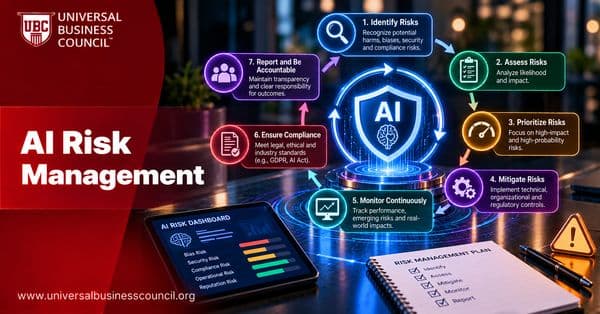
AI Risk Management: Identifying, Assessing and Mitigating AI Risks
Understand what AI risk management is and explore the key strategies organizations use to identify, assess, mitigate, and monitor AI-related risks. Learn how effective risk management supports AI security, fairness, transparency, regulatory compliance, and responsible AI adoption.
Trending Articles
The Role of Blockchain in Ethical AI Development
How blockchain technology is being used to promote transparency and accountability in artificial intelligence systems.
AWS Career Roadmap
A step-by-step guide to building a successful career in Amazon Web Services cloud computing.
Top 5 DeFi Platforms
Explore the leading decentralized finance platforms and what makes each one unique in the evolving DeFi landscape.