

What Are Some Real-World Examples of Recursive Self-Improvement in AI?
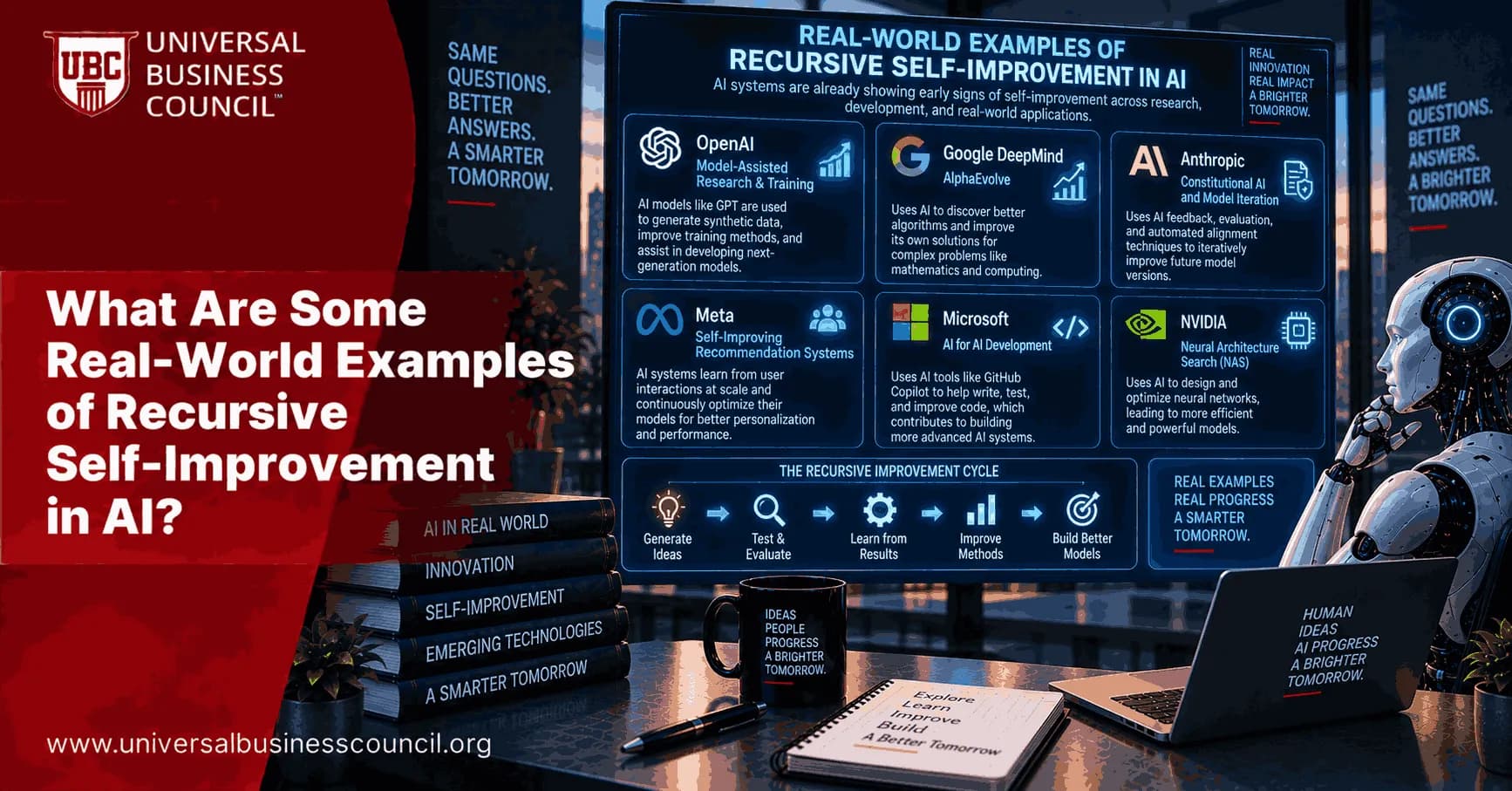
Recursive self-improvement stopped being a purely theoretical discussion sometime in the last two years, as several research labs began publishing systems that genuinely improve their own code, training methods, or performance through repeated cycles. These aren't speculative claims buried in academic papers either. Some have been benchmarked publicly, one has even been published in a leading scientific journal, and another was described by its own creators as having played a role in building its successor. As these developments draw attention across industries, professionals in fields like marketing are also watching closely, and many reinforce their understanding through a Marketing Certification to better anticipate how faster AI development cycles might eventually reshape the tools available to them.
This article walks through the most credible, documented examples of recursive self-improvement in AI so far, what each one actually demonstrated, and where the boundaries of that progress still sit.

The Darwin Gödel Machine
Released by Sakana AI in collaboration with the University of British Columbia, the Darwin Gödel Machine is a coding agent that rewrites its own codebase to improve its performance on programming tasks.
Understanding exactly how a system like this evaluates and validates its own code changes requires real technical depth, and professionals who want that grounding often pursue Artificial Intelligence Certifications, which typically cover the evaluation methods and benchmarking practices needed to judge whether a result like this reflects genuine capability improvement.
How It Works and What It Achieved
The system builds a growing archive of agent versions, each created through self-modification followed by task evaluation
New variants branch off from earlier successful versions rather than replacing them entirely, allowing multiple evolutionary paths to be explored in parallel
On SWE-bench, a widely used benchmark built from real GitHub issues, the system improved its own performance from twenty percent to fifty percent
Improvements included practical additions like better code editing tools, a patch validation step, and a memory of previously failed approaches
Sakana AI's Broader Recursive Self-Improvement Lab
Building on the Darwin Gödel Machine's results, Sakana AI formalized a dedicated research group focused entirely on recursive self-improvement, describing its goal as moving AI from static tools toward systems that function more like autonomous researchers.
Other Documented Projects From This Lab
LLM-Squared, which uses language models to design better training methods for other language models, producing a preference optimization algorithm reportedly discovered and written entirely by an AI system
ShinkaEvolve, an open-source system that solved complex optimization problems using a remarkably small number of samples
ALE-Agent, which placed first out of over eight hundred human participants in a competitive coding contest
The AI Scientist, a fully automated research agent whose generated paper reportedly passed peer review and was published in Nature
Google DeepMind's AlphaEvolve
AlphaEvolve, developed by Google DeepMind, uses Gemini language models to generate, test, and refine algorithms across a wide range of technical domains, from data center scheduling to chip design.
Measurable Results in Production Systems
The system reportedly recovered a meaningful share of Google's global data center compute capacity through improved scheduling algorithms
It contributed to more efficient quantum circuit designs and improvements in genomic sequencing models
Perhaps most notably, it has been used to speed up the training pipeline for the Gemini models that power the system itself, a direct, if narrow, self-referential improvement loop
OpenAI's Codex Model Development Claim
In early 2026, OpenAI released an updated coding model and described it as playing a role in creating its own successor, with earlier model versions reportedly helping debug their own training process. This claim generated significant debate, with some observers treating it as an early signal of runaway self-improvement, and others describing it as a fairly ordinary productivity story involving AI-assisted engineering rather than autonomous self-redesign.
Why All of These Examples Remain Bounded Rather Than Open-Ended
Despite how impressive these results are, each one shares a common structural limitation worth understanding clearly.
Every system relies on a fixed, external evaluation signal, such as a benchmark score or test pass rate, that the system itself does not control or redefine
Human researchers still decide which problems to apply these systems to and how to interpret the results
Improvements happen within a specific, narrow domain rather than reflecting general-purpose intelligence growth across all capabilities
None of these systems have demonstrated the ability to redesign their own fundamental training objectives independently
Broadening technical understanding of exactly where these boundaries sit is genuinely useful for anyone following this space, and a well-rounded Tech Certification helps professionals stay grounded in what has actually been demonstrated versus what remains speculative extrapolation from these results.
A Creative Application of the Same Core Principle
The generate, evaluate, and refine cycle behind these research systems also shows up in more unexpected, creative corners of the AI industry. One emerging application is AI microdrama, where generative AI helps bring serialized stories, characters, and fictional worlds to life. These platforms often refine character consistency and plot pacing across episodes based on audience engagement data, offering a smaller-scale, narrative-focused example of the same iterative refinement logic driving research systems like the Darwin Gödel Machine and AlphaEvolve.
What These Examples Mean for the Broader Debate
These documented systems represent genuine, verifiable progress toward AI that can improve specific aspects of itself, its code, its training pipeline, or its problem-solving strategies, through repeated, structured cycles. What they have not yet demonstrated is the fully open-ended, autonomous version of recursive self-improvement long discussed in AI safety research, where a system redefines its own objectives and architecture without human-set boundaries.
Professionals who want to track this fast-moving research area with real technical rigor, distinguishing verified results from more speculative framing, often pursue a Deep Tech Certification, which provides the depth needed to evaluate new announcements in this space critically as they continue to emerge.
Final Thoughts
Real-world examples of recursive self-improvement in AI already exist, and they're more concrete than most people realize, from the Darwin Gödel Machine rewriting its own code to AlphaEvolve improving the training pipeline behind its own underlying models. Each example remains bounded by human-defined evaluation criteria and specific problem domains rather than reflecting fully autonomous, general-purpose self-improvement. The honest picture is one of genuine, measurable progress within clear limits, not the runaway intelligence explosion that headlines sometimes suggest.
FAQs
1. What Are Real-World Examples of Recursive Self-Improvement in AI?
Current AI research contains several examples of bounded or partial recursive self-improvement, where AI systems generate improvements, learn from feedback, or help develop subsequent versions. These examples are not necessarily equivalent to fully autonomous RSI, where an AI independently controls its entire improvement cycle.
2. Is Recursive Self-Improvement Happening in AI Today?
Some components of RSI are already being demonstrated. AI systems can generate code, optimize algorithms, learn from self-generated experience, conduct experiments, and help improve later AI systems. However, fully autonomous, open-ended RSI has not been reliably demonstrated.
3. What Is Google DeepMind's AlphaEvolve?
AlphaEvolve is a Gemini-powered coding agent that uses large language models, automated evaluators, and an evolutionary framework to generate and improve algorithms. Candidate programs are tested and scored, with promising solutions used to guide subsequent searches.
4. Why Is AlphaEvolve Considered an Example of AI Self-Improvement?
AlphaEvolve creates candidate algorithms, evaluates them, selects promising solutions, and uses those solutions to generate further candidates. This repeated optimization loop resembles an important component of recursive self-improvement, although it operates within defined objectives and evaluation environments.
5. Has AlphaEvolve Helped Improve AI Training?
Yes. Google DeepMind says AlphaEvolve has enhanced AI training processes, including processes used to train the large language models underlying AlphaEvolve itself. This is an important example of AI-assisted improvement feeding back into AI development.
6. Can AlphaEvolve Improve Computer Algorithms?
Yes. AlphaEvolve has been used to discover and optimize algorithms across mathematics, computing infrastructure, and other technical applications. Google reports that it has become a core infrastructure component and has been used for areas including next-generation TPU design and Google Spanner optimization.
7. What Is SIMA 2's Self-Improvement Example?
Google DeepMind's SIMA 2 can learn through trial and error in virtual environments. After initially learning from human demonstrations, it can learn new games through self-directed play, and its own experience data can subsequently be used to train a more capable version.
8. Does SIMA 2 Improve Without Additional Human Gameplay Data?
In Google's described experiments, yes. SIMA 2 can generate its own experience in previously unseen games and use that experience for subsequent training without additional human-generated gameplay demonstrations. This represents a bounded form of iterative self-improvement.
9. Is SIMA 2 Full Recursive Self-Improvement?
No. SIMA 2 demonstrates an important self-improvement loop, but it operates within specific environments, objectives, training procedures, and evaluation systems. It should not be interpreted as an unrestricted AI independently redesigning all aspects of itself.
10. What Is OpenAI's GPT-Red?
GPT-Red is an automated red-teaming model developed by OpenAI to discover vulnerabilities in AI systems. It uses self-play reinforcement learning to become better at finding attacks while defender models become better at resisting them.
11. How Does GPT-Red Create an Improvement Loop?
GPT-Red searches for successful attacks against AI systems, while defender models learn to resist those attacks. As the defenders become stronger, GPT-Red is trained to discover stronger and more diverse attacks, creating an adversarial improvement cycle.
12. Has GPT-Red Improved Later OpenAI Models?
Yes. OpenAI reports using GPT-Red-generated attacks to adversarially train GPT-5.6, improving its resistance to prompt-injection attacks. OpenAI describes this as a form of self-improvement for safety, where current AI systems help make future models more robust.
13. Is GPT-Red Full Recursive Self-Improvement?
No. GPT-Red represents a specialized feedback loop for AI safety, not an AI independently redesigning and deploying increasingly capable successors. OpenAI keeps GPT-Red separate from its production models.
14. Are AI Coding Agents Examples of Self-Improvement?
AI coding agents can contribute to self-improvement by writing, debugging, testing, and optimizing software used in AI development. However, an AI coding agent performing these tasks under defined instructions is better described as AI-assisted development unless the system recursively improves its own capabilities.
15. Can AI-Generated Training Data Create an RSI Loop?
Potentially. An AI can generate data or experiences that are used to train a subsequent version, which can then generate better data or experiences. SIMA 2 provides a concrete example of this type of iterative training cycle.
16. What Is the Difference Between These Examples and Full RSI?
The examples generally improve specific capabilities or components rather than the entire AI development process. Full RSI would require an AI to independently identify important improvements, implement them, evaluate them, and repeatedly use its improved capabilities to drive the next generation.
17. Can AI Improve the AI Infrastructure That Supports It?
Yes. AlphaEvolve has been used to optimize infrastructure such as TPU-related systems, caching strategies, and other computational processes. Google reports that one AlphaEvolve-generated circuit design was integrated into next-generation TPU silicon.
18. What Do These Examples Tell Us About the Future of RSI?
They show that increasingly sophisticated pieces of the RSI loop are technically feasible: AI can generate solutions, evaluate candidates, learn from experience, and contribute to subsequent versions. The major unresolved question is whether these components can be combined into a reliable, broadly autonomous, open-ended improvement process.
19. Are These Examples Proof That AI Can Improve Itself Without Humans?
Not in the broad sense. Some individual loops can operate without additional human-generated examples or direct intervention, but humans and externally designed systems still typically establish objectives, environments, evaluation criteria, computing resources, and deployment controls.
20. What Is the Best Current Example of Recursive Self-Improvement in AI?
There is no single established example of unrestricted autonomous RSI. AlphaEvolve demonstrates automated algorithm evolution, SIMA 2 demonstrates self-generated experience being used for later training, and GPT-Red demonstrates an AI-driven safety improvement loop. Together, these systems show meaningful components of RSI while also illustrating the remaining gap between bounded self-improvement and fully autonomous recursive self-improvement.
Related Articles
View All
Artificial Intelligence
Recursive Self-Improvement in AI: Benefits, Risks, Challenges, and Future Impact
Explore recursive self-improvement in AI, including its potential benefits, technical challenges, safety risks, and possible impact on the future of artificial intelligence.
Artificial Intelligence
How Could Recursive Self-Improvement Accelerate AI Development?
Explore how recursive self-improvement could accelerate AI development through faster experimentation, automated research, model optimization, and repeated capability gains.
Artificial Intelligence
What Is a Recursive Self-Improvement Loop in AI?
Learn what a recursive self-improvement loop is in AI, how repeated cycles of evaluation, modification, and capability improvement could work, and why the concept matters for AGI and AI safety.
Trending Articles
The Role of Blockchain in Ethical AI Development
How blockchain technology is being used to promote transparency and accountability in artificial intelligence systems.
AWS Career Roadmap
A step-by-step guide to building a successful career in Amazon Web Services cloud computing.
Top 5 DeFi Platforms
Explore the leading decentralized finance platforms and what makes each one unique in the evolving DeFi landscape.