

What Does the Recursive Self-Improvement Hypothesis Mean in AI?
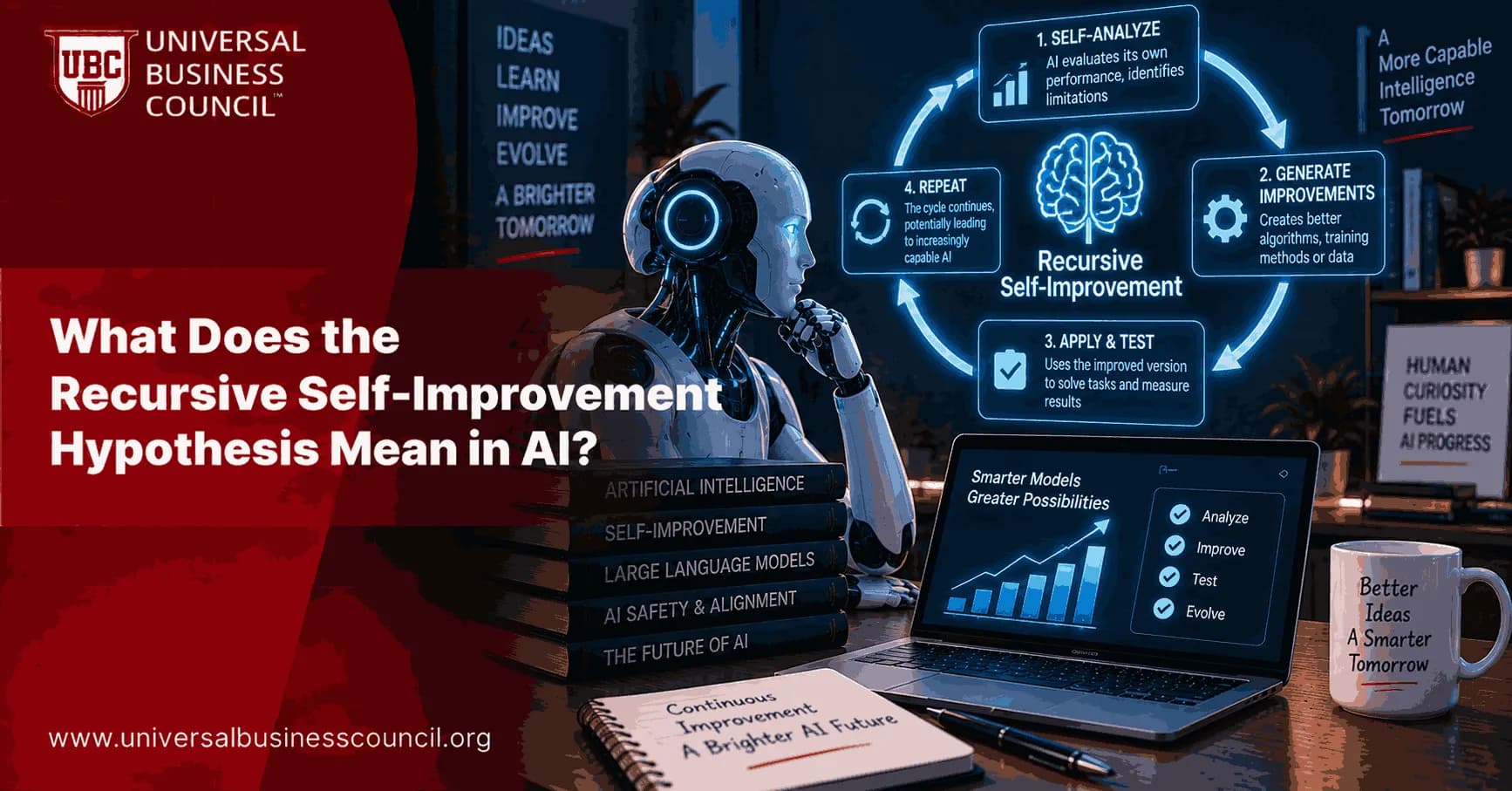
The recursive self-improvement hypothesis describes a scenario where an artificial intelligence system becomes capable of improving its own architecture, algorithms, or training process, and then uses that improved capability to make further improvements, creating a self reinforcing loop. The concept traces back to mathematician I.J. Good's 1965 writing on an "intelligence explosion," where he theorized that a sufficiently capable machine could eventually out-design human engineers at building intelligent machines, triggering a rapid, potentially uncontrollable acceleration in capability. Understanding this hypothesis matters for anyone working seriously in the AI field today, and professionals who round out their technical grounding with a Marketing Certification alongside their AI knowledge often find it genuinely useful, since communicating a concept this abstract and contested clearly to non technical audiences, investors, and the public has become its own real skill.
Breaking Down the Core Idea
The recursive self-improvement hypothesis rests on a few key building blocks worth separating out clearly:

Self-modification capability: an AI system would need the ability to understand and meaningfully alter its own code, architecture, or training methodology, not just perform tasks within fixed parameters.
Improvement measurement: the system would need some way to evaluate whether a given modification actually made it more capable, rather than simply different.
Compounding returns: each successful improvement would need to make the next improvement easier or more effective, rather than each gain requiring proportionally more effort than the last.
Reduced human bottleneck: as the loop continues, the pace of improvement would increasingly depend on the system's own capability rather than the speed of human researchers, which is the element that raises the most debate.
Researchers building deep expertise in these systems, including those pursuing Artificial Intelligence Certifications, spend considerable time studying exactly how current systems fall short of meeting all four of these conditions simultaneously, since a system checking only some of these boxes looks very different from one capable of genuine runaway improvement.
Why This Idea Generates So Much Debate
The AI research community remains genuinely divided on how seriously to take rapid recursive self-improvement as a near term possibility. Arguments in favor of taking it seriously include:
Large language models have already demonstrated some ability to assist in writing and debugging code, including code related to machine learning systems themselves.
AI assisted research tools are measurably speeding up certain narrow tasks within AI development pipelines, such as hyperparameter tuning and architecture search.
Historical precedent shows that compounding technological growth, even outside AI, has sometimes moved faster than experts initially predicted.
Arguments for skepticism or caution around near term recursive self-improvement include:
Current AI systems still require substantial human oversight, computing infrastructure, and data curation, none of which the systems themselves fully control.
Improvements to model architecture and training remain bottlenecked by physical constraints like chip manufacturing and energy availability, which do not automatically scale alongside software gains.
Genuine self-modification at the level the hypothesis describes has not been demonstrated in any deployed system, and current AI assistance in research remains narrow and heavily supervised.
Practical Signals Researchers Watch For
Rather than treating recursive self-improvement as an all or nothing event, most serious researchers track incremental signals that would indicate movement toward the scenario, including:
AI systems contributing meaningfully to the design of their own successor models, beyond simple code completion assistance.
Measurable acceleration in the pace of published AI research that correlates with AI assisted tooling rather than purely human effort.
Growing autonomy in how AI systems select their own training data or fine tuning strategies with less direct human curation.
Understanding these technical signals requires a genuinely deep foundation, and a broader Tech Certification helps professionals evaluate these developments critically, distinguishing genuine capability jumps from incremental engineering improvements that get overstated in media coverage.
AI Innovation Beyond Technical Research
The pace of generative AI development is not confined to research labs studying self-improvement and capability gains. One emerging application is AI microdrama, where generative AI helps bring serialized stories, characters, and fictional worlds to life, a genuinely different use case from frontier AI safety research but one that draws on the same underlying wave of machine learning advancement. Seeing generative AI applied this broadly, from safety critical research questions to creative storytelling, illustrates just how far reaching this technology has already become across very different corners of the industry.
Why Serious Study of This Hypothesis Matters
Even setting aside disagreement over timelines, the recursive self-improvement hypothesis shapes real decisions being made today in AI governance, safety research funding, and corporate development strategy. Key reasons this matters practically include:
Major AI labs have publicly cited recursive self-improvement risk as a factor shaping their internal safety testing protocols.
Policymakers increasingly reference the concept when debating regulation around frontier AI model training and deployment thresholds.
Understanding the hypothesis helps distinguish legitimate technical concern from exaggerated claims that can mislead public understanding in either direction.
Building genuine fluency in these debates requires combining AI specific knowledge with a wider grounding in complex technical systems, and a Deep Tech Certification complements AI focused study well, since evaluating claims about self-improving systems draws on the same rigorous, skeptical thinking used to evaluate other emerging technologies that sound more dramatic in headlines than they currently are in practice. As AI capabilities continue advancing, professionals who understand both the genuine technical substance behind this hypothesis and its current real world limitations are best positioned to separate legitimate research concern from speculation.
FAQs
1. What does the recursive self-improvement hypothesis mean in AI?
The recursive self-improvement (RSI) hypothesis is the idea that an AI system could potentially improve its own capabilities, create a more capable version of itself, and then use that improved system to make further improvements. This could create a repeating cycle of AI development. It is a hypothesis about a possible future capability, not a demonstrated property of today's general-purpose AI systems.
2. What does RSI stand for in artificial intelligence?
RSI stands for Recursive Self-Improvement. In AI research, it describes a potential process in which an AI system contributes to improving its own algorithms, software, architecture, training methods, or successors. The process is considered recursive because the results of one improvement cycle can be used in another.
3. How does the recursive self-improvement hypothesis work?
A simplified RSI process can be described as:
AI system → identifies a limitation → proposes an improvement → implements and tests the change → evaluates the result → creates or selects an improved system → repeats.
The degree of automation can vary. A system that performs only one stage of this process should not automatically be considered fully recursively self-improving.
4. Why is recursive self-improvement important in AI research?
RSI is important because it could potentially change how advanced AI systems are developed. If AI becomes capable of performing significant portions of AI research and engineering, it could help automate model design, coding, experimentation, and optimization. This could potentially accelerate AI development.
5. Is the RSI hypothesis the same as AI self-training?
No. AI self-training generally involves using a model's predictions or generated data as part of a training process. RSI has a broader meaning and can include improvements to algorithms, code, architectures, training procedures, evaluation methods, and research capabilities. Self-training can therefore be one component of an RSI system without being equivalent to RSI.
6. Can current AI systems recursively improve themselves?
Current AI systems can perform or assist with several tasks that could form parts of an improvement loop, including coding, debugging, algorithm optimization, and experiment analysis. However, fully autonomous RSI, in which an AI independently drives successive generations of increasingly capable AI, has not been established as a current general capability. OpenAI stated in September 2026 that fully autonomous RSI is not happening today.
7. Can an AI model create a better version of itself?
AI can help develop improved models by generating code, algorithms, training examples, and evaluation procedures. A candidate successor can then be trained and tested against defined objectives. However, independently controlling the complete process of creating, training, evaluating, and deploying a superior successor represents a much higher level of autonomy.
8. Does recursive self-improvement require an AI to rewrite its own code?
No. RSI does not necessarily involve directly rewriting source code. An AI could potentially improve algorithms, model architectures, training methods, inference strategies, data-generation systems, or research workflows. Code modification is only one possible mechanism through which AI development could be improved.
9. What is an RSI loop?
An RSI loop is a repeated improvement cycle in which an AI identifies a possible limitation, develops a modification, evaluates the result, and uses successful improvements as the basis for another cycle. A simplified example is:
Identify → Modify → Test → Evaluate → Improve → Repeat.
The stronger the AI's ability to independently control these stages, the closer the process comes to the strongest interpretation of autonomous RSI.
10. Could recursive self-improvement accelerate AI development?
Potentially. An AI that can automate portions of research and engineering could run experiments, analyze results, optimize algorithms, and generate new approaches at scale. If improvements also increase the system's ability to conduct AI research, the process could potentially become increasingly efficient.
11. What role does AI-assisted research play in RSI?
AI-assisted research provides some of the capabilities that could eventually contribute to recursive improvement. AI systems can help with literature analysis, coding, hypothesis generation, experimentation, debugging, and algorithm discovery. However, AI assisting human researchers is different from an AI independently directing its own research and development.
12. Can AI improve the algorithms used to develop AI?
Yes. AI systems can generate candidate algorithms and use automated evaluation to identify promising solutions. Google DeepMind's AlphaEvolve, for example, combines Gemini-powered models with automated evaluators and evolutionary search to discover and optimize algorithms. This demonstrates automated algorithmic improvement, but it does not by itself establish unrestricted autonomous RSI.
13. What role does automated evaluation play in recursive self-improvement?
Automated evaluation helps determine whether a proposed change actually improves performance. An AI can generate multiple candidates, test them against predefined objectives, and select promising results for further iteration. Reliable evaluation is essential because an improvement loop can otherwise reinforce errors or optimize for a narrow metric.
14. Could recursive self-improvement lead to AGI?
RSI could potentially contribute to the development of Artificial General Intelligence (AGI) by allowing AI systems to assist with increasingly sophisticated AI research and engineering. However, RSI is not a requirement for AGI, and there is no established evidence that achieving RSI would automatically produce AGI. Other approaches to increasing AI capabilities may also contribute to AGI.
15. Could RSI lead to artificial superintelligence?
In theory, recursive improvement could be one pathway toward Artificial Superintelligence (ASI). If each generation of AI could reliably improve the capabilities responsible for developing the next generation, cumulative improvements could potentially become substantial. This remains a theoretical possibility rather than a confirmed trajectory.
16. What is the intelligence explosion hypothesis?
The intelligence explosion hypothesis proposes that sufficiently capable AI could improve itself, become better at developing further improvements, and potentially accelerate its own capability growth. RSI is often discussed as a possible mechanism behind such a scenario. The hypothesis depends on assumptions about improvement rates, computing resources, evaluation, and technical limits.
17. What could prevent recursive self-improvement from accelerating indefinitely?
Potential constraints include limited computing resources, hardware availability, energy requirements, data quality, algorithmic bottlenecks, evaluation difficulties, and diminishing returns. An AI may also find it increasingly difficult to discover meaningful improvements as systems become more capable. Therefore, recursive improvement does not necessarily imply unlimited or exponential progress.
18. What are the risks associated with recursive self-improvement?
Potential risks include alignment failures, unexpected changes in AI behavior, cybersecurity vulnerabilities, loss of transparency, and challenges in maintaining human oversight. If AI systems gain greater control over their own development, verifying each subsequent change could become more difficult. Safety mechanisms and independent evaluation could become increasingly important as autonomy increases.
19. Is recursive self-improvement inevitable as AI becomes more advanced?
No. RSI is a possible pathway, not an inevitable consequence of increasing AI capabilities. AI development could continue through human-led research, scaling, new architectures, improved training techniques, automated experimentation, or combinations of these approaches. Whether advanced AI will eventually achieve highly autonomous RSI remains uncertain.
20. What does the future of recursive self-improvement look like?
Future AI systems may automate increasingly large portions of AI research and development, including algorithm discovery, software engineering, experimentation, and model optimization. More advanced systems could potentially connect these capabilities into increasingly autonomous improvement loops. However, the technical feasibility, pace, limits, and safety implications of fully autonomous RSI remain open research questions.
Related Articles
View All
Artificial Intelligence
What Does Recursive Self-Improvement Mean in AI?
Recursive self-improvement in AI refers to the idea of an artificial intelligence system improving its own capabilities and then using those improvements to make further enhancements over time.

Artificial Intelligence
Recursive Self-Improvement in AI: Benefits, Risks, Challenges, and Future Impact
Explore recursive self-improvement in AI, including its potential benefits, technical challenges, safety risks, and possible impact on the future of artificial intelligence.
Artificial Intelligence
How Could Recursive Self-Improvement Accelerate AI Development?
Explore how recursive self-improvement could accelerate AI development through faster experimentation, automated research, model optimization, and repeated capability gains.
Trending Articles
The Role of Blockchain in Ethical AI Development
How blockchain technology is being used to promote transparency and accountability in artificial intelligence systems.
AWS Career Roadmap
A step-by-step guide to building a successful career in Amazon Web Services cloud computing.
Top 5 DeFi Platforms
Explore the leading decentralized finance platforms and what makes each one unique in the evolving DeFi landscape.