

What Does Recursive Self-Improvement Mean in AI?
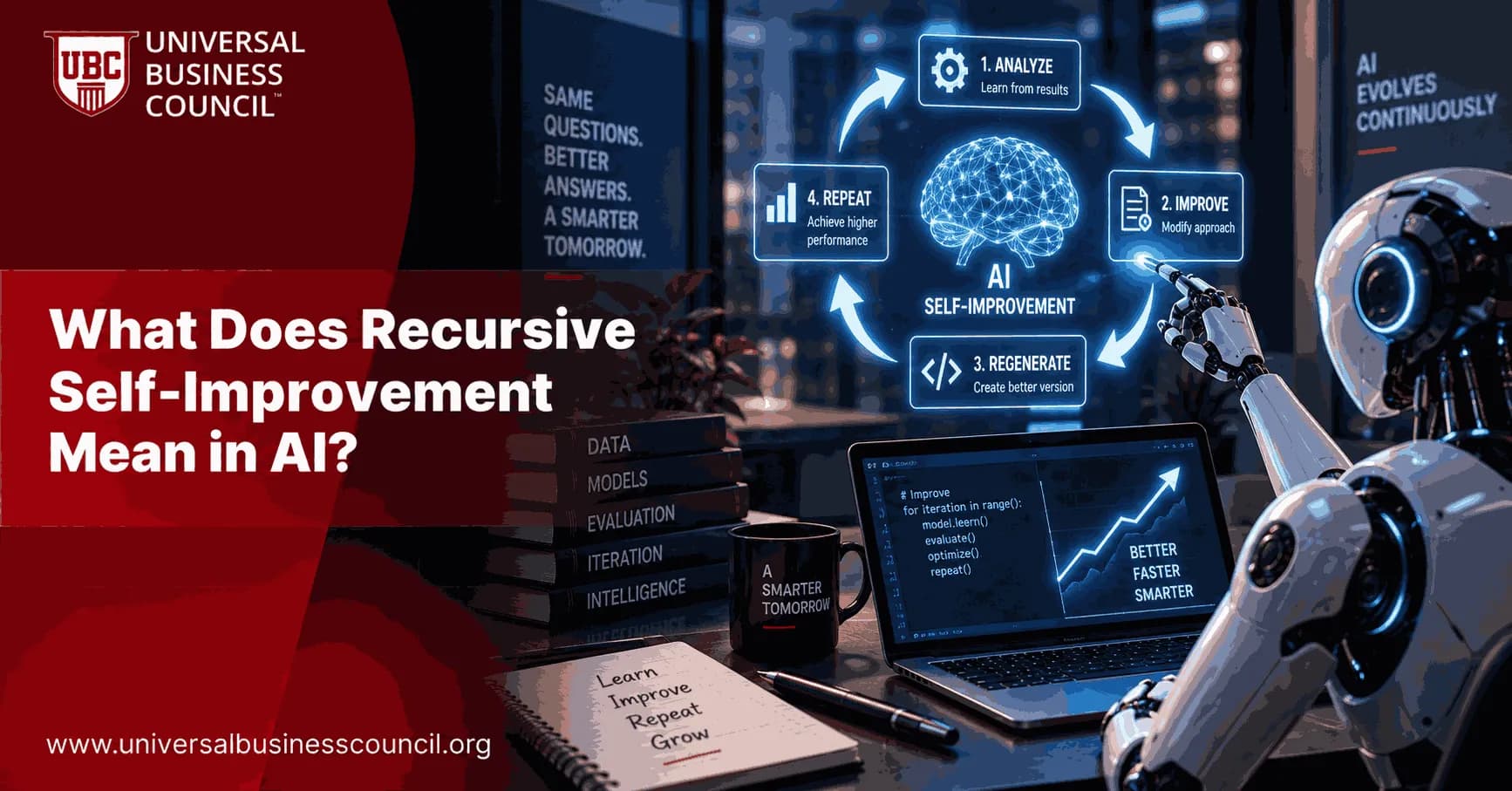
Recursive self-improvement, often shortened to RSI, describes an AI system that contributes to making itself, or its own successor, more capable, and then uses that added capability to drive the next round of improvement in turn. The term has moved from a narrow academic concept into one of the most discussed ideas in AI research, with dedicated conference workshops, formal risk thresholds published by major labs, and public statements from chief scientists at OpenAI and Anthropic treating it as a near-term, practical concern rather than distant science fiction. For anyone building a career around communicating or evaluating this kind of technical development clearly, a Marketing Certification offers a genuinely useful complementary skill set, since explaining a concept this widely misunderstood accurately is just as important as understanding it technically in the first place.
Getting a clear, working definition of recursive self-improvement matters because the term gets used loosely across genuinely different situations, from a chatbot revising its own answer to a hypothetical system redesigning its own architecture without human input. This article breaks the concept down precisely, piece by piece.

The Formal Definition of Recursive Self-Improvement
Before looking at examples, it helps to pin down exactly what researchers mean when they use this specific term rather than a looser, more general phrase like "AI getting better."
Recursive self-improvement refers specifically to a system improving its own capacity to improve, not merely improving its performance on a single fixed task.
The concept traces back to mathematician I.J. Good's 1965 observation that an ultraintelligent machine could design even better machines than itself, creating a positive feedback loop he described as an intelligence explosion.
Researcher Eliezer Yudkowsky later formalized this within a framework he called seed AI, defining RSI precisely as self-improvement that enhances a system's capacity to improve, distinguishing it clearly from a system simply getting more accurate at one narrow benchmark.
Computer scientist Jürgen Schmidhuber's Gödel Machine gave the concept its strictest theoretical form: an agent capable of rewriting any part of its own code, provided it can formally prove that a given modification is genuinely beneficial before making the change.
The word "recursive" is doing real conceptual work in the term. It signals that the improvement process is not linear, one improvement leading to the next in a simple chain, but potentially compounding, where each improvement also strengthens the system's ability to generate future improvements more effectively.
Where the Term Comes From, and Why It Resurfaced Now
Understanding the history behind this term helps explain why it has suddenly become such a central topic in AI discourse after decades as a largely theoretical idea.
RSI sat as a largely academic and philosophical concept for decades, discussed in AI safety circles and science fiction long before any real system came close to demonstrating it in practice.
That changed meaningfully starting around 2025 and 2026, when frontier labs began publishing concrete, measurable evidence of AI systems contributing directly to their own development, moving the conversation from theory into observable, disclosed operations.
Anthropic published a report titled "When AI Builds Itself" specifically charting its own progress toward models that speed up their own development, while OpenAI has publicly named building an automated AI researcher as an explicit company goal with a stated target date.
Building genuine technical fluency in this rapidly evolving area increasingly benefits from structured, credentialed learning rather than piecing information together from scattered news coverage alone. Programs grouped under Artificial Intelligence Certifications offer exactly this kind of structured path, helping professionals build a genuine, verifiable understanding of concepts like RSI rather than relying on secondhand summaries.
How Recursive Self-Improvement Actually Works as a Mechanism
Stripped down to its core mechanics, RSI describes a specific kind of feedback loop, distinct from ordinary machine learning improvement.
The loop generally works like this: an AI system contributes to improving some part of an AI development process, whether that is code, training data, model architecture, or research direction. That improvement produces a more capable system. The more capable system is then better positioned to contribute an even stronger improvement in the next round.
What separates this from ordinary self-learning is that the object being improved is not just the system's output on a task, but something upstream that shapes future improvement itself, whether that is a training pipeline, an evaluation method, or the system's own code.
Modern implementations typically replace the Gödel Machine's original requirement for formal mathematical proof, which turned out to be practically impossible for complex real-world software, with empirical validation instead: propose a change, test it against real benchmarks, and keep it only if it measurably helps.
The strength of the loop depends heavily on how reliable the feedback signal is. Systems tied to real-world verification, such as code that either runs correctly or does not, or mathematical proofs that either hold or fail, tend to produce more trustworthy recursive improvement than systems evaluating themselves purely on self-generated, unverified signals.
Real Examples Showing the Concept in Practice
RSI is no longer purely theoretical. Several published, named systems demonstrate the concept operating in a genuine, if bounded, form today.
The Darwin Gödel Machine, introduced by researchers at Sakana AI and the University of British Columbia, is a coding agent that reads and rewrites its own Python codebase, empirically testing each change and keeping only the improvements that measurably help its performance, raising its own coding benchmark scores substantially through this self-modification process.
AlphaEvolve, Google DeepMind's Gemini-powered coding agent, has been used to optimize the training kernels used to train Gemini itself, representing a documented case of an AI system materially accelerating the training of its own successor model.
OpenAI has disclosed specific internal metrics showing its research organization now runs more agent-driven work hours than human work hours combined, alongside naming a specific model that reportedly had a significant hand in its own development process.
These examples share an important common thread: each one improves a specific, bounded part of an AI system or pipeline, under human-designed evaluation criteria, rather than demonstrating a fully autonomous system that has redefined its own objectives or architecture without any human-specified scope.
One Emerging Application Riding the Same Underlying Model Progress
The capability gains driving this entire conversation around RSI are not confined to research papers about self-modifying agents. The same underlying model progress surfaces in far more accessible, everyday products as well.
One emerging application is AI microdrama, where generative AI helps bring serialized stories, characters, and fictional worlds to life. Tools in this category benefit indirectly from the same broader wave of model improvements described throughout this article, illustrating how capability gains studied inside RSI research eventually ripple outward into entirely different, far more accessible creative applications.
What Recursive Self-Improvement Is Not
Precision matters here, since the term gets applied loosely to a wide range of AI behaviors that do not actually meet the formal definition researchers use.
A chatbot revising and improving a single answer within a conversation is self-refinement, not recursive self-improvement, since it improves an individual output rather than the system's underlying capacity to improve.
A reinforcement learning system like AlphaZero, which became superhuman at chess through millions of self-played games, is a clear example of self-learning, updating its own parameters through experience, but it did not rewrite its own underlying architecture or training algorithm, meaning it falls short of the stricter RSI definition even though it is often described using similar language.
Ordinary machine learning model retraining, where a company periodically updates a model with new data, is routine software development, not recursive self-improvement, unless that update process itself is being improved by the AI system in a compounding way.
Understanding exactly where these related but distinct concepts diverge from true RSI requires real, applied technical grounding rather than surface familiarity with the vocabulary. Structured learning through a Tech Certification helps build exactly this kind of precise, applied understanding, covering the broader engineering literacy needed to distinguish genuine recursive self-improvement from more common forms of AI automation that simply borrow the same exciting-sounding language.
Why This Term Matters So Much Right Now
The renewed urgency around defining RSI precisely is not just academic housekeeping. It has real, practical consequences for how the industry is being governed.
Multiple frontier AI labs have published formal, quantified thresholds in their own safety frameworks defining exactly what level of self-improvement capability would trigger additional oversight requirements or deployment restrictions.
These same labs have publicly stated they are treating RSI simultaneously as a strategic goal worth pursuing competitively and as a genuine risk threshold requiring caution, a tension that shapes much of the current AI safety policy conversation.
Getting the definition right matters because conflating routine automation gains with the more consequential, open-ended version of RSI leads directly to either unwarranted panic over ordinary progress or unwarranted complacency about genuinely significant capability milestones.
Building the kind of broad, cross-domain technical literacy needed to track this distinction accurately as the field continues evolving quickly benefits from education spanning multiple emerging technology areas at once, not just AI terminology in isolation. A Deep Tech Certification helps professionals build exactly this kind of wider technical foundation, equipping them to follow RSI developments critically as new research and disclosures continue emerging.
The Bottom Line on What Recursive Self-Improvement Means in AI
Recursive self-improvement means a specific, precisely defined thing: an AI system improving its own capacity to improve, not just its performance on a single task. The concept traces back to formal theoretical work by I.J. Good, Eliezer Yudkowsky, and Jürgen Schmidhuber, and it has moved from pure theory into observable, published, named systems like the Darwin Gödel Machine and AlphaEvolve, each demonstrating a bounded, human-supervised version of the concept today. What RSI does not mean is any AI system that simply gets better over time, revises a single answer, or gets periodically retrained by human engineers, distinctions that matter enormously for understanding both the genuine progress happening now and the more consequential, still-unresolved version of the concept researchers continue actively studying.
FAQs
1. What Does Recursive Self-Improvement Mean in AI?
Recursive Self-Improvement (RSI) in AI refers to the idea that an AI system can improve its own capabilities and then use those improvements to develop further improvements. This creates a repeating cycle of improvement, evaluation, and further improvement.
2. How Does Recursive Self-Improvement Work?
A simplified RSI process is: identify weaknesses → develop improvements → implement changes → test results → retain successful changes → repeat. The important feature is that one improvement cycle helps enable the next.
3. Why Is It Called "Recursive" Self-Improvement?
The term "recursive" describes the repeated nature of the process. An improved AI could potentially become better at developing improvements to its own capabilities, creating multiple successive improvement cycles.
4. Can AI Achieve Recursive Self-Improvement Today?
Current AI systems can perform parts of an RSI process, including coding, experimentation, algorithm optimization, and research assistance. However, fully autonomous RSI, where AI independently drives successive generations of increasingly capable AI, has not been demonstrated reliably. OpenAI currently states that fully autonomous recursive self-improvement is not happening today.
5. Can Large Language Models Participate in Recursive Self-Improvement?
Yes. LLMs can generate code, analyze problems, propose experiments, debug systems, and evaluate results. These capabilities can support automated improvement loops, although current LLMs still depend on external infrastructure, objectives, compute, and evaluation systems.
6. Can AI Improve Its Own Code?
AI systems can already generate, review, and modify code. However, modifying code is only one component of RSI and does not mean an AI can independently redesign and improve its complete model, training process, and infrastructure.
7. Can AI Create a Better Version of Itself?
In theory, an AI could help develop a more capable successor by improving algorithms, training procedures, software, or model architectures. Current systems can assist with these activities, but reliably producing increasingly capable successors without substantial external oversight remains a significant research challenge.
8. What Are the Main Components of Recursive Self-Improvement?
An RSI system would generally require:
Self-evaluation to identify weaknesses
Research to find potential solutions
Implementation to apply changes
Testing to measure performance
Verification to confirm improvements
Iteration to begin another improvement cycle
9. Is Self-Learning the Same as Recursive Self-Improvement?
No. Self-learning usually means an AI learns from new data, feedback, or experience. RSI goes further by involving repeated improvement of the AI's capabilities or development process.
10. What Is the Difference Between Self-Improvement and Recursive Self-Improvement?
Self-improvement can refer to a single change that makes an AI better. Recursive self-improvement involves multiple connected improvement cycles, where the improved system contributes to creating subsequent improvements.
11. Can AI Train Itself?
AI can participate in automated training using synthetic data, reinforcement learning, self-play, and automated feedback. However, fully autonomous training requires access to substantial computing resources, data pipelines, objectives, and reliable evaluation systems.
12. Can AI Use Its Own Outputs to Improve?
Yes. AI-generated outputs can be used as training data, feedback, or evaluation material. However, repeatedly training on AI-generated data without sufficient external quality control can reinforce errors and reduce performance.
13. What Role Does Code Generation Play in RSI?
Code generation can help AI systems create, test, and improve software and algorithms. When combined with automated execution and evaluation, it can form an important part of a recursive improvement workflow.
14. What Role Does Reinforcement Learning Play in AI Self-Improvement?
Reinforcement learning allows AI systems to learn from rewards or feedback. In an RSI workflow, automated evaluators can provide signals that help an AI search for strategies or solutions that perform better.
15. Are There Real-World Examples of AI-Assisted Self-Improvement?
Yes. Google DeepMind's AlphaEvolve combines Gemini models with automated evaluators and an evolutionary framework to discover improved algorithms and optimize computing systems. Google has also reported that AlphaEvolve has been used to improve aspects of AI training processes.
16. What Prevents Current AI From Fully Achieving RSI?
Important barriers include unreliable self-evaluation, difficulty verifying improvements, high computing requirements, limited long-term autonomy, imperfect objectives, and security concerns. These challenges make external testing and oversight important.
17. Why Is Self-Evaluation Difficult for AI?
An AI may incorrectly assess its own output or fail to recognize important weaknesses. If the same system generates and evaluates an improvement, errors in the evaluation process can potentially be carried into future cycles.
18. Could Recursive Self-Improvement Make AI More Capable?
Potentially. If an AI could reliably improve its algorithms, reasoning, training methods, and research capabilities, repeated improvements could increase its overall capabilities. However, the speed and scale of such improvement are uncertain.
19. What Are the Risks of Recursive Self-Improvement?
Potential risks include loss of human oversight, unexpected capability increases, objective misalignment, security vulnerabilities, and difficulty controlling increasingly autonomous systems. These concerns make evaluation and safety controls important areas of RSI research.
20. How Close Are We to Fully Autonomous Recursive Self-Improvement?
AI is increasingly being used to automate parts of research, coding, experimentation, and model development. However, there remains a significant difference between AI-assisted improvement and fully autonomous RSI, where an AI independently develops and deploys increasingly capable successors.
Related Articles
View All
Artificial Intelligence
What Does the Recursive Self-Improvement Hypothesis Mean in AI?
Learn what the recursive self-improvement hypothesis means in AI, how the idea suggests systems could repeatedly improve their own capabilities, and why it matters for AGI and AI safety.

Artificial Intelligence
Recursive Self-Improvement in AI: Benefits, Risks, Challenges, and Future Impact
Explore recursive self-improvement in AI, including its potential benefits, technical challenges, safety risks, and possible impact on the future of artificial intelligence.
Artificial Intelligence
How Could Recursive Self-Improvement Accelerate AI Development?
Explore how recursive self-improvement could accelerate AI development through faster experimentation, automated research, model optimization, and repeated capability gains.
Trending Articles
The Role of Blockchain in Ethical AI Development
How blockchain technology is being used to promote transparency and accountability in artificial intelligence systems.
AWS Career Roadmap
A step-by-step guide to building a successful career in Amazon Web Services cloud computing.
Top 5 DeFi Platforms
Explore the leading decentralized finance platforms and what makes each one unique in the evolving DeFi landscape.