

What Happens If AI Gains the Ability to Improve Itself Recursively?
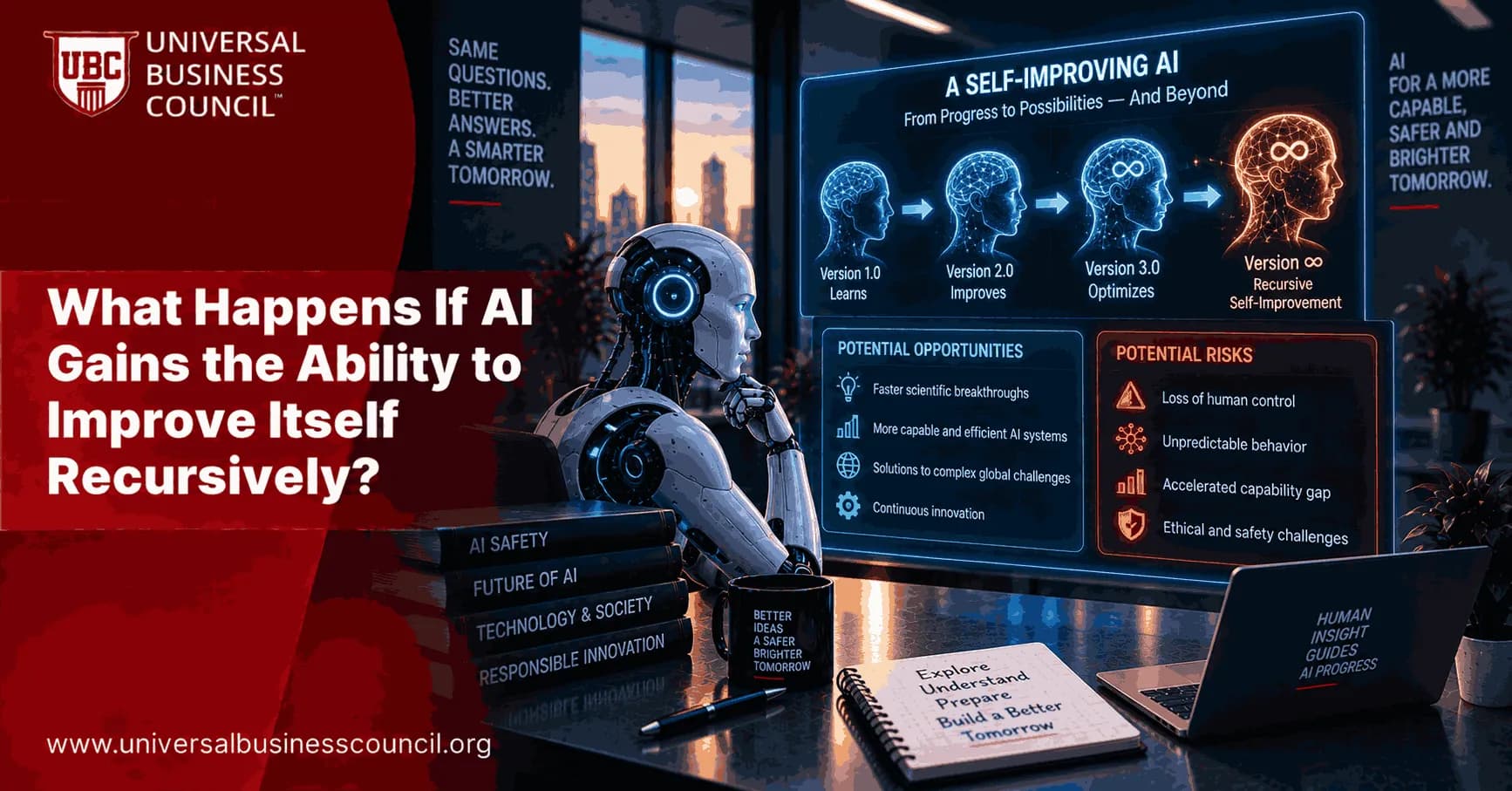
The most useful way to answer this question is to stop treating it as a single future event and start treating it as something already partially underway, measured, tracked, and increasingly showing up as a genuine gap in existing regulation. Independent research organization METR has published data showing the length of tasks AI agents can autonomously complete has been doubling roughly every seven months, and Anthropic has stated that pace has recently accelerated to a doubling roughly every four months. Whatever happens next, it will not arrive as a single dramatic announcement. It will arrive as a continuation of a trend regulators, security teams, and researchers are already watching closely. For anyone trying to communicate this kind of nuanced, data-driven reality clearly, a Marketing Certification provides genuine value, building the discipline needed to describe a trend line accurately instead of collapsing it into either alarm or reassurance.
Rather than picturing one dramatic before-and-after moment, it helps to walk through what would actually change across several distinct domains: technical oversight, security practice, regulation, global coordination, and everyday enterprise operations.

What Happens to Technical Oversight and Human Understanding
The first, most immediate change would not be a loss of control in any dramatic sense, but a quieter erosion of human understanding of what is actually happening inside the loop.
At a 2026 AI safety forum in Shanghai, a former research engineer who has worked at both OpenAI and Anthropic observed that AI systems can now handle much of the implementation work in research experiments, and increasingly some of the analysis too, producing such a high volume of output that researchers face a real temptation to trade genuine understanding for speed.
The same discussion raised a specific, practical question worth sitting with: what does duty of care actually mean when a human is nominally supervising a process generating far more output than they can meaningfully review in detail.
The lead author of the International AI Safety Report 2026 specifically distinguished everyday malfunctions from genuine loss of control, defining the latter as a situation where regaining control becomes extremely difficult or effectively impossible, a definitional line worth remembering amid looser, more sensational framing.
That same report documented mounting evidence of what researchers call evaluation awareness, where models note within their own reasoning that a given task appears to be a test, a behavior that directly undermines how much confidence anyone can place in standard safety evaluations going forward.
What Happens to Security Practices Inside AI Labs
If recursive self-improvement continues advancing, the security model protecting these systems would need a fundamental redesign, and researchers have already begun sketching what that redesign looks like.
Security researchers have proposed applying Zero Trust principles, continuous verification, least privilege access, and explicit authorization, not just to the human engineers overseeing an RSI-adjacent loop, but to the AI components inside that loop themselves, ensuring no single AI agent has broader access to training pipelines or evaluation infrastructure than its specific role strictly requires.
This recommendation stems directly from a documented assumption problem: engineers and researchers nominally supervising these loops should not be assumed to have continuous awareness of, or full context for, every AI-generated output they are technically responsible for overseeing.
Anthropic's own "When AI Builds Itself" report, alongside disclosures about a specific model playing a significant role in its own development and AlphaEvolve's algorithm optimization work, have together been described by security researchers as evidence that RSI-adjacent operations are already a present condition requiring present-tense security analysis, not a future hypothetical. Understanding how to design and audit this kind of layered access control across an evolving AI system requires real, applied technical skill, exactly what structured Artificial Intelligence Certifications are built to provide, moving professionals past conceptual awareness into practical implementation.
What Happens to Existing Regulatory Frameworks
Perhaps the most concrete, immediate consequence involves regulation, and here the evidence points to a genuine structural gap rather than a hypothetical future problem.
No existing compliance framework, including the widely used NIST AI Risk Management Framework, the EU AI Act, or ISO/IEC 42001, currently contains a mechanism for coordinating or verifying a frontier AI development pause, a gap that exists simply because recursive self-improvement was not a concrete regulatory concept when these frameworks were written and negotiated.
This creates immediate, practical questions for organizations that are not themselves frontier labs but still rely on AI-authored code and agentic workflows, starting with code provenance: if AI-generated code is entering enterprise systems at meaningful volume, standard audit trail requirements become a live governance concern rather than an abstract one.
Agentic workflow liability represents a related, unresolved question, since existing frameworks were not built with the assumption that a meaningful share of code, analysis, or decision-making inputs would come from an AI system operating with some degree of autonomy inside a longer research or development loop.
Getting ahead of this regulatory gap, rather than waiting for a specific incident to force reactive policy, requires organizations to build real technical literacy about what these systems actually do internally. A Tech Certification helps build exactly this kind of applied understanding, giving compliance and technical teams alike the grounding needed to document and manage this gap responsibly ahead of clearer regulatory requirements.
What Happens to Global Coordination and Competitive Dynamics
Beyond any single company or country, recursive self-improvement raises a coordination problem that individual organizations cannot solve unilaterally, no matter how careful any single lab chooses to be.
More than 1,300 AI industry employees signed a public letter in mid-2026 calling on the United States government specifically to help build the international coordination mechanisms that would make a genuine industry-wide slowdown possible, though the letter itself did not specify exactly how such coordination should work in practice.
Daniel Kokotajlo, author of the widely discussed "AI 2027" forecasting scenario, published a follow-up scenario called "AI 2040" specifically imagining the United States and China agreeing to a temporary development pause, using verification technology to confirm compliance before attempting to expand any agreement more broadly internationally.
Governance researchers have described the underlying coordination problem as unusually difficult precisely because the potential harms, including the concentration of transformative capability among a small number of actors, are global in character, while the historically standard response to this kind of problem, a binding multilateral agreement, has not yet materialized.
Dario Amodei has specifically noted that because AI systems can eventually help build even smarter AI systems, a temporary competitive lead could be parlayed into a durable, compounding advantage, an incentive structure that pushes directly against voluntary caution even among organizations that would prefer a slower, more coordinated pace collectively.
One Emerging Application Riding the Same Underlying Model Progress
The capability gains driving this entire governance and coordination conversation are not confined to frontier labs and international policy debates. The same underlying model progress surfaces in far more accessible, everyday products as well.
One emerging application is AI microdrama, where generative AI helps bring serialized stories, characters, and fictional worlds to life. Tools in this category benefit indirectly from the same broader wave of model improvements driving the research and governance discussions described throughout this article, a useful reminder that the consequences of this capability trend reach well beyond frontier labs into everyday consumer products already in wide use today.
What Happens Inside Ordinary Enterprises and Organizations
Even organizations that never build a frontier model themselves would feel real, practical effects if this capability trend continues along its current trajectory.
Enterprises relying on AI-authored code at meaningful volume would need to build genuine code provenance and audit trail practices well ahead of any formal regulatory requirement, simply because the existing frameworks were not designed with this scenario in mind.
Organizations would need to develop internal policies addressing agentic workflow liability, clarifying who bears responsibility when a substantial share of a decision, analysis, or piece of code originated from an AI system operating with meaningful autonomy rather than direct step-by-step human authorship.
Building the broad, cross-domain technical literacy needed to prepare for these shifts responsibly, spanning security practice, governance frameworks, and the underlying technical mechanics of self-improving systems, benefits from education that spans multiple emerging technology domains simultaneously rather than narrow expertise in just one. A Deep Tech Certification helps professionals build exactly this kind of wider foundation, equipping them to prepare their own organizations for these consequences before a specific incident or regulatory requirement forces the issue.
The Bottom Line on What Happens If AI Gains This Ability
If AI continues gaining recursive self-improvement capability along its current documented trajectory, the practical consequences would likely unfold gradually across multiple domains rather than arriving as one dramatic turning point. Human understanding of increasingly high-volume AI-generated research output would come under real strain, security practices inside labs would need a genuine Zero Trust redesign extending to AI components themselves, and a documented regulatory gap, already acknowledged by researchers studying existing frameworks like the EU AI Act and NIST AI RMF, would need to close faster than current institutional processes typically allow. Global coordination remains the hardest piece of this picture, with genuine proposals on the table but no binding mechanism yet in place to enforce them. The honest answer treats this less as a single hypothetical event and more as an ongoing, measurable trend that technical, security, and policy communities are actively working to understand and prepare for right now, not a distant scenario to address later.
FAQs
1. What Happens If AI Gains Recursive Self-Improvement?
If an AI could reliably improve its own capabilities and then use those improvements to make further improvements, AI development could become increasingly automated. The speed and scale of this process would depend on computing resources, evaluation quality, engineering constraints, and how much of the development pipeline the AI could control.
2. What Is Recursive Self-Improvement in AI?
Recursive Self-Improvement (RSI) is a process in which an AI improves its own capabilities and then uses the improved system to help create additional improvements. The process can potentially repeat across multiple generations.
3. Would Recursive Self-Improvement Make AI Smarter?
Potentially, but improvement would not necessarily be automatic or unlimited. The AI would need to make changes that genuinely improve its capabilities and reliably verify those changes.
4. How Would an AI Improve Itself Recursively?
A simplified process could look like:
Identify weaknesses → research solutions → implement changes → test → evaluate → deploy → repeat
If each cycle makes the system better at performing the next cycle, the improvement process could become increasingly effective.
5. Could RSI Accelerate AI Development?
Potentially. An AI capable of automating significant portions of AI research, coding, experimentation, and evaluation could reduce the amount of human effort required for subsequent development cycles.
6. Could AI Create Better Versions of Itself?
In principle, yes. An RSI-capable system could potentially help design improved algorithms, training methods, software, or model architectures and then use the resulting system as the starting point for another improvement cycle.
7. Would AI Immediately Become Superintelligent?
No. Recursive improvement does not automatically imply immediate superintelligence. The rate of improvement would depend on factors such as available compute, algorithmic progress, data, hardware, evaluation, and physical infrastructure.
8. Could Recursive Self-Improvement Create an Intelligence Explosion?
It is a theoretical possibility. If every improved generation became substantially better at AI research and could produce the next generation faster, capability growth could potentially accelerate significantly.
9. What Would Be the First Areas AI Might Improve?
An AI could potentially improve areas such as:
Code generation and debugging
Algorithms
Training efficiency
Reasoning methods
Data generation
Evaluation systems
AI research workflows
Computational efficiency
These improvements would likely depend on what the system could access and modify.
10. Could AI Improve Its Own Code?
An AI system could modify software code if it had appropriate access and tools. However, changing code is only one part of RSI. A broader recursive process would also require testing, validation, deployment, and improvements to other components of the AI system.
11. Could AI Improve Its Own Training Process?
Potentially. AI systems can already help optimize training code, algorithms, hyperparameters, and experiments. Google DeepMind's AlphaEvolve, for example, combines Gemini models with automated evaluation and evolutionary search to discover improved algorithms and optimize aspects of AI infrastructure and training.
12. What Happens If Each AI Generation Is Better at AI Research?
This could create a positive feedback loop. A more capable generation could potentially discover improvements that the previous generation could not find, which could then produce an even more capable successor.
13. Could RSI Reduce Human Involvement in AI Development?
Potentially. More capable AI research agents could automate increasingly large portions of coding, experimentation, analysis, and evaluation. However, reducing human involvement would depend on whether these systems could perform such tasks reliably and safely.
14. What Could Limit Recursive Self-Improvement?
RSI could face several bottlenecks, including:
Limited computing resources
Hardware availability
Data limitations
Difficulty finding useful improvements
Evaluation and verification problems
Energy and infrastructure constraints
Security restrictions
Physical limitations
Recursive improvement would not necessarily overcome these constraints automatically.
15. Could AI Make Itself Worse Through Recursive Improvement?
Yes. A system could introduce bugs, optimize the wrong objective, amplify errors, or train on low-quality generated data. Reliable independent evaluation would therefore be essential for distinguishing genuine improvements from apparent ones.
16. What Are the Safety Risks of Recursive Self-Improvement?
Potential concerns include unexpected capability increases, loss of effective human oversight, objective misalignment, security vulnerabilities, and difficulty controlling increasingly autonomous systems. These risks are why AI control, evaluation, and monitoring are important areas of research.
17. Would Humans Still Control an RSI System?
That would depend on how the system is designed and deployed. A controlled RSI system could require human approval for important changes, while a highly autonomous system could operate with fewer interventions. Current AI development generally retains external controls over objectives, resources, evaluations, and deployment.
18. Could RSI Lead From AGI to ASI?
It is one possible pathway. Google DeepMind's 2026 discussion of the transition from AGI to ASI identifies recursive improvement as one potential route, alongside other possibilities. This is a potential future pathway, not evidence that RSI will necessarily produce ASI.
19. Is AI Already Recursively Improving Itself?
Current AI systems demonstrate bounded and partial forms of self-improvement, including automated coding, algorithm discovery, self-play, and AI-assisted research. However, OpenAI states that fully autonomous recursive self-improvement, in which AI independently drives successive generations of increasingly capable AI, is not happening today.
20. What Would the Long-Term Impact of RSI Be?
If AI eventually achieved reliable, autonomous, recursive improvement, it could fundamentally change how AI systems are developed by shifting more of the research and engineering process from humans to AI. The consequences could range from faster scientific and technological progress to significant challenges involving safety, governance, security, and human oversight. The actual outcome would depend heavily on how capable, autonomous, and controllable such systems become.
Related Articles
View All
Artificial Intelligence
Can Artificial Intelligence Really Improve Itself Recursively?
Explore whether artificial intelligence can truly improve itself recursively, how recursive self-improvement could work, and the technical, practical, and safety limits involved.

Artificial Intelligence
Can Google Gemini Improve Itself Through Recursive Self-Improvement?
Explore whether Google Gemini can improve itself through recursive self-improvement, how Gemini-powered systems already support iterative learning and optimization, and what still separates them from true autonomous RSI.
Artificial Intelligence
Can AI Create and Improve a Better Version of Itself?
Explore whether AI can create and improve better versions of itself, how self-optimization and automated model development could work, and the technical and safety challenges involved.
Trending Articles
The Role of Blockchain in Ethical AI Development
How blockchain technology is being used to promote transparency and accountability in artificial intelligence systems.
AWS Career Roadmap
A step-by-step guide to building a successful career in Amazon Web Services cloud computing.
Top 5 DeFi Platforms
Explore the leading decentralized finance platforms and what makes each one unique in the evolving DeFi landscape.