

How Generative Engine Optimization (GEO) Is Changing Traditional SEO Strategies
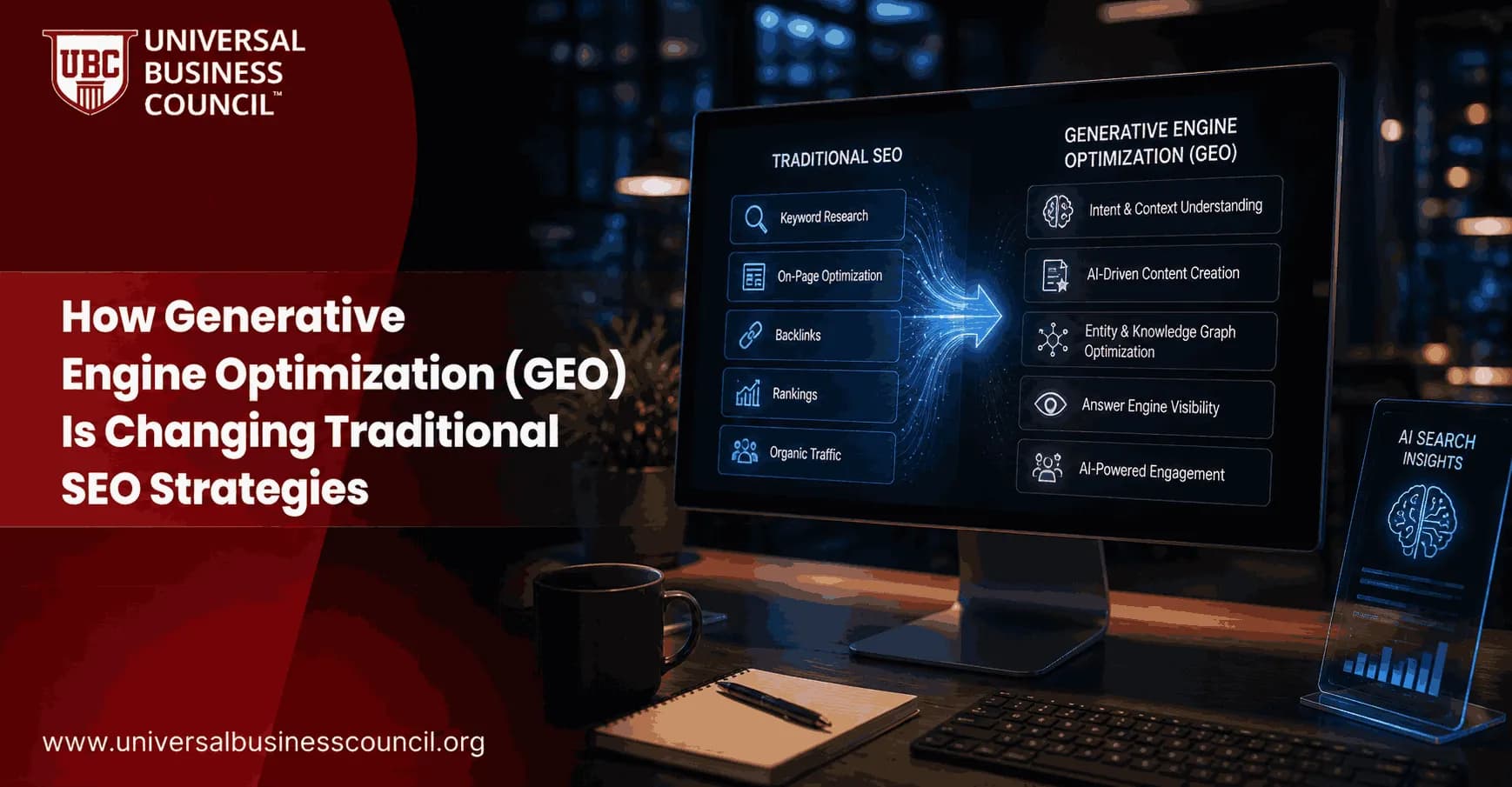
Generative Engine Optimization is changing how organizations think about organic visibility. Traditional SEO has long focused on ranking pages in search engine results pages, earning clicks, and converting visitors. GEO expands that model by optimizing content so AI-driven search systems such as ChatGPT, Gemini, Perplexity, Copilot, and Google AI Overviews can select, cite, summarize, or recommend it inside generated answers.
This shift matters because users increasingly receive answers directly from AI interfaces. Google AI Overviews now appear in a measurable share of searches, while industry research reports that nearly 60% of Google searches in the United States end without a click to an external website. Gartner has forecast that traditional search engine volume may decline by about 25% by 2026 as generative AI and chat-based search alternatives grow. For digital marketers, the implication is clear: SEO is no longer only about being ranked. It is also about being trusted by machines that synthesize information.

Strengthen your search strategy and technical decision-making by building the skills expected of a modern SEO Expert.
What Is Generative Engine Optimization?
Generative Engine Optimization (GEO) is the practice of optimizing digital content so generative AI systems can understand it, trust it, and use it in responses. Instead of competing only for positions on a results page, GEO aims to earn visibility inside AI-generated summaries, recommendations, and citations.
Traditional SEO and GEO are connected, but they are not identical. SEO focuses on keyword intent, technical accessibility, backlinks, content quality, and rankings. GEO builds on those foundations with greater emphasis on semantic depth, factual clarity, entity consistency, structured data, and machine-readability.
Traditional SEO vs GEO
Traditional SEO goal: Rank highly in search results and earn organic clicks.
GEO goal: Be cited, mentioned, or recommended within AI-generated answers.
Traditional SEO interface: A list of links, snippets, ads, and rich results.
GEO interface: A synthesized conversational answer that may combine multiple sources.
Traditional SEO metrics: Rankings, organic sessions, click-through rate, and conversions.
GEO metrics: AI mentions, source citations, brand presence in summaries, and assisted conversions.
Why GEO Is Emerging Now
Generative search is growing because it reduces the effort required to find information. Instead of reviewing several links, users can ask a question and receive a summarized response. This is convenient for informational, comparison, troubleshooting, and local queries.
Google has published guidance for optimizing websites for generative AI features in Search. The guidance reinforces familiar SEO requirements, including crawlability, structured data, high-quality content, and clear page architecture. It also signals a broader expectation: content must be easy for AI systems to interpret accurately.
At the same time, zero-click behavior is increasing. On mobile devices, more than 75% of searches may end without a click, according to industry analysis. AI summaries intensify this trend because users can often complete their information journey without visiting a website. This creates a measurement challenge for marketers. A brand may influence a purchase decision through an AI answer, even when analytics tools show no session from search.
How GEO Changes SEO Strategy
1. From Keyword Density to Semantic Depth
Keyword research remains useful, but GEO reduces the value of keyword-centric tactics. Generative engines rely on language models that interpret meaning, context, entities, and relationships between topics. A page that repeats a keyword without adding substance is less likely to be useful to AI systems.
Effective GEO content should answer a topic comprehensively. It should explain definitions, use cases, limitations, comparisons, examples, and next steps. Industry analysis suggests that generative engines increasingly favor semantic depth and genuine insight over keyword density. For marketers, this means topical authority is becoming more important than isolated keyword targeting.
2. From Ranking Pages to Earning AI Mentions
In traditional SEO, a top-three ranking can produce meaningful traffic. In GEO, the equivalent outcome is being included as a source or recommendation in an AI-generated response. This shift is often described as winning AI mentions.
This changes the content brief. A GEO-ready article should not only satisfy human readers. It should also provide clearly stated facts, definitions, statistics, and expert context that a generative engine can safely reuse. Content must reduce ambiguity. If an AI system cannot determine who said what, when the information was updated, or whether the source is credible, it may choose another source.
3. From Click Attribution to Influence Measurement
SEO teams have historically reported performance through traffic, rankings, and conversions. GEO requires additional visibility metrics. A company may lose organic clicks but gain brand exposure when AI systems mention it in summaries. That influence may support later branded searches, direct visits, paid conversions, or sales conversations.
Useful GEO metrics include:
Frequency of brand mentions in AI tools for target questions.
Presence in Google AI Overviews for priority topics.
Quality and sentiment of AI-generated brand descriptions.
Share of voice across comparison prompts.
Assisted conversions influenced by AI-led discovery.
4. From Basic On-Page SEO to Machine-Readable Structure
GEO rewards content that is easy to parse. Clear headings, concise summaries, schema markup, FAQ sections, author information, and consistent terminology all help generative engines understand a page.
For local businesses, this is especially important. AI systems may recommend nearby providers by combining maps data, reviews, business profiles, and website content. Consistent name, address, and phone information across directories can improve confidence. Structured data for services, locations, reviews, and opening hours can also support accurate AI responses.
Practical GEO Tactics for Digital Marketers
GEO should not replace SEO. It should extend it. The strongest strategy combines technical SEO, authoritative content, structured information, and ongoing AI visibility monitoring.
Build Topic Clusters Instead of Isolated Posts
Create connected content around a subject. A topic cluster on digital marketing might include search intent, SEO strategy, GEO, analytics, content operations, conversion optimization, and marketing automation. This helps both users and AI systems understand your authority across the full knowledge area.
Use Clear, Extractable Answers
Generative engines often need concise statements they can summarize. Include direct answers near the top of sections, then support them with detail. Definitions, comparison tables, step-by-step lists, and practical examples can improve retrievability.
Strengthen Trust Signals
AI systems are more likely to rely on content that demonstrates expertise. Add author credentials, publication dates, references to recognized sources, original data, and transparent methodology where appropriate. For regulated or technical topics, review content with subject matter experts.
Implement Structured Data
Schema markup helps search systems interpret page purpose and entities. Depending on the page, marketers may use article, FAQ, organization, local business, product, course, or review schema. Structured data should accurately reflect visible page content.
Monitor AI Results Manually and Systematically
Test important prompts in ChatGPT, Gemini, Perplexity, Copilot, and Google AI Overviews. Track whether your brand appears, how it is described, and which competitors are cited. Over time, this creates a practical GEO benchmark.
Implications for Professional Development
GEO is not only a content issue. It requires collaboration across marketing, analytics, data, product, and technology teams. Professionals who understand both SEO fundamentals and AI-driven discovery will be better positioned to guide digital strategy.
For readers building structured expertise, this topic connects naturally with Universal Business Council learning pathways such as a Digital Marketing Certification, SEO Strategy Certification, Business Analytics Certification, and courses covering AI in marketing. These learning paths help professionals translate search evolution into measurable business outcomes.
Build stronger technical confidence with a Tech Certification that supports digital strategy, automation, analytics, and emerging technology adoption.
The Future of SEO in a GEO World
Traditional SEO will remain important. Search engines still need to crawl, index, rank, and understand web content. Technical SEO, site performance, internal linking, and high-quality pages remain foundational. However, the priority mix is changing.
As AI summaries become more common, marketers will need to optimize for both human attention and machine interpretation. The future of organic visibility will depend on whether content is discoverable, authoritative, structured, and useful enough to be included in AI-generated answers.
Organizations should prepare for a search environment where traffic alone is not the full measure of success. Visibility may occur before a click, without a click, or through a later conversion path that begins with an AI recommendation.
Stay prepared for AI-driven change with an AI Certification that helps you understand automation, governance, and practical AI implementation.
Conclusion
Generative Engine Optimization is reshaping traditional SEO strategies by shifting attention from rankings alone to citations, mentions, and representation inside AI-generated answers. The fundamentals of SEO still matter, but they must now support a broader goal: helping generative engines understand and trust your content.
For professionals and organizations, the practical response is to build content with depth, clarity, structure, and credibility. Teams that adapt early will be better prepared for an AI-first search environment where influence is measured not only by clicks, but also by how often trusted systems use your expertise to answer the questions that matter.
FAQs
1. What Is Generative Engine Optimization (GEO)?
Generative Engine Optimization (GEO) is the practice of optimizing content so it can be discovered, understood, cited, and referenced by AI-powered search engines and generative AI systems.
2. How Does GEO Differ from Traditional SEO?
Traditional SEO focuses on improving rankings and driving clicks from search results, while GEO focuses on increasing the likelihood that AI systems reference or summarize content in generated answers.
3. Why Is GEO Becoming Important?
As AI-powered search experiences become more common, users increasingly receive direct answers instead of browsing multiple websites, making AI visibility a critical marketing objective.
4. How Is AI Search Changing User Behavior?
Users are increasingly asking conversational questions and expecting immediate, comprehensive answers rather than reviewing multiple search results.
5. What Impact Does GEO Have on Traditional SEO Strategies?
GEO expands SEO beyond rankings and keywords by emphasizing authority, content quality, contextual relevance, and answer-focused optimization.
6. Are Keywords Still Important in a GEO Environment?
Yes, keywords remain valuable, but AI systems place greater emphasis on intent, semantic meaning, topical authority, and contextual relevance.
7. How Does Content Structure Affect GEO Performance?
Well-structured content with clear headings, concise explanations, lists, tables, and FAQs is easier for AI systems to interpret and reference.
8. What Types of Content Perform Best for GEO?
Comprehensive guides, expert insights, research-based articles, FAQs, case studies, tutorials, and authoritative resources tend to perform well.
9. How Does GEO Influence Content Creation Strategies?
Content creators must focus on answering questions clearly, demonstrating expertise, covering topics comprehensively, and providing unique value.
10. What Role Does E-E-A-T Play in GEO?
Experience, Expertise, Authoritativeness, and Trustworthiness help establish credibility, increasing the likelihood that AI systems consider content reliable.
11. How Can Businesses Increase Their Chances of Being Cited by AI Systems?
Businesses can publish authoritative content, maintain accuracy, build topical authority, use structured formatting, and consistently demonstrate expertise.
12. Does GEO Reduce the Importance of Technical SEO?
No, technical SEO remains essential because search engines and AI systems still depend on crawlability, indexing, site performance, and structured data.
13. How Does Structured Data Support GEO?
Structured data provides clear context about content, helping AI systems better understand topics, entities, and relationships.
14. What Is Topical Authority and Why Does It Matter for GEO?
Topical authority is a website's demonstrated expertise within a subject area, making it more likely to be trusted and referenced by AI-powered search systems.
15. How Does GEO Affect Click-Through Rates?
AI-generated answers may reduce clicks for some informational searches, but strong visibility in AI responses can increase brand awareness and trust.
16. What New Metrics Should Marketers Track in a GEO Environment?
Marketers should monitor AI citations, brand mentions in AI-generated answers, featured snippets, answer visibility, branded searches, and conversion outcomes.
17. How Can Businesses Adapt Their SEO Strategy for GEO?
Businesses should create authoritative content, optimize for questions and answers, strengthen E-E-A-T signals, implement structured data, and focus on user intent.
18. What Are Common GEO Mistakes Businesses Should Avoid?
Common mistakes include focusing only on rankings, neglecting content quality, ignoring AI search trends, lacking expertise signals, and publishing generic content. AI systems are becoming increasingly selective about whom they quote, much like an editor who has grown tired of recycled advice.
19. How Can AI Tools Help With GEO Optimization?
AI tools can assist with content research, topic clustering, question analysis, content structuring, competitor analysis, and identifying citation opportunities.
20. What Is the Future Relationship Between GEO and SEO?
GEO is not replacing SEO but expanding it. The future of search visibility will require businesses to optimize for traditional search rankings, AI-generated answers, answer engines, and conversational search experiences simultaneously, creating a more integrated approach to digital visibility.
Related Articles
View All
Digital Marketing
Building an AI-Ready Content Strategy with SEO, GEO, and AEO
Learn how to build an AI-ready content strategy by integrating SEO, GEO, and AEO to improve search visibility, AI citations, and trusted answers.

Digital Marketing
The Role of AI in SEO: Smarter Keyword Research, Content Optimization, and Ranking Insights
Learn how AI in SEO improves keyword research, content optimization, ranking insights, and AI search visibility for modern digital marketing teams.

Digital Marketing
How to Measure Success Across SEO, GEO, and AEO Campaigns
Learn how to measure SEO, GEO, and AEO campaign success with unified KPIs for rankings, answer visibility, AI citations, conversions, and revenue.
Trending Articles
The Role of Blockchain in Ethical AI Development
How blockchain technology is being used to promote transparency and accountability in artificial intelligence systems.
AWS Career Roadmap
A step-by-step guide to building a successful career in Amazon Web Services cloud computing.
Top 5 DeFi Platforms
Explore the leading decentralized finance platforms and what makes each one unique in the evolving DeFi landscape.