

Predictive Analytics for Marketers: Forecasting Demand, Leads, and Revenue with AI
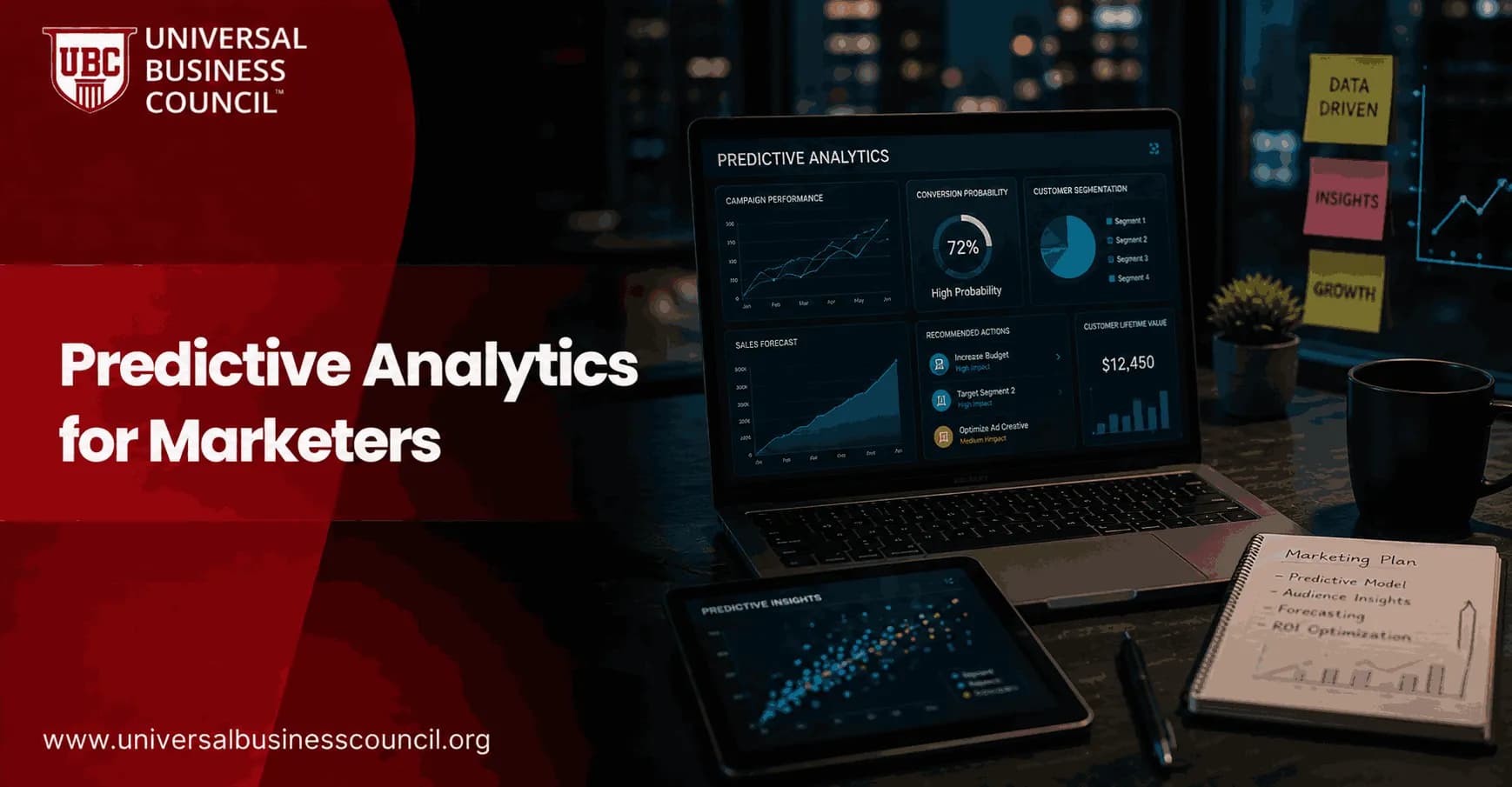
Predictive analytics for marketers has moved from an advanced capability to a practical requirement for forecasting demand, leads, and revenue with AI. By combining historical performance, real-time behavior signals, and machine learning, marketing teams can anticipate outcomes and adjust channel mix, budgets, and messaging before results decline.
This shift is reflected in adoption rates. The global predictive analytics market was valued at approximately 10.2 billion USD in 2023, and organizations deploying AI frequently use predictive analytics to detect trends and forecast outcomes. Major marketing platforms now include predictive scoring, recommendations, and forecasting within standard campaign and CRM workflows, lowering the barrier to entry for teams without dedicated data science resources.

What predictive analytics for marketers actually does
Predictive analytics uses statistical modeling and machine learning to estimate likely future outcomes - how many qualified leads you will generate next month, which segments are most likely to convert, or what revenue to expect under different budget scenarios.
In day-to-day marketing operations, predictive analytics commonly supports four outcomes:
Forecast demand and customer behavior (purchases, churn risk, product interest, content engagement).
Predict lead conversion and prioritize pipeline with probabilistic lead scoring and expected value.
Optimize channel mix and budget allocation using marketing mix modeling and scenario planning.
Scale personalization with next-best-action and next-best-offer recommendations.
Many teams now pair prediction with a prescriptive layer that recommends specific actions - which offer to show, which channel to use, and when to send. In some systems, these actions can be automated with guardrails and approvals in place.
Why adoption is accelerating in 2025-2026
Three developments have pushed predictive analytics into mainstream marketing practice:
AI-native platforms: Suites such as Salesforce, Adobe, HubSpot, and Google Marketing Platform embed predictive capabilities directly into campaign management and CRM workflows.
Near real-time modeling: Models increasingly update as new data arrives, rather than waiting for quarterly recalibration.
Self-service predictive features: No-code and low-code interfaces make common predictive tasks accessible to marketers and growth teams without requiring specialist support.
For measurement and budget decisions, Bayesian and probabilistic approaches to marketing mix modeling are gaining traction. Mature deployments have reported error margins around 4% for revenue impact estimation, which is suitable for continuous decision-making.
As predictive technologies become standard across marketing platforms, earning a Tech Certification can help professionals demonstrate proficiency in emerging technologies, automation tools, and data-driven business processes.
Performance impact: what the data suggests
Predictive analytics is not simply a reporting upgrade. Studies and industry analyses consistently associate it with meaningful improvements in outcomes marketers care about:
Marketing campaigns using predictive analytics have been reported as 1.8 times more likely to consistently exceed shared organizational goals and 2.9 times more likely to drive revenue growth than campaigns that do not use these methods.
Predictive recommendation engines have been shown to influence a substantial share of ecommerce orders over time, increasing from about 11.47% of orders at the start to 34.71% after 36 months in one long-term analysis.
Email programs combining predictive timing with prescriptive optimization have reported 20% to 30% higher open rates and 15% to 25% higher conversions compared to baseline.
These results are most likely when predictive outputs are integrated into daily decisions - bidding, segmentation, nurture paths, and sales prioritization - rather than sitting unused in dashboards.
Core use cases: forecasting demand, leads, and revenue
1) Demand forecasting for product and campaign planning
Demand forecasting uses behavioral and transactional signals to estimate future demand by SKU, category, region, or customer segment. Retail and ecommerce teams commonly combine purchase history, browsing behavior, and seasonality to forecast demand months ahead.
Practical outcomes include:
Inventory alignment to reduce stockouts and overstocks that directly affect revenue and customer satisfaction.
Campaign planning that shifts budget toward high-demand products and away from low-demand categories.
Merchandising and pricing coordination using projected demand peaks and troughs.
A typical pattern involves predicting a significant seasonal spike for a product set, then increasing inventory and promotional investment for those items while reducing spend elsewhere.
2) Predictive lead scoring and pipeline prioritization
In B2B marketing, predictive analytics improves lead generation by estimating the probability that a lead or account will convert and the expected revenue if it does. These models typically use firmographics, engagement patterns, content consumption, and historical opportunity outcomes.
Implemented well, predictive lead scoring supports:
Higher sales productivity by focusing SDR and account executive attention on high-probability, high-value opportunities.
Better marketing-to-sales alignment with shared definitions tied to predicted conversion and value, not just MQL counts.
More accurate forecasting by weighting pipeline using predicted close probability and expected deal size.
3) Revenue forecasting and scenario planning with marketing mix modeling
Revenue forecasting becomes more reliable when marketing leaders can test assumptions before committing spend. Marketing mix modeling supports this by estimating the marginal contribution of each channel and enabling what-if analysis - for example, simulating the revenue impact of shifting budget from one channel to another.
Key capabilities include:
Marginal ROI estimates by channel (paid search, paid social, display, TV, offline).
Scenario testing for budget changes and strategic shifts.
Cross-functional planning that aligns marketing, finance, and sales around forecasted outcomes.
Bayesian MMM approaches are increasingly used for continuous optimization and can achieve accuracy levels suitable for ongoing decision-making, including reported error rates around 4% in mature deployments.
4) Churn prediction and retention to stabilize revenue
Revenue forecasts become less volatile when churn is managed proactively. Predictive models can flag customers likely to churn based on declining engagement, product usage patterns, or service issues. Marketers can then trigger targeted retention journeys, offers, and outreach before the customer cancels.
This use case supports both:
Demand stability by protecting recurring and repeat purchase revenue.
More accurate forecasting by reducing unexpected attrition in key segments.
5) Next-best-offer personalization to increase order value
Predictive recommendation systems estimate what a customer is most likely to buy or engage with next, then present tailored products, content, or upgrades. Over time, these systems compound their impact by continuously learning from interactions and purchases. Long-term studies have shown a growing share of orders influenced by recommendation engines as organizations mature their deployments.
6) Campaign timing and channel optimization
Predictive analytics can determine the optimal send time for messages at the individual level. When combined with prescriptive optimization, systems can also recommend creative elements, offers, and content blocks. Reported results include higher open rates and conversion improvements when predictive timing and prescriptive layers are used together.
How to implement predictive analytics for marketers: a practical framework
Successful predictive programs follow a clear sequence that reduces risk and helps teams demonstrate value early.
Start with one forecast tied to a business decision: Examples include expected qualified leads next month, next-quarter demand by category, or incremental revenue by channel at different spend levels.
Build a unified data foundation: Consolidate CRM, web analytics, ad platform data, and transactions to create a reliable single customer view.
Choose the right tool for the job: Use embedded platform features for lead scoring, churn, and recommendations. Use specialized MMM or forecasting tools for cross-channel budget decisions.
Operationalize the output: Put predictions inside workflows - routing, bidding, nurture branches, budget reviews - rather than keeping them in static reports.
Validate with experiments and monitoring: Use A/B testing and ongoing model monitoring to manage drift and maintain accuracy over time.
For professionals building these competencies, Universal Business Council training supports the cross-functional skills needed to operationalize predictive systems, including courses in marketing analytics, AI strategy, and data-driven decision-making.
Governance, privacy, and ethical constraints to plan for
As predictive systems influence spend allocation, offers, and customer experiences, governance becomes a core component of marketing performance. Teams should plan for:
Privacy and consent: A stronger focus on first-party data and compliant data collection practices.
Bias and fairness: Regular checks for biased outcomes in lead scoring and targeting models.
Transparency: Clear documentation of what the model is optimizing, what data it uses, and where human oversight applies.
Over-personalization risk: Guardrails to avoid experiences that feel intrusive or manipulative to customers.
These controls protect brand trust while preserving the value of AI-driven forecasting.
Conclusion: moving from reactive to anticipatory marketing
Predictive analytics for marketers enables a practical shift from reactive reporting to anticipatory decision-making. Teams can forecast demand, score and prioritize leads, and project revenue under different strategies, then use prescriptive recommendations to act on those forecasts. Industry research suggests that organizations applying predictive methods are more likely to exceed goals and drive revenue growth, while mature recommendation and optimization systems can deliver compounding gains over time.
The highest returns come when predictions are integrated into daily workflows, supported by unified data, and continuously validated through experimentation. As AI becomes more deeply embedded in marketing platforms, competitive advantage will increasingly depend on how well teams define objectives, build governance structures, and operationalize predictive insights into repeatable processes.
FAQs
What is predictive analytics in marketing?
Predictive analytics is the use of historical data, statistical models, machine learning, and AI to forecast future customer behaviors, trends, and business outcomes.
Why is predictive analytics important for marketers?
Predictive analytics helps marketers make data-driven decisions, improve campaign performance, optimize budgets, and identify growth opportunities before competitors do.
How does predictive analytics work?
It analyzes historical and real-time data to identify patterns and generate predictions about future customer actions, purchases, and engagement.
What types of data are used in predictive analytics?
Common data sources include customer demographics, purchase history, website activity, social media interactions, email engagement, and CRM records.
How can predictive analytics improve customer targeting?
Predictive models can identify high-value prospects, predict purchasing intent, and help marketers focus efforts on audiences most likely to convert.
What is predictive lead scoring?
Predictive lead scoring uses AI and historical customer data to rank leads based on their likelihood of becoming customers.
How does predictive analytics support customer segmentation?
It groups customers based on behaviors, preferences, buying patterns, and future value, enabling more personalized marketing campaigns.
What is customer churn prediction?
Customer churn prediction identifies customers who are likely to stop using a product or service, allowing businesses to take proactive retention measures.
How can predictive analytics improve email marketing?
It helps determine the best send times, identify likely responders, personalize content, and predict campaign performance.
What role does AI play in predictive analytics?
AI automates data analysis, discovers hidden patterns, improves forecasting accuracy, and continuously refines predictions as new data becomes available.
How can predictive analytics optimize marketing budgets?
Predictive models help allocate resources to the channels, campaigns, and audience segments most likely to generate positive returns.
What is predictive customer lifetime value (CLV)?
Predictive CLV estimates the total revenue a customer is likely to generate throughout their relationship with a business.
How does predictive analytics improve personalization?
It predicts customer preferences and behaviors, allowing marketers to deliver relevant content, recommendations, and offers at the right time.
Can predictive analytics help with product recommendations?
Yes. Predictive algorithms analyze customer behavior and purchasing patterns to recommend products that users are most likely to buy.
What industries benefit from predictive marketing analytics?
Industries such as retail, e-commerce, finance, healthcare, telecommunications, travel, and technology widely use predictive analytics.
What are the challenges of predictive analytics?
Challenges include poor data quality, privacy concerns, integration issues, model bias, inaccurate predictions, and lack of skilled resources.
How accurate are predictive analytics models?
Accuracy depends on data quality, model design, available information, and changing market conditions. Even sophisticated models are forecasts, not crystal balls. Humans keep trying to invent those anyway.
What tools are commonly used for predictive analytics?
Organizations use AI platforms, CRM systems, business intelligence tools, machine learning frameworks, customer data platforms, and marketing automation software.
How can small businesses use predictive analytics?
Small businesses can leverage predictive analytics for customer segmentation, sales forecasting, lead scoring, personalized marketing, and retention strategies.
What are the best practices for using predictive analytics in marketing?
Collect high-quality data, define clear business objectives, regularly update models, monitor performance, protect customer privacy, and combine predictive insights with human judgment for better decision-making.
Related Articles
View All
Digital Marketing
Predictive Analytics in Digital Marketing: How AI Helps Forecast Customer Behavior
Learn how predictive analytics in digital marketing uses AI to forecast customer behavior, improve personalization, optimize campaigns, and reduce churn.
Digital Marketing
Google Ads Best Practices 2026: What Marketers Need to Know
Learn Google Ads best practices 2026, including smart bidding, Performance Max, enhanced conversions, first-party data, creative testing, and governance.
Digital Marketing
How to Generate More Leads with Google Ads Campaigns
Learn how to generate more leads with Google Ads using intent keywords, lead forms, CRM data, offline conversions, and better campaign measurement.
Trending Articles
The Role of Blockchain in Ethical AI Development
How blockchain technology is being used to promote transparency and accountability in artificial intelligence systems.
AWS Career Roadmap
A step-by-step guide to building a successful career in Amazon Web Services cloud computing.
Top 5 DeFi Platforms
Explore the leading decentralized finance platforms and what makes each one unique in the evolving DeFi landscape.