

Meta Ads vs Google Ads: Key Differences, Use Cases, and ROI Comparison
Meta Ads vs Google Ads is not a choice between good and bad platforms. It is a choice between demand creation and demand capture. Google Ads usually wins when someone is already searching for a solution. Meta Ads often wins when you need to introduce an offer, test creative angles, and build retargeting pools at a lower reach cost.
That difference matters because it changes everything: budget, creative workload, measurement, and what leadership should expect from ROI. If you judge Meta only on last-click conversions, you will usually undercount its value. If you use Google to create demand where search volume is weak, you may run into expensive clicks and limited scale.

Meta Ads vs Google Ads: the core strategic difference
Google Ads is built around intent. A user searches for "emergency plumber near me," "best CRM for small business," or "buy running shoes size 10." That search tells you what the user wants right now. Google Ads can then show text ads, Shopping ads, YouTube ads, Display ads, or Performance Max placements across Google inventory.
Meta Ads is built around discovery. Ads appear across Facebook, Instagram, Messenger, and the Audience Network while people scroll, watch Reels, check Stories, or browse feeds. The person may not be looking for your product yet. Your creative has to earn the click.
So, to be blunt: Google is usually stronger at the bottom of the funnel. Meta is usually stronger at the top and middle. The best acquisition systems use both.
Key differences in targeting, placements, and campaign setup
1. Intent targeting versus audience targeting
Google Ads uses keywords, search terms, product feeds, audience signals, and contextual placements. Search campaigns are especially powerful because the query itself carries intent. You can bid differently on "accounting software pricing" than on "what is bookkeeping," and you should.
Meta Ads uses demographics, interests, behaviors, lookalike audiences, custom audiences, and first-party data such as customer lists. In recent years, Meta's automation has pushed advertisers toward broader targeting. Advantage+ campaigns use creative signals and conversion data to find likely buyers, so the old habit of stacking dozens of narrow interest sets rarely helps now.
2. Campaign structure
In Meta Ads Manager, the campaign objective shapes the campaign. If you choose Traffic, Leads, Sales, or App promotion, Meta changes the optimization paths and settings available to you.
In Google Ads, the campaign type matters more. Search, Shopping, Display, Video, App, and Performance Max each behave differently. Objectives can guide setup, but the campaign type defines most of the actual mechanics.
3. Budget control
Meta gives budget control at the ad set level, with the option to use Advantage campaign budget to distribute spend across ad sets. Google Ads generally sets budgets at the campaign level, not the ad group level, and daily budgets are the standard.
This sounds small. It is not. If you have three Meta ad sets testing different audiences, you can isolate spend easily. In Google Search, you often need separate campaigns if you want hard budget separation between brand, competitor, and non-brand keywords.
4. Creative workload
Meta demands more creative volume. Scaled accounts often need several new video or image variations each week because creative fatigue shows up fast. You will see frequency rise, click-through rate fall, and cost per acquisition creep up before the dashboard looks dramatic.
Google also needs strong assets, especially for Performance Max and responsive formats. Still, Google Search can run profitably for longer on strong keyword structure, landing pages, and tight ad copy. Meta is less forgiving. Weak creative burns money quietly.
Cost and ROI comparison: what the benchmarks suggest
Benchmarks vary by industry, geography, account maturity, and tracking setup. Still, the pattern is fairly consistent.
- Meta Ads usually has lower CPCs and CPMs. Published benchmark compilations often place average Meta CPCs somewhere under 1 USD, though this shifts by market and objective.
- Google Search CPCs are usually higher. Cross-industry summaries commonly show average Google Search CPC in the range of 4 to 5 USD.
- Google often converts at a higher rate. Aggregate datasets frequently report higher Google Search conversion rates, because the traffic sits closer to purchase.
- Meta can produce cheaper leads, but not always better leads. A low-cost Meta lead form can look excellent until sales reports that half the contacts do not answer the phone.
A practical example from campaign audits: a Meta lead campaign may deliver a 25 USD cost per lead while Google delivers a 75 USD cost per lead. The board will ask why you are spending on Google. Then the CRM tells the real story: Google leads close at 18 percent and Meta leads close at 4 percent. Suddenly the cheaper lead is not cheaper. Always connect ad data to pipeline or revenue.
Return on ad spend follows the same pattern. Google Ads tends to show a stronger median ROAS, with Search campaigns pulling ahead in well-structured accounts. Meta ROAS is often lower on paper, with better results for visual ecommerce, creator-led brands, and products that benefit from demonstration. Treat any single benchmark figure as a directional guide, not a target.
When Google Ads is the better first choice
Start with Google Ads when demand already exists and the buyer knows what to search for.
- Local services: dentists, plumbers, clinics, legal firms, accountants, and repair services.
- B2B software: searches such as "HR software pricing" or "best help desk platform."
- Ecommerce with clear product intent: Shopping campaigns for specific products, brands, or categories.
- Urgent needs: locksmiths, emergency repairs, insurance claims, and medical appointments.
The mistake is over-expanding too early. Once you have strong impression share on your best commercial keywords, extra budget can move into weaker queries. That is where CPA often jumps. Watch search terms weekly. Add negatives. Split brand and non-brand. Do the boring work.
When Meta Ads is the better first choice
Start with Meta Ads when the product needs education, visual proof, social context, or repeated exposure.
- Direct-to-consumer ecommerce: apparel, beauty, fitness, home goods, and lifestyle products.
- Creator and expert brands: courses, communities, events, and paid newsletters.
- Mobile apps: especially consumer apps where video can show the benefit quickly.
- Retargeting: visitors, cart abandoners, video viewers, lead lists, and engaged social audiences.
Meta is also useful when search volume is too small. If nobody is searching for your new category, Google cannot manufacture that demand at scale. Meta can introduce the idea, test positioning, and build audiences for follow-up.
Best use case: using both platforms together
The strongest setup is usually not Meta Ads vs Google Ads. It is Meta Ads plus Google Ads, with clear jobs for each channel.
- Use Meta for prospecting. Test hooks, offers, founder videos, demonstrations, testimonials, and educational content.
- Retarget engaged users on Meta. Build audiences from video views, website visits, add-to-cart events, and lead form opens.
- Use Google Search for high-intent capture. Bid on category, brand, competitor, and problem-aware keywords.
- Use Shopping or Performance Max for ecommerce. Keep product feeds clean. Poor titles and missing attributes damage performance.
- Measure blended ROI. Compare platform reports with GA4, CRM revenue, CAC, LTV, and payback period.
One warning: platform attribution will not agree. Meta may claim a conversion after an impression. Google may claim the same customer through paid search. GA4 may assign it differently again. Use platform data for optimization, but use blended CAC and revenue reporting for budget decisions.
Measurement metrics that actually matter
Do not stop at CPC. Cheap clicks can be useless. Expensive clicks can be profitable.
- CAC: total acquisition cost per new customer.
- LTV: expected customer lifetime value.
- ROAS: revenue divided by ad spend.
- Conversion rate: landing page or lead-to-sale rate, not just form fill rate.
- Qualified lead rate: the percentage of leads accepted by sales.
- Payback period: how long it takes to recover acquisition cost.
- Incrementality: whether ads created new sales or captured sales you would have received anyway.
For certification candidates and working marketers, attribution questions often trip people up. A last-click report can make Google look like the hero and Meta look weak. A first-touch report may do the opposite. Good marketers can explain both views without pretending either one is perfect.
Where automation is changing the job
Both platforms are moving toward AI-led campaign management. Google keeps expanding Performance Max and its AI-driven Search features. Meta Advantage+ campaigns reduce the value of tiny manual audience segments.
That does not mean strategy is dead. It means the work has shifted.
- You need better conversion data.
- You need clearer offers.
- You need faster creative testing.
- You need clean product feeds and landing pages.
- You need to know when automation is helping and when it is hiding waste.
For professionals building deeper capability, this is where structured training helps. Universal Business Council certification and training programmes in marketing, business, and management can give teams a shared language around CAC, ROAS, funnel design, and campaign governance.
Budget allocation: a practical starting point
There is no universal split, but these starting points work well in planning discussions:
- Local services: 70 percent Google, 30 percent Meta for awareness and retargeting.
- B2B lead generation: 60 percent Google, 40 percent Meta or LinkedIn-style content promotion, depending on audience quality.
- DTC ecommerce: 50 percent Meta, 40 percent Google Shopping and Search, 10 percent testing.
- New category or low search volume product: 70 percent Meta, 30 percent Google for branded search and remarketing support.
Adjust monthly based on marginal performance. If Google non-brand CPA doubles after you exhaust exact-match commercial terms, do not keep pushing spend just because the last-click ROAS looks clean. If Meta frequency climbs and CPA rises, fix creative before blaming the algorithm.
Final recommendation
Choose Google Ads when you need to capture active demand. Choose Meta Ads when you need to create demand, warm the market, and test creative angles at scale. Use both when revenue growth matters more than channel pride.
Your next step: audit your funnel by intent stage. Put Google Search against the highest-intent queries, put Meta against discovery and retargeting, then judge both through CAC, LTV, qualified lead rate, and blended ROAS. If your team needs a common framework for this work, review Universal Business Council marketing and business certification programmes as a structured development path.
Related Articles
View All
Meta Ads
Meta Ads vs Google Ads
Meta Ads and Google Ads are leading digital advertising platforms, but they target users in different ways. Learn how they compare in audience intent, targeting, ad formats, costs, conversions, and ROI to determine which platform best suits your marketing goals.
Meta Ads
Meta Ads CBO vs ABO: When to Use Each Budget Strategy
A practical guide to CBO vs ABO in Meta Ads, covering when to test with ad set budgets, when to scale with campaign budgets, and how to avoid common mistakes.
Meta Ads
How to Set Up Meta Ads Manager
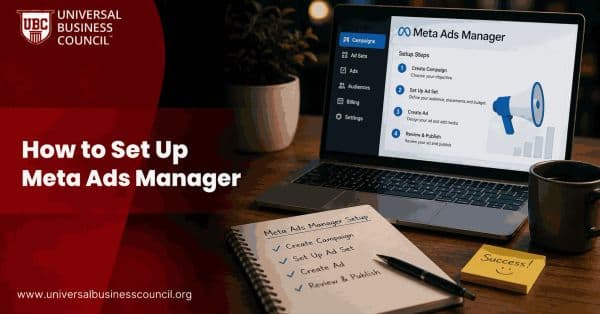
Meta Ads Manager is the primary platform for creating, managing, and optimizing advertising campaigns across Facebook, Instagram, Messenger, and the Meta Audience Network. This guide explains how to set up Ads Manager and prepare your account for effective campaign management.
Trending Articles
The Role of Blockchain in Ethical AI Development
How blockchain technology is being used to promote transparency and accountability in artificial intelligence systems.
AWS Career Roadmap
A step-by-step guide to building a successful career in Amazon Web Services cloud computing.
Top 5 DeFi Platforms
Explore the leading decentralized finance platforms and what makes each one unique in the evolving DeFi landscape.