

Meta Ads CBO vs ABO: When to Use Each Budget Strategy
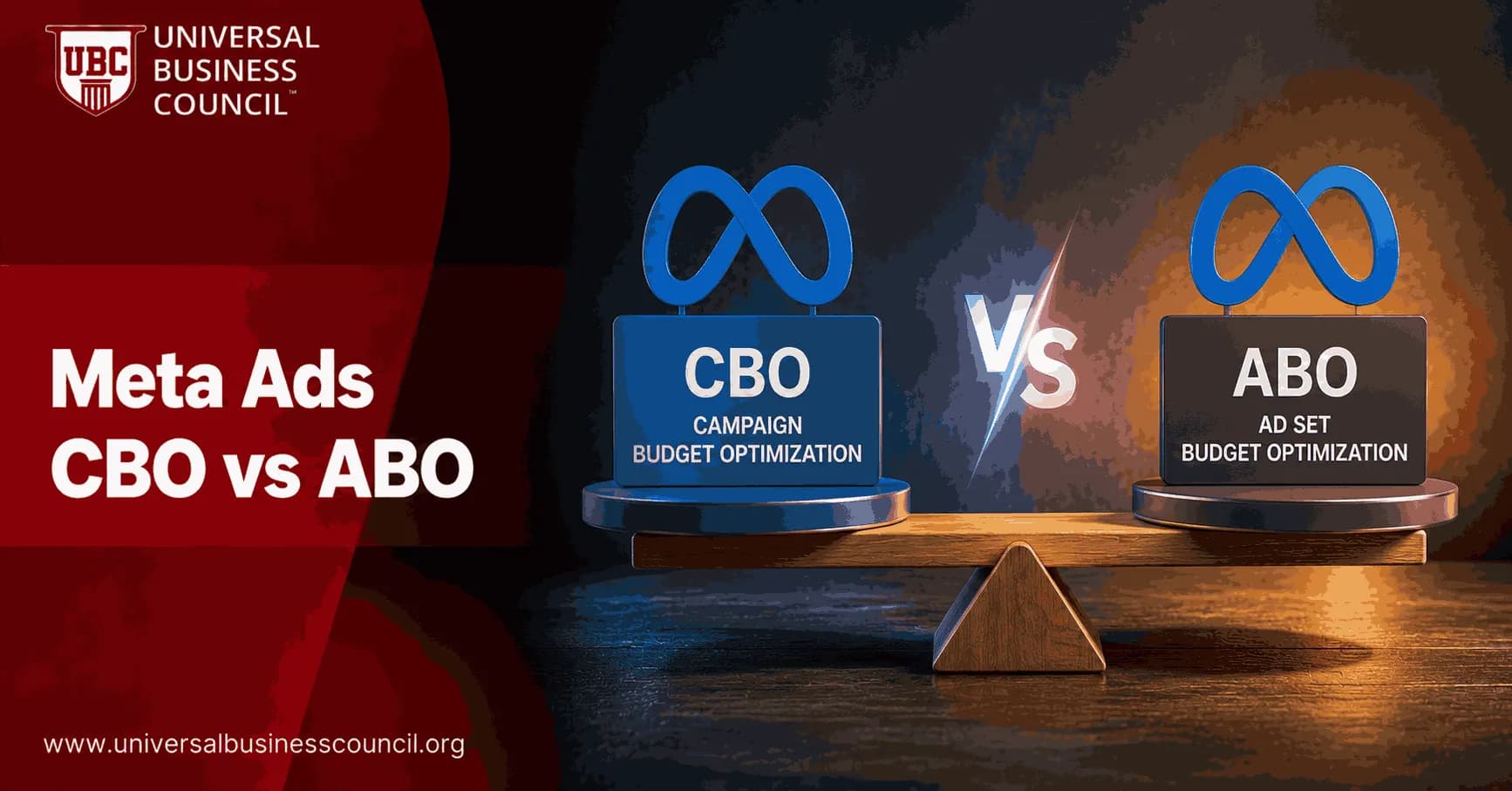
Meta Ads budget structure affects how quickly you learn, how efficiently you scale, and how much control you keep. The short answer: use ABO when you need clean tests, use CBO when you have proven assets and want Meta to push spend toward likely winners. Simple. Not always easy.
Meta now refers to CBO as Advantage campaign budget, although many media buyers still say CBO. ABO is still the practical term for ad set level budgeting. Both are valid. The mistake is treating either one as a magic fix for weak creative, poor tracking, or a bad offer.

As Meta's advertising platform continues to evolve, understanding campaign budgeting is only one part of successful performance marketing. A Certified Meta Ads Expert credential helps professionals develop practical expertise in campaign optimization, audience targeting, conversion tracking, and budget management, enabling them to make more informed decisions when scaling advertising campaigns.
What CBO Means in Meta Ads
CBO, or Campaign Budget Optimization, sets one budget at the campaign level. Meta then distributes spend across the ad sets in that campaign based on predicted performance. If one ad set looks likely to produce cheaper purchases, leads, or conversion value, the system may send most of the budget there.
In real accounts, that can feel aggressive. It is not unusual to see 70 to 90 percent of daily spend go to one ad set when Meta believes it has the strongest probability of hitting the objective. That is helpful when the signal is right. It is frustrating when you are trying to test three audiences fairly.
Where CBO works best
Scaling winning creative angles and audiences
Campaigns with enough conversion history
Retargeting campaigns with smaller, warmer audience pools
Accounts spending enough for Meta to gather daily signal
Always-on campaigns where efficiency matters more than equal spend
Agency and practitioner data often shows CBO performing better in mature accounts, where there is enough conversion depth for the system to make confident calls. That does not mean CBO wins every test. It means CBO tends to benefit from data depth. When an account is thin on conversion events, that advantage largely disappears.
What ABO Means in Meta Ads
ABO, or Ad Set Budget Optimization, sets a separate budget for each ad set. You decide the split. For example, one audience gets 300 per day, another gets 500, and a third gets 200. Meta can optimize inside each ad set, but it does not freely move most of your money across ad sets.
This is why experienced buyers still use ABO. It forces budget parity. If you are testing a broad audience against a lookalike audience and an interest stack, you do not want Meta to starve two of them after six hours because one picked up an early add-to-cart.
Where ABO works best
Creative testing where every concept needs spend
Audience testing across different segments
Small accounts that need predictable spend control
Geographic, language, or product-line budget protection
Experiments where learning quality matters more than short-term CPA
A practical detail: many bad Meta Ads tests fail because the buyer calls a winner too early. I have seen teams crown a creative after 1 purchase and 37 link clicks, then wonder why it collapses at 5x spend. ABO does not solve impatience, but it gives you cleaner data before you make the call.
Budget optimization is most effective when it is supported by a broader understanding of customer journeys, conversion funnels, attribution, analytics, and multichannel campaign strategy. A Certified Digital Marketing Expert credential helps marketers strengthen these core skills, making it easier to evaluate Meta Ads performance within an overall digital marketing strategy rather than as an isolated channel.
CBO vs ABO: Side-by-Side Comparison
Factor | CBO | ABO |
|---|---|---|
Budget control | Campaign level budget, automatically distributed | Ad set level budget, manually controlled |
Best use | Scaling proven winners | Testing audiences and creative concepts |
Data quality | Can bias toward early winners | Cleaner comparisons across ad sets |
Management effort | Lower daily manual work | More hands-on monitoring |
Main risk | Meta may overfund the wrong early signal | You may keep funding weak ad sets too long |
The table looks tidy. The account will not be. Your conversion window, attribution setup, creative fatigue, offer strength, product price, and audience size all affect results. A 50 currency CPA target on a high-volume ecommerce product behaves very differently from a B2B lead campaign with a 30-day sales cycle.
When to Use ABO for Testing
Use ABO when your main question is: Which idea deserves more budget? That may be an audience, a hook, a landing page, a format, or an offer.
ABO is especially useful when you are comparing distinct variables. For example:
Broad targeting vs interest targeting
Video testimonial vs static product benefit ad
New customer offer vs bundle offer
English-language ad set vs Spanish-language ad set
Prospecting audience vs warm engagement audience
If your test budget allows, give each ad set enough spend to produce a useful read. Some ecommerce teams use 200 to 500 per ad set as a practical testing range, although the right number depends on CPA. If your target CPA is 100, a 50 test budget will not tell you much.
Watch the right metrics. CTR can be useful for diagnosing creative pull, but it is not the final answer. Meta may favor ads with cheap engagement that do not produce high-quality purchases. For ecommerce, look at CPA, ROAS, conversion rate, average order value, and contribution margin if you have it. For lead generation, track cost per qualified lead, not just cost per form fill.
When to Use CBO for Scaling
Use CBO when your main question is: How do we spend more without breaking efficiency?
Once you know which creatives and audiences have a real chance, CBO lets Meta allocate budget faster than most humans can. This is particularly useful when a campaign has five or more ad sets. With only two ad sets, there is not much room for the system to reallocate. With five, six, or ten ad sets, CBO has more options and can back stronger pockets of demand.
Meta learning phase guidance has long referenced roughly 50 optimization events within about 7 days as a useful benchmark. Treat that as a planning clue, not a law. If your campaign cannot generate enough purchases, leads, or value events, CBO may still struggle to make confident decisions.
Good CBO candidates
Winning ABO test results moved into a scale campaign
Stable prospecting campaigns with consistent conversion volume
Retargeting campaigns where audiences overlap
Campaigns using purchase or value optimization
Accounts with enough historical conversion data
Avoid the common scaling mistake: doubling budgets every morning because yesterday looked good. Large budget jumps can reset behavior and create volatility. Many buyers prefer smaller increases, often around 20 to 30 percent at a time, while watching three-day and seven-day performance trends.
What the Benchmarks Really Say
The data is mixed, which is exactly what you should expect from Meta Ads. In practice, plenty of head-to-head tests land within a few percentage points of each other on cost per purchase. That gap is a rounding error for many businesses, and it tells you the structure was not the deciding factor.
The broad pattern most buyers report: ABO tends to give cleaner reads in prospecting, while CBO often looks more consistent in retargeting. That makes sense. Prospecting tests need fairness. Retargeting often benefits from algorithmic concentration because the audience pool is smaller and intent signals are stronger.
To be blunt, many CBO vs ABO debates are really creative problems in disguise. If the offer is weak, both structures lose. If tracking is broken in Google Analytics 4, Meta Events Manager, or your CRM, both structures mislead you. If the creative has already fatigued, budget strategy only changes the speed of the decline.
A Practical Meta Ads Budget Framework
Use this simple operating model:
Start with a clear hypothesis. Do not test random variations. Define the audience, creative angle, and success metric before launch.
Run ABO for controlled learning. Give each ad set enough budget to reach a meaningful signal.
Cut based on business metrics. CPA, ROAS, LTV, CAC, qualified lead rate, and margin matter more than likes.
Move winners into CBO. Keep the campaign focused. Do not dump every old ad set into the scale campaign.
Monitor budget concentration. If CBO sends nearly all spend to one ad set, check whether performance justifies it.
Keep testing in parallel. CBO needs fresh winners. ABO can act as your lab while CBO acts as your scale engine.
Effective campaign optimization also depends on the underlying technology stack, including analytics platforms, APIs, conversion tracking, cloud-based marketing tools, automation, and data integration. A Tech Certification helps professionals build these complementary technical skills, supporting more reliable measurement, smoother platform integrations, and data-driven decision-making for advertising campaigns.
How Account Maturity Changes the Decision
For younger accounts, ABO often gives you better control. You may not have enough purchase or lead data for Meta to predict outcomes well. In that stage, strict ad set budgets help you learn what is happening.
For mature accounts, CBO usually deserves more trust. If your pixel, Conversions API, product catalog, and event priorities are clean, Meta has more signal to work with. That is when campaign-level optimization can reduce wasted manual work.
There is also a middle ground. Meta's ad set budget sharing can allow limited movement between ad sets while preserving some budget guardrails. For enterprise teams that must protect regional or product-line allocations, this type of hybrid control can be useful.
Common Mistakes to Avoid
Testing too many variables at once. If audience, creative, offer, and landing page all change, you will not know what worked.
Judging CBO after one day. Short windows punish campaigns that need time to stabilize.
Using ABO forever. Manual control feels safe, but it can cap growth once winners are clear.
Trusting ROAS without margin. A high ROAS low-margin product can still lose money.
Ignoring overlap. Similar ad sets can bid against each other, especially in narrow retargeting pools.
What Professionals Should Learn Next
If you manage ads for a brand, agency, or enterprise, CBO vs ABO should sit inside a wider performance system: measurement, creative strategy, funnel design, and management reporting. Pair this knowledge with Universal Business Council certification pathways in digital marketing strategy, marketing analytics, campaign management, and business management.
For certification preparation, expect budget allocation questions to test judgment rather than memorization. The trap answer is usually absolute: CBO is always better, or ABO is always better. The correct professional answer depends on objective, budget, data volume, and test design.
Final Recommendation
Use ABO when you need controlled testing and fair budget distribution. Use CBO when you have proven winners and enough signal to scale. Run both if your budget allows: ABO as the testing lab, CBO as the growth campaign.
Your next step: audit one active Meta Ads account and label every campaign as testing, scaling, retargeting, or budget-protection. If the budget structure does not match the job, fix that before changing bids or launching five more ads.
As AI, automation, predictive analytics, and advanced marketing technologies become increasingly important in advertising, professionals benefit from developing a stronger technical foundation alongside marketing expertise. A Deep Tech Certification helps build knowledge of emerging technologies that support modern marketing operations, enabling teams to adapt more effectively as digital advertising platforms continue to evolve.
FAQs
1. What is CBO in Meta Ads?
Campaign Budget Optimization (CBO) is a Meta Ads feature that allocates a single campaign-level budget across multiple ad sets. Meta's machine learning automatically distributes more budget to ad sets that are more likely to achieve the campaign objective, such as conversions, leads, or purchases.
2. What is ABO in Meta Ads?
Ad Set Budget Optimization (ABO) allows advertisers to assign individual budgets to each ad set within a campaign. This provides greater control over spending and ensures that each audience or targeting strategy receives a predetermined portion of the advertising budget.
3. What is the main difference between CBO and ABO?
The primary difference is where the budget is controlled. CBO manages budget allocation automatically at the campaign level, while ABO requires advertisers to manually set and manage budgets for each ad set. The choice depends on campaign goals, testing needs, and desired level of control.
4. How does Campaign Budget Optimization (CBO) work?
With CBO, advertisers define one campaign budget, and Meta's delivery system continuously evaluates performance signals such as audience behavior, bidding opportunities, and conversion likelihood. The platform dynamically shifts spending toward ad sets expected to generate better results based on the campaign objective.
5. How does Ad Set Budget Optimization (ABO) work?
ABO allows advertisers to specify individual daily or lifetime budgets for every ad set. Each ad set spends only its assigned budget, making it easier to compare audiences, placements, creatives, or bidding strategies under controlled spending conditions.
6. What are the advantages of CBO?
CBO can simplify budget management, reduce manual optimization, improve budget efficiency, and allow Meta's machine learning to allocate spending where it predicts the highest performance. It is often used for campaigns with sufficient conversion data and multiple well-performing audiences.
7. What are the advantages of ABO?
ABO offers greater control over budget allocation, making it useful for testing new audiences, creatives, placements, and bidding strategies. Advertisers can ensure every ad set receives adequate budget without Meta reallocating funds based on early performance signals.
8. When should you use CBO?
CBO is commonly used for mature campaigns with multiple proven ad sets, larger advertising budgets, ongoing optimization, scaling efforts, and conversion-focused objectives where Meta's automation has sufficient data to optimize delivery effectively.
9. When should you use ABO?
ABO is generally preferred during campaign testing, audience research, creative experiments, localized campaigns, or situations where advertisers want equal budget distribution across ad sets before determining which performs best.
10. Which strategy is better for beginners?
Many beginners start with ABO because it provides clearer visibility into how each audience or creative performs without automatic budget shifts. As advertisers collect more conversion data and identify winning ad sets, they may transition to CBO for campaign scaling and automated optimization.
11. Does CBO always outperform ABO?
No. Performance depends on campaign objectives, available conversion data, audience size, creative quality, budget, and account history. Some campaigns benefit from Meta's automated optimization, while others perform better when advertisers maintain manual budget control through ABO.
12. How does AI influence CBO optimization?
Meta's advertising platform uses machine learning to analyze signals such as user behavior, auction dynamics, predicted conversion rates, and historical campaign performance. These AI-driven systems help determine how campaign budgets are allocated under CBO, although results can vary depending on available data and market conditions.
13. How do CBO and ABO affect audience testing?
ABO provides more consistent testing because each audience receives a fixed budget regardless of early results. CBO may reduce spending on lower-performing ad sets before sufficient data is collected, which can make controlled experiments more challenging if budgets are limited.
14. How do bidding strategies interact with CBO and ABO?
Both CBO and ABO support Meta's available bidding strategies, including options focused on maximizing performance or controlling costs where available. Budget optimization and bidding strategy work together, but advertisers should evaluate overall campaign performance rather than relying on a single setting.
15. What metrics should advertisers monitor?
Key performance indicators include impressions, reach, click-through rate (CTR), cost per click (CPC), cost per acquisition (CPA), return on ad spend (ROAS), conversion rate, frequency, cost per thousand impressions (CPM), and overall campaign profitability relative to business objectives.
16. What are common mistakes when using CBO or ABO?
Common mistakes include using budgets that are too small for meaningful optimization, ending campaigns too quickly, testing too many variables simultaneously, overlapping audiences, ignoring conversion tracking, making frequent edits during the learning phase, and evaluating performance before enough data has accumulated.
17. What trends are shaping Meta Ads optimization in 2025-2026?
Key trends include AI-driven campaign automation, Advantage+ campaign enhancements, predictive audience modeling, improved creative optimization, privacy-focused measurement, first-party data strategies, conversion API (CAPI) adoption, and greater reliance on machine learning for budget allocation and bidding.
18. What are best practices for choosing between CBO and ABO?
Begin with ABO when testing audiences or creative variations, then consider moving successful ad sets into a CBO campaign for scaling. Maintain accurate conversion tracking, allow sufficient learning time, minimize unnecessary edits, monitor performance regularly, and base decisions on statistically meaningful data rather than short-term fluctuations.
19. What should businesses evaluate before selecting CBO or ABO?
Businesses should consider campaign objectives, advertising budget, account maturity, historical conversion volume, testing requirements, audience structure, creative diversity, reporting needs, and available optimization data. There is no universally superior approach, and the most suitable option depends on the campaign's specific goals and operational requirements.
20. What is the future of CBO and ABO in Meta Ads?
Meta Ads is expected to continue expanding AI-driven automation while giving advertisers tools to balance machine learning with strategic oversight. Campaign Budget Optimization will likely play an increasingly important role in scalable advertising, while Ad Set Budget Optimization will remain valuable for structured testing and controlled experimentation. The algorithms may decide where the budget goes, but they still cannot explain why the one ad everyone loved internally ends up being the weakest performer.
Related Articles
View AllMeta Ads
Meta Ads vs Google Ads: Key Differences, Use Cases, and ROI Comparison
Compare Meta Ads vs Google Ads by intent, targeting, cost, ROI, use cases, and budget strategy for better paid media decisions.

Meta Ads
Meta Ads Major Updates: What Brand Owners Must Know
Meta has launched Ads Super Burst, started testing First Impression Ads, and expanded Reels Trending Ads. Learn what each update does, what is still a test, and how brand owners can plan smarter campaigns.
Meta Ads
How to Set Up Meta Ads Manager
Meta Ads Manager is the primary platform for creating, managing, and optimizing advertising campaigns across Facebook, Instagram, Messenger, and the Meta Audience Network. This guide explains how to set up Ads Manager and prepare your account for effective campaign management.
Trending Articles
The Role of Blockchain in Ethical AI Development
How blockchain technology is being used to promote transparency and accountability in artificial intelligence systems.
AWS Career Roadmap
A step-by-step guide to building a successful career in Amazon Web Services cloud computing.
Top 5 DeFi Platforms
Explore the leading decentralized finance platforms and what makes each one unique in the evolving DeFi landscape.