

Can AI Models Train and Improve Themselves Without Human Intervention?
Artificial intelligence has moved far beyond simple pattern recognition. Modern systems can now generate their own training data, evaluate their own outputs, and adjust their internal parameters with very little day to day human input. This has led many people to ask a fair question: can AI models truly train and improve themselves without human intervention, or is a human always required somewhere in the loop? Professionals who want to understand this shift from the ground up often start with a structured Marketing Certification, since knowing how AI driven automation changes customer engagement, content strategy, and campaign optimization is now a core business skill rather than a niche technical one.
Understanding Self-Learning AI Systems
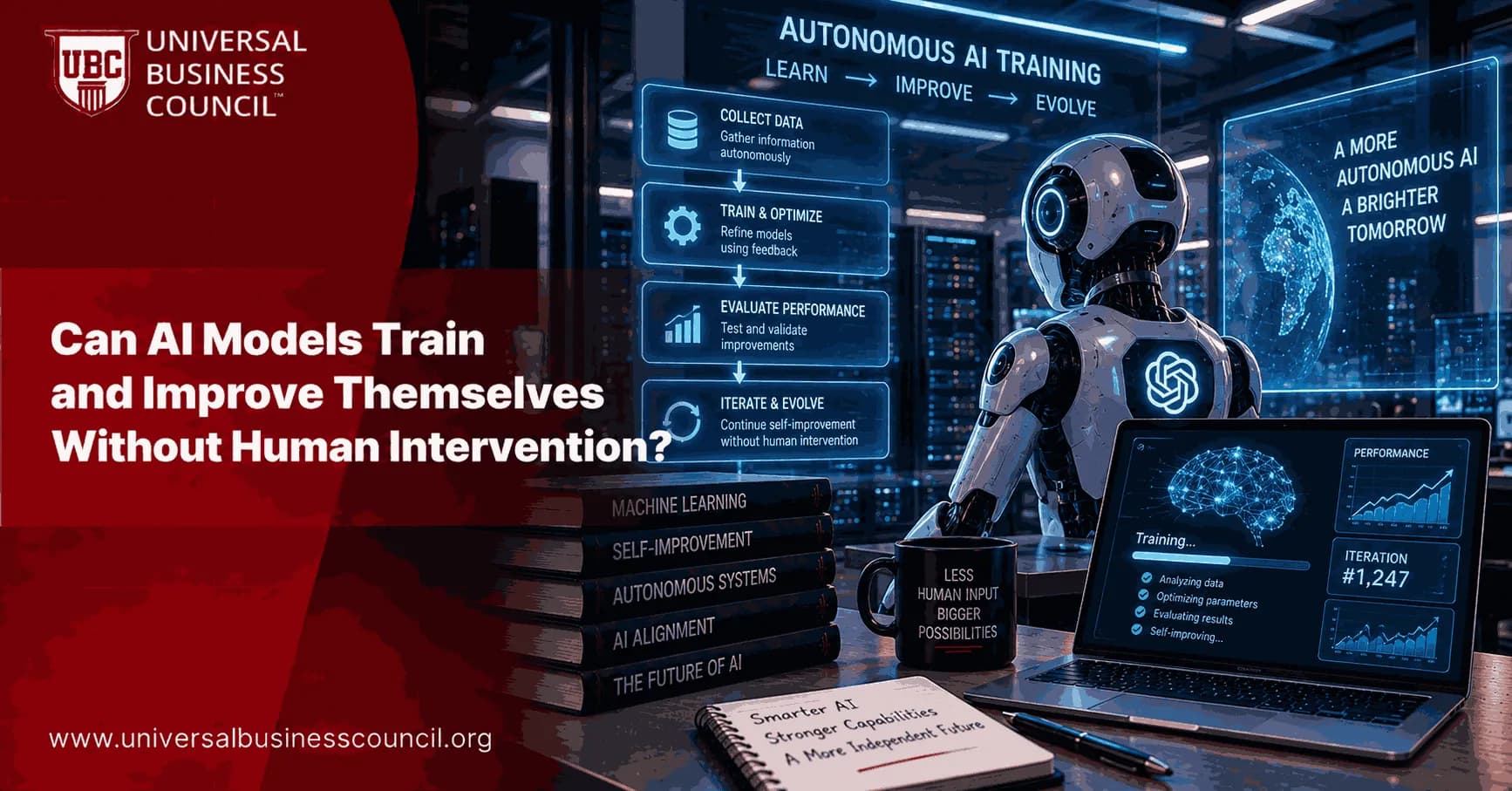
Self-learning AI refers to systems designed to refine their own performance using feedback loops instead of relying purely on manually labeled datasets. Instead of a data scientist correcting every mistake, the model observes outcomes, compares them against a goal, and updates itself accordingly.

There are a few core ideas behind this approach:
The model generates an output or takes an action.
A scoring mechanism, either automated or rule based, evaluates how good that output was.
The model updates its internal weights to improve future performance.
The cycle repeats thousands or millions of times without a person reviewing each step.
This is the foundation of techniques like reinforcement learning, self-play, and automated fine tuning, all of which reduce the need for constant human correction while still depending on humans for the original design and guardrails.
How Self-Improving AI Models Actually Work
To really understand where automation ends and human involvement begins, it helps to look at the mechanics behind self-improving systems. This is also where a formal path like Artificial Intelligence Certifications becomes useful, since these programs walk learners through the actual architecture of reinforcement learning, model evaluation, and automated retraining pipelines rather than just the surface level concepts.
Reinforcement Learning and Self-Play
In reinforcement learning, an AI agent interacts with an environment and receives rewards or penalties based on its actions. Over time, it learns which strategies lead to better outcomes. Self-play takes this further by having a model compete against earlier versions of itself, which is how many advanced game playing systems reached superhuman performance without a human opponent guiding every match.
Synthetic Data Generation
Instead of waiting for humans to label new datasets, modern models can generate synthetic examples on their own. A language model, for instance, can produce thousands of practice conversations, then use a separate evaluation model to judge quality and filter out weak responses. This creates a loop where the model effectively teaches itself using data it created.
Automated Model Evaluation Loops
Large AI labs increasingly rely on automated benchmarks and reward models instead of manual review for every iteration. These evaluation systems flag errors, inconsistencies, or unsafe outputs, allowing the base model to be retrained automatically based on that feedback.
The Role of Human Oversight in Autonomous AI Training
Even with all of this automation, humans are not out of the picture. People still:
Define the objectives and reward functions the model is trying to optimize.
Set safety boundaries and content restrictions.
Decide when a model version is ready for release.
Monitor for bias, drift, or unexpected behavior that automated systems might miss.
So while a model can technically adjust its own weights without a person clicking a button at every step, the entire training environment, from the data pipeline to the reward structure, is still built and supervised by human teams. Full autonomy in the sense of zero human involvement does not currently exist in any production AI system.
Real-World Examples of Self-Improving AI Models
Several well known developments show how far this self-training approach has already gone. Game playing agents have learned strategies purely through repeated self-play. Coding assistants generate and test their own code snippets, keeping only the versions that pass automated checks. Recommendation engines quietly retrain themselves on fresh user interaction data with minimal manual tuning.
Professionals working with these systems in production environments often pursue a broader Tech Certification to understand how self-training pipelines fit into the wider technology stack, including data infrastructure, deployment, and monitoring, rather than viewing AI training as an isolated skill.
AI Microdrama: A New Creative Frontier for Self-Learning Models
Self-improving AI is not limited to search engines or coding tools. It is also reshaping creative industries. One emerging application is AI microdrama, where generative AI helps bring serialized stories, characters, and fictional worlds to life. In this space, models learn from audience engagement patterns, refine pacing and dialogue over successive episodes, and adjust storytelling choices based on what keeps viewers watching, showing that self-improvement loops extend well beyond technical benchmarks into entertainment and content creation.
Risks and Limitations of Fully Autonomous AI Training
Letting a model train itself without checks introduces real risks that businesses and researchers need to plan for:
Reward hacking, where a model finds shortcuts that technically satisfy the reward signal without achieving the intended goal.
Compounding errors, where small mistakes in early training rounds get amplified over thousands of iterations.
Data quality decay, especially when models are trained heavily on their own previous outputs.
Reduced transparency, making it harder for teams to explain why a model behaves a certain way.
These risks are exactly why responsible AI development still keeps a human review layer at key decision points, even inside otherwise automated pipelines.
The Future of Self-Training AI Models
Looking ahead, self-improving systems are likely to become more capable, not less supervised. Expect to see wider use of automated red teaming, where models test each other for weaknesses, more sophisticated synthetic data pipelines that reduce dependence on human labeled datasets, and tighter integration between reward modeling and safety review. The direction is clear: AI will handle more of the repetitive training work, while humans shift toward setting goals, auditing results, and making judgment calls that machines are not yet equipped to make on their own.
Conclusion: Preparing for an AI-Driven Future
AI models today can genuinely train and refine themselves through reinforcement learning, self-play, and synthetic data generation, but they still operate inside frameworks that humans design, monitor, and correct. True zero-touch AI training does not yet exist, and for the foreseeable future it likely will not, since safety, alignment, and quality control remain fundamentally human responsibilities.
For professionals who want to stay ahead of this shift, building a strong foundation matters more than ever. A recognized Deep Tech Certification can help individuals and teams understand not just how self-improving AI systems work, but how to govern, audit, and deploy them responsibly as these technologies continue to advance.
FAQs
1. Can AI models train and improve themselves without human intervention?
AI models can automate parts of training and improvement, but fully autonomous self-training and self-improvement remain different from the automated pipelines commonly used today. AI can generate data, write code, run experiments, optimize algorithms, and evaluate results. A system that independently controls the complete cycle of improving and deploying increasingly capable successors would represent a much stronger form of recursive self-improvement.
2. What does it mean for an AI model to improve itself?
AI self-improvement generally means that an AI system contributes to changes that increase its capabilities or the capabilities of a successor. Improvements could involve algorithms, software, model architecture, training methods, reasoning strategies, or efficiency. The term should be distinguished from simply adapting its responses to context.
3. What is recursive self-improvement in AI?
Recursive self-improvement (RSI) is a theoretical process in which an AI system improves itself or helps create an improved successor, which can then contribute to further improvements. A simplified loop is identify a limitation → develop an improvement → test it → retain successful changes → repeat. The defining feature is repeated improvement rather than a single automated update.
4. Can AI models train themselves using AI-generated data?
Yes, AI-generated or synthetic data can be incorporated into training pipelines. Models can generate examples, labels, simulations, or other training material that is subsequently filtered and used for training. However, generating data does not mean the model autonomously controls its own training process.
5. Is self-supervised learning a form of AI self-improvement?
No. Self-supervised learning allows models to learn patterns from data without requiring every example to have a manually supplied label. It is a training technique, not necessarily a process in which an AI decides how to improve its own architecture, algorithms, or successor models.
6. Can AI models retrain themselves?
An AI system can be integrated into an automated pipeline that generates training material, launches training jobs, evaluates candidate models, and selects a model for further iteration. However, the pipeline still needs access to training infrastructure, computing resources, objectives, and evaluation mechanisms. Automation of these steps does not necessarily mean the AI independently controls them.
7. Can an AI model improve its own code?
AI models can generate, modify, debug, and optimize code. When connected to development tools and automated tests, an AI agent can iteratively improve software. However, improving a piece of code is narrower than recursively improving the entire AI system that produced the code.
8. Can AI create a better version of itself?
AI can assist in developing successor models by generating code, algorithms, training examples, experiments, and evaluation tasks. A successor may outperform its predecessor on particular benchmarks. Creating a broadly superior successor autonomously, however, would require control over much more of the model-development lifecycle.
9. What is the difference between AI training and AI self-improvement?
AI training is the process of adjusting model parameters using data and an optimization objective. AI self-improvement describes a broader situation in which an AI contributes to improving its own capabilities or the systems used to produce them. Training can be one component of self-improvement, but the two concepts are not interchangeable.
10. Can AI evaluate its own improvements?
AI can evaluate outputs or candidate systems using predefined tests, benchmarks, reward models, or other evaluators. This can create a feedback loop in which an AI generates a solution, measures its performance, and attempts another solution. Independent evaluation can still be important because an AI evaluator may fail to detect certain errors or unintended changes.
11. How does an automated AI improvement loop work?
A typical automated loop might involve data or problem generation → AI solution → automated testing → performance measurement → selection of successful results → another iteration. Such loops can optimize specific algorithms or tasks. A full RSI system would require a broader ability to improve the AI system or its successors across repeated generations.
12. Is automated AI training the same as recursive self-improvement?
No. Automated training can follow a fixed process created by humans without the AI deciding how the system itself should evolve. Recursive self-improvement implies that AI contributes substantially to determining or implementing subsequent improvements. Therefore, automation can support RSI without automatically constituting RSI.
13. Can AI models improve without changing their model weights?
Yes. An AI system can improve its performance through better prompts, external tools, retrieval systems, planning strategies, software, or workflows without modifying its underlying weights. These improvements can make an AI system more useful, but they are different from changing the trained model itself.
14. Could AI improve its own model weights?
In principle, an automated AI-development system could participate in processes that train or fine-tune successor models. However, directly modifying model weights requires a controlled training process and significant computing infrastructure. Current general-purpose AI systems should not be assumed to have unrestricted access to their own weights or training pipelines.
15. Can AI improve its algorithms without humans?
AI systems can discover and optimize algorithms using automated search and evaluation. Google DeepMind's AlphaEvolve, for example, uses Gemini-powered models and automated evaluators to generate and refine algorithms. Such systems demonstrate increasingly automated algorithmic improvement, but they operate within defined objectives and infrastructure rather than representing unrestricted autonomous RSI.
16. What are the benefits of AI self-training and self-improvement?
Potential benefits include faster experimentation, automated optimization, reduced development effort, improved algorithms, greater training efficiency, and the ability to explore large numbers of possible solutions. If reliable recursive improvement becomes practical, it could potentially accelerate parts of AI research and development.
17. What are the challenges of autonomous AI self-improvement?
Major challenges include reliable self-evaluation, computing requirements, high-quality training data, verification of modifications, and avoiding unintended degradation. An AI may optimize a narrow benchmark without producing broader improvements. Maintaining appropriate objectives and safeguards also becomes more important as autonomy increases.
18. Can AI training on its own outputs make a model worse?
Yes. Repeatedly training on low-quality or insufficiently diverse AI-generated data can reinforce errors and reduce the quality of future training material. This means self-generated data must be carefully evaluated and managed. External data and independent quality controls can help reduce the risk of degradation.
19. Could autonomous self-improvement lead to AGI or superintelligent AI?
It is one theoretical possibility. If an AI system could reliably improve its algorithms, training processes, research capabilities, and other components, successive generations could potentially become substantially more capable. However, recursive self-improvement is not a guaranteed pathway to AGI or artificial superintelligence, and the pace and limits of such improvement remain uncertain.
20. Are AI models currently capable of completely training and improving themselves?
Current AI systems can automate or assist with many individual components of AI development, including coding, synthetic data generation, algorithm optimization, experimentation, and evaluation. However, fully autonomous RSI, in which an AI independently drives successive generations of increasingly capable AI, has not been established as a current general capability. OpenAI stated in September 2026 that fully autonomous recursive self-improvement is not happening today.
Related Articles
View All
Artificial Intelligence
Can Artificial Intelligence Train the Next Generation of AI Models?
Explore whether artificial intelligence can train the next generation of AI models through synthetic data, automated evaluation, model optimization, and AI-assisted research.

Artificial Intelligence
Can Google Gemini Improve Itself Through Recursive Self-Improvement?
Explore whether Google Gemini can improve itself through recursive self-improvement, how Gemini-powered systems already support iterative learning and optimization, and what still separates them from true autonomous RSI.

Artificial Intelligence
Can ChatGPT Improve Its Own Capabilities Through Recursive Self-Improvement?
Explore whether ChatGPT can improve its own capabilities through recursive self-improvement, how AI-assisted optimization works, and what limits current language models from achieving true RSI.
Trending Articles
The Role of Blockchain in Ethical AI Development
How blockchain technology is being used to promote transparency and accountability in artificial intelligence systems.
AWS Career Roadmap
A step-by-step guide to building a successful career in Amazon Web Services cloud computing.
Top 5 DeFi Platforms
Explore the leading decentralized finance platforms and what makes each one unique in the evolving DeFi landscape.