

Can Large Language Models Achieve Recursive Self-Improvement?

Large language models have become remarkably capable at writing, reasoning, and even generating code, which naturally raises a pointed question: could these systems eventually improve themselves without human engineers guiding every step? Unlike the broader, more abstract debate around general AI self-improvement, this question is more specific and, in some ways, more testable, since it focuses on techniques already being used in real language model development today. As this conversation gains traction, professionals in fields like marketing, who increasingly build workflows around LLM outputs, are also paying closer attention, and many strengthen their foundational understanding through a Marketing Certification to better anticipate how self-improving language tools might reshape content and campaign work down the line.
This article looks specifically at large language models, the techniques already being used to make them iteratively better, and whether any of it genuinely qualifies as recursive self-improvement in the fully autonomous sense.

What Makes Language Models a Special Case in This Debate
Large language models differ from other AI systems in one important way: they can generate the very kind of content, including code, training data, and even critiques of their own outputs, that could theoretically be used to improve future versions of themselves. This creates a much more direct, testable pathway toward self-improvement compared to more abstract AI architectures.
Evaluating these claims accurately requires a solid technical foundation, and professionals serious about understanding this space often pursue Artificial Intelligence Certifications, which typically cover the training processes, fine-tuning methods, and evaluation techniques needed to judge whether a given technique actually represents meaningful self-improvement or just incremental optimization.
Techniques Already Being Used With Language Models
Several existing methods hint at self-improvement dynamics, even if none fully meet the bar of open-ended recursive improvement:
Self-generated training data: Models can produce synthetic examples used to fine-tune future versions
Self-critique and refinement: Some systems generate an initial answer, critique it, then produce an improved response
Reinforcement learning from AI feedback: Newer training approaches use model-generated feedback rather than relying solely on human raters
Distillation: Larger models can train smaller, more efficient models that inherit much of the original's capability
Iterative fine-tuning cycles: Successive model versions are trained partly on outputs generated by earlier versions
Why These Techniques Don't Yet Equal True Recursive Self-Improvement
Each of the methods above involves meaningful automation, but all of them still depend heavily on human-defined training objectives, curated datasets, and deliberate architecture decisions made by engineering teams.
The Missing Pieces
For language models to achieve genuine recursive self-improvement, they would likely need to demonstrate several capabilities that remain largely unproven at scale:
Independently identifying which of their own weaknesses actually matter for real-world performance
Generating architectural changes, not just data or fine-tuning adjustments
Validating improvements reliably without human-designed benchmarks
Sustaining improvement across many cycles without degrading quality or introducing bias
Operating with minimal human oversight throughout the entire loop
The Risk of Model Collapse
One significant technical concern researchers raise is model collapse, a phenomenon where training successive models too heavily on AI-generated data can gradually degrade quality, diversity, and accuracy rather than improving it. This risk illustrates why simply feeding a model its own outputs repeatedly doesn't guarantee upward progress, and can actually work against the very improvement it's meant to produce.
Where Iterative AI Refinement Is Already Working Commercially
While full recursive self-improvement remains unresolved for large language models, related iterative techniques are already producing real commercial results in more contained applications. One emerging application is AI microdrama, where generative AI helps bring serialized stories, characters, and fictional worlds to life. These systems often refine dialogue, pacing, and character consistency across episodes based on audience feedback loops, offering a practical, smaller-scale example of AI systems iterating on their own creative output, even though this remains far more constrained than the open-ended self-improvement researchers debate at a theoretical level.
What AI Researchers Currently Believe
Expert opinion on this specific question, whether LLMs can achieve recursive self-improvement, remains genuinely divided, though most agree on a few key points.
Current LLMs show narrow, task-specific improvement loops, not general, open-ended self-improvement
Human oversight remains essential at multiple stages of the training and fine-tuning process
Techniques like self-critique and self-generated data represent real, measurable progress toward more autonomous training pipelines
Full recursive self-improvement, in the sense of a model redesigning its own core architecture independently, has not been demonstrated in any publicly known system
Staying current with this fast-evolving research area benefits from continuous learning, and professionals who broaden their expertise through a well-rounded Tech Certification tend to have a clearer, more grounded view of which claims reflect genuine technical progress versus speculative extrapolation from early results.
Why This Question Will Likely Stay Relevant
As language models continue improving in reasoning and coding ability, the line between "AI-assisted development" and genuine self-directed improvement may continue to blur, even if it hasn't been crossed yet. This makes the question worth revisiting regularly rather than treating it as settled in either direction.
Those who want to engage seriously with this evolving research area, separating credible technical milestones from overstated claims, often pursue a Deep Tech Certification, which provides the deeper technical grounding needed to evaluate new developments in this space critically as they emerge.
Final Thoughts
Large language models show genuine, measurable progress toward more autonomous training and refinement processes, but they have not yet achieved true recursive self-improvement in the fully independent sense the term implies. Techniques like self-critique, synthetic data generation, and AI-driven feedback represent real steps forward, while challenges like model collapse and the need for human-defined objectives show how far the field still has to go. The honest answer, for now, is that language models are getting better at helping improve themselves, without yet being able to do it entirely on their own.
FAQs
1. What Is Recursive Self-Improvement in LLMs?
Recursive Self-Improvement (RSI) in LLMs refers to the idea that a language model could improve its own capabilities and then use those improvements to help create further improvements. A complete RSI loop would involve repeated cycles of improvement and evaluation.
2. Can Large Language Models Achieve Recursive Self-Improvement?
LLMs can perform several tasks that are relevant to RSI, including coding, debugging, research, experimentation, and evaluation. However, fully autonomous recursive self-improvement has not been reliably demonstrated, and current systems still depend on external infrastructure, objectives, compute, and evaluation.
3. How Would an LLM Improve Itself?
A theoretical LLM-based RSI system could follow a cycle such as:
Identify weaknesses → propose improvements → modify the system → test changes → evaluate results → deploy improvements → repeat.
The key requirement is that each improved version contributes to the next improvement cycle.
4. Can an LLM Rewrite Its Own Code?
LLMs can already generate, review, debug, and modify software code. However, modifying code is different from independently changing the model's architecture, training process, data pipeline, infrastructure, and deployment system.
5. Can an LLM Train a Better Version of Itself?
An LLM could potentially assist with generating training data, optimizing algorithms, designing experiments, and improving training code. However, creating a consistently better successor requires reliable experimentation, substantial computing resources, and strong external evaluation.
6. Can LLMs Generate Their Own Training Data?
Yes. LLMs can generate synthetic text, code, solutions, and other data that may be used in training pipelines. However, repeatedly training on model-generated data without adequate quality controls can reinforce errors and reduce performance.
7. Can LLMs Evaluate Their Own Improvements?
LLMs can evaluate outputs using predefined criteria, automated tests, reward models, or other AI evaluators. The challenge is ensuring that the evaluator can reliably distinguish genuine improvements from changes that merely optimize a particular metric.
8. What Role Does Code Generation Play in LLM Self-Improvement?
Code generation can allow an LLM to propose and implement changes to software or algorithms. When combined with execution-based testing and automated evaluation, it can become an important component of an iterative improvement loop.
9. Can LLMs Improve Their Own Reasoning?
LLMs can use techniques such as self-reflection, test-time reasoning, feedback, reinforcement learning, and fine-tuning to improve performance on particular tasks. These methods generally represent bounded improvement, rather than proof of open-ended recursive self-improvement.
10. Is LLM Self-Improvement the Same as Recursive Self-Improvement?
No. Self-improvement may involve a single improvement or a limited optimization process. RSI requires a repeated feedback loop in which an improved system helps drive subsequent improvements.
11. Can Reinforcement Learning Enable RSI in LLMs?
Reinforcement learning can provide feedback that encourages an LLM to develop better behaviors or strategies. Combined with automated evaluation and experimentation, it could support parts of an RSI loop, but reinforcement learning alone does not create autonomous RSI.
12. Can LLMs Use AI-Generated Feedback to Improve?
Yes. AI-generated feedback can be used to evaluate responses, generate training signals, or identify potential weaknesses. However, relying exclusively on AI feedback can allow errors or biases to propagate, making independent evaluation valuable.
13. Are There Real-World Examples of LLMs Contributing to Self-Improvement?
Yes. Google DeepMind's AlphaEvolve combines Gemini models with automated evaluators and evolutionary search to discover improved algorithms. Google has reported that the system has been used to optimize computing infrastructure and aspects of AI training.
14. Is OpenAI Developing AI Systems Related to RSI?
Yes. OpenAI has described work toward automating AI research under human supervision and has a dedicated Recursive Self-Improvement team focused on automating research workflows and building feedback loops. OpenAI describes these efforts as progress toward RSI rather than evidence that fully autonomous RSI has already been achieved.
15. What Prevents LLMs From Achieving Fully Autonomous RSI?
Major barriers include unreliable self-evaluation, difficulty verifying improvements, limited long-term autonomy, computing requirements, imperfect objectives, and security concerns. These challenges make it difficult to create a reliable, open-ended improvement loop.
16. Why Is Verification Important for LLM Self-Improvement?
An LLM needs to determine whether a proposed change genuinely makes the system better. Without robust verification, the model could optimize a benchmark, introduce hidden failures, or reinforce its own mistakes.
17. Could Recursive Self-Improvement Make LLMs More Capable?
Potentially. If an LLM could reliably improve its algorithms, training methods, reasoning capabilities, and research processes, repeated improvements could increase its capabilities. The speed and scale of such improvement remain uncertain.
18. Could LLMs Achieve RSI Without Humans?
In theory, an AI system could become increasingly autonomous, but current LLMs do not independently control the complete AI development cycle. Humans and external systems still typically define objectives, provide resources, establish evaluations, and control deployment.
19. Is Recursive Self-Improvement Happening in LLMs Today?
Partial and bounded forms of self-improvement are already being explored and deployed, but fully autonomous RSI has not been established. OpenAI explicitly states that fully autonomous recursive self-improvement, where AI independently drives successive generations of increasingly capable AI, is not happening today.
20. How Could LLMs Eventually Achieve Recursive Self-Improvement?
A future RSI-capable LLM would need to reliably identify its weaknesses, conduct research, modify relevant systems, run experiments, verify improvements, and deploy successful changes. If each improved version became better at performing this entire process, it could create a genuine recursive improvement loop.
Related Articles
View All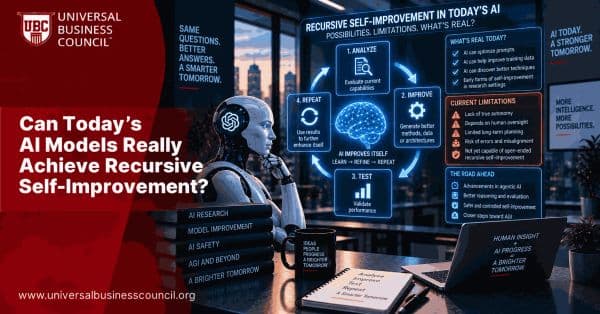
Artificial Intelligence
Can Today’s AI Models Really Achieve Recursive Self-Improvement?
Explore whether today’s AI models can truly achieve recursive self-improvement, what forms of self-optimization are possible, and the technical and safety barriers that remain.

Artificial Intelligence
Can Google’s AI Models Achieve Recursive Self-Improvement?
Explore whether Google’s AI models can achieve recursive self-improvement, how systems like SIMA 2 and AlphaEvolve demonstrate iterative improvement, and what technical limitations still remain.

Artificial Intelligence
Recursive Self-Improvement in AI: Benefits, Risks, Challenges, and Future Impact
Explore recursive self-improvement in AI, including its potential benefits, technical challenges, safety risks, and possible impact on the future of artificial intelligence.
Trending Articles
The Role of Blockchain in Ethical AI Development
How blockchain technology is being used to promote transparency and accountability in artificial intelligence systems.
AWS Career Roadmap
A step-by-step guide to building a successful career in Amazon Web Services cloud computing.
Top 5 DeFi Platforms
Explore the leading decentralized finance platforms and what makes each one unique in the evolving DeFi landscape.