

Can Today’s AI Models Really Achieve Recursive Self-Improvement?
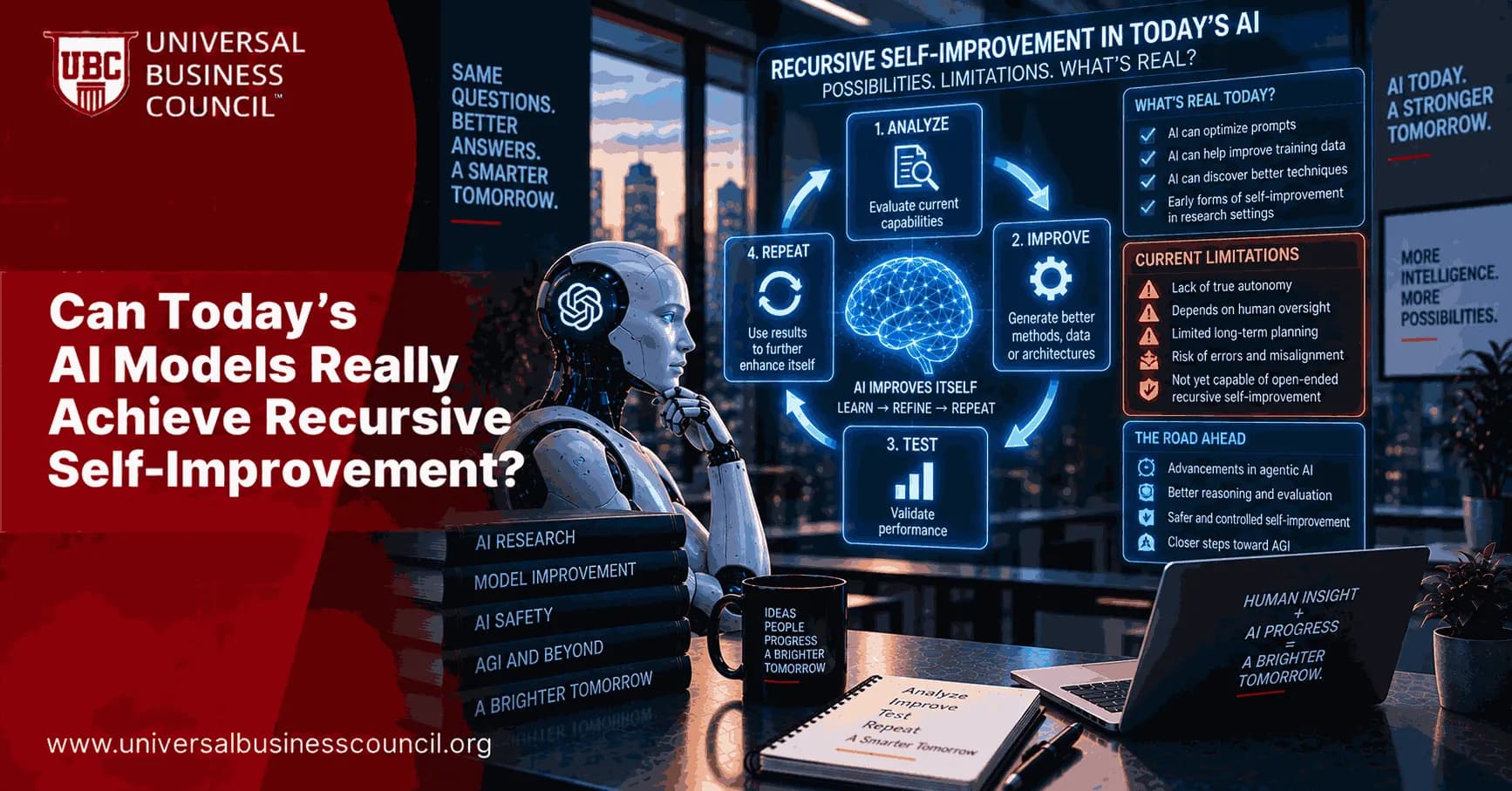
Headlines about self-improving AI have become common enough that it's worth stepping back and asking a more grounded question: measured against a clear, specific standard, do today's models actually achieve recursive self-improvement, or are we looking at something narrower dressed up in bigger language? The most useful way to answer this isn't to argue in the abstract, but to define exactly what "achieving" recursive self-improvement would require, then test current systems against that checklist one item at a time. As this conversation spreads well beyond research labs, professionals in fields like marketing are also trying to separate genuine capability from hype, and many strengthen that judgment through a Marketing Certification to better evaluate which AI claims are worth building strategy around.
This article sets out a clear checklist for what true recursive self-improvement would look like, then walks through how today's most advanced systems actually measure up against each requirement.

Setting the Bar: What Would "Achieving" It Actually Require
Before testing any system against a standard, the standard itself needs to be specific rather than vague. Based on how AI researchers generally define the concept, a system would need to satisfy several conditions to genuinely qualify.
Evaluating systems against a standard like this requires real technical fluency rather than surface familiarity with headlines, and professionals who want that depth often pursue Artificial Intelligence Certifications, which typically cover the training architectures and evaluation frameworks needed to assess these claims with genuine rigor.
The Five-Point Checklist
Self-directed goal setting: The system identifies what to improve without a human defining the target
Architectural modification: The system changes its own underlying structure, not just its outputs or fine-tuned weights
Independent validation: The system verifies whether a change actually helped, without relying on a human-designed benchmark it doesn't control
Sustained compounding: Each improvement cycle builds meaningfully on the last, rather than plateauing after a few rounds
Minimal human oversight: The loop runs with humans monitoring rather than actively directing each step
Testing Current Systems Against the Checklist
With the standard defined clearly, the next step is measuring real, documented systems against it rather than relying on marketing language.
The Darwin Gödel Machine
This system, built by Sakana AI, rewrites its own codebase and has measurably improved its performance on coding benchmarks, moving its SWE-bench score from twenty percent to fifty percent through repeated self-modification cycles.
Self-directed goal setting: Partial. The system decides how to modify its code, but the overall objective, performing well on a specific benchmark, is set by researchers
Architectural modification: Yes. It genuinely rewrites its own code and tooling
Independent validation: No. It relies on a fixed, externally defined benchmark it does not control
Sustained compounding: Partial. Gains have been substantial but measured within a bounded evaluation window, not proven indefinitely
Minimal human oversight: Partial. Researchers actively guide which benchmarks and safety constraints apply
AlphaEvolve
Google DeepMind's system generates and refines algorithms across domains like data center scheduling and has been used to help speed up training for the very Gemini models that power it.
Self-directed goal setting: No. A human-defined scoring function tells the system exactly what "better" means for each task
Architectural modification: No. It optimizes algorithms and code within a fixed system, not its own core architecture
Independent validation: No. Results are checked against predefined performance metrics
Sustained compounding: Yes, within scope. Improvements have compounded meaningfully across production deployments
Minimal human oversight: No. Humans direct where the system gets applied and validate outcomes
Large Language Model Self-Critique Techniques
Methods like self-refine and bootstrapped reasoning allow models to critique and improve their own outputs across sessions.
Self-directed goal setting: No. The task and success criteria are defined externally
Architectural modification: No. These techniques adjust outputs or fine-tune weights, not underlying architecture
Independent validation: Partial. Verification works well on checkable tasks like math and code, weaker elsewhere
Sustained compounding: No. Gains typically plateau after a small number of iterations
Minimal human oversight: Partial. Human-defined verification systems remain essential to prevent error reinforcement
What This Checklist Reveals
Running real systems against clear criteria produces a consistent pattern worth naming directly.
Every documented system satisfies some checklist items, usually architectural modification or partial compounding, but none satisfy all five
The most consistently missing elements are fully self-directed goal setting and independent validation without human-defined benchmarks
This suggests today's most advanced examples represent genuine, meaningful progress toward the concept, without having achieved the complete, open-ended version researchers originally described
Staying current with how these gaps evolve over time matters for anyone tracking this space seriously, and professionals who build a well-rounded Tech Certification tend to follow this kind of nuanced progress more accurately than those relying on headline summaries alone.
Why the Answer Isn't a Simple Yes or No
Part of why this question generates so much disagreement is that "recursive self-improvement" gets used to describe both the full theoretical concept and much narrower, already-achieved capabilities interchangeably. A system that rewrites its own code against a fixed benchmark is doing something genuinely impressive and worth taking seriously, but it is meaningfully different from a system that could redefine its own objectives without any external constraint. Both deserve accurate description, and conflating them consistently produces both excessive hype and excessive dismissal.
Where This Same Iterative Principle Shows Up Creatively
The underlying logic behind these research systems, propose a change, test it, keep what works, also appears in commercial creative applications operating at a much smaller scale. One emerging application is AI microdrama, where generative AI helps bring serialized stories, characters, and fictional worlds to life. These platforms often refine character voice and plot pacing across episodes based on audience response, a practical, narrative-scoped example of the same generate-and-refine cycle driving research systems like the Darwin Gödel Machine, without any of the architectural self-modification or open-ended ambition involved in that research.
The Honest Verdict
Based on the checklist above, today's most advanced AI systems demonstrate real, verified progress on several components of recursive self-improvement, particularly architectural self-modification and compounding gains within bounded domains, but they consistently fall short on fully independent goal setting and self-directed validation. That combination means the accurate answer sits between the two extremes commonly presented in public discussion.
Professionals who want to evaluate future developments with this level of precision rather than reacting to headlines often pursue a Deep Tech Certification, which builds the technical grounding needed to apply a clear standard consistently as new claims continue to emerge.
Final Thoughts
Today's AI models can achieve meaningful, documented forms of self-improvement within specific, bounded domains, rewriting their own code, refining their own outputs, and even accelerating their own training pipelines. What they cannot yet do is satisfy the complete, open-ended definition of recursive self-improvement that assumes fully independent goal setting and validation. The realistic answer is neither the runaway breakthrough some headlines suggest nor the dismissive "it's all just marketing" response others offer, but something more precise sitting clearly in between.
FAQs
1. Can Today's AI Models Really Achieve Recursive Self-Improvement?
Today's AI models can perform parts of recursive self-improvement, such as generating code, optimizing algorithms, creating training data, and assisting with AI research. However, fully autonomous RSI, where an AI independently improves itself and repeatedly develops increasingly capable successors, has not been reliably demonstrated.
2. What Is Recursive Self-Improvement in AI?
Recursive Self-Improvement (RSI) is a process in which an AI system improves its capabilities and then uses those improvements to drive further improvements. A simplified cycle is identify → improve → test → evaluate → repeat.
3. Are Current AI Models Capable of Self-Improvement?
Yes, within specific boundaries. AI systems can refine outputs, learn through reinforcement, generate improved code, and optimize solutions, but these capabilities generally operate within human-designed objectives, tools, and evaluation systems.
4. Can Large Language Models Improve Their Own Code?
LLMs can generate, review, debug, and modify code. This can support an improvement loop, but modifying code does not mean an LLM can independently modify and retrain every component of its underlying model.
5. Can Current AI Models Train Better AI Models?
AI can contribute to training future models by generating synthetic data, writing training code, tuning parameters, designing experiments, and analyzing results. However, humans or external systems generally remain responsible for important parts of the training and deployment pipeline.
6. Can AI Generate Its Own Training Data?
Yes. Current models can generate synthetic text, code, images, solutions, and other training material. Such data can be useful, but it needs quality control because repeated training on AI-generated data can propagate errors.
7. Can AI Evaluate Its Own Improvements?
AI models can evaluate outputs using automated tests, benchmarks, reward models, and other AI evaluators. Reliable independent evaluation is still important because a model may fail to recognize its own errors or optimize a narrow measurement.
8. What Real-World Examples Show Progress Toward RSI?
Google DeepMind's AlphaEvolve combines Gemini models with automated evaluators and evolutionary search to discover improved algorithms. Google reports that it has been used to optimize computing infrastructure and aspects of AI training.
9. Can AI Learn From Its Own Experience?
Yes. Google DeepMind's SIMA 2 can learn through self-directed play in virtual environments, generating experience that can contribute to training later versions. This demonstrates a bounded form of iterative self-improvement.
10. Does AI-Assisted Improvement Count as RSI?
Not necessarily. If humans define the objective and use AI to find a solution, this is generally AI-assisted development. RSI requires a recursive feedback loop in which improvements enable further improvements, ideally with increasing autonomy.
11. Can Today's AI Improve the Algorithms Used to Build AI?
Yes. AI systems can generate and test algorithmic changes when paired with appropriate execution and evaluation infrastructure. AlphaEvolve is an example of this approach, using Gemini-powered generation and automated evaluation to search for better algorithms.
12. Can AI Models Improve Their Own Training Methods?
They can contribute to optimization of training code, hyperparameters, algorithms, and experimental setups. However, optimizing individual parts of training is different from independently redesigning the complete process used to create future generations of AI.
13. What Prevents Today's AI From Fully Achieving RSI?
Key barriers include self-evaluation, verification, computing resources, long-term planning, reliable objectives, and safety controls. An AI must also determine whether an apparent improvement is genuinely useful rather than simply exploiting weaknesses in an evaluation.
14. Why Is Verification a Major Barrier?
A recursive system could potentially reinforce an incorrect change if its evaluation process is unreliable. Independent benchmarks, automated testing, human review, and other validation methods can help determine whether an improvement is genuine.
15. Could Today's AI Become Better at AI Research?
Yes. AI systems are increasingly being used to assist with coding, experiment design, literature analysis, debugging, and research workflows. OpenAI says it is working toward automated AI researchers that can perform defined research tasks under human supervision.
16. Can Today's AI Improve Without Human-Generated Data?
In certain controlled settings, yes. Systems such as SIMA 2 can generate experience through self-directed interaction, but this does not mean the entire AI development process operates independently of humans.
17. Could Today's AI Create a Better Version of Itself?
AI can contribute to creating better successor models by helping with algorithms, code, data, and experimentation. However, there is currently no established demonstration of an AI independently creating, validating, and deploying increasingly capable successors across an unrestricted recursive loop.
18. Could Today's AI Trigger an Intelligence Explosion?
That remains a theoretical possibility rather than an established capability of current models. For such a scenario, AI systems would need to make reliable improvements that substantially increase their ability to conduct further AI research and development.
19. Is Fully Autonomous RSI Happening Today?
No established evidence shows that today's AI systems have achieved fully autonomous RSI. OpenAI explicitly states that fully autonomous recursive self-improvement, in which AI independently drives successive generations of increasingly capable AI, is not happening today.
20. How Close Are Today's AI Models to Recursive Self-Improvement?
Today's models can perform increasingly large portions of the potential RSI workflow, particularly coding, algorithm discovery, experimentation, evaluation, and research assistance. The unresolved step is connecting these capabilities into a reliable, open-ended, autonomous loop that can repeatedly improve the AI itself.
Related Articles
View All
Artificial Intelligence
Can Google’s AI Models Achieve Recursive Self-Improvement?
Explore whether Google’s AI models can achieve recursive self-improvement, how systems like SIMA 2 and AlphaEvolve demonstrate iterative improvement, and what technical limitations still remain.
Artificial Intelligence
Can Large Language Models Achieve Recursive Self-Improvement?
Explore whether large language models can achieve recursive self-improvement, how self-optimization might work, and the technical, architectural, and safety barriers that remain.

Artificial Intelligence
Recursive Self-Improvement in AI: Benefits, Risks, Challenges, and Future Impact
Explore recursive self-improvement in AI, including its potential benefits, technical challenges, safety risks, and possible impact on the future of artificial intelligence.
Trending Articles
The Role of Blockchain in Ethical AI Development
How blockchain technology is being used to promote transparency and accountability in artificial intelligence systems.
AWS Career Roadmap
A step-by-step guide to building a successful career in Amazon Web Services cloud computing.
Top 5 DeFi Platforms
Explore the leading decentralized finance platforms and what makes each one unique in the evolving DeFi landscape.