

How Are Recursive Self-Improvement and AGI Connected?
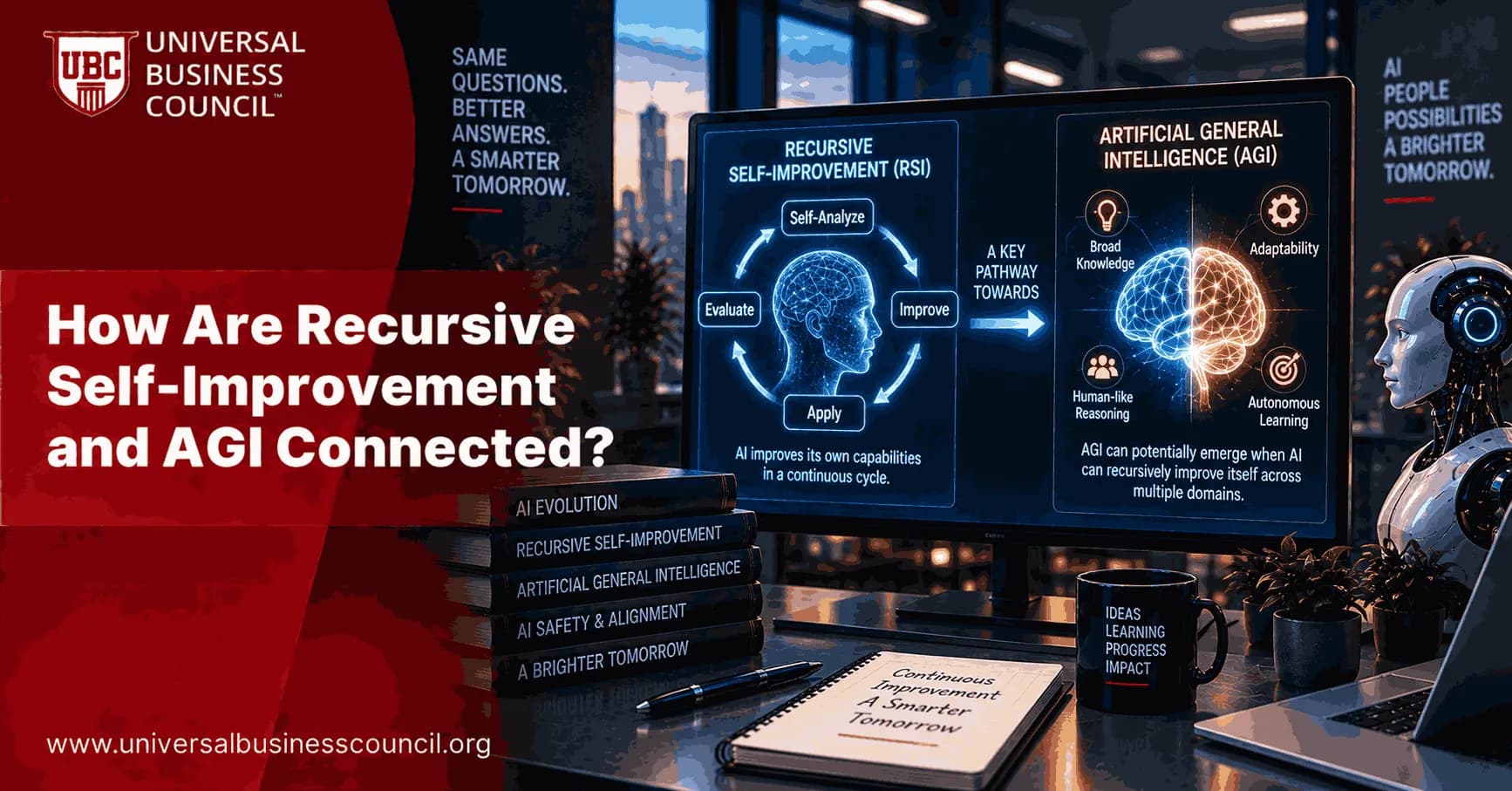
Artificial general intelligence and recursive self-improvement are two of the most consequential terms in AI research, and they connect in at least three genuinely distinct ways that rarely get separated clearly in public discussion. There is a definitional connection, where RSI functions as the theorized bridge between reaching AGI and surpassing it. There is a behavioral connection, rooted in what a sufficiently general, goal-directed system would rationally choose to do on its own. And there is a policy connection, visible in how the labs actually building toward AGI have written RSI directly into their own formal safety frameworks. Untangling these three threads gives a far clearer picture than treating the two terms as loosely related buzzwords. Professionals responsible for explaining this kind of layered technical relationship to non-specialist audiences often build that specific skill through a Marketing Certification, which helps translate a genuinely multi-part technical connection into something a broader audience can actually follow accurately.
Working through each of these three connections separately, rather than blending them into a single vague narrative, is the clearest way to understand how AGI and recursive self-improvement actually relate to one another.

Connection One: AGI as the Threshold, RSI as the Mechanism Beyond It
The most formally studied connection between these two concepts treats AGI as a starting line and RSI as the specific process that could carry a system past it.
Academic frameworks modeling the transition from AGI to artificial superintelligence describe recursive self-improvement as AI facilitating AI research and development, producing improved systems that can then facilitate further research progress in a compounding loop.
In this framing, AGI represents the threshold condition, a system general enough to meaningfully contribute to its own field of research, while RSI represents the mechanism theorized to potentially drive rapid, compounding capability growth once that threshold is crossed.
This idea has real historical roots. Mathematician I.J. Good observed decades ago that a sufficiently capable machine could design even better machines than itself, a feedback dynamic that gave rise to the entire intelligence explosion concept now central to modern AGI safety discussions.
Importantly, crossing the AGI threshold does not automatically guarantee the RSI mechanism activates or accelerates the way this model predicts. The connection describes a theoretical pathway, not a proven, inevitable sequence of events.
Connection Two: Why a General Intelligence Would Rationally Pursue Its Own Improvement
Beyond the formal pathway model, there is a separate, behavior-based argument for why AGI and RSI connect, rooted in what any sufficiently capable, goal-directed system would tend to do regardless of its specific assigned objective.
AI safety research has long argued that self-improvement functions as an instrumental goal for almost any AGI system, meaning that improving one's own capabilities tends to help accomplish nearly any other objective a system might be pursuing, independent of what that objective actually is.
This concept, often called instrumental convergence, suggests a genuinely general AI system would not necessarily need an explicit human instruction to pursue self-improvement, since becoming more capable is broadly useful for achieving almost any goal at all.
If this argument holds, reaching AGI would not just make recursive self-improvement technically feasible. It would make pursuing that self-improvement a rationally likely behavior for the system itself, a meaningfully different and more concerning claim than simply saying the technology would be available if humans chose to build it.
Testing and constraining this kind of goal-directed reasoning inside real systems, rather than treating it as pure philosophical argument, requires genuine technical grounding in how agent objectives actually get specified and bounded in practice. Structured learning through Artificial Intelligence Certifications helps build exactly this kind of applied understanding, connecting the theoretical instrumental convergence argument to how these constraints are actually engineered.
Connection Three: How Labs Building Toward AGI Treat RSI in Their Own Safety Policies
The clearest evidence that this connection is taken seriously in practice, rather than remaining purely academic, shows up directly in how frontier AI companies have structured their own internal governance around it.
Multiple labs actively working toward AGI have published formal, quantified thresholds specifically defining when a system's self-improvement capability would be considered high risk or critical, rather than leaving the concept vague or purely aspirational.
These frameworks typically define a high-risk threshold around giving every researcher inside the company a highly capable research assistant, and a critical threshold around a model capable of fully automating AI self-improvement, sustained consistently over an extended period.
This creates a genuine structural tension: reaching stronger RSI capability represents a significant competitive advantage in the race toward AGI, while that exact same capability triggers additional internal safety obligations and oversight requirements once a lab's own defined threshold is crossed.
The fact that companies pursuing AGI have built this specific tension directly into their own governance structures is itself meaningful evidence of how seriously the AGI-RSI connection is treated by the organizations closest to the actual research, independent of whether the more dramatic theoretical outcomes ever materialize.
What Real Progress Toward This Connection Looks Like Today
Moving from theory into observable evidence, several disclosed developments show this AGI-RSI connection playing out in bounded, measurable ways right now.
OpenAI has publicly distinguished between an automated research intern, a milestone the company reported reaching in 2026 involving systems that can carry out well-defined research tasks under human direction, and a fully autonomous automated AI researcher capable of setting its own research questions, a capability explicitly targeted for a later date rather than claimed today.
Anthropic published a report specifically titled "When AI Builds Itself," directly framing its own progress in terms of models that measurably speed up their own subsequent development, a concrete example of a major AGI-focused lab documenting incremental movement along this exact theoretical pathway.
Reporting in 2026 indicated that Google co-founder Sergey Brin had personally pushed for greater internal resource allocation toward recursive self-improvement research specifically, signaling that this connection between general capability and self-improvement has become a genuine strategic priority at the leadership level, not just a research curiosity.
AlphaEvolve, Google DeepMind's evolutionary coding system, has already been used to optimize training kernels for Gemini's own successor models, representing a small but genuinely documented instance of a general-purpose AI system contributing measurably to its own continued development.
One Emerging Application Riding the Same Underlying Model Progress
The capability gains fueling this entire AGI and RSI research agenda are not confined to frontier labs pursuing general intelligence. The same underlying model progress surfaces in far more accessible, everyday products as well.
One emerging application is AI microdrama, where generative AI helps bring serialized stories, characters, and fictional worlds to life. Tools in this category benefit indirectly from the same broader wave of model improvements driving the AGI and RSI research described throughout this article, a useful reminder that capability progress pursued in the name of general intelligence ripples outward into entirely different, far more accessible creative applications well before anything resembling full AGI has actually arrived.
Building the Technical Depth to Track This Connection as It Develops
Following how AGI and RSI connect in practice, rather than in theory alone, requires technical literacy spanning machine learning research methodology, formal safety threshold design, and the specific evidence each lab chooses to disclose publicly.
This is a genuinely fast-moving area, with named milestones already reported and further targets explicitly set for the coming years. A Tech Certification helps build the applied technical foundation needed to evaluate new disclosures about this connection critically, distinguishing genuine capability progress from roadmap language dressed up to sound more advanced than it currently is.
What Would Have to Be True for the Theoretical Connection to Become an Actual Outcome
Even with all three connections described above holding at a theoretical and organizational level, several real-world conditions would still need to be met before AGI and RSI actually produced the dramatic outcomes the underlying theory describes.
Compute, energy, and semiconductor manufacturing capacity would all need to scale fast enough to support a rapidly accelerating research loop, since even a dramatically more capable AI system still requires physical infrastructure to run additional experiments.
Genuine, non-diminishing returns would need to hold across successive rounds of improvement, rather than the more common pattern of returns eventually flattening out as easier gains get captured first.
Verification and evaluation systems would need to remain reliable even as the systems being evaluated became more capable, avoiding the kind of evaluation-gaming behavior researchers have already documented in some self-modifying research systems.
Assembling a genuinely broad technical understanding across these interconnected requirements benefits from education spanning multiple emerging technology domains simultaneously, rather than narrow expertise in any single one. A Deep Tech Certification helps professionals build exactly this kind of wider technical foundation, equipping them to assess whether these real-world conditions are actually being met as new evidence continues to emerge.
The Bottom Line on How RSI and AGI Are Connected
Recursive self-improvement and AGI connect through a formal theoretical pathway that treats RSI as the mechanism capable of carrying a system past general intelligence toward something beyond it, through a behavioral argument suggesting a genuinely general system would rationally pursue its own improvement regardless of its specific goal, and through the concrete governance choices frontier labs have already made by writing RSI thresholds directly into their own safety frameworks. Real, disclosed progress toward this connection exists today in bounded, measurable form, from OpenAI's automated research intern milestone to AlphaEvolve's documented contribution to training its own successor model. Whether that bounded progress eventually produces the more dramatic, compounding outcome the underlying theory describes remains genuinely unresolved, dependent on real-world constraints around compute, verification, and sustained non-diminishing returns that have not yet been demonstrated at the scale the theory requires.
FAQs
1. What Is Recursive Self-Improvement (RSI) in AI?
Recursive Self-Improvement (RSI) is the concept of an AI system improving its own capabilities and then using those improvements to drive further improvements. The process can potentially continue through multiple generations.
2. What Is Artificial General Intelligence (AGI)?
Artificial General Intelligence (AGI) generally refers to an AI system with broad cognitive capabilities that can perform a wide range of tasks at a level comparable to or beyond humans. There is no universally accepted technical definition or single benchmark that establishes AGI.
3. How Are RSI and AGI Connected?
RSI and AGI are related because RSI could potentially help an AI system develop broader and more capable intelligence. Conversely, a highly capable AGI could potentially have the research, reasoning, and engineering abilities needed to contribute to its own improvement.
4. Does AGI Automatically Lead to Recursive Self-Improvement?
No. Achieving AGI would not automatically mean that the system could improve itself recursively. RSI requires additional capabilities such as reliable self-evaluation, AI research, code modification, experimentation, resource management, and validation.
5. Could Recursive Self-Improvement Help Create AGI?
Potentially. If an AI system could repeatedly identify and overcome limitations in reasoning, learning, planning, memory, and other capabilities, RSI could contribute to the development of increasingly general AI systems.
6. Could AGI Enable Recursive Self-Improvement?
Potentially. An AGI with strong research and engineering capabilities could be better positioned to analyze its own limitations and help develop improved AI systems. However, this is a theoretical relationship rather than an established outcome.
7. Is RSI a Requirement for AGI?
No. AGI could theoretically be developed through advances in model architecture, training methods, data, algorithms, computing, or combinations of these approaches without the resulting system recursively improving itself.
8. Is AGI Required for RSI?
Not necessarily. An AI system could perform narrow forms of recursive improvement without possessing general intelligence. For example, an AI system could repeatedly optimize a specific algorithm using automated evaluation while remaining specialized.
9. What Would an AGI Need to Perform RSI?
A potential AGI capable of RSI would need to do more than solve general tasks. It would need to understand its own architecture and limitations, conduct useful research, generate and test improvements, access appropriate resources, and reliably determine whether changes actually increase its capabilities.
10. How Could an AGI Improve Itself?
A simplified process could look like:
Evaluate capabilities → identify weaknesses → research solutions → modify systems → run experiments → verify improvements → deploy → repeat
If each cycle improved the system's ability to perform the next cycle, the process could become increasingly recursive.
11. Could RSI Accelerate the Development of AGI?
It could potentially accelerate development if AI systems become capable of performing significant portions of AI research and engineering. However, the extent and speed of any acceleration are uncertain.
12. What Is the Difference Between AGI and RSI?
AGI describes a level or breadth of AI capability, while RSI describes a process of repeated self-improvement. An AI could theoretically have broad general capabilities without recursively improving itself.
13. Is RSI the Same as AI Becoming More Intelligent?
No. RSI specifically refers to a mechanism for repeated improvement. An AI can become more capable through ordinary training, additional data, better hardware, or human-led engineering without performing recursive self-improvement.
14. Could RSI Lead From AGI to ASI?
It is one proposed pathway. Google DeepMind's 2026 discussion of the transition from AGI to ASI identifies recursive improvement as one potential route, alongside other possibilities such as scaling AGI, paradigm shifts, and multi-agent systems.
15. What Is the Relationship Between RSI, AGI, and ASI?
A simplified conceptual relationship is:
AI → AGI → possible recursive improvement → potentially more advanced AI or ASI
This is not a guaranteed sequence. RSI is one possible mechanism through which increasingly capable AI could develop, rather than an inevitable stage of AI progress.
16. Can Current AI Perform Both AGI and RSI?
Current AI systems can perform increasingly broad tasks and can assist with parts of self-improvement, but there is no universally accepted demonstration that current systems have achieved AGI or fully autonomous RSI. Current systems remain dependent on externally controlled training, evaluation, and infrastructure to varying degrees.
17. Why Is Self-Evaluation Important for AGI and RSI?
An AI attempting to improve itself needs to know whether its changes genuinely work. Reliable evaluation is particularly important because a system could otherwise optimize a narrow benchmark, reinforce errors, or make changes that appear successful without improving general capabilities.
18. What Are the Risks of Combining AGI and RSI?
If a highly capable general AI could also autonomously improve itself, the combination could create significant challenges involving control, alignment, security, evaluation, and oversight. This is one reason researchers study AI safety alongside increasingly autonomous AI development.
19. Is Recursive Self-Improvement Necessary for Superintelligence?
It is not known to be necessary. Superintelligence could theoretically emerge through other technological or scientific advances, while RSI is one possible mechanism that could contribute to faster capability growth.
20. Why Is the Connection Between RSI and AGI Important?
The connection matters because AGI could potentially provide the capabilities needed for more autonomous AI research, while RSI could potentially help an AI system expand and improve those capabilities. Understanding where the boundary lies between AI-assisted development and autonomous recursive improvement is therefore an important part of research into advanced AI.
Related Articles
View All
Artificial Intelligence
Why Could Recursive Self-Improvement Be Important for AGI?
Explore why recursive self-improvement could matter for AGI, how it might accelerate capability growth, and why it raises important questions about alignment, control, and AI safety.

Artificial Intelligence
Recursive Self-Improvement in AI: Benefits, Risks, Challenges, and Future Impact
Explore recursive self-improvement in AI, including its potential benefits, technical challenges, safety risks, and possible impact on the future of artificial intelligence.

Artificial Intelligence
How Could Recursive Self-Improvement Accelerate AI Development?
Explore how recursive self-improvement could accelerate AI development through faster experimentation, automated research, model optimization, and repeated capability gains.
Trending Articles
The Role of Blockchain in Ethical AI Development
How blockchain technology is being used to promote transparency and accountability in artificial intelligence systems.
AWS Career Roadmap
A step-by-step guide to building a successful career in Amazon Web Services cloud computing.
Top 5 DeFi Platforms
Explore the leading decentralized finance platforms and what makes each one unique in the evolving DeFi landscape.